
Crossed Boundaries: The Cold Strategy of a Suburban Land Line War

CHAPTER 1: THE ACCIDENT

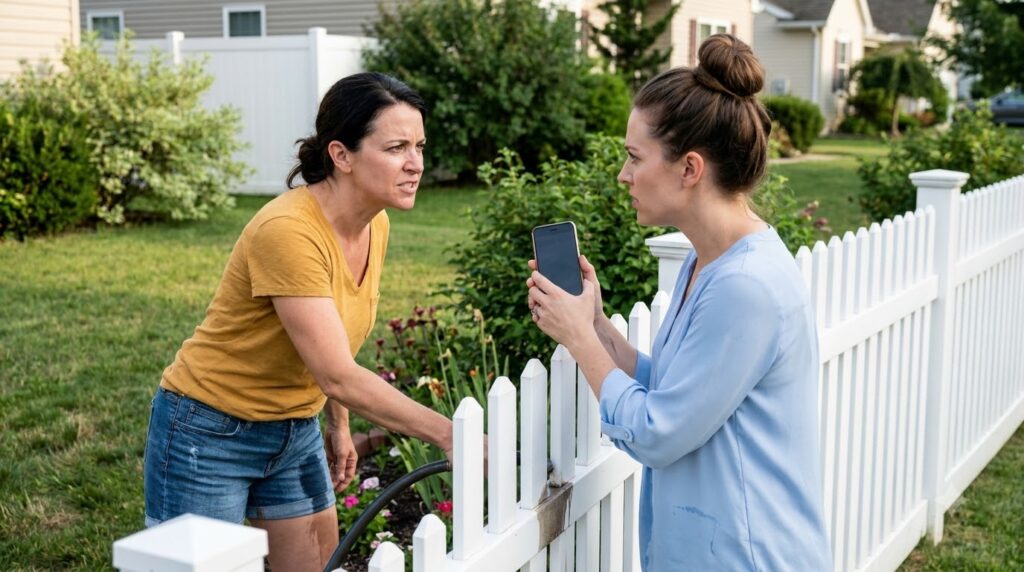
The jet of cold water hit my chest like a thrown stone, soaking clean through the cotton of my light-blue blouse before I could even take a breath. It drove the fabric hard against my skin, chilling, heavy, and immediate.

Across the top rail of the fresh white vinyl fence, Brenda didn’t drop the brass nozzle. She held it steady in her right hand, her knuckles white against the metal, her mustard-yellow T-shirt bright against the overgrown hydrangeas behind her. For three long seconds, the high-pressure stream held its line across my yard, heavy droplets splattering against my face and pinning my dark hair in wet streaks across my forehead.

She didn’t flinch. Her posture was squared, flat sandals dug firm into her damp mulch, her jaw set in the familiar, sharp line of someone who believed the ground beneath her feet answered only to her rules.

Then, with a deliberate flick of her wrist, she dipped the nozzle toward the grass.

“It’s just an accident,” Brenda said. Her voice carried easily over the low hum of a distant lawnmower down Oakridge Court, smooth, rehearsed, and dripping with a flat, mocking sweetness. “I can’t help where the water goes.”

The water in my blouse began to pool at my waist, dripping steadily down my dark trousers onto the dry lawn. My skin prickled under the sudden cold, but my hands didn’t shake. I didn’t step back. I didn’t reach up to wipe the water from my eyes. Anger was a useless currency in a neighborhood like this—it only gave people like Brenda something to frame and hang on their wall.

Instead, I shifted my weight forward, resting my hip against the solid vinyl post I had paid two thousand dollars to sink four feet into the soil. I lifted my right hand.

The black casing of my smartphone sat firmly between my palms, angled chest-high. I didn’t tap the screen. I simply turned the glass toward her.

On the display, the small red recording dot blinked silently against a live, four-kilobit stream. The counter read 00:01:42. The wide-angle lens had caught every frame: her arm elevating over the property line, the direct horizontal sweep of the nozzle, the three-second hold on my chest, and the tight, triumphant smirk on her face as she spoke the word accident.

“I recorded every second of that,” I said.

My voice didn’t rise. It didn’t need to. It sat flat and quiet in the space between us, carrying the exact weight of a legal summons.

Brenda’s smirk didn’t fade so much as it cracked. The color drained from her cheeks, leaving the red patches around her nose stark against her tan skin. Her eyes darted from my face down to the glowing red dot on the glass, then back up to my eyes. The brass nozzle in her hand clinked against the vinyl fence rail as her grip loosened.

Across the cul-de-sac, the distant lawnmower sputtered and cut out. The sudden silence in the backyard felt heavy, almost pressurized.

Brenda opened her mouth to speak, her lips shaping the beginning of another protest, but her gaze locked onto the phone’s lens. The red light kept pulsing.

Behind her, hidden deep beneath the roots of her prized hydrangeas where the white pickets ended, something rusted caught the afternoon light—a glint of old metal buried in the dirt where no pipe should have been.


CHAPTER 2: THE SHADOW ON THE PARCEL

The silence stayed heavy as I backed away from the white vinyl fence, my thumb locking the smartphone screen to a dark, blank mirror. Brenda didn’t say another word. She stood frozen in her mustard-yellow shirt, her flat sandals half-sunk into the damp mulch, watching me through the narrow gap between the pickets.

I turned my back on her and walked across the grass toward the rear patio. The wet fabric of my light-blue blouse clung cold and heavy against my spine, sending a slow, rhythmic chill through my ribs with every step. Water dripped from my hem, leaving a dark, fading trail across the gray flagstones.

Inside the kitchen, the air was cool and smelled faintly of lemon cleaner and stale coffee. I didn’t stop to change out of the soaked shirt. I placed the phone flat on the granite countertop, plugged in the charging cable, and immediately initiated a cloud backup of the video file. The blue progress bar crawled from left to right—12%… 48%… 100%. Once the checksum verified the transfer, I mirrored the encrypted file to a local flash drive and dropped it into my pocket.

Only then did I peel the clammy cotton from my skin, throwing the ruined blouse into the sink. I pulled a dry gray sweatshirt over my head and walked down the hallway to the small front office where I kept the house records.

On the bottom shelf of the filing cabinet sat the thick accordion folder labeled Property Title & Survey. I pulled it out, bringing it under the harsh desk lamp.

When I bought this three-bedroom ranch four years ago, the closing documents had been standard—a stack of white legal paper, notary stamps, and a boundary sketch from twenty years back. I unrolled the original plot map drawn by the previous owner’s surveyor in 2004.

Under the bright LED bulb, the sharp edges of the faded blue ink lines looked clear enough at first glance. But as I traced the eastern boundary—the exact three-hundred-foot line running between my lot and Brenda’s—my finger caught on an anomaly.

The line wasn’t straight.

Near the rear corner, where Brenda’s overgrown hydrangeas now crowded the fence, the original draftsman had drawn a subtle, three-degree jog inward, carving a long, sliver-shaped notch out of my property and awarding it to lot 14. But beneath the faded blue line, faintly visible under the legal seal, was a erased pencil mark—a straight line running true from the iron corner pin.

Beside the alteration was a small, hand-initialed stamp: B.V. / Exception Approved.

Brenda’s initials.

I leaned closer, my pulse ticking methodically against my jaw. The modern survey I paid for three weeks ago had used satellite GPS and uncovered iron corner pins driven four feet deep into the subsoil—pins that matched the original, erased pencil line, not the hand-altered ink map. Brenda hadn’t just been protective of her garden beds; she had been relying on a falsified document for two decades to claim an extra fourteen inches of my land.

A soft knock rattled the glass of my back patio door.

I closed the accordion folder, slipped the 2004 plat map into a clear protective sleeve, and walked back through the kitchen. Through the glass, I saw Arthur, the homeowner association president, standing on the flagstones. He was a retired accountant in his late sixties, wearing his usual khaki vest, a clipboard tucked beneath his arm, looking visibly uncomfortable.

I slid the door open. The afternoon air outside was turning cool as shadows lengthened across the lawn.

“Martha,” Arthur began, adjusting his wire-rimmed glasses and shifting his weight on the flagstones. “Brenda called me five minutes ago. She was… quite hysterical, to be frank. She claims you harassed her at the property line and threatened her while she was watering her garden.”

I didn’t answer right away. I let the silence stretch until Arthur shifted his clipboard, his eyes darting toward the wet patches still drying on my patio stones.

“Come inside, Arthur,” I said, my voice flat and even. “I want to show you something.”

He stepped past the threshold, wiping his loafers on the mat. I didn’t hand him a cup of coffee or offer a chair. I walked straight to the granite counter, tapped my phone screen, and turned the display to face him.

“This is what Brenda calls watering her garden,” I said, pressing play.

Arthur leaned in, his eyebrows rising behind his lenses as the high-definition video filled the screen. The footage was crystal clear: Brenda’s squared stance, her arm deliberately extending over the white vinyl pickets, the high-pressure jet pinning me against my own lawn, and the tight, mocking grin as she delivered her line.

The audio played loudly in the quiet kitchen: “It’s just an accident, I can’t help where the water goes.”

Arthur stared at the screen long after the video ended. The color slowly drained from his weathered face. “Good lord,” he muttered softly. “She… she aimed right at you.”

“She did,” I replied, opening the folder on the counter and pulling out the 2004 plat map alongside the new, stamped state survey. “And before we talk about HOA nuisance rules, Arthur, I want you to look at these two boundary descriptions. Look at the corner pin coordinates.”

Arthur pulled his glasses down his nose, peering at the papers. His eyes narrowed as he spotted the erased pencil line beneath the ink. “Where did you get this old plat?”

“It was in the seller’s disclosure file,” I said. “Brenda had someone alter this map twenty years ago to justify her garden expansion. But when I put the new fence in, I followed the real iron pins. She isn’t mad about the fence, Arthur. She’s terrified because the real line puts her right in violation of county setback laws.”

Arthur touched the edge of the paper, his fingers trace-following the erased pencil line. “This isn’t just an HOA dispute, Martha. If she altered an official county land plat…” He trailed off, looking toward the window that faced Brenda’s yard.

“It’s fraud,” I said simply.

Arthur shook his head, looking troubled. “I’ll call an emergency board meeting. But Martha… be careful. Brenda’s been on this street since it was built. She knows every inspector in the township.”

“So do I,” I said.

After Arthur left, I walked out to the fence line once more. Twilight was settling over Oakridge Court, turning the grass a deep, bruised purple. On the other side of the white pickets, Brenda’s house was dark, except for a single lamp burning in her kitchen.

I knelt near the rear corner post, where the white vinyl met the dense shadow of her hydrangea bushes. Reaching through the lower pickets, I pushed aside a layer of wet mulch.

My fingers brushed against something hard and metallic buried four inches down in the soil—not an iron survey pin, but a heavy PVC coupling connected to a corrugated metal pipe, running straight out from under Brenda’s foundation and terminating directly onto my side of the line.

It was wet, coated in dark, foul-smelling silt.

CHAPTER 3: THE BOARDROOM CONFRONTATION

The foul silt clung to the tips of my fingers, cold and slick like oil, as I pulled my hand back through the pickets. I stood up in the twilight, wiped my hands clean on a dry rag, and looked at the single lit window of Brenda’s kitchen. She was inside, standing behind the curtain, her silhouette motionless. She was waiting for me to panic.

Instead, I walked back inside, retrieved my smartphone and the clear sleeve containing the 2004 plat map, and grabbed my car keys.

The Oakridge Community Center sat two miles down the main avenue, a sterile brick building that smelled of floor wax and stale air conditioning. The emergency board meeting Arthur had called was scheduled for seven-thirty, but when I walked into the side conference room at seven-twenty, the long oak table was already populated.

Arthur sat at the head of the table, his clipboard resting on the wood, his eyes tired behind his wire-rimmed glasses. To his left sat Evelyn Vance, the HOA legal liaison—a sharp-featured woman in a tailored navy blazer whose cold demeanor had buried dozen of homeowner grievances over the years. Beside her sat Brenda.

Brenda had changed out of her wet mustard-yellow shirt. She wore a high-collared pastel sweater, her dark hair combed back into a rigid hairspray-held shell. In front of her lay a thick manila folder stamped with a red municipal seal.

“Martha,” Evelyn said, her voice dropping like an iron grate before I could even take a seat. “Thank you for joining us. Arthur shared the video file you sent him. While the board does not condone personal squabbles between neighbors, we have a far more pressing legal matter to address tonight regarding your fence.”

I pulled out a wooden chair opposite Brenda, the metal feet scraping sharply against the polished linoleum. “My fence sits two inches inside my surveyed property line. There is no legal ambiguity.”

Brenda smiled—a tiny, razor-thin twitch of her lips. She didn’t look at me; she looked straight at Evelyn.

Evelyn reached into Brenda’s manila folder and slid a thick document across the oak table toward me. The top page bore an official seal from the township registrar, dated 2004, with a bright yellow county clerk stamp across the header.

“This is the master lot covenant filed when Oakridge Phase Two was incorporated,” Evelyn said, tapping the paper with a manicured nail. “It includes an explicit easement modification signed by the original developer. The three-degree boundary adjustment along lot fourteen was legally recorded as an irrevocable landscaping buffer. According to this filing, your fence sits directly inside a protected community zone. The county recognized Brenda’s lot line as the binding boundary twenty years ago.”

I didn’t touch the paper immediately. I looked across the table at Brenda. Her eyes held that same triumphant, calculating glint I had seen when the hose stream hit my chest. She believed she had executed a flawless maneuver. She had used her long-standing relationship with the former township clerk to bury a falsified easement document deep inside the HOA archives, creating a paper trail designed to make my modern land survey look like a trespass.

This was the decoy she had spent twenty years perfecting: a legal maze of altered maps and fake municipal approvals to make any homeowner give up and surrender the fourteen inches of land.

“Read the signature block, Martha,” Brenda said softly, her voice smooth and devoid of the hysterical tone Arthur had reported. “The township approved that easement. You built your fence on land that isn’t legally yours to fence off.”

I reached out and pulled the document closer. Under the harsh fluorescent light, the red county clerk stamp looked authentic. The text cited ordinance codes, setbacks, and developer rights. It was a masterclass in bureaucratic misdirection.

“It’s a very convincing forgery,” I said flatly.

Evelyn’s eyes narrowed. “Watch your tone, Martha. That is a certified copy from the township record vault.”

“It’s a certified copy of an illegal filing,” I corrected her, opening my own folder on the table. I laid down the 2004 plat map I had pulled from my closing files, side-by-side with the document Evelyn had provided. “Look at the notary stamp on page three of your covenant, Evelyn. The commission number belongs to a notary whose license expired in 2002—two years before this document claims it was executed.”

Evelyn froze. She pulled her glasses down her nose and leaned over the two papers.

“Furthermore,” I continued, my voice steady, sharp, and cut with absolute precision, “I called the State Surveyor’s Board forty-five minutes ago. The surveyor named on Brenda’s covenant—B. Vance—was stripped of his license in 2005 for falsifying lot boundaries in three neighboring subdivisions. Brenda didn’t just file an easement; she paid a disgraced surveyor to generate a fraudulent paper trail to cover up her boundary expansion.”

Arthur leaned forward, his mouth slightly open, staring at the expired notary stamp. “Good God… Evelyn, is that true?”

Evelyn didn’t answer. Her face had turned rigid. She looked at Brenda, whose tight composure was beginning to fracture once again. Brenda’s throat moved in a hard, dry swallow.

“This… this is an old administrative oversight,” Brenda stammered, her voice losing its calm cadence. “The board accepted those maps when the neighborhood was built! You can’t just come in four years ago and override twenty years of established boundaries!”

“I am not overriding established boundaries, Brenda,” I said, leaning across the table until I was looking directly into her eyes. “I am enforcing the true deeded parcel that I pay property taxes on. And tomorrow morning at eight-thirty, when the municipal code enforcement officer arrives at Oakridge Court to review the video of you spraying me, I will hand him this fraudulent filing alongside the state surveyor audit.”

Brenda’s breath hitched. She opened her mouth to argue, but the words died in her throat. The paper armor she had relied on for two decades had been stripped away in less than five minutes.

“This meeting is adjourned,” Evelyn said abruptly, closing the manila folder with a heavy snap. She didn’t look at Brenda. She gathered her papers, stood up, and walked out of the conference room without another word.

Arthur stayed behind, looking at me with a mixture of shock and quiet respect. “Martha… if that filing is fraudulent, the HOA has no standing to force you to take down the fence. In fact, Brenda is in violation of three separate community bylaws.”

“I know,” I said.

I packed my documents into my briefcase, snapped the brass latches shut, and walked out to my car.

The victory felt clean, decisive, and absolute. I had dismantled her legal cover, exposed her falsified survey, and secured Arthur’s support. The decoy secret had fallen apart under the cold light of legal scrutiny.

But as I drove back down Oakridge Court and pulled into my driveway, the victory began to feel hollow.

I parked the car, walked into the dark backyard, and stood near the rear corner post where the white vinyl pickets met Brenda’s overgrown hydrangeas. I knelt once more in the grass and shone my flashlight beam down into the gap between the fence and the dirt.

The heavy corrugated metal pipe I had touched earlier was still there, protruding illegally onto my side of the line. But under the bright beam of the LED flashlight, I saw something new—something the darkness had hidden earlier.

The metal pipe wasn’t just dumping water. It was buckled. The heavy iron collar connecting the pipe to Brenda’s foundation was crushed and splitting open under immense underground pressure. Dark, filthy water was slowly oozing from the fracture, soaking deep into the soil directly beneath my new fence posts.

Brenda hadn’t faked those land maps twenty years ago just to grow hydrangeas or steal fourteen inches of grass.

She had done it because her foundation was failing, and the illegal pipe was the only thing keeping her basement from collapsing—a pipe that my new fence posts had just pinned and crushed completely.

CHAPTER 4: THE ONSITE AUDIT

The flashlight beam trembled slightly against the wet, blackened metal of the crushed pipe. I knelt in the damp grass, watching gray, sulfur-smelling silt bubble up from the cracked seam where my fence installer had driven the rear corner post. The four-inch concrete footings sat flush against the iron collar, acting like a hydraulic vise against Brenda’s hidden drainage line.

She hadn’t just sprayed me out of spite. She had been trying to flood the trench before the concrete cured, desperate to scour the mud out from around the pipe before the weight of my fence permanently sealed her basement’s only relief valve.

Sirens chirped twice at the end of the cul-de-sac.

I stood up, wiping my soil-stained palms against my gray sweatshirt as twin beams of headlights cut through the darkness along Oakridge Court. A white municipal Code Enforcement vehicle pulled up to the curb, followed immediately by a county sheriff’s patrol car.

Officer Miller, the city inspector, stepped out first. He was a broad-shouldered man with a high-visibility vest pulled tight over his chest, holding a heavy industrial flashlight in one gloved hand. Behind him, Deputy Hallowell unclipped his tactical torch, his radio crackling softly with static in the cool night air.

Arthur had made the calls on my behalf the moment the board meeting dissolved.

“Martha?” Officer Miller called out, stepping onto my driveway. “We received the emergency report from Arthur regarding a boundary dispute, intentional property damage, and a recorded assault.”

“Over here, Officer,” I said, my voice cutting cleanly through the hum of idling engines. “In the backyard.”

Brenda’s back door slammed open before we reached the gate. She practically ran down her patio steps, her pastel sweater unbuttoned, her face pale under the amber glow of her porch lights.

“Officer!” Brenda shouted, her voice thin and high-pitched. “Thank God you’re here! She’s trespassing! She’s destroying my property line right now!”

Deputy Hallowell raised a hand, stepping between Brenda and the gate line. “Ma’am, stay on your side of the property boundary. We are conducting an official inspection based on video evidence submitted to the department.”

Miller walked straight to the white vinyl fence, shining his heavy beam down the length of the clean, straight pickets. “Is this the fence installed under Permit 408?”

“Yes,” I said, stepping beside him. “Installed strictly along the surveyed iron corner pins. I also have the 4K video of the incident from earlier today ready for your review.”

I pulled out my smartphone, opened the local file, and handed it to Miller. Deputy Hallowell leaned in over his shoulder.

The bright glare of the screen lit up their faces in the dark yard. The video played without interruption: Brenda’s squared stance, the deliberate raise of the brass nozzle, the three-second high-pressure blast hitting my chest, and her cold, mocking declaration.

Miller’s jaw tightened. He paused the video at the exact frame where Brenda’s arm extended four inches over the top rail of my fence.

“That’s a direct, deliberate discharge across a residential boundary line,” Miller said, his voice dropping into a professional, icy register. “That’s not overspray, ma’am. That’s intentional property intrusion and civil harassment.”

“She provoked me!” Brenda cried out, her hands shaking as she pointed at me over the fence. “She put that fence up on my land! She’s blocking my drainage!”

“Your land?” Deputy Hallowell interrupted, pulling a notebook from his pocket. “We checked the county registry on the way over. The stamped survey filed three weeks ago by a licensed state engineer confirms this fence sits entirely within lot fifteen. Furthermore, the HOA legal liaison confirmed your 2004 easement claim was filed under a revoked notary stamp.”

Brenda stumbled backward a half-step, her heel catching on the edge of her stone flower bed. “That… that’s a technicality!”

“It’s fraud, Brenda,” I said, my voice calm, flat, and absolute. “And while we’re talking about drainage, Officer Miller, you need to look at this.”

I directed my flashlight down into the gap between the rear vinyl post and Brenda’s hydrangeas. Miller knelt down, resting his heavy gloved hand on the vinyl post, and aimed his industrial beam into the dirt.

The light illuminated the bubbling silt, the cracked corrugated iron, and the pooling water rising around the post footing.

Miller’s eyes widened. “What in the world is this?”

He reached down with a small metal gauge from his belt and probed the buried line. A sharp, metallic clang echoed up from the mud as he hit the heavy iron collar.

“This isn’t a surface drain,” Miller said, looking up at Brenda with sudden, stern realization. “This is a six-inch unpermitted foundation bypass line. You piped your basement sump runoff directly across the property line into lot fifteen’s soil.”

“It’s been there for twenty years!” Brenda shrieked.

“Which makes it a twenty-year unpermitted municipal code violation,” Miller snapped, standing up and pulling a thick yellow citation book from his vest. “You diverted heavy subterranean water runoff onto an adjoining private lot without an easement, without a permit, and in direct violation of township environmental protection codes.”

He began writing rapidly on the yellow pad, the press of his pen sharp and loud in the night.

“Because the fence posts were set on the legal property line,” Miller continued, tearing off the first ticket, “your illegal pipe has backed up against the concrete footings. The pressure is cracking your own main line. The city is issuing an immediate Cease-and-Desist.”

He stepped over to the fence and slapped the bright yellow citation directly onto Brenda’s side of the vinyl post.

“You have forty-eight hours to disconnect this bypass line and repair your foundation at your own expense,” Miller declared. “If you cross this fence line, attempt to touch this structure, or direct water toward this lot again, Deputy Hallowell will execute an immediate arrest for misdemeanor criminal trespass and stalking.”

Deputy Hallowell handed Brenda a formal police warning notice, his expression stern. “Consider this your official notice, ma’am. Stay away from Martha, stay away from this fence.”

Brenda stared at the yellow citation stuck to the post, then at the police warning in her trembling hand. The conviction that had sustained her for twenty years—the belief that she controlled Oakridge Court through quiet manipulation and false papers—shattered completely under the flashing blue lights of the patrol car.

She turned without a word, her head hanging low, and walked slowly back toward her lit porch, her sandals dragging through the damp grass.

Miller turned to me, nodding once. “You handled this with remarkable restraint, Martha. Most people would have lost their temper months ago.”

“Restraint gets results, Officer,” I said quietly.

As the patrol car and code enforcement vehicle pulled away, leaving Oakridge Court in quiet darkness once more, I stood alone at the fence line. The white vinyl pickets glistened under the starlight, unyielding, clean, and perfectly aligned with the iron pins deep in the earth.

I looked down at the dark water pooling around the base of the rear post. The legal victory was complete, the citations were issued, and Brenda was legally bound to retreat. But as the dark water continued to seep slowly from the crushed metal beneath the soil, I knew the physical reality of the buried pipe would demand one final, definitive resolution.

CHAPTER 5: THE FINAL BOUNDARY

The morning sun broke thin and bright over Oakridge Court, casting long, sharp shadows across the dew-soaked grass. By seven-thirty, the low rumble of a heavy diesel engine echoed down the street as an official municipal utilities work truck pulled onto my driveway, its amber safety lights rotating silently against the pale sky.

Officer Miller stepped out from the passenger side, carrying a digital clipboard and a rolled set of municipal utility blueprints. Behind him, two city utility technicians in heavy leather gloves and steel-toed boots unlatched the rear hydraulic gate, retrieving a set of pneumatic excavation tools and a heavy cast-iron pipe cap.

I stood on my back patio, dressed in a clean black jacket, my smartphone tucked into my pocket and a hot cup of black coffee held firmly in my hands. The morning air was cold, crisp, and completely still.

On the other side of the white vinyl fence, Brenda’s house remained dead quiet. The yellow code enforcement citation still gleamed on her side of the rear vinyl post, its edges fluttering faintly in the early breeze.

“Morning, Martha,” Miller said, walking around to the backyard gate with the technicians close behind. “Township public works ordered an immediate emergency cap on the illegal line under Section 12-B. Since the pipe crosses the deeded boundary without an active easement, the city is legally obligated to seal it at the lot line to prevent further subsoil contamination.”

“Proceed, Officer,” I said, my voice quiet, steady, and entirely free of hesitation. “My fence line remains clear.”

The two technicians dropped to their knees near the rear corner post. Using hand spades and precision suction hoses, they cleared away the remaining damp mulch and dark silt, exposing the full length of the six-inch corrugated iron pipe where it extended past the property boundary.

The fracture in the iron collar was stark under the morning light—a jagged, rusted split where the pipe had buckled against the reinforced concrete post footing.

Brenda’s back door clicked open.

She stepped out onto her patio slowly, wearing a dark wool coat buttoned up to her chin. She looked older in the morning light; the sharp, aggressive posture that had defined her for eight months was gone, replaced by a hollow, defensive rigidity. She walked to the edge of her lawn, stopping five feet short of the white pickets, her hands shoved deep into her coat pockets.

She didn’t scream. She didn’t wave her phone or cite fake bylaws. She simply watched as the head technician fitted a pair of hydraulic steel shears around the exposed iron pipe on my side of the fence line.

SNAP.

The sound of metal shearing under hydraulic pressure echoed sharply across the quiet yards—a clean, violent bite that severed the illegal bypass line flush with the property boundary.

The technician immediately wiped the severed metal edge clean, brushed on a thick layer of industrial sealant, and fitted the heavy cast-iron cap over the opening. With three precise turns of a pneumatic torque wrench, the bolts locked into place with a series of sharp, metallic clicks.

CLICK. CLICK. CLICK.

The line was permanently sealed. The water that had drained illegally onto my land for two decades had nowhere left to go except back toward its origin—forcing Brenda to pay for a legal, interior sump pump installation entirely within her own home’s footprint.

Officer Miller stepped forward with his digital tablet, snapped three high-resolution photos of the capped pipe, and pressed his thumb to the screen to record the official municipal seal.

“Work complete,” Miller announced, turning to face Brenda across the fence. “The line is legally severed and capped at the property boundary. Any attempt to tamper with this cap or alter the soil within two feet of this fence will result in immediate criminal prosecution under county property laws.”

Brenda stared at the iron cap gleaming dark and sealed in the dirt. Her jaw twitched once, her lips pressing into a thin, white line, but she said nothing. She couldn’t. Every legal avenue had been mapped, audited, and closed.

Miller handed me a stamped copy of the Municipal Completion Certificate. “You’re all set, Martha. Your boundary is fully secured, legally and physically.”

“Thank you, Officer,” I said, signing the digital pad.

As the utility crew packed their tools and drove away, the quiet returned to Oakridge Court. Brenda turned without a word and walked back inside her house, the heavy click of her deadbolt echoing across the yard before her kitchen curtains drew shut.

I walked down the length of the lawn, stopping at the rear post. The crisp white vinyl pickets stretched in a flawless, straight line toward the street—bright, unyielding, and perfectly aligned with the iron corner pins buried deep in the earth beneath my feet.

I took a slow sip of coffee. The air was clean, the yard was quiet, and the boundary was mine.

Similar Posts

Leave a Reply

Your email address will not be published. Required fields are marked *






