
The Cold Boundary of Deeded Ground and Unearned Authority
CHAPTER 1: THE LIQUID LINE
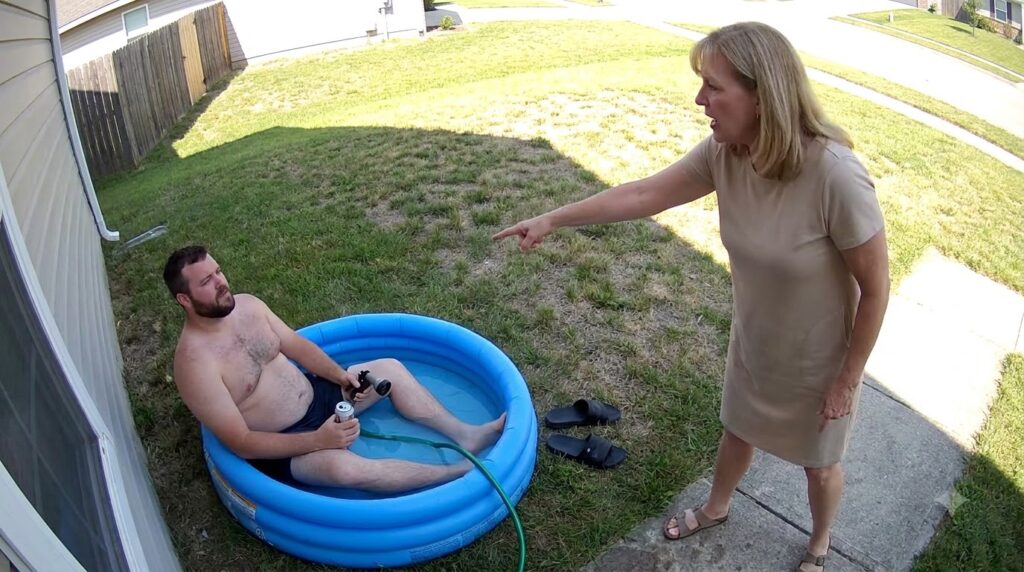
The brass nozzle didn’t leak, but the cold vinyl of the garden hose hummed against Mark Vance’s palm like a live wire.
He didn’t move his back from the blue plastic wall of the twelve-dollar pool. He didn’t drop the condensation-slicked silver can in his left hand. He simply lifted his right wrist four inches, adjusted his thumb on the black lever, and let eighty pounds of municipal water pressure answer the woman standing over his face.
The spray caught Evelyn Higgins square in the sternum.
The solid stream hit her beige cotton dress with a wet, heavy smack. She gasped—a sharp, strangled intake of heat-baked air—as the blast drove her back two full steps across his grass. Her sandals skittered in the sod. The beige fabric turned instantly dark, clinging transparently to her torso, while the shoulder-length blonde hair she spent forty dollars a week to maintain plastered itself flat against her cheeks.
“Stay off my lawn,” Mark said. His voice didn’t rise above the low hum of the air conditioning compressor unit vibrating against the red brick behind him. “And mind your own business.”
Evelyn’s mouth opened, closed, and opened again, working like a landed carp. Her pointed index finger—the same finger she had been shaking three inches from his nose a second prior—remained frozen in mid-air, trembling.
“You… you sprayed me!” Her voice cracked on the second syllable, escalating from shock to a high-pitched screech that carried straight across the heat-shimmering asphalt of Oakridge Avenue. “You physically assaulted me on this block!”
“You’re standing six feet past my deeded property line, Evelyn,” Mark said, his eyes tracking the dark, dripping hemline of her dress. “You crossed the iron pin by the driveway. That makes you a trespasser.”
“I am the vice-president of the neighborhood preservation board!” She stumbled backward another foot, her heels sinking into the dry, patchy turf near the sidewalk edge, but she didn’t leave the lot. Her hands plunged into her structured handbag, tearing out a white smartphone with erratic, frantic jerks. “This entire setback is subject to community standards! You have an unsanitary, trashy hazard on your lawn, and you just committed battery!”
Across the street, the steady rhythmic thump-clack of Carl Rivera’s porch swing ground to a sudden halt. Carl leaned his forearms against the wooden railing, squinting through the glare. Slowly, deliberately, Carl reached into his shirt pocket, pulled out his phone, and raised the lens toward Mark’s yard.
Mark didn’t look at Carl. He didn’t look at the sky. He kept his eyes fixed on Evelyn’s trembling thumbs as she punched three digits into her screen.
He set his drink down in two inches of lukewarm water beside his hip, wiped his right palm against his swim trunks, and reached behind his head toward the porch step. His fingers brushed the smooth, thick plastic of a waterproof accordion folder. He didn’t open it yet. His thumb tapped the screen of his own phone resting on a folded towel beside the folder, locking the previous two minutes of wide-angle fisheye footage recorded by his doorway security camera.
On the screen, a small red dot confirmed the file was saved to local storage.
“They’re coming, Vance,” Evelyn spat, her voice tight with a cold, desperate venom as she pressed the phone to her wet hair. “The sheriff’s department is going to haul you out of that pathetic tub in front of this entire street.”
Mark reclined his head back against the blue inflatable ring, his thumb resting lightly over the brass nozzle lever. “I’ll be right here.”
A sudden, sharp chime sounded from Mark’s phone—not a security alert, but a direct text notification from an unknown local number, displaying three words that made his brow furrow: Check her folder.
Want me to continue directly into Scene 2?
Yes

CHAPTER 2: THE PAPER SHIELD
The message on the screen stayed static, three words in stark black against the glowing white box: Check her folder.
Mark Vance didn’t look up toward Carl Rivera’s porch, nor did he glance down the street toward the other two neighbors standing near their mailbox posts. In a tactical exchange, changing your field of vision reveals where your intelligence is coming from. He kept his eyes locked on Evelyn Higgins’ shivering frame as she stood near the sidewalk, the phone pressed hard against her wet ear, her chest heaving under the drenched beige cotton of her dress.
“Yes, Deputy, I am on the scene!” Evelyn screeched into her receiver, her voice sharp enough to slice through the heavy drone of the neighborhood air conditioners. “The suspect is non-compliant, aggressive, and actively occupying a non-conforming structure on the front easement! I need an officer here immediately before this escalates further!”
Mark didn’t move from the cold water. He reached smoothly over the blue plastic rim, his calloused thumb sliding over his phone’s glass to bring up his local file manager. He didn’t check the text thread. He opened his doorway camera’s live feed, switching to the dual-view mode. The fisheye lens above his porch captured Evelyn from behind—and specifically, the structured leather handbag dangling from her left forearm.
The side pocket of the bag was unzipped. Tucked inside was a thick, yellowed manila folder, its edge bent and stained with old oil finger-marks.
Mark knew that folder. Or rather, he recognized the type. When he had bought the ranch home four years ago, the closing attorney had handed him a stack of municipal disclosures, deeds, and title insurance policies thick enough to stop a low-caliber round. Evelyn wasn’t holding a standard municipal code notice. Municipal notices came on crisp white county letterhead with a blue seal in the upper left corner. The folder in her bag carried the faded, mimeographed tone of old local records.
He reached behind his back again, his hand dropping to the waterproof accordion file resting on the shade of his porch step. He pulled out his own laminated documents: the 2018 county survey map stamped with red ink by the land recorder’s office, and the single-page municipal land-use ordinance governing temporary residential leisure items.
Evelyn ended her call with a sharp tap on her screen. Her face was flushed, blotchy red beneath her wet blonde hair, but a cold, malicious triumph lit her eyes. She stepped forward—not onto the grass this time, but staying precisely on the concrete strip of the public sidewalk, her sandals dripping onto the sun-baked stone.
“You think you’re clever, Vance,” she said, her voice dropping into a tight, transactional hiss meant only for him. “You think because you fix bus engines and keep your mouth shut, the rules don’t apply to you. But I have the original 1984 neighborhood covenant right here.”
She reached into her unzipped handbag and pulled out the yellowed folder. She held it high, the faded ink of the cover sheet visible even from six feet away.
“Clause 14B,” she recited, her voice rising again so Carl Rivera across the street could hear every syllable. “All front setback areas extending thirty feet from the curb line are designated as shared aesthetic easements under the administrative control of the Oakridge Preservation Board. Private installation of temporary water vessels, storage units, or unapproved shade structures is strictly prohibited without a signed variance!”
Mark didn’t flinch. He looked at the yellowed paper, then down at the text message still sitting in his notification queue. Check her folder.
“That covenant was drafted forty years ago, Evelyn,” Mark said, his tone flat, unhurried, carrying the dry weight of a man reading a repair manual. “This subdivision was unincorporated in ’92. The county absorbed the road rights-of-way.”
“The covenant runs with the land!” Evelyn stepped right to the edge of his turf, her damp toes touching the outer rim of his buried survey pin. “We have twenty-four signatures from the original homeowners granting the board enforcement power! I have the petition right here signed by three-quarters of this block!”
She held up a second sheet from the folder—a white paper with a grid of signatures, the top line dated three months prior.
Mark’s eyes narrowed slightly, taking in the sharp contrast: the yellowed, decades-old covenant document paired with a fresh, bright-white signature page. The paper edges didn’t match. The staple marks on the top left corner of the petition showed three separate puncture holes where old sheets had been yanked out and replaced.
She wasn’t just enforcing a rule; she was leaning on a constructed paper shield.
Across the street, a dark blue county sheriff’s patrol car rounded the corner of Oakridge Avenue, its tires crunching softly against the loose gravel near the curb as it slowed down in front of Mark’s driveway.
CHAPTER 3: THE DECOY COVENANT
The dark blue patrol car didn’t roll onto the grass. It stopped two feet short of Mark Vance’s gravel driveway extension, its front tires aligned perfectly with the concrete curb edge. The engine didn’t idle; the driver cut the ignition immediately, leaving the hot metal ticking in the ninety-five-degree air.
Mark didn’t get out of the pool. He reached down, gripped the brass nozzle with his right hand, and laid the hose flat across his lap, its black spray tip pointed straight at the grass line. With his left hand, he lifted the waterproof accordion folder off the shade of the porch step and slid out his two laminated sheets.
Deputy Miller stepped out of the vehicle, his boots making a dry, crunching sound on the hot asphalt. He didn’t unholster his sidearm or touch his belt clips, but his eyes swept the yard in a single, three-second sweep: the soaked beige dress clinging to Evelyn Higgins, the cold silver can resting in two inches of blue plastic water, and the quiet line of neighbors sitting motionless on distant porches.
“Afternoon,” Deputy Miller said. His voice was flat, gravelly, and entirely stripped of urgency. He stopped on the public sidewalk, two inches on the street side of Mark’s buried iron property pin. “Got a call regarding a water disturbance and an unpermitted structure in the front setback.”
“He attacked me, Deputy!” Evelyn stepped up beside Miller, her soaked sandals squeaking loudly against her skin. She thrust the yellowed manila folder toward the officer’s chest. “He sprayed me with a high-pressure line when I attempted to deliver an official notice of non-compliance! I am the vice-president of the Oakridge Preservation Board, and this man is violating Clause 14B of our deeded aesthetic covenant!”
Deputy Miller didn’t take the folder immediately. He looked at Evelyn’s dripping hair, then down at the yellowed paper, then across the lawn at Mark.
“Clause 14B,” Mark said from the pool. He didn’t raise his voice. He held his laminated county survey map out in his left hand, the red official seal of the land recorder’s office catching the hard glare of the afternoon sun. “There is no active setback easement on this lot, Deputy. The county land survey completed in 2018 shows my deeded property line extends six inches past that concrete sidewalk edge. Mrs. Higgins walked six feet past my property pin, stepped into my personal space, and refused to leave after two verbal warnings.”
“He’s using outdated municipal maps!” Evelyn’s voice rose an octave, sharp and piercing against the heat. She yanked the white staple-bound petition out of the folder and held it two inches from Miller’s nose. “Look at this! Twenty-four registered homeowners on this block signed this petition three months ago, re-affirming the Preservation Board’s authority over all front yard setbacks! It’s a binding neighborhood agreement!”
Deputy Miller took the petition. He squinted against the sun, his thumb tracing the top staple near the corner.
Mark watched the deputy’s face. He knew what Miller was looking at because Mark was looking at the exact same detail from ten feet away: the top left corner of that signature sheet didn’t have one staple hole. It had three distinct, rectangular puncture marks where old staples had been yanked out with a flathead tool and re-bound.
“This covenant,” Deputy Miller said slowly, looking at the yellowed cover page, “refers to the Oakridge Homeowners Association, Inc.”
“Yes!” Evelyn declared, her shoulders squaring under her damp dress as she cast a triumphant look at Mark. “We hold jurisdiction over all setback visual standards!”
“Mrs. Higgins,” Miller said, his tone dropping into a quiet, measured cadence as he turned the yellowed page over. “This document was recorded with the county clerk in 1984. But the petition attached to it is dated April of this year. And the header on your petition doesn’t mention an association. It says ‘Oakridge Neighborhood Watch Committee’.”
Evelyn blinked, her rigid posture wavering for a fraction of a second. “It’s the same organization! We updated the title for administrative clarity during the last board review!”
“Administrative clarity doesn’t rewrite deeded covenants, ma’am,” Miller said flatly. He looked over at Mark. “Mr. Vance, do you have your survey?”
Mark didn’t get up. He reached out over the blue vinyl rim and handed the laminated sheet across the grass line. Miller took it, his eyes scanning the red-ink boundary lines, the buried iron pin markers, and the county recorder’s timestamp.
“Your property line covers this entire grass patch right up to the concrete,” Miller noted.
“It does,” Mark replied. “And the municipal code for temporary seasonal recreation units allows inflatable structures under eighteen inches without a permit. The water depth in that pool is seven inches.”
Evelyn’s face turned a darker shade of crimson, the wet fabric of her dress shivering as a gust of hot wind swept down Oakridge Avenue. “That petition gives the committee power to remove blighted items! We have twenty-four signatures!”
Miller flipped the petition sheet over, looking at the names. Then his thumb stopped on the third line. He stared at it for a long, silent moment before looking up at Evelyn.
“Mrs. Higgins,” Miller said quietly, “line three is signed by Arthur Pendelton.”
“Art signed it willingly!” Evelyn snapped. “He agrees that front yard pools ruin the street’s character!”
“Art Pendelton moved to an assisted living facility in Phoenix two years ago,” Miller said, his eyes locking onto hers with cold, professional scrutiny. “I know because I helped his son load the moving van. Who signed his name on this page three months ago?”
The air on the lawn seemed to freeze despite the heat. Across the street, Carl Rivera lowered his phone slightly, a slow, tight smile spreading across his face as he watched Evelyn’s jaw tighten.
Mark didn’t smile. His mind was already calculating the shift. The petition was a fake—a fabricated weapon constructed by Evelyn using old homeowner names to simulate legal authority she didn’t possess. That was the decoy secret she had been hiding in her yellowed folder to intimidate the block.
But as Deputy Miller handed the fake petition back to her, Mark’s phone buzzed again against the dry towel beside his hip. He glanced down at the screen.
The same unknown local number had sent a second text, accompanied by an attached PDF file icon: The petition is a distraction. Search the 2012 county tax dissolution records for Oakridge HOA. She’s been collecting cash dues for a non-existent entity for twelve years.
Mark’s chest tightened as the true scale of the shift hit him. The fake petition in her hands wasn’t just an overreach; it was a desperate cover-up to protect a decade-long financial fraud.
CHAPTER 4: THE BREAKING POINT
Deputy Miller’s thumb stayed planted over Arthur Pendelton’s signature for three agonizing seconds. The quiet on the lawn stretched until the rhythmic hum of the air conditioning unit behind Mark Vance sounded like a turbine.
“Art Pendelton’s son moved him out in 2024, Mrs. Higgins,” Miller repeated, his voice dropping an octave, carrying the flat, unyielding weight of a sworn officer recognizing a falsified document. “This signature is dated April of this year. You want to explain to me how a man living in a memory care facility in Maricopa County signed a petition on Oakridge Avenue three months ago?”
Evelyn Higgins didn’t back down. Instead, her chin snapped up, her wet blonde hair whipping against her neck. “His power of attorney authorized local community representation! The board holds proxy rights for non-resident owners under the original charter!”
“Proxy rights don’t let you sign another man’s legal name on a public document,” Miller said sharply. He folded the petition once, the crisp white paper snapping in the dry heat, and tucked it flat against his utility notepad. “And if this petition is manufactured, then your basis for claiming an active setback violation on Mr. Vance’s private property is completely void.”
Mark saw his opening. It was the tactical moment he had waited for—the clean, definitive leverage point where an intruder is forced off the map. He shifted his weight in the blue inflatable pool, his hand gripping his phone as he prepared to step out of the water and present his survey once and for all.
“The petition isn’t just invalid, Deputy,” Mark said, his voice cold and precise as he reached for the brass nozzle to lay it aside. “She’s using a dead board to harass this block. I’m filing a formal criminal trespass charge right now, and I want her off my lot.”
He moved to push himself up from the plastic wall—and his foot slipped.
The algae-slick bottom of the twelve-dollar pool gave way under his heel. Mark’s stocky frame lurched sideways. His shoulder clipped the flexible vinyl rim, and forty gallons of sun-warmed water surged over the crushed plastic edge, bursting across the dry sod in a muddy, churning wave. The sudden rush of water flooded the patchy grass, washing straight over Mark’s paired slide sandals and pooling around Deputy Miller’s leather boots.
In that single, clumsy fraction of a second, the tactical posture collapsed. Mark tumbled onto his knees in the mud, his phone slipping from his fingers and landing face-down in the wet sod.
Evelyn’s eyes flared with instant, predatory triumph. She didn’t retreat; she lunged forward two steps, her wet sandals splashing directly into the muddy overflow inside Mark’s property pin.
“Look at him!” she shrieked, her voice echoing off the brick facade of Carl Rivera’s home across the street. “He’s intoxicated! He’s destroying the front yard, creating an open mud hazard, and spilling untreated wastewater onto the municipal easement! Deputy, look at this disaster! He’s unstable!”
Deputy Miller stepped back sharply to keep his boots out of the deepening mud, his face hardening as his eyes swept from the collapsed blue pool to Mark, who was wiping mud from his dark beard as he retrieved his dripping phone.
“Mr. Vance,” Miller said, his tone shifting instantly from professional neutrality to guarded authority. “Hold on right there. Don’t move.”
“It’s just water, Deputy,” Mark said, getting his footing on the slick grass, his chest heaving as the heat baked the mud onto his skin. “The pool collapsed when I stood up.”
“You’re creating a public drainage issue across the sidewalk line,” Evelyn spat, her hands trembling with feverish energy as she pointed at the muddy trickles snaking toward the street curb. “He’s running a public nuisance! I demand an immediate citation and a mandatory removal order!”
Miller looked at the mud spreading toward the concrete, then at Mark’s dripping phone. “Sir, I need you to step out of the lawn area and stand by the driveway. Mrs. Higgins, step back onto the public pavement right now. Neither of you moves until I review the ordinance code for municipal drainage hazards.”
The leverage had flipped in five seconds. Mark stood on his own driveway, his bare feet caked in wet dirt, his cold beverage can floating upside down in the ruined blue plastic ring. Evelyn stood on the sidewalk, wet, disheveled, but emboldened by the sudden chaos, her handbag tucked tightly against her ribs.
Mark wiped the mud off his phone screen against his dry forearm. The display flickered, the glass cracked along the bottom edge from the impact against the hidden driveway stone beneath the grass. But the screen stayed lit.
The PDF icon from the unknown sender was still sitting in his notification bar.
Mark’s thumb pressed the cracked glass, forcing the file to download over the cellular network. His eyes scanned the document as Deputy Miller flipped through his regional codebook by the patrol car’s hood.
It wasn’t a standard land survey. It was a certified copy of a State Department of Revenue Audit from October 2012.
The title at the top made Mark’s blood run cold: Notice of Administrative Dissolution and Forfeiture of Corporate Charter: Oakridge Homeowners Association, Inc.
Below the red state seal, a single summary paragraph outlined the cause: Entity dissolved for failure to file annual reports following an unresolved audit into unrecorded cash assessments totaling $42,000. All corporate officers stripped of legal authority. Continued collection of dues or enforcement of covenants under this title constitutes active civil fraud and illegal impersonation of a corporate entity.
At the bottom of the page, listed as the sole Treasurer and Vice-President of the dissolved entity, was a single name: Evelyn M. Higgins.
Mark looked up from the cracked glass. Across the five feet of wet grass, Evelyn was watching him, a smirk of cold, bureaucratic arrogance still lingering on her lips as she waited for the deputy to issue a drainage citation.
She didn’t know what was on his screen. She thought she was fighting over a kiddie pool and a muddy setback. She had no idea that her decade of fake notices, cash collection envelopes, and neighborhood intimidation was about to detonate right beneath her feet.
Mark took a slow, deep breath, the raw heat of the asphalt burning the soles of his feet as he turned toward Deputy Miller.
“Deputy,” Mark said, his voice dropping into a low, terrifyingly calm register that made Carl Rivera lean forward on his porch across the street. “Forget the drainage code. You need to look at this state audit report right now.”
CHAPTER 5: THE FINAL BOUNDARY
“Look at the red state seal at the top, Deputy,” Mark Vance said, his voice cutting through the thick afternoon heat with the cold, unyielding precision of an iron pin hitting granite.
He didn’t step into the mud. He held the cracked glass screen directly in front of Deputy Miller’s chest, two inches from the brass nameplate pinned to his navy uniform.
Evelyn Higgins didn’t stay on the sidewalk. She took two fast, frantic strides across the wet grass, her damp sandals slapping against the sod, her fingers reaching out like talons toward Mark’s forearm. “Give me that phone! He’s displaying altered documents! He’s tampering with evidence!”
Deputy Miller’s left arm snapped out like an iron bar. He didn’t unholster his weapon; he simply planted his flat palm against the wet center of Evelyn’s beige dress, stopping her momentum dead in her tracks two feet short of Mark’s body.
“Stand back, ma’am,” Miller commanded. His tone wasn’t polite anymore. It carried the low, dangerous vibration of a man who realized he was being played. “Do not touch this citizen.”
Miller took Mark’s phone by its cracked edges. His eyes narrowed as he scrolled through the single-page PDF document. The midsummer sun beat down on his shoulders, reflecting off the glass, highlighting the sharp black lettering of the State Department of Revenue seal.
Notice of Administrative Dissolution and Forfeiture of Corporate Charter: Oakridge Homeowners Association, Inc.
Entity dissolved for failure to file annual reports following an unresolved audit into unrecorded cash assessments totaling $42,000. All corporate officers stripped of legal authority. Continued collection of dues or enforcement of covenants under this title constitutes active civil fraud and illegal impersonation of a corporate entity.
Treasurer and Vice-President: Evelyn M. Higgins.
The silence that settled over Oakridge Avenue wasn’t the quiet of a hot afternoon; it was the heavy, suffocating stillness that follows an explosion.
Across the street, Carl Rivera took two steps off his porch, his phone still held high, recording every second of Miller’s face as the officer read the state filing. Two doors down, Mrs. Gable stepped onto her driveway, her garden shears dropping onto the concrete with a sharp, metallic clatter.
Miller lowered the phone. He didn’t look at Mark. He turned his head slowly, his dark eyes locking onto Evelyn with a cold, terrifying clarity.
“Twelve years,” Miller said quietly.
Evelyn’s chest rose and fell in rapid, shallow hitches. The color had drained completely from her face, leaving her skin a blotchy, ash-gray beneath the wet blonde hair plastered to her cheeks. Her hands trembled violently as she clutched her handbag against her ribs.
“Deputy… Deputy, listen to me,” she stammered, her voice stripping away its rehearsed authority, revealing the thin, desperate screech underneath. “That was an administrative misunderstanding with the state tax office! We… we continued operating as an informal collective to protect property values! The residents wanted us to enforce the standards!”
“You’ve been handing out fake citation notices, threatening municipal fines, and collecting cash dues for a dissolved legal entity since 2012,” Miller said, his voice rising just enough to carry across the street to every watching porch. “That isn’t neighborhood preservation, Mrs. Higgins. That is civil extortion.”
“I was protecting this street!” she screamed, her voice cracking as she pointed a shaking finger at Mark’s flooded front lawn. “Look at him! Look at what he put on this grass! If nobody controls these people, this whole block turns into a dump!”
“This grass is paid for,” Mark said. His voice was low, dry, and steady as he stepped forward, his bare feet pressing firmly into the dry stone at the edge of his driveway. “My deed is recorded at the county courthouse. My survey is stamped by the land recorder. And nobody tells me how to sit on my own ground.”
Deputy Miller reached into his pocket and pulled out Mark’s laminated land survey, handing it back along with the cracked phone. He then reached for his official citation pad, his pen clicking with a sharp, final sound.
“Evelyn Higgins,” Miller said, his eyes hard as flint as he wrote on the top carbon sheet. “I am issuing you a formal, written criminal trespass warning for this address. You will turn around right now, walk down this sidewalk, and step off Mr. Vance’s property. If you set foot past his property pin again—or if you place another notice in his screen door—I will arrest you on the spot and book you into the county jail.”
Evelyn stared at the yellow carbon slip Miller held out to her. Her hand shook so hard she could barely grip the paper. She didn’t look at Mark. She didn’t look at Carl Rivera, who was standing at the curb across the street with his camera running. She looked down at her drenched, mud-splattered beige dress, her fake authority completely stripped away in front of the entire neighborhood she had spent twelve years terrorizing.
She snatched the yellow paper, turned on her heel, and hurried down the sidewalk, her wet sandals squeaking rhythmically against the hot concrete until she vanished into her own driveway three houses down.
Deputy Miller turned back to Mark. He looked at the mud drying on Mark’s chest, the collapsed blue plastic ring of the pool, and the green garden hose resting flat across the grass. A faint, rare ghost of a smile touched the corner of the officer’s mouth.
“Get that pool cleaned up when you can, Mr. Vance,” Miller said, giving a brief, respectful nod. “Have a quiet afternoon.”
“Appreciate it, Deputy,” Mark said.
The patrol car doors closed with a solid, heavy thunk, and the cruiser rolled slowly down Oakridge Avenue, its tires humming against the hot asphalt.
Mark stood on his driveway for a long moment, feeling the heat of the sun-baked stone burning the bottoms of his bare feet. Across the street, Carl Rivera gave him a single, sharp nod of respect before turning to walk back up his porch steps. Mrs. Gable waved from her driveway, a quiet, relieved smile on her face.
Mark walked over to the brass fitting of the hose, turned off the spigot at the house wall, and picked up his silver beverage can from the grass. He took a long, cold sip, looked down at the iron property pin buried neatly at the edge of his turf, and sat down on his porch step under the shade of his own roof.
The lawn was quiet again. The line was drawn. And Oakridge Avenue finally knew who owned the ground beneath his feet.







