
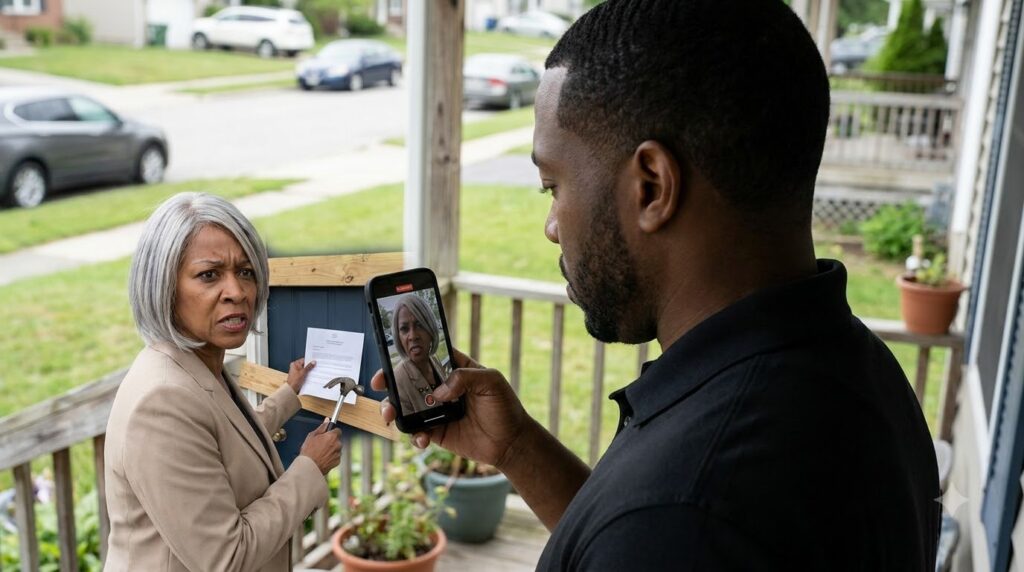
The Weight of Pine and Paper: A Novel of Boundaries and Iron
CHAPTER 1: THE WEIGHT OF PINE AND PAPER
The dull, heavy thunk of sixteen-penny nails biting into kiln-dried pine rattled the glass inserts of the front door before Mark Vance even cut the engine of his F-150.
He sat in the idling truck for three seconds, his calloused hands locked onto the steering wheel at ten and two. The bed of the Ford was loaded with two sacks of quick-set concrete and a box of galvanized joist hangers—forty dollars’ worth of hardware to fix the back step railing before the county inspector came by on Thursday. But the noise wasn’t coming from the back. It was ringing out across the manicured lawns of Oakridge Court, sharp and rhythmic, like a framer setting studs on a Monday morning.
Except nobody worked on a Sunday in this neighborhood. Not unless they had a permit stamped in triplicate by the Board.
Mark killed the ignition. Through the windshield, the scene settled into focus with the harsh clarity of a midday heat wave. Three neighbor cars were idling near his driveway curb, their drivers leaning over steering wheels with phones held up against the tint. On his porch, framed by the dark blue paint he’d spent three weekends applying with a two-inch trim brush, stood Evelyn Sterling.
She wore a beige blazer despite the eighty-degree heat, her silver bob hair immaculate, her stance planted wide on the concrete steps. In her right hand was a heavy, yellow-handled claw hammer. In her left, held against her ribcage like a riot shield, was a thick sheath of white paper topped with a red-ink stamp.
Beside her lay two raw, rough-sawn two-by-fours stretching horizontally across his entryway, their pale pine grain contrasting violently against the dark blue door frame. As Mark stepped out of the cab, his boots hitting the asphalt with a dry crunch, Evelyn swung again.
Clack.
The hammer head bit into the upper plank, driving a four-inch spike straight through the door casing.
Behind the narrow glass panes flanking the deadbolt, two tiny shapes pressed forward. Mark saw the pale oval of eight-year-old Lily’s face, her small palm slapping frantically against the glass. Behind her, six-year-old Toby stood on tiptoe, his eyes wide, his lips moving behind the soundproof double-pane seal.
Mark didn’t run. A contractor learns early that running signals panic, and panic makes men drop things or miss details. He pulled his smartphone from his polo pocket, swiped the screen upward, and tapped the red record icon. He held the phone vertically at chest height, locking his elbow into his side like a tripod brace.
“Evelyn,” Mark said, his voice flat, dry, and low. It carried across the thirty feet of Bermuda grass without rising in pitch.
Evelyn didn’t flinch. She set the flat face of the hammer against the bent head of the second nail, pulled back, and struck it flush with the wood. Then she turned her head slowly, looking down at him over the rim of her reading glasses.
“You’re trespassing on an active enforcement zone, Mr. Vance,” she said. Her voice was thin, crisp, and clipped at the edges, cultivated over twenty years of chairing sub-committee meetings. “This property has been issued an administrative closure for persistent architectural non-compliance under Article Four, Section Twelve.”
She raised the paper in her left hand, holding it toward his camera lens as if the red ink could blind the sensor.
“This HOA notice authorizes the closure,” she stated, her tone entirely devoid of doubt. “Your family must leave immediately.”
Mark kept the phone steady. Through the glass insert behind her shoulder, he saw Lily’s hand knock three times—short, sharp taps against the glass.
“Move those boards,” Mark said, taking his first step onto the bottom brick riser of the porch. “My family is inside.”
Evelyn raised the claw hammer, resting the cold steel cheek of the tool directly against the pine plank she had just driven home. “Step back, Mark. One more inch and I add obstruction of board duties to your lien.”
Mark took a slow breath, feeling the heat of the porch bricks radiating through the soles of his work boots. In the upper corner of his phone display, the red timestamp counter rolled past 0:42. On the driveway, a car door opened with a soft latch-click.

CHAPTER 2: THE ANCHOR ON THE PORCH
“You are fifty-two days past the curing window, Mark,” Evelyn said, her voice dropping into a flat, practiced cadence that sounded like a deposition transcript. She didn’t lower the claw hammer. The polished steel head glinted in the harsh midday light, resting an inch from the dark blue door casing. “The Board gave you written notice on the twelfth. You chose to pour unapproved masonry on a secondary structure.”
“I replaced rotting pine with concrete,” Mark said. He didn’t shift his weight. The soles of his work boots were glued to the red brick step, the heat of the clay burning right through the thick rubber. He raised the smartphone three inches higher, centering Evelyn’s face and the raw pine board in the frame. “And this isn’t a secondary structure. This is my front door. My kids are inside that house.”
Evelyn’s chin tilted up, just enough for the midday sun to flash off the lenses of her reading glasses. She reached into the left pocket of her beige blazer with her free hand, her fingers rustling against a stiff sheet of paper. For a fraction of a second, the corner of a yellow legal pad slipped into view—unstamped, handwritten, and lined with dense black ink—before she shoved it deeper into the lining and pulled out her printed HOA notice instead.
“The covenants grant the Architectural Committee emergency lien status in cases of willful structural alteration,” she said, her voice entirely unbothered by the lens pointed at her throat. “When a resident refuses access for inspection, the property is deemed abandoned and subject to protective seal.”
“Read the deed, Evelyn,” Mark said. He kept his elbow locked into his ribcage, tracking the tiny movement of her thumb against the handle of the hammer. “You have no right of entry. You have no right of seizure. And if you don’t take those two-by-fours down in sixty seconds, I’m calling the county sheriff.”
“Call them,” she replied instantly. The response came out too fast, too smooth, like a line she’d rehearsed in the mirror before driving over. “Deputy Miller knows the bylaws. He’s enforced four Board closures in the Estates this year alone. Your title is encumbered, Mr. Vance. You signed the master deed when you bought the parcel.”
Behind the thick glass of the sidelight window, Lily’s face pressed harder against the pane. Her small mouth opened, shaping the word Daddy against the glass, leaving a faint circle of condensation that evaporated in the heat. Beside her, Toby’s fingers hooked around the brass interior latch, twisting it back and forth, but the latch was deadlocked against the pressure of the pine boards nailed across the exterior frame. The door couldn’t yield an eighth of an inch.
Mark’s chest tightened, a cold, sharp knot pulling tight beneath his black polo shirt. He felt the familiar weight of the past six months settling on his shoulders—the stack of rejected permit slips, the registered letters marked Non-Compliant Color Palette, the fifty-dollar daily fines for the porch railing he’d spent two weeks welding after Sarah died. He’d built that railing out of solid wrought iron so the kids wouldn’t fall off the edge when they played outside in the evenings. Evelyn had cited it because the scrollwork wasn’t on the approved vendor list.
“I’m not arguing about the paint, Evelyn,” Mark said quietly. “I’m telling you that you’ve trapped two minors inside a residential structure.”
“They have a rear exit,” she said smoothly, tapping the paper against her knee.
“The rear exit is deadbolted from the inside with a key lock,” Mark said. “Which you’d know if you were an inspector instead of a trespasser.”
A low murmur rippled from the driveway mouth. Mrs. Gable, who lived two doors down at 412, had stepped out of her sedan. Her phone was up, her pale face strained as she looked from the raw lumber on the door to the small hands pressing against the glass. Behind her, a delivery van slowed to a crawl in the middle of the cul-de-sac, its engine idling with a wet, heavy diesel rattle.
Evelyn glanced toward the street for a brief micro-second, her nostrils flaring. For the first time, the rigid posture of her spine stiffened just a fraction. She didn’t lower the hammer, but her fingers tightened on the hickory handle until her knuckles turned the color of chalk.
“This is a civil matter,” Evelyn said, addressing the gathering crowd as much as Mark. “The Board is acting well within its statutory authority to protect community property values.”
“Then keep standing there,” Mark said, his thumb hovering over the screen. He tapped the dial pad without breaking eye contact with her. He pressed three digits he’d hoped he’d never have to use on his own front lawn. He set the call to speaker, the sharp, rhythmic ringing tone blasting out of the phone’s bottom speaker into the heavy summer air.
Evelyn didn’t move, but her eyes locked onto the yellow pad sticking out of her blazer pocket. She adjusted her grip on the hammer, the iron head resting heavily against the top nail, holding her ground like an officer waiting for a cavalry that she was dead certain was coming down the street.
CHAPTER 3: THE COST OF IRON AND CEMENT
“County Emergency Services, what is the location of your emergency?”
The dispatcher’s voice cracked through the smartphone’s tiny bottom speaker, metallic and crisp, cutting through the heavy midday heat like a cold wire.
Evelyn didn’t move an inch. Her eyes remained fixed on Mark’s face, cold and unblinking behind her reading glasses. But her left thumb pressed harder into the corner of her blazer pocket, pushing the stiff yellow legal pad flat against her hipbone so only the white printed notice remained visible to the street.
“Four-twelve Oakridge Court,” Mark said, his voice dropping into a low, measured register. “I have an active trespasser and unlawful restraint in progress. A neighbor is currently nailing wood across my front door while my two minor children are locked inside.”
“Are you in immediate physical danger, sir?” the dispatcher asked.
“My children are,” Mark replied. “They’re trapped behind a deadbolted entrance that’s being structurally blocked from the outside. The individual carrying out the obstruction is armed with a hammer.”
Evelyn let out a short, dry breath through her nose—not quite a laugh, but a dismissive exhalation meant for the growing crowd at the driveway edge. “Tell the operator it’s a civil compliance officer, Mark. Don’t waste county emergency resources on your delinquent maintenance.”
“Units are dispatched to your location, sir. Keep your distance and remain on the line,” the dispatcher said.
Mark tapped the screen to mute the speaker, lowering the device two inches while keeping the video frame locked on Evelyn’s hands.
His eyes tracked down the edge of the dark blue door casing, where the fresh pale pine of the two-by-four bit into the trim. Five months ago, that same casing had been bare cedar, water-stained and swollen from a three-day nor’easter that blew out the gutters. He remembered standing on this exact porch step at two in the morning with a flashlight between his teeth, holding a tarp against the fascia while Sarah held the ladder below. Her hands had been cold, wet from the driving rain, her knuckles raw from scrubbing the mildew that always tried to creep up the shadow side of the porch.
“If we fix it ourselves,” she’d whispered that night, her voice barely carrying over the deluge drumming on the shingles, “they can’t say we don’t belong here.”
Four weeks after the funeral, the first letter arrived. It wasn’t a condolence note from the Board. It was a formal Notice of Unapproved Exterior Alteration, printed on twenty-pound cream bond paper, flagging the wrought-iron railing Mark had custom-welded to replace the rotten wooden balusters. The notice cited a three-eighths-inch discrepancy in spindle spacing according to the 1998 Oakridge Estates Architectural Manual.
Mark had spent three hundred dollars out of his remaining savings to file an appeal with the Architectural Review Board. He brought two separate engineering reports showing the welded iron exceeded county building code structural load standards by four hundred percent.
Evelyn had presided over the hearing in a windowless basement room at the community clubhouse. She hadn’t even opened his binder. She had simply slid a fifty-dollar-per-day fee schedule across the folding table, her red pen circling the clause that granted the Board authority to assess cumulative liens against the title for uncorrected non-conforming fixtures.
“Uniformity is the value of this neighborhood, Mr. Vance,” she had told him, her voice as smooth and dry as polished limestone. “If we allow one home to deviate, the entire subdivision loses its structural integrity.”
Now, standing on the sun-baked brick of his own porch, Mark looked past Evelyn’s shoulder at the wrought-iron railing. The black paint near the lower mounting bracket was flaking slightly where the salt from winter de-icing had eaten into the primer. Behind it, in the shadow beneath the potted hydrangeas, lay the small yellow chalk drawings Lily and Toby had drawn yesterday afternoon—a crooked sun, a two-story house with a red roof, and four stick figures holding hands.
“You’re not trying to protect the neighborhood, Evelyn,” Mark said softly, the flat tone returning to his voice. “You’ve been trying to force a forced-sale foreclosure on this lot since March.”
Evelyn’s jaw set into a rigid line. Her left hand twitched inside her blazer pocket, the paper rustling against her side. For a fleeting second, the top margin of the yellow legal pad peeked past her lapel again—showing three columns of dates and dollar amounts written in precise, cramped handwriting, culminating in a hand-drawn circle around a date three years in the past.
“This Board acts solely on behalf of the deed restrictions,” Evelyn said, her voice rising just enough to reach Mrs. Gable at the curb. “If you cannot afford the assessments required to maintain an Oakridge property to standard, that is a personal financial failure, not an administrative overreach.”
“I paid the assessment on the first of the month,” Mark said. “By cashier’s check. Sent via certified mail.”
“The check was rejected,” she retorted instantly. “It was incomplete because it failed to include the accrued legal enforcement fees.”
“Which you added arbitrarily without a court order,” Mark countered, taking another half-step up the riser until his chest was level with the top plank.
The raw pine smelled of wet sap and fresh saw-kerf in the hot afternoon sun. Beneath his work boots, the brick mortaring cracked softly under the shifted weight. Above them, down the tree-lined stretch of Oakridge Boulevard, the low, rising warble of a siren cut through the cicadas’ hum, growing louder with every passing second.
Evelyn didn’t turn toward the sound. She raised the hammer another inch, her fingers tightening on the grip until her wrist trembled with the strain, her eyes locked on Mark’s face with the fierce, desperate certainty of a woman who believed the law was something she could nail into place herself.
CHAPTER 4: THE THRESHOLD SHIFT
Mark took the final step up onto the top landing, bringing his boots flush with the threshold of his own porch.
The heat radiating off the dark blue door casing pressed against the left side of his face. Two inches separated his shoulder from the raw grain of the top pine plank. Above his head, the four-inch steel spike protruded three-eighths of an inch through the interior jamb, its bent tip glistening with a smear of clear pine sap.
“Get off the landing, Mark,” Evelyn commanded. She didn’t retreat. She shifted her grip on the hickory handle of the claw hammer, pulling the steel head back until the claw rested against the lower two-by-four. “You are interfering with a physical enforcement order.”
“This isn’t an order, Evelyn. It’s a trespass,” Mark said. He kept his smartphone raised with his right arm, the camera lens inches from her face, tracking every twitch in her jaw. With his left hand, he reached into his back jeans pocket, feeling the stiff, folded corner of his laminated county land survey and original property deed—documents he’d carried in his truck since the first warning letter arrived six months ago.
Inside the sidelight, Lily’s palm hit the glass again—a dull, muffled slap that left a damp print on the double-pane pane. Toby’s face appeared beneath hers, his forehead pressed so hard against the glass that his nose flattened into a pale white oval. He was crying now, silent tears streaking through the dust on his cheeks, his small fingers hooking into the brass latch that refused to budge against the outer timber.
Evelyn noticed the children’s movement. Her gaze flicked toward the window frame for a fraction of a second, her nostrils flaring as her lip thinned into a pale, bloodless line.
“They shouldn’t be in there,” she muttered, her voice dropping out of its rehearsed, administrative cadence into something sharper, harsher. “The property was posted on Friday. You were given seventy-two hours to surrender possession to the Committee.”
“You posted a paper notice on a mailbox thirty feet from the porch,” Mark said, his voice dropping an octave, resonant and dangerous. “That doesn’t dissolve a county deed. It doesn’t dissolve private ownership. And it damn sure doesn’t give you the right to lock my kids in a house on a ninety-degree afternoon.”
“Section Four gives the Board emergency easement over all residential entryways in default!” Evelyn snapped. Her composure cracked, her left hand jerking inside her blazer pocket. In her haste, she pulled her fingers free too quickly, dragging the stiff yellow legal pad out into the open air.
Beneath the lined paper, tucked into the inner crease of her blazer lining, a second document slid into view. It wasn’t HOA letterhead. It was a faded, tri-folded blueprint sheet executed on heavy rag paper, bearing an old, dark-blue ink stamp from the County Recorder’s Office dated three years prior—a document marked Emergency Protective Easement / Special Access Agreement.
Mark’s eye caught the blue seal instantly. The date stamped on the margin matched the exact month Sarah had gone into the hospital for her first round of treatment—a period when Mark had signed dozens of medical authorizations and financial deferrals at the kitchen table, often late at night under the dim light of the stove hood.
Evelyn saw him look. With a swift, defensive motion, she shoved the yellow pad back into her jacket, pinning the blue-sealed paper deep beneath her lapel, her chest heaving against the beige fabric of her blazer.
“You think you can just ignore the rules because you lost your wife, Mark?” she hissed under her breath, stepping so close he could smell the stale mint and coffee on her breath. “You think this community owes you a pass? Sarah knew how the covenants worked. She understood what happens when people stop paying into the common fund.”
Mark’s left hand tightened around his county survey until the heavy lamination creaked in his fist. A cold, sharp stillness settled in his chest, drowning out the ambient noise of the street—the idling delivery van, the murmuring neighbors, the distant whine of the approaching police cruiser as it turned off the main avenue onto Oakridge Boulevard.
“Don’t speak her name,” Mark said quietly.
“I’ll speak her name whenever I review the Board’s records,” Evelyn shot back, holding her ground on the porch landing. She raised the claw hammer three inches, tapping the flat face against the upper plank with a dull clack that rattled the door frame. “Because her name is on the easement record, Mark. She knew what this Board was entitled to take.”
Behind her, the front door rattled again—a hard, desperate kick from inside as Lily tried to throw her weight against the lower panel. The raw pine board held fast, the four-inch nails groaning against the cedar trim but refusing to yield a millimeter.
Down at the curb, the warble of the siren cut out abruptly. A black-and-white Ford Explorer belonging to the County Sheriff’s Department pulled up behind Mark’s truck, its tires crunching heavily over the dry gravel along the gutter. The driver’s side door swung open, and Deputy Miller stepped out into the blinding glare of the summer sun, adjusting his duty belt with a slow, deliberate rhythm as his eyes took in the raw lumber, the hammer in Evelyn’s hand, and the smartphone camera locked on her face.
CHAPTER 5: THE WITNESS RECORD
“She’s got kids locked behind those boards, Officer!”
Mrs. Gable’s voice broke across the driveway, sharp and shrill, cracking the heavy silence that had settled over the cul-de-sac. She stepped off the curb, her phone held high in both hands, streaming directly to the neighborhood private group page.
Behind her, Mr. Henderson from 416 stepped onto Mark’s lawn, his work-call headset dangling around his neck. “I saw her hammering from my kitchen window, Deputy. She brought those two-by-fours out of her trunk ten minutes ago.”
Deputy Miller didn’t hurry. His heavy leather duty belt creaked with every measured stride across the Bermuda grass. His eyes, shielded behind dark aviator sunglasses, swept over the three idling sedans, the delivery van blocking the road, and the five neighbors standing along the property line with their camera lenses glowing in the glare.
“Everyone stay back on the grass,” Miller said, his voice a low, gravelly baritone that carried over the murmur of the street. He stopped at the foot of the brick porch steps, his gaze rising slowly from Mark’s work boots to the raw pine boards nailed horizontally across the dark blue door, and finally locking onto Evelyn Sterling.
Evelyn didn’t step back, but her shoulders squared into a rigid, defensive posture. “Deputy Miller. I’m glad you arrived so quickly. As the presiding officer of the Oakridge Homeowners Association Board, I am requesting that you clear Mr. Vance from the porch so we can complete the administrative seal.”
She extended her right hand, holding out the printed white paper with its bright red ink stamp. “The Board has executed a formal Notice of Emergency Closure under Section Four. The parcel is in default of architectural compliance, and Mr. Vance has repeatedly refused lawful inspection.”
Miller didn’t take the paper. He shifted his weight, his eyes fixing on the claw hammer held at Evelyn’s side, its steel claw resting against the lower timber.
“Put the tool down, Mrs. Sterling,” Miller said softly.
“This is an official Board action, Deputy,” Evelyn insisted, her voice tight, pitching up half an octave. “We are well within our private covenant enforcement rights. We hold a recorded interest.”
“I said put the hammer down,” Miller repeated. His voice didn’t rise, but the flat, unyielding tone left no room for negotiation.
Evelyn’s jaw twitched. Slowly, with stiff, deliberate movements, she set the claw hammer on the top brick step. The steel clattered against the clay, a hollow, metallic ring that sounded like a dropped latch in a quiet room.
Mark didn’t lower his smartphone. His camera recorded Deputy Miller stepping up onto the first riser, his heavy frame filling the left side of the lens.
“Deputy,” Mark said, his voice calm, steady, and low. “My two children, ages six and eight, are inside that house. They were taking an afternoon nap when I stepped out to the hardware store for fifteen minutes. Mrs. Sterling brought lumber and nails onto my private property and physically barred the primary exit while they were inside.”
Miller looked past Evelyn’s shoulder. Through the glass sidelight, Lily’s small face was still visible, her eyes fixed on the deputy’s uniform, her small hands pressed flat against the pane. Beside her, Toby had stopped crying, his forehead resting against the wood casing, watching the big man in the tan shirt with wide, frightened eyes.
“Mrs. Sterling,” Deputy Miller said, turning his head slowly toward her. “Are there minors inside that residence?”
“Mr. Vance was issued a vacate order seventy-two hours ago,” Evelyn replied instantly, reaching instinctively toward her blazer pocket. Her fingers caught the edge of the stiff yellow legal pad, but in her panic, she pulled too hard.
The paper tore along the top spiral, and the tri-folded blueprint document beneath it slipped out entirely, fluttering to the brick landing between Miller’s boots and Mark’s feet.
The heavy rag paper unfolded slightly as it hit the ground. The bright afternoon sun illuminated the dark blue ink stamp of the County Recorder’s Office at the top—and directly beneath it, a bold, typed heading: EMERGENCY PROTECTIVE EASEMENT & VOLUNTARY SURRENDER OF ACCESS.
Mark’s gaze dropped to the signature line at the bottom of the page. Dated three years ago to the exact month Sarah was undergoing her second round of chemotherapy, the line bore a sharp, stylized script in faded blue ink: Sarah M. Vance.
The sight hit Mark like a physical blow to the chest, a cold, sickening shock that threatened to steal the air from his lungs. Sarah’s handwriting had always been rounded, soft, and loose—never this rigid, sharp, geometric slant.
“What is that?” Mark demanded, his voice dropping into a razor-thin whisper as he pointed the phone camera down at the paper lying on his porch floor.
Evelyn’s face drained of color, the pale, lined skin around her eyes tightening into a mask of pure panic. She lunged forward, her hand darting down toward the brick landing to snatch the document back.
“That is a confidential Board record!” she snapped, her voice cracking for the first time. “It is private community property!”
Before her fingers could touch the paper, Deputy Miller’s boot came down firmly on the edge of the sheet, pinning the corner to the brick.
“Leave it on the floor, Mrs. Sterling,” Miller commanded, stepping between her and the document. He glanced down at the paper, his eyebrows drawing together as he read the county seal and the signature line pinned beneath his boot.
On the driveway, three more neighbors stepped onto the grass, their phone screens flashing in the sunlight as they recorded Evelyn kneeling frantically on the porch steps, trying to shield the document with her hands while Deputy Miller stood over her like an iron post.
CHAPTER 6: THE AUTHORITY SHIFT
Deputy Miller slowly crouched down on the top brick riser, the leather of his duty belt creaking under his weight. He didn’t take his eyes off Evelyn Sterling as his gloved fingers pinched the corner of the tri-folded blueprint paper and lifted it from under his boot heel.
“Step back against the shutter, Mrs. Sterling,” Miller said. The command was flat, devoid of anger, carrying the cold weight of fifteen years on road patrol. “Now.”
Evelyn retreated two steps, her black trousers brushing against the dark blue door trim. Her breathing was shallow and fast, her silver bob hair slightly unspooled from its rigid style. “Deputy, that document is a recorded covenant instrument. It grants the Board administrative right-of-way. Mr. Vance’s late wife signed that agreement in good faith to resolve previous non-compliance fines.”
Mark stepped past her, coming to a stop directly beside Miller. His phone camera recorded the paper in Miller’s thick fingers. The afternoon light illuminated the blue ink stamp at the top: County Recorder’s Office – Miscellaneous Lien Filings. Below it ran the typed declaration: Voluntary Grant of Emergency Access and Architectural Easement.
And there, at the bottom, was the signature line.
Sarah M. Vance.
Mark felt a sudden, sharp tightness in his throat, a sensation like swallowing crushed glass. “Look at the signature, Deputy,” Mark said. His voice was terrifyingly calm, stripped of all emotion, a contractor inspecting a broken load-bearing wall. “My wife passed away three years ago in November. This paper is dated August fourteenth of that year. Sarah was in an intensive care isolation unit at Saint Jude’s during the entire second week of August. She couldn’t hold a pen, let alone sign a legal conveyance.”
Miller’s thumb smoothed the heavy rag paper. He tilted it toward the sunlight, his dark sunglasses reflecting the blue ink text. He didn’t comment on the signature style, but his eyes tracked down to the lower right corner where a notary public seal ought to have been embossed into the fiber.
There was no raised seal. No state commission expiration date. Only a typed name beneath an illegible scrawl: E. Sterling, Commissioner of Oaths / HOA Secretary.
“Where is the county clerk’s filing stamp, Mrs. Sterling?” Miller asked, turning his head slowly toward her. “This has a recorder heading printed on the top, but there’s no volume or page book stamp from the courthouse.”
“It… it was filed under the master parcel declaration,” Evelyn stammered, her left hand clutching her beige blazer closed as if trying to hide the torn remnants of her yellow legal pad. “It doesn’t require individual index logging under section nineteen…”
“Section nineteen applies to municipal utility easements, Evelyn,” Mark interrupted, his gaze locking onto her trembling chin. He brought his county survey map up, unfolding the laminated white document with a sharp, plastic snap that sounded like a whip cracking on the small porch. “This is my certified boundary survey, drawn by a state-licensed surveyor six months ago. It shows zero recorded easements on this parcel. No HOA right-of-way. No access reservation. Nothing.”
Evelyn pressed her back flatter against the boarded door. “The survey is incomplete! The Board’s legal counsel holds the master file!”
“Then your legal counsel can produce it in District Court,” Miller said cleanly. He folded the blueprint paper along its original creases and slid it into the breast pocket of his uniform shirt, buttoning the flap down tight. “Because right now, what I have on this porch is a non-recorded paper, two raw timber planks nailed across an occupied home’s primary egress, and two minor children locked inside on a nineties day.”
A sudden chorus of voices rose from the street. Mrs. Gable was standing at the edge of Mark’s driveway, holding her phone out toward the porch while three other neighbors—Mr. Henderson, a young couple from down the block, and the driver of the idling delivery van—gathered in a tight arc along the curb.
“We’re recording this live on the community portal, Evelyn!” Mrs. Gable shouted, her voice shaking with rage. “You told the block association last month that Mark gave written permission for the architectural review! You lied to the entire street!”
“Turn those cameras off!” Evelyn shrieked, her voice suddenly cracking into a shrill, hysterical pitch that echoed off the brick facades of the surrounding homes. She took a blind step toward the porch steps, waving her hands defensively. “This is private neighborhood business! You have no right to stream this!”
“They’re standing on a public street, Mrs. Sterling,” Miller said, stepping into her path and blocking her view of the driveway. “And right now, you need to worry about what’s happening on this porch.”
Miller reached down, picking up the yellow-handled claw hammer from the top brick riser where Evelyn had left it. He held it by the neck, testing its weight for a second before turning to face the barricaded door.
“Mr. Vance,” Miller said, looking at Mark. “You called county dispatch to report a active physical obstruction of your home?”
“I did,” Mark said.
“And you are the sole legal owner of this parcel according to county tax records?”
“I am.”
Miller turned back to Evelyn. His posture shifted, his broad shoulders blocking the sun, casting a long, dark shadow across her beige blazer and pale face.
“Mrs. Sterling,” Miller said, his voice dropping into a register that made the window glass behind them hum softly. “You have two choices. You can take this hammer, pull every single nail out of those two-by-fours, and clear this doorway in the next three minutes… or I am placing you under arrest right now for unlawful imprisonment, reckless endangerment of minors, and criminal trespass.”
Evelyn froze. The color didn’t just leave her face; it drained out completely, leaving her skin the gray, chalky color of dried mortar. She stared at the yellow handle held out toward her, her mouth opening and closing without making a sound.
Behind the dark blue door, Lily tapped twice on the glass.
CHAPTER 7: THE PROOF OF DEED
Deputy Miller held the yellow hammer handle stationary between them, suspended in the baking summer air. His sunglasses reflected Evelyn’s trembling form, framed against the dark blue casing and raw pale pine.
“I asked you a question, Mrs. Sterling,” Miller said, his voice dropping into a flat, deadly quiet. “Are you taking those boards down yourself, or am I taking you down to the county processing desk in cuffs?”
Evelyn didn’t reach for the hammer. Her fingers twitched against her beige trousers, her throat working hard as she tried to swallow. Her eyes darted toward the driveway, where Mr. Henderson had stepped up beside Mrs. Gable, both phones pointing straight at her face like twin barrels.
“Mark,” she whispered, her voice stripped of every drop of its administrative authority. It sounded dry, cracked, and desperate. “Mark… talk to me for a moment. Privately.”
Mark didn’t lower his smartphone. He shifted his stance on the porch landing, his shoulder steadying against the brick pillar. “My kids are in that house, Evelyn. There is no private conversation.”
“You don’t understand the board’s liability,” she muttered, stepping closer to him, her voice dropping lower so Miller had to lean in to catch it. “The master account… if the covenants are breached on this block, the bank re-evaluates the entire subdivision’s line of credit. It’s not just your home. It’s the whole street’s equity.”
“You forged my wife’s name on a fraudulent access easement,” Mark said, his voice ringing out sharp and clear over the lawn. He held up the laminated county survey map, pressing the clear, stiff sheet right toward her lens-obscured eyes. “Read the red boundary line, Evelyn. Certified by the County Clerk. Zero encumbrances. Zero HOA easements. Zero authority.”
Deputy Miller took the laminated deed from Mark’s left hand. He held it up alongside the folded blueprint paper he’d tucked into his pocket moments earlier, comparing the two seals in the harsh glare of the midday sun.
“This survey was recorded six months ago, Mrs. Sterling,” Miller observed, pointing a thick index finger at the raised gold seal imprinted on the corner of the laminate. “It carries the official county auditor’s signature. That blueprint sheet you brought out of your pocket doesn’t have an auditor stamp, it doesn’t have a volume page, and it doesn’t have a state notary stamp.”
“It was an internal draft!” Evelyn blurted out, the word bursting out before she could stop it. “It was an internal board agreement!”
“An internal draft that you brought to my property with a claw hammer and four-inch nails,” Mark said, stepping directly between her and the front steps. “You used a forged paper to lock two children inside a house.”
“I didn’t know they were inside!” she cried, her voice pitching up into a thin, frantic squeak.
“They knocked on the glass five feet from your head while you drove the second nail!” Mrs. Gable screamed from the driveway, her phone shaking as she captured Evelyn’s hands flying up to cover her mouth. “We all heard it from the street! We saw them!”
Deputy Miller’s patience ran out with a single heavy exhale. He reached down to his duty belt with his left hand, his thumb unsnapping the leather retention strap over his handcuffs. The cold, metallic clack of the steel links clearing the leather holster echoed across the porch.
“Last chance, Mrs. Sterling,” Miller said, holding out the claw hammer again, turning the handle toward her chest. “Take the hammer and start pulling those spikes out of Mr. Vance’s door trim. Or put your hands behind your back right now.”
Evelyn stared at the steel cuffs resting against Miller’s dark belt. Her chest rose and fell in rapid, shallow hitches. Slowly, painfully, as if the yellow fiberglass handle weighed fifty pounds, her right hand extended. Her fingers wrapped around the rubber grip of the hammer.
Her knuckles were white. Her silver bob hair was disheveled, a strand sticking to the cold sweat on her temple. She looked down at the raw pine two-by-four nailed horizontally across the dark blue door, then up at Mark’s phone camera, which remained locked on her face without wobbling an inch.
Behind the glass, Lily’s small hand tapped once more against the pane—soft, expectant, and close.
CHAPTER 8: THE FORCED STRIP
Evelyn’s hand shook so violently that the yellow claw hammer rattled against the top pine plank with a sharp, hollow tink.
She stood on the top step, her beige blazer dark with sweat under the arms, her silver bob hanging in limp strands around her flushed face. Deputy Miller didn’t step back. He stood two feet away on the porch landing, his broad chest blocking her escape route, his left hand resting lightly on the open leather strap of his handcuff holster.
“Start with the top rail, Mrs. Sterling,” Miller said, his voice flat, procedural, and absolute.
Evelyn swallowed, a harsh, dry sound. She wedged the forged steel claw of the hammer beneath the lip of the upper two-by-four, right where the four-inch spike held the raw timber against Mark’s dark blue door trim. She leaned her weight back, trying to pry the claw downward.
Nothing moved.
Mark had built structural frames for fifteen years. He knew the bite of sixteen-penny galvanized sinkers in seasoned pine. A sixty-eight-year-old woman in dress shoes couldn’t leverage forty pounds of holding force without her feet slipping on the slick brick landing.
“Set the fulcrum against the casing, Evelyn,” Mark said from behind his camera lens. His voice was cold, precise, and completely devoid of pity. “Angle the neck thirty degrees left, or you’re just bending the shank.”
Evelyn let out a strained, ragged gasp, adjusting her grip on the rubber handle. She threw her upper body weight against the tool.
Squeeeak.
The sound of iron pulling free from dry cedar tore across the porch like a rusted hinge giving way. A fine shower of dried pine sap and pale wood dust flaked off the timber, drifting down onto the toes of her black trousers. The head of the spike popped free three-quarters of an inch, revealing its ridged steel shaft.
Down at the driveway, the crowd had grown to a dozen neighbors. Mrs. Gable hadn’t lowered her phone for a single second. Behind her, Mr. Henderson was holding his tablet up high, streaming the video directly into the county public registry group. A young mother from two doors down held her toddler’s hand, pointing toward the porch as the community board president was forced to physically undo her own barricade.
“Leverage it again,” Miller instructed calmly.
Evelyn reset the claw beneath the raised nail head. She pulled down with a desperate, guttural grunt, her dress shoes squeaking sharply on the red brick.
POP.
The top spike ripped free, flying off the porch step and bouncing with a metallic clatter onto the concrete walkway below. The left side of the top plank dropped six inches, hanging loosely by the single nail on the right jamb.
Inside the sidelight, Lily and Toby backed away from the glass pane as the wood shifted. Mark saw his daughter’s small hands drop from the brass latch, her eyes wide as she watched Evelyn’s trembling hands grasp the sagging board.
Evelyn moved to the right side of the doorway. Her breathing was ragged, her chest heaving against her white blouse. She jammed the claw beneath the remaining top nail, her foot slipping an inch on the brick landing before she caught her balance against the door frame. She threw her shoulders back, pulling with everything she had left.
SCREECH.
The second spike yielded. The upper two-by-four fell away, hitting the brick landing with a heavy, solid thud that echoed off the porch ceiling.
“One more,” Miller said, pointing his gloved finger at the lower timber pinned across the threshold. “Clean the frame.”
Evelyn didn’t speak. Tears of humiliation and physical exhaustion welled in the corners of her eyes, tracking through the makeup creased along her cheeks. She dropped to one knee on the hard brick, her beige blazer dragging through the pale wood dust scattered on the landing. She wedged the hammer claw under the bottom plank, her hands bleeding slightly where the rough pine grain had scraped against her palm.
She yanked upward. Once. Twice.
On the third pull, the lower board snapped free with a sharp crack that sounded like a dry branch breaking in a storm. The timber clattered against her shins before rolling down the porch steps, coming to rest in the Bermuda grass at the foot of Mark’s walkway.
The threshold was clear.
Mark lowered his smartphone three inches. The dark blue door frame stood open to the summer air, marred only by four small, raw nail holes in the cedar casing where the wood fibers had been torn open.
Inside, the brass latch clicked. The deadbolt slid back with a heavy, smooth mechanical sound.
The dark blue door swung inward. Lily stepped out onto the porch threshold first, her small sneakers crunching softly over the wood dust on the floorboards, her arms wrapping instantly around Mark’s waist. Toby followed a second later, burying his face into the fabric of Mark’s contractor jeans.
Mark dropped to one knee, wrapping his arms around both of them, his hands cupping the backs of their heads as he pressed them close against his chest. He didn’t say a word. He just held them, feeling the rapid, frightened beat of their hearts against his ribs while the hot afternoon wind swept across the porch, carrying away the smell of fresh saw-kerf and pine sap.
On the porch landing, Evelyn remained on her knees, the yellow claw hammer resting limply in her lap, her head bowed as the deputy stood over her with a thick black citation book pulled from his pocket.
CHAPTER 9: THE UNBROKEN LINE
“Sign the lower line, Mrs. Sterling,” Deputy Miller said. His voice was a flat, heavy rumble that settled over the porch like cool evening shade. “This is a criminal summons for reckless endangerment, criminal trespass, and obstruction of a residential structure. Court appearance is mandatory on the twenty-fourth.”
Evelyn remained sitting on the top brick step, her dress shoes tucked awkwardly beneath her knees. The yellow claw hammer lay beside her right ankle, its steel claws dusted with fine pine flour. Her fingers trembled so violently she could barely hold the pen Miller handed her. She pressed the ballpoint against the yellow carbon paper, leaving a jagged, illegible scrawl before handing the clipboard back without raising her head.
Miller tore the pink copy from the pad with a crisp, sharp snap of paper. He folded it once and tucked it into the lapel pocket of her beige blazer—right where her torn yellow legal pad had rested an hour ago.
“You are barred from entering this parcel,” Miller stated, stepping down to the second riser. “If you set foot on Mr. Vance’s porch, driveway, or lawn before your court date, you will be taken directly to the county jail without a summons. Do you understand?”
Evelyn didn’t answer. She pulled herself up by the wrought-iron railing—the very railing she had spent six months issuing daily fines against—and stumbled down the brick steps. Her knees gave a small, unsteady wobble as her heels hit the concrete walkway. Down at the curb, the gathering of neighbors parted silently, no one speaking to her, no one offering a hand as she walked toward her vehicle with her head bowed against the sun.
Mr. Henderson stepped forward as she passed, holding his tablet firmly at chest height. “The board meeting is at seven tonight, Evelyn,” he called out across the lawn, his voice carrying the firm consensus of the street. “We’re introducing an emergency petition to remove you from the chair and initiate a full audit of every lien filed in Oakridge over the last three years.”
Evelyn didn’t turn around. She pulled open the driver’s side door of her sedan, slipped inside, and pulled away from the curb, her tires kicking up a small cloud of dry dust against the gutter.
On the porch, Mark remained crouched on the landing, his arms holding Lily and Toby close against his sides. Lily’s head rested against his shoulder, her breath coming in slow, steady rhythms now that the pounding had stopped. Toby reached out with his small fingers, tracing the raw, pale holes in the dark blue door casing where the four-inch nails had been ripped free.
“Is the lady coming back, Daddy?” Toby asked softly.
“No, buddy,” Mark said, his voice quiet and firm as granite. “She’s not coming back.”
Deputy Miller walked back up the porch steps, his boots crunching over the wood dust scattered across the brick landing. He pulled the folded, blue-ink blueprint document from his breast pocket and handed it down to Mark, alongside the laminated county survey map.
“The county prosecutor’s office will want this blueprint, Mr. Vance,” Miller said, pointing to the blue stamp at the top. “I checked the state notary registry on my cruiser terminal while she was pulling those nails. The notary commission number on that document belongs to a clerk who retired five years ago. That signature wasn’t just unauthorized—it’s federal wire and real estate fraud.”
Mark took the paper, feeling the heavy rag fiber between his thumb and fingers. He looked at the forged signature—the sharp, geometric slant that had tried to impersonate Sarah’s soft, rounded hand. The decoy of an old easement had been built on a lie, designed to exploit his grief and force him off his land before anyone looked close enough at the county books.
“Thank you, Deputy,” Mark said.
“Keep the phone video backed up on a thumb drive,” Miller advised, tapping his chest where his own bodycam recorded. “And if anyone from that board comes near your property before the hearing, you call my cell directly.”
The officer turned and walked down the steps, his heavy leather belt creaking in the quiet afternoon air. Down at the driveway, Mrs. Gable waved a quiet, respectful hand at Mark before walking back toward her porch, her phone finally slipped away into her pocket. The delivery van pulled away, its diesel engine humming softly as the cul-de-sac returned to the stillness of a late summer Sunday.
Mark stood up slowly, lifting Toby onto his hip while Lily held tight to his left hand. He looked down at the dark blue front door. The cedar trim was scarred where the boards had been forced against it, the paint chipped away around the nail holes to reveal the raw, honest wood beneath.
He didn’t care about the paint. He didn’t care about the board’s manual, or their fines, or their official red-ink stamps.
He ran his hand over the wrought-iron railing, feeling the solid, cool strength of the metal he’d welded with his own hands. The iron held. The survey lines held. The house was his, rooted deep in the dirt of the parcel he had paid for in sweat and labor.
Mark pushed the dark blue door open, stepping across the threshold with his children, and closed it firmly behind them against the summer heat.







