
The Weight of Asphalt and Tape: A Story of Curbside Boundaries and Rusted Truths

CHAPTER 1: THE CURBSIDE THRESHOLD

“Drop the box, Evelyn,” Mark said, his fingers digging into the brass teeth of his house keys until the metal bit back.

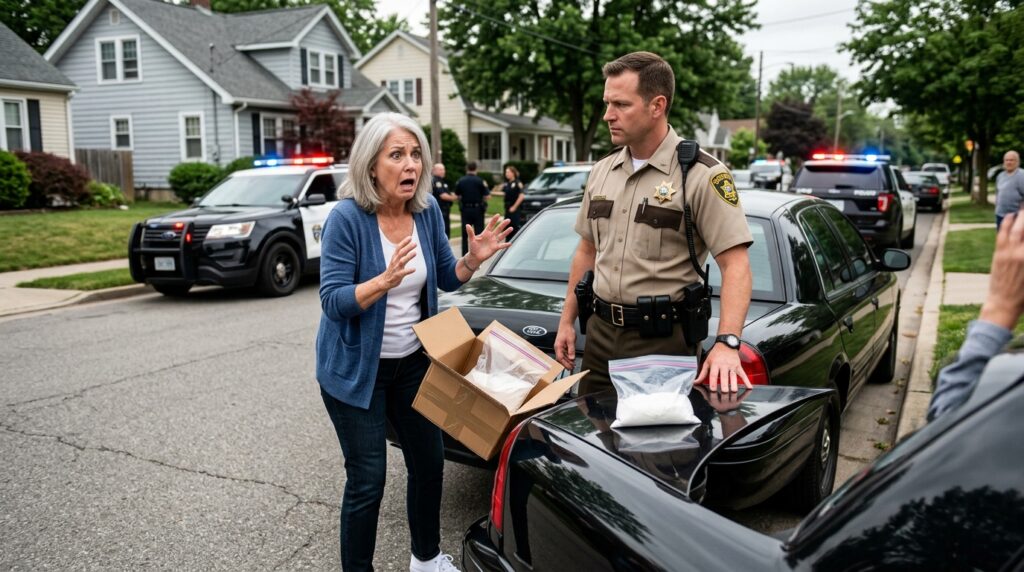
The heat coming off the asphalt carried the sour smell of old engine oil and sun-baked pine needles. Two feet past the sun-bleached concrete of Mark’s driveway, Evelyn stood with her heels planted squarely on the street seam. Her silver-gray hair was clipped into tight, immaculate waves that didn’t move in the afternoon breeze. In her hands—pressed hard against the blue knit of her cardigan—was a compact cardboard parcel wrapped in double-thick strands of fiberglass tape.

“This street has standards for unmonitored drops, Mark,” Evelyn said. Her voice didn’t rise; it had the dry, practiced cadence of a recording clerk reading back a code violation. “Unattended packages left within six feet of an uncurtained garage apron constitute an attractive nuisance under Section 4-B. I’m securing it for the board’s afternoon log.”

“It has my name on the printed label,” Mark said. He didn’t step off his concrete onto her asphalt. He had learned the physical geometry of Evelyn’s authority months ago—how six inches over an easement line became a written trespass warning, how an open garage door past seven in the evening triggered a certified letter. “You walked fifteen feet past my property line to take it off my steps.”

“I walked where the safety of this block required me to walk.” Evelyn turned her shoulder slightly, shielding the box with her torso as she moved toward the rear bumper of a black sedan parked at the curb. Her fingers twitched against the cardboard, feeling the sharp corners of the reinforced tape. “If you wanted your deliveries private, you should have signed the courier access rider at the spring meeting. You chose to leave your threshold open.”

Mark took one slow step down off the curb, his work boots making a gritty crunching noise against the loose gravel in the gutter. He could feel the eyes behind the surrounding living room blinds—the quiet, watchful stillness of a street that had learned to stay inside when Evelyn walked her perimeter. He didn’t raise his hands. He kept his left arm dead at his side, the brass keys heavy in his fist, while his eyes locked onto the black ink of the shipping label taped to the parcel’s top flap.

Directly beneath his house number, visible right through the crease of Evelyn’s thumb, was a faint, blue-ink stamp that didn’t belong to any standard postal service—a crisp, square outline containing a single hand-lettered digit.

Evelyn caught him looking. Her grip tightened, the cardboard groaning under the pressure of her thumbs as she reached the sedan’s trunk. “Don’t look at me like I’ve committed a fault, Mark. I am the only reason this street hasn’t decayed into a transit corridor.”

“That stamp under your thumb,” Mark said softly, the sun hot on the back of his neck. “That didn’t come off a delivery truck.”

Before Evelyn could answer, the slow, mechanical rumble of a Ford V8 drifted from the corner of the avenue, and a tan county cruiser rounded the curb, its tires rolling over the dry pine needles with a heavy, deliberate crush.
CHAPTER 2: THE STANDOFF AT THE DOOR

“Stay on your side of the gutter, Mark,” Evelyn said, her body shifting to pin the parcel against the rear door of the black sedan. The metal of the quarter panel groaned under her weight, the black paint scorching hot under the high sun. “You have no standing here.”

Mark stopped three feet short of the bumper. The gravel beneath his boots ground down to dust, the grit biting through his leather soles. His left thumb remained pressed into the sharp edge of his brass key, the dull ache keeping him tethered to the ground. “You’re standing in front of my driveway, Evelyn. Holding a box with my street number stamped on the top.”

“A number that means nothing without the master manifest,” she snapped, though her eyelids fluttered once—a tiny, involuntary micro-twitch that gave away the frantic calculation behind her eyes. Her fingers, stiff and slightly liver-spotted, adjusted their grip on the cardboard. The blue cardigan she wore was far too heavy for the August heat, dark patches of dampness blooming under the arms where the fabric met her ribcage. “The HOA has an emergency protocol for untagged residential drops. It’s for the security of the block.”

“You aren’t security, Evelyn. You’re a neighbor who likes to walk on other people’s grass.”

“I am the only person keeping this street from turning into a dumping ground!” Her voice flared, losing its rehearsed, administrative cadence for a fraction of a second. The composure cracked, revealing something raw and jagged underneath—an anxious, desperate urgency that went beyond petty neighborhood control. She leaned closer to the car, her hip slamming into the door handle with a hard thud.

Mark didn’t reach for the box. He knew the legal geometry of the curb better than she did. If his hand touched that cardboard while she held it, she would call it an assault before his boots hit the grass. Instead, he leaned in just enough to bring his eyes level with the top flap.

The blue-ink stamp wasn’t a standard courier mark. Up close, the lines were slightly blurred, the ink bleeding into the rough, recycled fibers of the box. Inside the square frame, the hand-written digit wasn’t a ‘1’ or a ‘7’. It was an uppercase ‘E’ with a horizontal strike through the middle—a custom routing mark. And directly beneath it, where the white adhesive shipping label was peeling back from the heat, the dark corner of a second, older label peeked out.

“Where did you get this, Evelyn?” Mark asked, his voice dropping into a flat, dangerous register. “That isn’t a post office code. And that box wasn’t misdelivered.”

Evelyn’s chin snapped up, her nostrils flaring. “It was on the apron! It was left unattended!”

“It was dropped on the edge of my property line because someone knew you’d pick it up,” Mark said, watching her face closely.

The color drained from her cheeks, leaving her skin looking like powdered chalk against the bright silver of her hair. For a second, the overbearing, rule-quoting HOA enforcer vanished, replaced by the hollow, terrified silhouette of a woman who had backed herself into a corner she didn’t understand. Her chest hitched in a shallow, silent breath. Her hands trembled against the box, the fiberglass tape crinkling under the sudden spasm of her fingers.

“Don’t you dare accuse me,” she whispered, her voice thin and raspy now. “I built this neighborhood. I kept the trash out when your family moved in, and I will keep it out now.”

“You didn’t build anything,” Mark said softly, his key ring clinking once in his closed palm. “You just built a fence around yourself and called it a board.”

Behind them, the rumble of the approaching sheriff’s V8 dropped an octave as the cruiser drifted to a halt three feet from the sedan’s rear bumper. The driver’s side door swung open with a heavy, mechanical latch-click, and the thick, rubbery smell of hot tread and brake dust washed over the asphalt.

Deputy Miller stepped out into the heat, his tan uniform crisp, his eyes already sweeping the three feet of neutral gravel between Mark’s boots and Evelyn’s heels.

“Alright,” the deputy said, his voice carrying the calm, immovable weight of an officer who had handled a hundred suburban petty disputes. “Let’s leave the box on the car and step back.”

Evelyn didn’t move. Her fingers dug deeper into the cardboard, the paper tearing slightly under her fingernails. “Officer, I summoned you. This man is interfering with official board safety procedures—”

“Ma’am,” Deputy Miller interrupted, his tone unyielding as his hand rested casually near his belt line. “Put the package on the trunk. Now.”

CHAPTER 3: THE NEUTRAL ZONE

Evelyn’s knuckles went bone-white against the cardboard. For two full beats, her heart seemed to hit her ribs in a frantic, visible cadence through the thin knit of her blue cardigan. Then, with a jerky, unnatural stiffness, she lifted the box three inches off her chest and set it down flat on the sun-baked enamel of the sedan’s trunk lid.

The heat off the dark paint crackled against the bottom of the cardboard.

“Step back to the curb line, Evelyn,” Deputy Miller said, his boots crunching methodically as he bypassed Mark by three paces. His left thumb hooked into the heavy nylon web of his duty belt, right hand hovering four inches above the stiff retention hood of his holster. “Mark, you stay right where you are. Nobody touches the box.”

Mark didn’t move. The brass teeth of his house keys were cold against his palm now, slicked with sweat from the midday heat. He watched Miller’s eyes—small, pale gray, and entirely void of interest in neighborhood board politics. Miller was a county man, used to rural highway speed traps and property-line fence disputes that ended in shotguns, not clipboards.

Evelyn retreated two steps, her heels catching on the ragged seam where the asphalt met Mark’s concrete apron. “Deputy, I must insist you take my statement first. I observed this parcel dropped from an unmarked delivery vehicle moving at an unsafe speed down the cul-de-sac. As neighborhood safety coordinator, I initiated an immediate custody hold to verify—”

“Evelyn,” Miller said, his voice flat as an unplaned oak board. “I’m going to ask you once. Is this your box?”

“It is in my custody under Section 4-B—”

“Is it yours?” Miller repeated, turning his torso just enough to bring the body camera clipped to his sternum into a direct line with her face. The small green indicator light on top of the lens blinked in a steady, rhythmic pulse. “Simple question. Yes or no.”

Evelyn swallowed hard. Her tongue flicked out to wet her lower lip, leaving a faint streak of saliva across her pale skin. Across the street, the second-story blinds at Number 402 twitched, the white slats angling down as Mrs. Gable adjusted her view. Beyond her lawn, the idling delivery truck that had been delayed down the block gave a loud, pneumatic hiss of air brakes, its diesel engine chugging lazily in the heat.

“It is my responsibility,” Evelyn said, her voice rising to regain its authoritative timbre. “The homeowner has consistently refused to comply with HOA package logging. Therefore, as representative of the board, I am the rightful recipient of all unverified drops until the origin can be established.”

Miller didn’t answer her. He stepped up to the rear bumper of the black sedan, his broad shadow falling over the cardboard box. He didn’t pick it up. Instead, he leaned down until his eyes were six inches from the shipping label.

“Mark,” Miller called out, not looking away from the package. “Your name on here?”

“Mark Vance,” Mark said, his voice steady. “408 Elm. Exactly where the courier dropped it before Evelyn ran across the ditch to grab it.”

“And you were expecting a parcel today?”

Mark hesitated. The silence between them stretched, filled only by the distant hum of an air conditioner kicking on down the street. “No,” Mark admitted, keeping his eyes fixed on Miller. “I wasn’t. But that doesn’t give her the right to take it off my steps.”

“It’s an unauthorized drop!” Evelyn interjected, stepping off her heels onto her toes as if trying to see over Miller’s shoulder. “He’s admitting it! He didn’t order it!”

Miller reached into his duty pocket and pulled out a small, folding utility knife. The brass frame was worn smooth at the corners, the stainless steel blade sliding out with a sharp, metallic click that made Evelyn jump.

“Neither of you ordered it,” Miller muttered, his thumb tracing the edge of the shipping label where the paper was peeling away from the box. “Yet here we are standing on the street in ninety-degree heat arguing over who gets to keep it.”

He didn’t slice the tape across the top flaps. Instead, he used the tip of the blade to gently pry at the corner of the white shipping label—the spot where Mark had spotted the darker paper underneath.

With a slow, dry tearing sound, the top label peeled back.

Evelyn took a half-step forward, her hands instinctively rising toward her throat. “Officer, what are you doing? That is private HOA evidence—”

“Shut up, Evelyn,” Miller said, without raising his voice.

The paper peeled away in one smooth strip, dropping onto the hot black paint of the trunk. Beneath it sat the original shipping label, crisp and uncreased.

It wasn’t addressed to Mark Vance. It wasn’t addressed to 408 Elm.

Printed in dark, bold thermal ink was a freight routing code from a regional terminal sixty miles north—and directly beneath it, in clear capital letters, was the name E. M. HARPER.

Evelyn’s full legal name.

Mark’s chest tightened, the sudden shift in gravity pulling at his stomach. He looked from the name on the box up to Evelyn’s face. The enforcer wasn’t just pale now; her mouth had fallen open in a slack, horrified oval. Her eyes were fixed on the thermal ink with a wild, uncomprehending panic that went far beyond the embarrassment of being caught in a lie.

“That’s…” Evelyn stammers, her hand reaching out toward the car before snatching it back as if the metal were white-hot. “That’s a mistake. That wasn’t on there. Someone put that on there!”

“It was under your name label, Evelyn,” Mark said softly, the realization settling into his spine like cold iron. “You didn’t intercept my package. You were collecting your own.”

“No!” she shrieked, the thin veneer of her neighborhood authority shattering entirely. “I don’t know what that code is! I’ve never seen that routing number! Mark, you did this—you pasted that label over it to trap me!”

Miller didn’t engage in the argument. His face had gone stone-hard, his eyes shifting from the freight code down to the heavy fiberglass tape sealing the center seam of the box. He inserted the tip of his utility blade under the edge of the reinforced tape.

“Both of you,” Miller said, his voice dropping into a register that made the hair on the back of Mark’s neck stand up. “Step back another three feet. Right now.”

CHAPTER 4: THE STEEL ON TAPE

Mark backed his heels up until the soles hit the raised concrete edge of his lawn. Three feet away, Evelyn swayed on the asphalt like a dead pine in a sudden squall, her spine stiffening as if a single step backward would dissolve the last shred of authority she held over the street.

“Evelyn,” Deputy Miller repeated, his thumb resting flat on the side of his utility knife. “Back up.”

Her slippers dragged against the hot asphalt, leaving faint grey streaks in the grit before she stopped beside the sedan’s rear tire. Her fingers twitched at her sides, grasping at the air as if looking for the clipboard she had left on her front porch.

Miller didn’t take his eyes off the box. He shifted his weight, his heavy duty boots grinding loose pebbles against the street, and pressed the honed edge of the blade against the center seam. The fiberglass tape resisted for half a second before giving way with a sharp, dry zippp that cut clean through the summer heat.

The cardboard flaps sprang open two inches, released from the tension of the glue.

A wave of heat rose from the dark interior of the box, carrying the faint, chemical bite of unwashed industrial vinyl and stale glue. Miller reached down with two gloved fingers, hooking the edge of the top flap, and pulled it wide.

Mark leaned forward from his patch of grass, his heart hammering a hard, rhythmic thud against his ribs. The brass key ring in his hand was slippery now, the cold metal completely warmed by the heat of his palm.

Sitting inside the corrugated walls, wedged between two yellowed blocks of packing foam, was a clear, heavy-gauge plastic bag sealed with a thick heat-bar seam. Inside the bag lay a dense, brick-shaped mass of white powder, its surface compressed into tight, chalky striations that reflected the glare of the noon sun.

Tucked neatly into the narrow gap between the foam block and the plastic brick was a folded slip of green manifest paper—printed with a barcode and a local courier account number.

The street went dead silent. Even the idling diesel engine of the delivery truck down the block seemed to drop into a muffled, distant hum.

Miller didn’t flinch. His shoulders went rigid beneath the stiff tan fabric of his uniform shirt. Slowly, deliberately, he withdrew his hand from the box, stepping back half a pace to clear his right hip. His hand didn’t rest on his holster; it snapped down onto the leather retention strap, unbuckling the snap with a distinct, metallic clack.

“Don’t move,” Miller said. The calm, weary tone was gone, replaced by a cold, flat cadence that left zero room for argument. “Neither of you. Put your hands where I can see them.”

Mark raised both hands instantly, spreading his fingers wide so the brass key ring hung plainly from his index finger. His eyes darted from the plastic brick up to Evelyn.

She hadn’t moved her hands. They remained frozen at her waist, her jaw working silently as her eyes locked onto the white mass inside the open box. The color didn’t just leave her face; her skin turned a mottled, greenish-gray, the fine veins around her temples standing out like blue threads under parchment.

“Officer,” she gasped, her voice cracking into a high, hysterical register. “Officer, I didn’t—that isn’t—I was securing the property! You saw me! I took it off his driveway!”

“I saw you claim ownership of a parcel delivered under your legal name, Evelyn,” Miller said, taking another step back and unclipping the microphone from his shoulder. He pressed the side button, his voice barking over the static burst of the channel. “Dispatch, 214. I have an active 10-80 at 408 Elm Avenue. Requesting two additional units code two, and notify narcotics.”

“No!” Evelyn shrieked. She took a panicked step toward the car, her hand reaching out toward the open flaps as if she could pull the cardboard closed and erase the last two minutes from the street. “You don’t understand! That address label was a mistake! Someone put my name on that box because they knew—”

“Step away from the vehicle!” Miller roared, his hand bringing the heavy black grip of his sidearm up halfway from the leather holster. “Evelyn! Hands on the trunk! Now!”

She froze, her fingers hovering inches above the hot black paint of the sedan.

Mark watched her, the puzzle pieces clicking together in a dark, jagged line, but something in her eyes stopped him cold. It wasn’t the cunning horror of a criminal caught in a sting. It was the raw, unadulterated terror of a woman who had just stepped onto a landmine she hadn’t known was buried in her own yard.

And then, as Miller stepped in to grab her wrist, Mark’s eyes caught the green manifest slip resting against the foam. Printed at the very bottom of the paper, beneath the courier account code, was a hand-written delivery instruction written in faded blue ink: Leave at 408 apron if blue cardigan is on street.

Mark’s breath caught in his throat. The blue cardigan wasn’t a disguise. It was a trigger.

Across the avenue, two hundred yards away at the corner of the cul-de-sac, the dark tinted window of a silver pickup truck rolled down two inches, a thin wisp of cigarette smoke drifting out into the hot afternoon air before the engine turned over with a heavy, throaty roar.

CHAPTER 5: THE RECKONING ON THE ASPHALT

The rumble of the silver pickup truck echoed off the surrounding brick gables, its tires squealing against the pavement as it backed out of the cul-de-sac and accelerated down the avenue.

Deputy Miller didn’t chase it. He couldn’t. His left hand had clamped around Evelyn’s right wrist with the crushing, mechanical pressure of a vice, forcing her arm behind her back while his chest microphone crackled with frantic dispatch traffic.

“Keep those hands on the trunk lid, Evelyn!” Miller ordered, his voice cutting through the high-pitched whine of approaching sirens echoing two streets over. “Don’t you pull away from me!”

“I don’t know who owned that truck!” Evelyn screamed, her voice cracking as her forehead slammed against the hot enamel of the sedan’s rear quarter panel. Her silver hair had finally shaken loose from its neat clips, strands hanging limp across her damp, flushed face. “I swear to God, Mark! Tell him! Tell him I just take the packages! I don’t know what’s inside them!”

Mark took two steps off his lawn onto the asphalt, ignoring Miller’s sharp glare. His eyes were locked on the green manifest slip resting against the yellow packing foam inside the open box.

Leave at 408 apron if blue cardigan is on street.

The handwriting wasn’t anonymous. The looping ‘g’ in cardigan had a distinctive, broken tail—a lazy stroke where the pen lifted early. Mark had seen that exact handwriting on a hundred yellowed index cards taped to the community board at the neighborhood pool years ago, back when Evelyn’s son, Scott, still lived in her basement before he vanished into three separate probation violations.

“Miller,” Mark said, his voice flat and cutting through the wail of the incoming squad cars. “Look at the manifest.”

“Stay back, Mark,” Miller barked, ratcheting a cold steel handcuff over Evelyn’s left wrist with a sharp clack. “I mean it. This is a federal felony scene now.”

“Look at the note at the bottom of the slip,” Mark insisted, stepping right to the edge of the driver’s side door. “The delivery wasn’t meant for me. And it wasn’t a mistake that she grabbed it.”

Evelyn froze under Miller’s weight, her chest heaving against the sedan’s hot sheet metal. Her head snapped sideways, her eyes wide, bloodshot, and wild as she stared at Mark. “What are you talking about? What note?”

“Scott,” Mark said simply.

The name hit her like a physical blow. Evelyn’s body went completely limp, her knees buckling so hard that Miller had to jerk her upward by her pinned wrists to keep her from dropping face-first onto the gravel.

“No,” she whimpered, the harsh, authoritative HOA enforcer completely gone now, replaced by a hollow, broken shell. “No… Scott is in Oregon. He’s working at the lumber yard. He sends me postcards…”

“Scott knew you couldn’t resist a package on my apron,” Mark said, the bitter, rusted truth settling over the street like heavy smog. “He knew you walked this curb every day at noon like clockwork. He didn’t drop it at your door because he knew your house might be watched. He dropped it on my property because he knew you’d march right over, snatch it off my steps, and carry his weight past your own threshold.”

“You’re lying!” she sobbed, her tears streaking the dust on the sedan’s trunk. “He wouldn’t do that to me! I built this home for him!”

“He used you as his mule, Evelyn,” Mark said, his fingers relaxing their grip on his house keys until the brass ring slipped down to his knuckles. “He traded your obsession with everyone else’s business to cover his own.”

Two county sheriff SUVs rounded the corner at high speed, their red and blue strobe lights sweeping across the manicured lawns and casting long, violent flashes against the neighborhood windows. Tires shrieked as the cruisers swerved to block both ends of the street, sealing the curb.

Deputy Miller didn’t say a word. He looked down at the handwriting on the green paper, then glanced toward the fading tire marks left on the asphalt by the silver pickup truck. The calm, methodical officer clicked the second cuff over Evelyn’s right wrist, securing her behind her back.

Across the street, front doors were opening now. Neighbors were stepping out onto their porches, watching the woman who had spent five years citing them for weeds and paint chips being read her Miranda rights while pinned against a sedan beside a box of white powder.

Miller turned to Mark, his face unreadable under the brim of his hat. “I’m going to need you to stay right here, Mark. You’re going to have to give a full statement to the investigators when they get here.”

Mark looked at Evelyn, whose face was buried against the hot car trunk, her shoulders shaking in silent, agonizing sobs as the flashing red lights washed over her silver hair.

“I’m not going anywhere,” Mark said softly, stepping back onto his concrete apron and folding his arms. “I’ve been standing right here the whole time.”

CHAPTER 6: THE SILENCE AT THE BORDER

The rear door of the county cruiser clicked shut with a heavy, double-sealed latch, cutting off Evelyn’s frantic, muffled sobbing.

Through the tinted glass, Mark could see only the distorted silhouette of her silver hair pressed against the frame. Her shoulder twitching, her blue cardigan crumpled around her upper arms where the steel restraints bound her hands. The red-and-blue strobes swept across the dark glass in slow, rhythmic pulses, casting long violet shadows across the dry grass of Mark’s front lawn.

Deputy Miller stood beside the sedan’s trunk lid, his gloved hands carefully sealing the open cardboard flaps with yellow evidence tape. The sharp, tearing sound of the adhesive echoed down the street, loud in the sudden, dead quiet that had settled over the cul-de-sac.

“Narcotics team is two minutes out,” Miller said without turning around. He smoothed the yellow tape down over the cardboard seam with the heel of his palm. “They’ll process the car and the driveway apron. You’ll need to step back inside your home once they set the tape, Mark.”

“I’ll stay right here,” Mark said.

His voice didn’t carry anger. It carried the flat, unyielding weight of the concrete apron beneath his boots. He unclasped his left hand, opening his fingers to look at his brass house keys. The metal had cooled against his skin, no longer burning with the midday heat, the sharp teeth resting inert in his palm.

Across the avenue, the doors at Number 402 and Number 406 remained half-open. Neighbors stood on their porches—some holding cell phones at their chests, others simply staring in stunned, motionless silence. For eighteen months, those same neighbors had ducked into their garages whenever Evelyn’s clipboard appeared at the end of the block. They had paid the fifty-dollar fines for overgrown edging and unpainted shutters rather than face her shrill, administrative tribunal at the quarterly meetings.

Now, none of them spoke. The silence wasn’t triumphant; it was the heavy, exhausted air of a battlefield after the artillery stops.

Miller finished smoothing the tape, then straightened his spine. He reached into his shirt pocket, pulled out a small white card, and handed it across the three feet of neutral ground between the asphalt and the driveway.

“Case reference number,” Miller said. His gray eyes met Mark’s with a quiet, unvarnished respect. “State Investigator Vance will call you tomorrow for the formal deposition. You gave her room to dig her own ditch, Mark.”

Mark took the card, tucking it into his front shirt pocket next to his pen. “She dug it years ago, Deputy. She just didn’t realize who she was filling it for.”

“Her son’s silver pickup won’t make it past the county line,” Miller added, his tone clipped and matter-of-fact. “State police have the plate from the traffic camera at the avenue intersection. Scott set her up, but he left his own thumbprint on that green slip.”

Miller turned and walked back to his cruiser, his heavy boots crunching softly on the loose gravel along the gutter. He opened the driver’s door, climbed inside, and engaged the transmission. The tires rolled slowly over the asphalt, trailing behind the second unit as the two squad cars guided Evelyn away from the street she had spent a decade trying to control.

Mark didn’t watch the cruisers turn the corner. He turned his back on the avenue and walked three paces up his driveway to the exact spot where the box had landed an hour ago.

The concrete was bare. Only a small, square shadow remained where the sun hadn’t quite baked away the morning moisture beneath the cardboard.

Mark stood on his apron, his thumb tracing the smooth, worn brass of his front door key. For the first time in two years, the street felt wide, quiet, and completely his own. He slid the key into the deadbolt latch of his front door, turned the cylinder, and stepped inside, letting the door fall shut with a clean, solid click.

Similar Posts

Leave a Reply

Your email address will not be published. Required fields are marked *






