The Cold Geometry of Lane Four: A Study in Tactical Restraint and Public Vindication
CHAPTER 1: THE BLOCKADE AT LANE FOUR
The fluorescent tubes overhead didn’t just illuminate the linoleum; they buzzed with a low, persistent frequency that vibrated right through the soles of Marcus’s work boots. Twelve hours on the concrete floor at the regional distribution depot had left his lower back radiating a dull, familiar ache, but his hands remained steady. He held three items against his ribcage: a cold gallon of whole milk, a loaf of white sandwich bread, and a small plastic tub of deli salad. No cart. A cart meant staying, and Marcus only intended to pass through.
He calculated his exit route the moment he crossed the sliding glass doors. Lane Four was moving at forty-two seconds per customer. The cashier, a thin kid named Jimmy with ink-stained fingers, was working the scanner with mechanical rhythm. When Jimmy cleared the elderly man ahead and waved his palm toward the aisle—”I can take whoever’s next with a small basket right here!”—Marcus made his move. Two steps forward. One precise placement of the plastic divider stick onto the black rubber belt.
Then came the metal-on-metal impact.
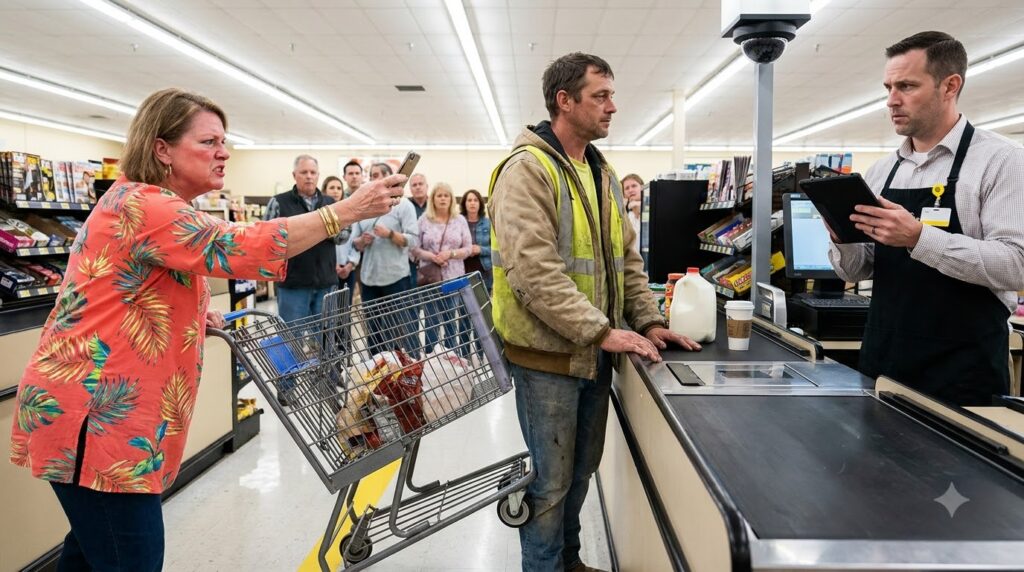
A heavy wire shopping cart slammed diagonally across the divider rail. The front caster wheel bit hard into the thick denim over Marcus’s right knee, pinning his leg against the stainless-steel trim of the scanner housing. The force transmitted through his joint, a sharp shock of pressure that would have made a lesser man flinch. Marcus didn’t flinch. He simply let his hands drop flat onto the rubber belt, palms open, feeling the cool, textured vinyl beneath his calloused fingertips.
“Drop that basket right now, or I’m having security drag you out of this building!”
The voice was a high-frequency blade, raspy and artificially projected to command the entire front end of the store. Marcus turned his head three inches to the left. Brenda Caulfield was already squared up in a low, aggressive stance behind the handle of her overflowing cart. She wore a bright coral tunic patterned with oversized tropical leaves, gold bangles clinking violently against her wrist as she thrust a smartphone forward. The camera lens was six inches from Marcus’s nose, the flash pulsing in rapid, blinding bursts.
“You cut the line, you harassed an elderly woman, and you think because you wear a work vest you can ignore basic public decency in this store!” Brenda’s voice boomed toward the high ceilings, intentionally catching the acoustic bounce of the main walkway.
Marcus looked at the lens, then down at the wheel wedged against his kneecap, then back at her eyes. Her irises were wide, dilated with the dark high of an impending victory.
“Ma’am,” Marcus said. His voice was a flat, low baritone that barely registered above the hum of the refrigeration units, yet it carried an immovable density. “Your cart is on my leg.”
“Your leg shouldn’t be in my space!” Brenda declared, her finger slamming against her screen to lock the recording. “You saw me standing near the floral display! You saw me waiting for Lane Four, and you deliberately used your bulk to cut in front of me!”
Around them, the background noise of the supermarket began to die away. The cashier’s hand hovered over a box of tea, frozen. Two aisles over, a mother pulled her child back behind a display of magazines. The room was shrinking, collapsing down to the four feet of linoleum between the belt and the rail.
Marcus didn’t shift his stance. He didn’t pull his leg back, because stepping back meant validating the impact. He simply reached into his back pocket, his fingers moving with deliberate, unhurried precision toward his leather billfold.
“The clerk called for small baskets,” Marcus said quietly. “I have three items. You have a full cart.”
“Do not speak to me about procedure!” Brenda took half a step forward, putting her hip directly into the back frame of the cart, applying another five pounds of physical pressure to his knee. “I know this store. I know the general manager. And I know an aggressive threat when he steps in my way!”
She tilted her phone upward, catching the glare of his faded high-visibility jacket. “Look at him! He’s refusing to step back! He’s trapping the counter!”
A tiny silver latch on her handbag caught the overhead light—a small, scratched brand emblem that held a trace of dried polish in its grooves. The small detail hung in Marcus’s peripheral vision while her shouting continued to fill the air.
“I am giving you three seconds,” Brenda spat, her free hand coming up to hover over her phone screen like a hammer over an anvil. “Three seconds to pull your items off that belt and get behind my cart, or I call emergency dispatch.”
Marcus didn’t move a muscle. He set his wallet flat on the metal shelf beside his milk, picked up his paper coffee cup with his left hand, and took a slow, deliberate sip. The dark roast was tepid, bitter, and completely real.
“Time’s up,” she whispered, her eyes flashing with absolute, terrifying satisfaction.

CHAPTER 2: THE ESCALATION AT THE SCANNER
“He is using his physical body to trap me against my cart!” Brenda screamed into the speaker, her voice vibrating against the cold steel housing of the scanner. “He is hostile, he has something hidden inside his heavy jacket, and he refuses to clear the space! Send an officer immediately!”
The dispatcher’s voice crackled out from the small smartphone speaker, tinny and distant against the hum of the store: “Ma’am, is the individual making verbal threats? Does he have a visible weapon?”
“He’s making subtle physical gestures! He’s using his bulk!” Brenda shifted her weight, slamming her hip harder into the back of her cart. The rubber wheel bit deeper into the side of Marcus’s right knee, grinding denim against bone. “He’s got his hands hidden—look at him, he’s reaching into his coat!”
Marcus didn’t flinch. His left hand remained locked around the paper coffee cup, the cardboard soft and tepid against his palm. His right hand stayed flat on the black conveyor belt, fingers spread wide, exposed under the harsh 4000-Kemper glare of the overhead light tubes. He didn’t pull back. Stepping back meant ceding ground; stepping back gave her accusation a shape.
“My hands are on the counter, ma’am,” Marcus said. His voice didn’t rise. It stayed in the lower register—a low, flat rasp born of thirty years on cold loading docks. “The cashier called me forward. My items are on the belt.”
“Don’t you talk over me!” Brenda’s face flushed a deep, mottled crimson beneath her foundation, the sharp contours of her jaw tightening as she thrust the phone closer to his nose. “You think because you put on a high-vis jacket you can push around residents who actually contribute to this township? You’re blocking a commercial lane!”
Beneath the clear plastic corner of her phone case, Marcus caught a sliver of yellow paper—a folded, color-coded dispatch reference note with a printed municipal seal, worn soft at the edges. It wasn’t the behavior of a panicked citizen. It was the rehearsed paraphernalia of someone who kept county lines on speed dial. She didn’t want the police to resolve a dispute; she wanted the uniform as an enforcement arm for her own perimeter.
“Jimmy,” Marcus said softly, not shifting his eyes from Brenda’s dilated irises. “Keep scanning.”
The eighteen-year-old cashier hesitated, his thumb hovering over the price-override key. His face was pale, his eyes darting between the bright coral of Brenda’s tunic and the faded yellow reflective tape on Marcus’s chest. “Uh—sir—maybe if we just—”
“Scan the milk,” Marcus repeated. The tone wasn’t an order; it was an anchor.
Jimmy’s hand dropped. The red laser line flicked across the barcode. Beep.
Brenda gasped, a sharp, theatrical intake of air that drew a collective murmur from the circle of shoppers gathering at the mouth of Lane Four. “You see that? He’s commanding the staff! He’s overriding customer safety!” She pivoted on her heel, her gold bangles clinking violently as she gestured to a middle-aged woman holding a basket of organic produce two feet away. “You saw him! He jammed his body into my cart when I tried to exit!”
The woman with the produce shifted her weight, her eyes dropping to the floor. She didn’t speak. In the cold geometry of the supermarket checkout, no one wanted to be drawn into the strike zone of a woman who wielded emergency dispatch like a lawn ornament.
“Ma’am?” the dispatcher’s voice cut back through the static. “I have a unit dispatched to Crestview Plaza. Is the suspect still stationary?”
“He is barricading the scanner!” Brenda declared, her finger tapping the phone screen so hard the glass clicked. “He’s got something bulky in his left interior pocket—I saw him press his hand against it when he stepped up! It could be a blade, it could be stolen merchandise from the back aisles!”
The accusation hung in the air, heavy and poisonous. A collective step back echoed through the aisle as three more shoppers retreated toward the magazine racks. In a retail space, the mention of an unseen object in a coat pocket transformed a petty argument over line priority into an active security event.
Marcus slowly turned his head, his cap casting a dark crescent shadow across his brow. He didn’t reach for his jacket. He didn’t touch the zipper. He kept his right hand planted firmly over the rubber belt, right beside his gallon of milk and his loaf of white bread.
“I have a pair of work gloves and an air pressure gauge in my pocket, ma’am,” Marcus said, his voice dropping another fraction into absolute stillness. “If you want the officers to check them, they can check them when they arrive. But your cart is still on my knee.”
“It stays right there until the police clear this lane!” Brenda countered, her chin thrust forward. Her eyes gleamed with a cold, triumphant satisfaction. She had built the trap perfectly: if he tried to push the cart away, it was physical assault; if he stayed, he was an active threat barricading the register.
From fifty feet down the central aisle, the heavy, rhythmic thud of hard-soled shoes against linoleum broke through the ambient hum of the refrigeration units. Two men in dark uniforms were cutting through the crowd near the bakery display, moving with the practiced, unhurried cadence of store management clearing a hazard.
Marcus didn’t move. He felt the cold iron frame of the cart pressing against his joint, felt the eyes of twenty strangers locked on his high-visibility vest, and waited for the floor to shift.
CHAPTER 3: THE STANDOFF AT THE LANE
Assistant Manager Darrell Vance didn’t slow his stride until his soft-soled dress shoes skidded three inches on the waxed linoleum, stopping precisely at the edge of the Lane Four divider. Beside him, Officer Miller—the store’s chief of private security—kept his hands low near his utility belt, his broad chest filling the narrow choke point between the magazine display and the register counter.
“What is going on over here?” Darrell’s voice dropped like a heavy steel grate over the sharp chatter of the ambient store noise. “Mrs. Caulfield? What’s the issue?”
“Darrell! Thank God!” Brenda didn’t lower her smartphone, though her arm dropped two inches, tilting the lens so it captured Darrell’s corporate apron along with Marcus’s shoulder. “This man cut the queue, shoved his way past my cart, and when I attempted to enforce basic register order, he pinned me against the scanner! I have 911 on the speaker right now!”
The dispatcher’s tinny voice rattled through the small phone speaker: “Unit 4-B is en route, caller. Do you still require an immediate tactical entry?”
“Hold the line!” Brenda snapped into the microphone, her eyes locked on Darrell. “I want this man removed from the building before he reaches into his jacket again!”
Marcus didn’t turn his torso. He kept his spine straight against the edge of the stainless-steel belt housing, feeling the cold vibration of the motor beneath his palms. He looked at Darrell, then down at Miller’s brass belt buckle, then back to the silver key ring dangling from Darrell’s lanyard. A tiny yellow plastic tag—notched with asset code 304-CAM—swung against the manager’s chest.
“Sir?” Darrell asked Marcus, his eyebrows pulling together into a sharp, analytical V. “Can you explain why your leg is wedged under the cart rail?”
“I can,” Marcus said. His tone was clipped, stripped of emotion, built like a dry stone wall. “The cashier called for three items or fewer. I stepped into the aisle. The lady drove her front caster wheel into my knee and jammed the frame across the divider.”
“He’s lying!” Brenda’s voice hit a glass-shattering register. “He saw me standing at the floral corner! I had territorial priority for the next open lane! He used his physical size to crowd me out because he saw a woman standing alone!”
She swung her screen toward Darrell’s face, the glare reflecting off his brass name badge. “Look at the posture, Darrell! Look at the high-vis jacket! He’s hiding something in that interior lining—he pressed his hand against his ribs the second I warned him I was filming!”
Darrell blinked, his gaze dropping to the left breast pocket of Marcus’s faded canvas coat. A thick, rectangular bulge outline was visible beneath the heavy cotton weave.
“Mr. Holloway,” Darrell said, his tone shifting into a colder, risk-averse register. “For the safety of the floor, I need you to step back two feet so we can clear this cart.”
“I step back,” Marcus said, “and she tells the dispatcher I tried to evade her after making physical contact. I stay right here.”
“Are you refusing a direct request from store management?” Brenda shrieked, her gold bangles clattering together as she pointed her index finger at Marcus’s chest. “You see that, Darrell? He’s defying store authority! He’s barricading the asset!”
The air in the lane felt dense, pressurized by the heat of thirty onlookers holding their breath across three adjacent checkout lanes. Jimmy, the cashier, shrank back against the receipt printer, his hands pressed flat against his thighs.
Miller, the security guard, took half a step forward, his boot heavy against the floor rail. “Sir, if you have an object in your jacket, you can show us right now, or we can wait for the municipality unit to clear the aisle.”
Marcus looked at Miller’s eyes. There was no malice in them—only the exhausted calculation of an hourly employee trying to avoid a corporate liability report.
“The object in my pocket,” Marcus said, reaching up with two slow, deliberate fingers to unbutton his outer flap, “is a pair of dirty leather work gloves and an iron tire-pressure gauge. But if you want to know who drove into who, you don’t need my pocket.”
Marcus raised his right thumb, pointing it directly upward toward the ceiling assembly.
Suspended twelve feet above the register light pole, a black glass hemisphere gleamed under the fluorescent tubes. Inside the dome, a high-definition 4K optic lens was angled at a precise forty-five-degree pitch, pointed directly down the rubber belt of Lane Four.
“You’ve got a continuous telemetry feed running on the back-office server,” Marcus said, his baritone steady as an anvil. “Pull the buffer on the manager tablet, Vance. Let’s see who moved where at 18:42.”
Brenda’s chest heaved beneath her coral tunic. For a fraction of a second, her phone hand trembled, the digital screen tilting toward the floor.
“I don’t need a corporate video review to validate my safety!” Brenda barked, her voice tightening as she thrust her phone back toward her ear. “I am a local board officer! My verbal statement is the official record!”
Darrell didn’t answer her. His eyes had already tracked up to the black dome above the light pole, then down to the yellow asset tag dangling from his key ring.
“Miller,” Darrell said softly, reaching for the heavy black tablet clipped to his hip holster. “Log into the lane four buffer.”
CHAPTER 4: THE UNBLINKING EYE
“I am advising you right now as a member of the township safety task force, do not touch that screen!” Brenda’s voice cracked across the lane, sharp enough to make the cashier flinch. She shoved her phone closer to Darrell’s chin, her gold bangles clattering against the plastic case. “You are tampering with a crime scene! The officer on this line is taking notes!”
The dispatcher’s voice tinny-rattled through the speaker, cutting over the store chatter: “Caller, be advised, Patrol Unit 4-B is turning into the Plaza main entrance.”
“He’s right here, Officer!” Brenda shouted into the microphone, her eyes darting between Darrell’s thumb and the dark tablet screen. “The store manager is attempting to suppress the record before you arrive!”
Darrell didn’t answer. He dragged his thumb across the capacitive glass surface, tapping in his five-digit override PIN. The black screen flickered, shifting from standby black to the high-contrast grid of the store’s camera management interface.
Marcus kept his shoulders squared against the metal register rim. He didn’t look at Brenda. He watched Darrell’s pupils contract as the manager selected the direct feed for Lane Four.
“Miller,” Darrell said softly, his voice dropping into a flat, professional baseline. “Hold the lane boundary.”
Officer Miller stepped his boots shoulder-width apart, his broad body forming a physical barrier between Brenda’s cart and the counter. “Ma’am, please step back two inches from the screen.”
“I have a constitutional right to observe!” Brenda’s face was mottled with red splotches running down her neck into the floral collar of her tunic. Beneath her trembling thumb, the folded yellow dispatch sheet shifted under her clear phone case. Marcus caught the top line: a series of handwritten entries in red ballpoint ink—L4-0728, L2-0611, L5-0419—each paired with dates and municipal code citations.
It wasn’t just a list of emergency numbers. It was an index. A ledger of systematically manufactured disruptions, mapped out by register lane and date.
“Timestamp 18:41:50,” Darrell read off the tablet monitor, his voice cold and devoid of inflection. He turned the screen forty-five degrees so the bright LED panel caught the light. “Camera 04, overhead fish-eye.”
The video played in high-definition 4K clarity.
On the screen, a wide-angle shot of Lane Four showed Marcus standing three feet back from the belt, his hands tucked loosely near his belt line, waiting behind the previous customer. At 18:42:04, Jimmy waved his arm. Marcus took two steps forward, laying his milk, bread, and deli salad onto the black rubber track.
“Stop it right there!” Brenda barked, pointing a manicured nail at the glass. “Look at how he angles his shoulders! That’s physical lunging!”
“Timestamp 18:42:11,” Darrell continued, completely ignoring her. He tapped the frame-advance button.
On the screen, Brenda’s bright coral tunic appeared from the top right frame. She wasn’t standing in line. She was positioned near the floral stand, six feet away, watching the checkout banks. The video clearly captured her head pivoting toward Jimmy’s waving hand, her expression sharpening before she grabbed the handle of her heavy wire cart.
She didn’t walk. She accelerated.
The footage showed her driving the front of her cart diagonally across the yellow painted floor divider, bypassing three empty feet of aisle space, and driving the steel caster wheel straight into the side of Marcus’s right leg while his back was turned.
A loud, collective intake of breath echoed from the circle of twenty shoppers pressed against the aisle endcap.
“Look at the wheel impact,” Miller noted aloud, pointing his thick finger at the display. “She hit him from behind. He didn’t move into her path—she rammed the divider.”
Brenda’s chest rose and fell in rapid, shallow hitches. The color drained from her cheeks, leaving her skin a pale, papery gray under the fluorescent glare. “The frame rate is compressed! You’re skipping the verbal provocation before she moved!”
“There is no audio on overhead security, Mrs. Caulfield,” Darrell said. He tapped the screen, locking the frame on the exact millisecond of impact, then raised his eyes to meet hers. “And at 18:42:15, you pulled out your smartphone and initiated the emergency call while holding the cart against his knee.”
The dispatcher’s voice broke through the silence of the lane, loud and jarring: “Caller? Unit 4-B is pulling up to the front glass doors. Are you in immediate physical danger?”
Brenda stood frozen behind the handle of her cart, her jaw working silently. Her eyes flicked from Darrell’s stone-cold expression to the surrounding crowd.
The shoppers were no longer shifting uncomfortably. They were watching her with sharp, unwavering disgust. Two teenagers near the magazine rack held their phones high, capturing her pale, trembling face in high-definition video.
“Mrs. Caulfield,” Darrell said, his voice flat as a steel rule. “You just filed a false police report inside this establishment, made fraudulent claims of physical assault against a customer, and weaponized emergency services on store property.”
“I… I misinterpreted his movement,” Brenda stammered, her voice dropping two octaves into a breathless, thin rasp. She reached for her phone screen, her fingers fumbling against the glass as she tried to disconnect the line. “I felt threatened by the environment…”
“Cancel the unit,” Miller said, taking a step toward her. “Cancel it right now on speaker, or the patrol officer will handle the false report report on the sidewalk.”
Brenda’s fingers shook violently against the glass as she pressed the speaker button to her lips. “Dispatch… dispatch, this is… cancel the response. It was an error.”
“Acknowledged, caller. Canceling Unit 4-B,” the dispatcher replied before the line went dead with a soft tone.
The silence that followed was absolute, broken only by the low, mechanical hum of the conveyor belt. Marcus slowly picked up his paper coffee cup from the counter, taking a single, quiet sip.
“Mr. Holloway,” Darrell said, turning toward Marcus and bowing his head in an unequivocal gesture of corporate respect. “I am deeply sorry for this incident. Jimmy, scan Mr. Holloway’s items immediately.”
“Wait,” Marcus said softly, his baritone cutting through the quiet. He didn’t look at Darrell. He looked at the yellow reference sheet sticking out from under Brenda’s phone case, his eyes picking out the top red entry: L4-0728.
“What is that paper under your case, ma’am?” Marcus asked.
Brenda gasped, snatching the phone against her stomach, but it was too late. The decoy secret of a simple line dispute had just shattered—revealing the edge of something far more calculated.
CHAPTER 5: THE PUBLIC REVERSAL AND CONSEQUENCE
“It’s nothing,” Brenda choked out, her fingers pressing into the silicone edges of her phone case to crush the yellow paper against the plastic backing. “It’s personal administrative notes.”
Marcus didn’t move his boots, but his eyes narrowed, locked onto the red ballpoint ink visible through the clear casing. “L4-0728. Lane Four, July twenty-eighth. That’s today’s date.” He turned his head two degrees toward Darrell. “What are the other two codes, Vance?”
Darrell took a step closer to Brenda, his posture no longer cautious, but rigid with corporate realization. He held out his hand, palm open under the cold LED lights. “Mrs. Caulfield, turn that paper over.”
“This is private property!” Brenda’s voice cracked, a desperate, thin screech that carried no authority left to back it. “You have no right to demand my personal—”
“You just placed a false emergency call on our store bandwidth using municipal incident codes,” Officer Miller said, stepping his broad frame directly into her retreat path. His hand hovered two inches above his duty belt. “Hand over the reference sheet, or we wait right here for the municipal patrol sergeant to collect it as evidence of public nuisance filing.”
Brenda’s lower lip trembled. The manicured composure, the pristine floral tunic, the gold bangles that had clinked with weaponized confidence—all of it seemed to shrink, collapsing into the rigid, panicked reality of a caught predator. Her fingers slipped. The phone tilted, and the yellow sheet slid out, fluttered once through the sterile air, and landed flat on the black rubber conveyor belt, right beside Marcus’s container of deli salad.
Darrell picked up the paper. The silence across the front of the store was absolute. No registers beeped. No carts moved. Twenty shoppers stood in an unbroken arc, watching.
“L2-0611,” Darrell read aloud, his voice echoing off the high steel trusses of the ceiling. “A customer in a delivery uniform cited for disorderly conduct at Lane Two on June eleventh. L5-0419. A night-shift sanitation worker cited for trespassing at Lane Five on April nineteenth.” He raised his eyes, looking at Brenda with cold, unvarnished disgust. “Every single one of these entries is a working-class patron quietly shopping after hours. Every single one resulted in a false dispatch call from your cell phone.”
A sharp, collective hiss of murmurs broke out across the crowd.
“Unbelievable,” a man in the adjacent line muttered loudly. “She’s been hunting people here.”
“She tried to get that guy arrested over a line jump,” a woman with a stroller added, pointing her phone directly at Brenda’s pale face. “Look at her. She’s got a whole hit list.”
Brenda looked left, then right. The room she had tried to command with loud, righteous outrage had turned into an impenetrable wall of cameras and cold, judging eyes. The social hierarchy she used as a club had disintegrated into a cheap, exposed scam.
“Mrs. Caulfield,” Darrell said, his voice dropping into the finality of an official corporate decree. “You are officially trespassed from Crestview Plaza Supermarket, effective immediately. If you set foot on this parking lot or inside this building again, Officer Miller will have you processed for criminal trespass. Escort her to the manager’s office to sign the formal notice, Miller.”
“You can’t do this to me!” Brenda gasped, her voice cracking into a pathetic, high-pitched plea as Miller placed a heavy, firm hand on her elbow. “I know the district owner! I am a civic officer!”
“The district owner watched the 4K feed on his phone thirty seconds ago,” Darrell replied flatly. “Move along.”
As Miller led the trembling, silent woman down the main aisle toward the back office corridor, the crowd parted for her like water around a sinking stone. The whispering followed her every step, phones flashing as her public standing crumbled into permanent digital record.
Darrell turned back to Lane Four, taking a deep breath and straightening his apron. He looked at Marcus, his expression softened by profound professional respect and embarrassment.
“Mr. Holloway,” Darrell said, bowing his head slightly. “There is no apology deep enough for what you were subjected to tonight. Your order is completely on the house.”
Marcus stood still for a moment, letting the adrenaline drain from his shoulders. He reached into his pocket, pulled out his worn leather wallet, and extracted a ten-dollar bill, placing it flat on the counter next to the scanner.
“Appreciate the gesture, Vance,” Marcus said, his voice low, steady, and unbothered. “But I pay for what I take. Just scan the items.”
Jimmy, the young cashier whose hands were no longer shaking, quickly passed the gallon of milk, the bread, and the salad over the glass screen. Beep. Beep. Beep. The machine chimed, the drawer popped, and Jimmy handed Marcus his paper bag along with his change.
Marcus picked up his bag, tucked his coffee cup into his left hand, and adjusted his faded canvas cap over his eyes. He turned to leave, pausing for a single beat beside the metal divider where Brenda’s cart had been wedged moments before.
He looked at the manager, then at the young cashier, his face unreadable under the low brim of his hat.
“Next time someone tries to teach a lesson about rules,” Marcus said quietly, “make sure you check who’s holding the ledger.”
He walked down the main aisle, his work boots making a steady, rhythmic tread against the polished linoleum, passing through the sliding glass doors and out into the cool, dark night air of the Plaza parking lot. Behind him, the store returned to its quiet, ordinary hum—the line at Lane Four moving forward once again.