The Silent Line Drawn on Sun-Baked Asphalt

CHAPTER 1: THE SILENT LINE DRAWN

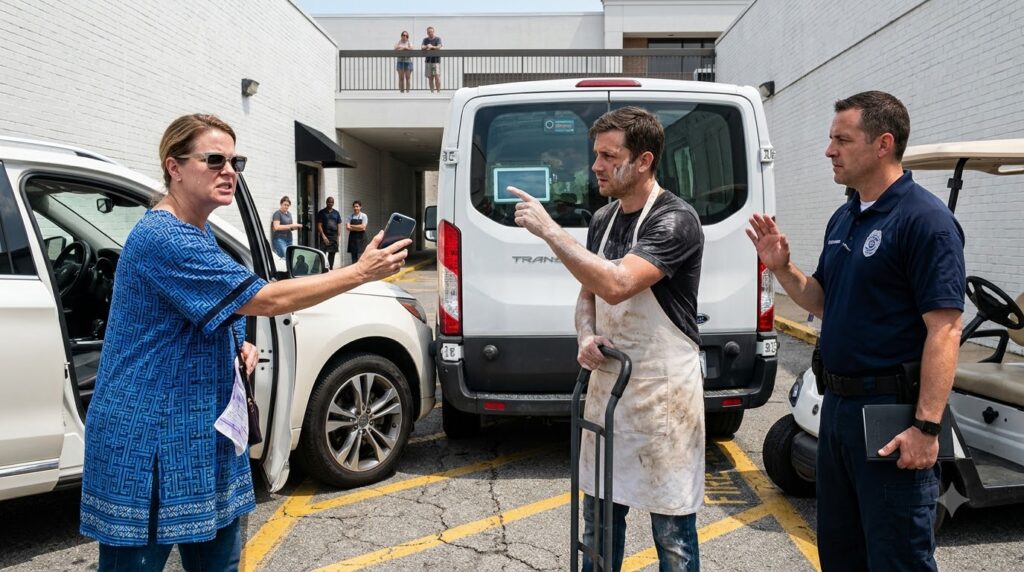
“You have thirty seconds to clear this lane before I have your vendor license pulled,” Brenda said, stepping into the three-inch gap between the van door and Marcus’s chest.

The air in the rear alley of Oak Ridge Plaza smelled of hot asphalt, diesel exhaust, and fresh sourdough cooling under plastic domes. Marcus Holloway didn’t move his boots. His hands remained resting on the rubber grips of his folding hand truck, flour dust clinging to the hair on his forearms. On the dashboard of the Ford Transit behind him, the green LED delivery timer ticked down silently: 08:42 remaining.

“The sign above my roof reads fifteen-minute commercial loading,” Marcus said. His voice was flat, low enough that Brenda had to tilt her head to catch it over the rumble of his idling engine. “I’m six minutes in. I have two trays left for the anchor cafe.”

Brenda’s response was a sharp, practiced scoff. She wore an oversized tunic with aggressive blue geometric patterns, her eyes hidden behind thick, squared sunglasses that reflected the blinding mid-morning sun. In her right hand, her smartphone was already raised, the screen glowing as she held the camera lens four inches from Marcus’s nose.

“You are obstructing a public access artery,” she declared, raising her voice two octaves so it bounced off the brick walls of the service corridor. “Look at this, everyone. Look at how this vendor treats customers. Refusing to step aside for a resident drop-off. Threatening me when I politely asked him to make room!”

Ten feet away, near the back entrance of the Italian bistro, two line cooks stopped scraping a prep table. Along the elevated concrete walkway above the alley, three shoppers carrying retail bags slowed down, their eyes darting between Brenda’s raised phone and Marcus’s flour-dusted apron.

Marcus calculated the geometry of the trap. The pearl-white luxury SUV was parked diagonally across the yellow hatch marks—a painted buffer zone meant for emergency access. Its front bumper sat less than two inches from his rear step. He couldn’t open his back doors fully; he couldn’t step into the driver’s seat without making physical contact with Brenda’s shoulder. She had engineered a physical cage on public pavement, waiting for him to push past her so she could claim assault on camera.

“I haven’t touched you, Brenda,” Marcus said quietly. “And I’m not moving the truck until my delivery pass expires.”

“You don’t get to tell me what the rules are!” Brenda stepped closer, her tunic brushing the faded metal of his driver-side panel. Her thumb tapped her phone screen, making a direct call to the plaza’s private dispatch line. “Officer Carver? I need you behind the west concourse right now. We have an uncooperative vendor making physical threats against a shopper.”

Marcus didn’t blink. He reached slowly into the deep front pocket of his work apron, his fingers brushing against the cold, rectangular frame of his tablet. Through the driver’s side window, the small red light on his newly installed interior dashcam blinked twice, silently logging the audio feed into a encrypted continuous loop.

At the far end of the service lane, the high-pitched whine of an electric patrol cart rounded the corner, its amber strobe light flashing against the sun-bleached brick.

CHAPTER 2: WEAPONIZED ESCALATION

“Step back from the vehicle, sir,” Officer Carver said before his electric cart had even come to a complete halt on the sun-baked asphalt.

Carver’s boots hit the pavement with a heavy, deliberate thud. He was a broad-shouldered man in his mid-forties, wearing the navy polo shirt and rigid duty belt of Oak Ridge Plaza’s private security detail. His face was weathered, set in the permanent mask of a man who spent ten hours a day refereeing disputes over parking spots, illegal dumping, and panhandling.

“I haven’t moved a foot, Officer,” Marcus said. His voice remained anchored in his chest, low and steady. He didn’t drop his hands from the rubber grips of his delivery cart. “I’m in the middle of an authorized fifteen-minute drop.”

“He threatened me!” Brenda interjected, her voice rising to a sharp, piercing pitch that echoed off the brick concourse. She stepped sideways, placing herself directly at Carver’s elbow, effectively using the security officer’s physical frame as a shield. “He told me he’d make sure my car got damaged if I didn’t get out of his way! I have my daughter in the passenger seat, Greg. I am dropping her off for her shift at the boutique, and this vendor is actively blocking a marked access lane!”

Marcus watched Carver’s eyes shift. The officer didn’t look at the sign above the van hood first; he looked at Brenda’s face, then at her phone, which was still angling its high-definition lens directly at Marcus’s chest. Carver’s right hand rested casually on his radio holster. He was calculating the path of least resistance—the universal reflex of commercial security. Pleasing the woman in the three-hundred-dollar tunic who claimed to know the plaza management team was almost always easier than siding with a flour-covered driver in a dented Ford Transit.

“Let me see your plaza vendor pass, son,” Carver said, extending a hand. His tone was transactional, clipped. He was looking for an administrative flaw—a missed renewal, an expired date, a missing signature—anything that would give him a clean reason to order the van moved without taking a side in the argument.

“It’s on the driver’s side dashboard, right next to the inspection stamp,” Marcus replied. He didn’t reach into his pockets or make any sudden gestures. He pointed with a single, dust-caked knuckle toward the glass. “And my delivery log is open on my tablet inside the cab.”

Brenda let out a short, triumphant laugh. She reached into the clear pocket of her jewel-encrusted phone case and pulled out a folded slip of heavy paper, its corner stamped with a dark purple seal. She thrust it toward Carver’s face.

“I have a provisional courtesy pass right here,” she declared, her manicured fingers pressing the paper flat against Carver’s chest. “It grants immediate access to the rear service corridor for emergency and drop-off utility. The board issued it to me last month. He is in direct violation of plaza courtesy code four-dash-B!”

Marcus’s eyes narrowed slightly, zeroing in on the document. The paper was heavy stock, creased sharply at the center. But even from three feet away, under the harsh glare of the mid-morning sun, the purple seal didn’t bear the stylized tree emblem of Oak Ridge Plaza Management. It bore the jagged geometric crest of the Whispering Pines Homeowners Association—a residential development three miles up the highway where Brenda served as vice president.

She was using a residential HOA notice template, re-stamped and re-worded, to perform authority over a private commercial loading dock.

“Let me see that document, Officer,” Marcus said, his voice dropping another octave, sharpening like a cold chisel.

“You don’t get to demand anything!” Brenda snapped, pulling the paper back instantly and sliding it deep into her purse before Carver could fully unfold it. She raised her smartphone higher, turning the screen so the gathering crowd on the walkway could see the live recording interface. “Look at him demanding to inspect private documents! Officer Carver, I want this man cited for harassment and I want this vehicle towed right now. He is creating a hostile environment for shoppers!”

Carver exhaled slowly, a long, tired breath that rustled the fabric of his polo shirt. He looked at the rear bumper of the white SUV, which was wedged so tightly against the Transit’s frame that the rubber guard was almost touching the paint. Then he looked at the onlookers hanging over the wrought-iron railing of the upper walkway—a dozen shoppers, two store managers, and a delivery runner from the pharmacy, all holding their breath.

“Sir,” Carver said, turning his full body toward Marcus, his posture hardening into an ultimatum. “I don’t have time to sort through who crossed what line first. You’re causing a public disturbance behind the main concourse. I’m ordering you to put your truck in reverse, clear the lane, and wait out by the perimeter road until the area is clear. If you refuse, I’m issuing an immediate commercial trespass notice and revoking your loading access for the rest of the quarter.”

Marcus didn’t flinch. He felt the cold weight of the moment settling in his gut, the familiar, bitter memory of every time he had stepped aside just to keep the peace, every time he had let a loud voice rewrite the boundary.

“Officer Carver,” Marcus said, his tone devoid of anger, stripped down to pure, immovable friction. “Before you sign that order, step over to my driver’s window. You need to look at something on my dash.”

CHAPTER 3: THE SECURITY INTERVENTION

“Don’t you dare step away from this driver, Greg!” Brenda shouted, her voice cutting through the heavy hum of the nearby HVAC units. She stepped directly into Carver’s path, her arm raised like a barricade, phone still recording. “He’s stalling. He’s trying to manufacture a distraction so he can evade the parking violation!”

Officer Carver paused, his boots shifting on the heat-softened asphalt. His gaze lingered on Brenda’s arm before turning back toward Marcus, who hadn’t moved an inch from his stance beside the van.

“What am I looking at, son?” Carver asked, his tone laced with a deep, professional exhaustion. “Because if this is just a delivery route printout, we’re done here. You’re clearing the lane.”

“It’s not a printout,” Marcus said. He turned his head sideways, gesturing toward the small, matte-black housing mounted beside his rearview mirror. “Dual-lens 4K loop recorder. Wide-angle exterior sensor on the rear glass, interior cabin unit with continuous audio integration. It records forty-eight hours of rolling buffer straight to a local solid-state drive.”

Brenda’s phone hand twitched slightly. For a fraction of a second, the lens dropped an inch, catching the glare of the noon sun off the van’s side mirror before she jerked it back upright.

“That’s a violation of private property regulations!” Brenda declared, her pitch rising into a sharp, brittle register. “You cannot record patrons or security personnel in a commercial retail zone without explicit written consent from the plaza board! I demand you seize that device immediately, Greg!”

“It’s mounted inside a licensed commercial transport vehicle operating within a public-access service artery,” Marcus replied calmly, his eyes remaining fixed on Carver. “It records the front bumper, the rear clearance zone, and every sound within fifteen feet of the frame. It went live three seconds before that SUV crossed the yellow safety hatch.”

Carver didn’t answer immediately. He took two steps closer to the Transit, leaning his upper body slightly through the open driver’s side window to peer at the glowing blue status indicator on the dash unit. As he leaned, his shoulder brushed against Brenda’s purse, causing the top flap to fold back.

Beneath the heavy stock of the purple-stamped paper Brenda had jammed inside, Marcus caught a glimpse of a second document—a handwritten sheet in red marker bearing a jagged header: WHISPERING PINES HOA – UNAUTHORIZED VEHICLE NOTICE. The purple seal hadn’t been stamped by plaza management at all; it was a rubber stamp from a residential neighborhood committee, hand-applied over a generic municipal warning form.

The decoy was sitting right there in her leather bag: a forged authority slip built from residential muscle, designed to make commercial drivers back down out of sheer confusion.

“Play it,” Carver said, his voice dropping into a quiet, neutral register that ignored Brenda’s protest entirely.

“Greg!” Brenda barked, her sunglasses slipping down the bridge of her nose as her forehead creased into deep, furious lines. “You are taking the word of a delivery driver over a verified local representative? I am on the executive council for the regional neighborhood association! I have direct contact with the property owners!”

“Ma’am,” Carver said, turning his head just enough to catch her in his peripheral vision, “you told me this driver threatened you verbally and physically blocked you from exiting your vehicle. If he’s got forty-eight hours of rolling audio mounted on his chassis, I’m going to spend thirty seconds checking it before I call a tow truck.”

Marcus reached across the driver’s seat, his hand hovering over the tablet mounted to the center console. His thumb pressed the local sync key. The high-resolution display flickered twice, then illuminated with a split-screen video feed. On the left side, the rear-facing camera showed the white luxury SUV cutting aggressively across the yellow diagonal lines at twenty miles an hour, missing the van’s rear step by inches before coming to a sudden, tire-screeching stop.

On the right side, the interior audio track began to play through the tablet’s exterior speaker, crisp, uncompressed, and loud enough to float straight past Carver’s ear and out into the sun-baked alley.

“Move your little delivery truck right now before I have your vendor license pulled!” Brenda’s recorded voice boomed from the speaker, flawless and ringing with absolute clarity.

The two line cooks standing by the bistro’s back door leaned forward over the concrete railing. On the upper walkway, a shopper holding a clothing bag stopped mid-step, her head snapping down toward the alley.

Carver didn’t say a word. His hand remained resting on his radio holster, but his fingers went completely still as the recorded track continued to roll.

“The sign above my roof reads fifteen-minute commercial loading,” Marcus’s recorded voice replied, steady and low on the tape. “I’m six minutes in.”

“You don’t get to tell me what the rules are!” the recording blasted back, accompanied by the distinct audio crunch of Brenda’s heels stepping directly into the narrow gap against the driver’s door. “I will make sure security believes me over some delivery man.”

The silence that followed the recording in the physical alley was immediate and absolute. The heavy hum of the rooftop air conditioners seemed to drop out entirely, replaced only by the distant, idle rumble of the van’s diesel exhaust.

Brenda stood frozen beside Carver’s patrol cart. Her smartphone was still raised, but her arm had gone rigid, the camera lens pointing uselessly at the sky. The bright, geometric pattern of her tunic seemed to vibrate against the white brick wall behind her.

“Officer Carver,” Marcus said, breaking the silence with the same level, unhurried tone he had used from the first second. “That tape has a live GPS timestamp synced to the plaza’s cell tower. Would you like me to play the section where she pulled out the HOA warning slip?”

Carver slowly straightened his back, turning his full body away from the van window to face Brenda directly. His tired expression had vanished, replaced by the cold, heavy posture of an officer who realized he had almost been maneuvered into executing a fraudulent administrative action on public record.

“Ma’am,” Carver said, his hand moving off his radio and dropping to the heavy leather citation book clipped to his belt. “Hand me that purple-stamped paper out of your purse. Right now.”

CHAPTER 4: THE PROOF UNVEILING

“Hand me that paper, ma’am,” Carver repeated, his voice dropping into the flat, unyielding tone of an officer who had already made up his mind. He extended an open palm toward the leather flap of Brenda’s purse.

Brenda’s hand recoiled toward her waist, clutching the strap of her bag so tightly that her knuckles turned white beneath her manicured polish. Her sunglasses glinted sharply in the harsh mid-day sun, hiding her eyes, but her jaw muscles twitched twice in rapid succession.

“This is an internal administrative record,” Brenda said, her pitch dropping out of its loud, public theater into a tense, rapid hiss. “It contains confidential resident registration data from Whispering Pines. You do not have the legal authority to seize private committee records, Officer Carver.”

“I’m not seizing anything,” Carver said, stepping forward until his boots were two inches from her front tire. “You presented that document as proof of an official plaza loading waiver to override a commercial delivery pass. You put it in my face, ma’am. That makes it part of an active parking obstruction call. Now pass it over, or I’m calling county dispatch to request a deputy.”

A rustle went through the onlookers on the elevated walkway. The pharmacy runner stepped closer to the wrought-iron railing, whispering something to a boutique clerk who had just stepped out onto the concourse. Below, Marcus didn’t move. He stood anchored beside his open driver’s door, watching the tactical geometry shift. The trap Brenda had built around his front bumper was dissolving, but the cornered animal inside it was looking for a new exit.

Slowly, with deliberate, furious hesitation, Brenda unzipped the inner pouch of her designer tote. She pulled out the folded sheet of heavy stock paper, avoiding Carver’s eyes, and held it by its extreme corner as if it were contaminated.

Carver took the paper, unfolded it across the flat hood of his electric patrol cart, and smoothed the creases down with two calloused fingers.

The purple stamp sat prominently near the header: OAK RIDGE PLAZA – SPECIAL COURTESY PASS. But beneath the fresh, wet-ink imprint, the underlying text told a completely different story. The header lines had been typed over a pre-printed form with a faintly mismatched typeface. At the very bottom edge of the page, in fine gray micro-print that Brenda had attempted to obscure with a thick red marker line, ran a standardized serial string: FORM 104-B: WHISPERING PINES HOA – NEIGHBORHOOD PROPERTY WARNING.

It wasn’t just a misapplied residential rule. It was a calculated, home-made forgery—a template taken from her neighborhood committee, modified on an office printer, and stamped with a custom rubber seal to give her private SUV unfettered priority anywhere she chose to park.

“Where did you get this stamp, ma’am?” Carver asked, his voice chillingly calm as his finger tapped the purple ink.

“Our association has a reciprocal courtesy agreement with plaza management,” Brenda blurted out, her voice betraying its first real tremor. “It was authorized during the quarterly joint safety meeting! My husband is on the regional planning board—”

“The plaza management office is run by Oak Ridge Commercial Holdings out of Chicago,” Carver interrupted, his eyes lifting to meet her sunglasses. “I’ve worked security here for seven years. There is no reciprocal agreement with Whispering Pines. There never has been. And this stamp doesn’t match the master seal sitting on the desk in the administration suite.”

Marcus stepped around the edge of his van door, his flour-dusted boots making a quiet, steady crunch against the grit on the asphalt. He reached out and tapped his tablet screen once more, opening the secondary camera folder.

“Officer Carver,” Marcus said, his voice cutting through the rising heat of the corridor like a steel wire. “Take a look at the timestamp from three weeks ago—June sixteenth, nine-forty AM.”

Brenda snapped her head toward Marcus, her lips parting in sudden, sheer panic. “What are you talking about?”

“My rear dashcam doesn’t just record when I’m idling,” Marcus said, keeping his tone measured, devoid of triumph, purely analytical. “It has an integrated motion-activation park mode. Three weeks ago, while I was inside delivering to the bakery vendor on the east wing, that same white SUV pulled into this exact spot. The video shows her stepping up to the plaza directory board near the management office with a blank binder.”

Carver looked down at the tablet display as Marcus swiped to the archived video file. The screen showed the rear aspect of the alley from June sixteenth. In crystal-clear 4K resolution, Brenda could be seen standing beside the unattended security booth outside the administration door, using a handheld rubber stamp from her purse to ink a stack of blank cardstock sheets before slipping them into her leather tote.

She hadn’t just created a one-time fake pass for today’s drop-off. She had systematically fabricated a stack of fraudulent plaza credentials to turn every commercial loading zone in the shopping center into her personal reserved parking layout.

The silence that fell over the alley was heavy, suffocating, and absolute.

Carver slowly refolded the purple-stamped sheet and slid it cleanly into his own chest pocket. He unclipped a heavy, black leather citation book from his duty belt and pulled a ballpoint pen from his collar slot.

“Ma’am,” Carver said, his voice dropping into a register that admitted no further debate. “Turn off your vehicle engine and step away from the driver’s door.”

Brenda’s hand hovered over her purse, her mouth opening and closing as she looked from Carver’s cold, steady posture to the line of spectators staring down from the upper balcony. For the first time since she had cut across the yellow hatch marks, her supreme, unyielding entitlement shattered into raw, visible humiliation.

“You can’t do this to me,” she whispered, her voice cracking as her polished authority dissolved into the hot, diesel-scented air. “Do you have any idea who I am?”

“I know exactly who you are,” Carver said, clicking his pen with a sharp, metallic snap. “You’re a driver parked illegally in a commercial fire lane with a forged administrative pass.”

CHAPTER 5: PUBLIC COLLAPSE ACCOUNTABILITY

“You can’t write me a ticket,” Brenda said, her voice dropping an octave into a brittle, trembling rasp. “I am going to phone property management right now. I will have your job by three o’clock, Greg.”

Carver didn’t look up from his citation book. The yellow carbon sheet fluttered against the hard plastic backing as his pen pressed into the paper, making a sharp, scratchy sound that carried clearly across the quiet alley.

“The plaza director is on the copy of this notice, ma’am,” Carver said smoothly, his posture rigid and unyielding. “Along with the high-definition footage from Mr. Holloway’s vehicle. If you refuse to move this SUV in sixty seconds, I’m signing the dispatch order for the flatbed tow truck waiting at the east gate.”

Brenda’s phone slipped another inch in her grip. The screen went dark, its live-stream recording finally cutting off as her thumb accidentally hit the lock button. She looked up at the elevated walkway. The line of spectators hadn’t moved. The boutique manager stood with her arms crossed over her apron, while the pharmacy runner held his phone openly, capturing every second of Carver filling out the heavy yellow slip.

Her theatrical authority had vanished. What remained was a woman standing in a bright, ridiculous tunic in the middle of a sun-baked loading dock, completely exposed under the midday glare.

“Get in the car, Brenda,” a quiet, strained voice called from the passenger window of the luxury SUV.

Brenda turned sharply. Her teenage daughter had slid down in her seat, her face pale with burning embarrassment, her hands holding her denim jacket up to block the view of the onlookers above.

“Get in the car,” her daughter repeated, her voice cracking. “Please. Everyone is watching.”

Brenda’s jaw worked silently. For three long seconds, she looked at Marcus. She looked at his flour-dusted hands resting steadily on the handlebars of his delivery cart, his expression completely devoid of anger, mocking, or excitement. There was no victory in his posture, only the cold, unyielding weight of a man who had set a boundary on asphalt and refused to let anyone push him across it.

Without another word, Brenda ripped her sunglasses off her face, shoved them into her purse, and yanked the SUV’s heavy door open. She climbed into the driver’s seat and slammed the door with a violent, metallic bang that echoed off the brick concourse.

Carver stepped forward, peeled the top yellow copy from his citation book, and slapped it flat under the luxury SUV’s driver-side wiper blade.

The engine roared to life with a harsh, aggressive surge of horsepower. Brenda threw the transmission into reverse, the tires screeching loudly as she backed the heavy vehicle out across the yellow hatch marks. The rear bumper swung wide, missing the concrete pillar by inches, before she slammed the shifter into drive and tore down the service alley, kicking up a cloud of dust and dry leaves into the hot air.

The alley went still again.

The line cooks on the back porch of the Italian bistro let out a low, collective whistle, returning to their prep work. Above, the crowd on the walkway slowly dispersed, their voices dissolving into the ambient hum of the shopping center.

Carver tore the white original from his pad, folded it once, and turned toward Marcus.

“You’ve got five minutes left on your loading timer, son,” Carver said, a faint, weary trace of a smile tugging at the corner of his mouth.

“I only need three,” Marcus replied.

He turned to his delivery van, pulled the remaining two trays of fresh sourdough onto his hand truck, and wheeled them through the service door of the anchor cafe. The cool, air-conditioned air inside smelled of roasted coffee beans and toasted yeast—a sharp, clean contrast to the hot exhaust of the alley outside.

When Marcus returned to the alley three minutes later, his hand truck was folded flat and secured in the side rack of the Transit. He closed the heavy rear doors, the steel latches clicking into place with a solid, resonant thud.

Carver was sitting in his electric patrol cart near the exit gate, his radio humming softly with routine maintenance calls. As Marcus climbed into the driver’s seat of the van, he looked at his dashboard tablet. The red recording light was still blinking silently, logging the quiet, empty alley.

On the screen, the green LED timer hit zero: 00:00.

Marcus turned the key in the ignition. The diesel engine rumbled to life, smooth and steady under his boots. He adjusted his side mirror, put the van in gear, and pulled out onto the main perimeter road, right on schedule, leaving the sun-baked asphalt behind him in perfect, unbroken order.

Similar Posts

Leave a Reply

Your email address will not be published. Required fields are marked *