The Unbroken Line on St. Jude Lane: A Novel of Quiet Boundaries and Unyielding Echoes

CHAPTER 1: THE SILENT GATE

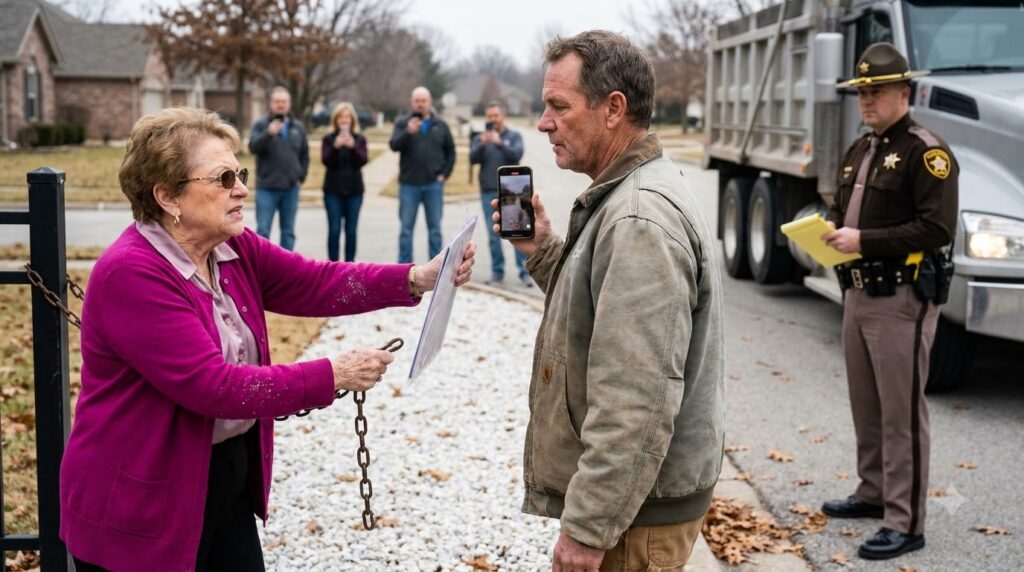
“Hold the load right there!” Brenda Hollings shouted, her voice cutting through the heavy diesel pulse of the triple-axle dump truck idling on St. Jude Lane.

Julian Mercer did not rush down his porch steps. He paused on the bottom riser, the morning air carrying the sharp, familiar scent of sun-warmed pine and exhaust. He adjusted the cuff of his faded canvas work jacket, feeling the cold weight of his smartphone in his palm. Across the cul-de-sac, three neighbors stood near their lawnmowers, phones already tilting upward, taking in the spectacle.

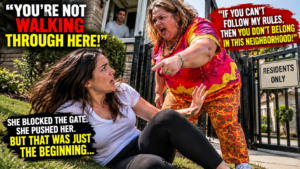
Brenda stood squarely in the mouth of Julian’s private gravel lane. Her bright magenta cardigan stood out sharply against the pale limestone dust drifting from the truck’s tires. In her left hand, she clutched a thick leather folder like a shield; in her right, a laminated white board she waved at the truck driver.

“I said dump it!” she yelled again, her gold-rimmed sunglasses reflecting the harsh morning glare. “This entire easement is association property as of nine o’clock this morning, Julian! Move your pickup or I’ll have Deputy Hayes tow it off the block before noon!”

Julian walked toward the property line, his work boots crunching rhythmically into the white river stone his father had laid thirty years ago. He felt the phantom ache in his left knee—the lingering reminder of the hydraulic lift accident at the rail yard six months back—but his stride remained steady.

“Morning, Brenda,” Julian said quietly, stopping three feet short of the iron gate post. He didn’t raise his voice. He didn’t glance at the idling truck. He kept his eyes fixed on the fraying edges of the leather folder in her arm. “You’re standing on my land.”

“Not anymore,” Brenda snapped, stepping forward until the toe of her designer flat touched the rusted iron gate latch. She tapped her clipboard sharply against Julian’s chest, the hard plastic clicking against the heavy canvas of his coat. “Your father never filed the secondary boundary release in ninety-four. The board reviewed the original subdivision plats on Monday. This lane is a community fire access route now. Non-compliance means immediate liens on your deed and impoundment of any unauthorized machinery.”

A quiet settled over the street. The truck driver leaned his elbow out the cab window, looking back and forth between Brenda’s raised clipboard and Julian’s still, unbothered posture.

Julian looked down at the clip where her hand rested against his coat. He felt no anger—only a deep, settled exhaustion that had been building since the night he found the gate chain clipped two weeks ago.

“My father bought this lot in seventy-eight, Brenda,” Julian said, his tone smooth, almost conversational. “He laid every yard of this gravel himself while you were still living three towns over. The board doesn’t own this dirt. You don’t own this dirt.”

“The papers say otherwise!” Brenda raised her voice, turning her chin toward the porch watchers across the street to make sure every word landed. “You’ve been staging unapproved commercial equipment back by that barn for months! The association has a responsibility to protect property values from blue-collar clutter!”

Julian slowly lifted his smartphone. He didn’t open a document or pull up an email. He tapped the screen twice and held it out between them, the display glowing brightly under the open morning sky.

On the screen, bathed in the sharp, ghostly green of night-vision infrared, Brenda Hollings walked down the gravel lane at 1:15 AM. In the video, she carried a pair of three-foot bolt cutters. The crowd on the sidewalk went dead silent as the phone speaker played the distinct, metallic clack of Julian’s gate chain snapping under her weight.

Brenda’s breath caught in her throat. Her clipboard tilted downward, her index finger freezing mid-air.

“That was Tuesday night, Brenda,” Julian said, his voice dropping into the quiet space between them. “Want to watch Thursday’s footage together?”

Want me to continue to Chapter 2?

Yes
CHAPTER 2: THE FORGED EASEMENT

“That phone footage doesn’t prove a single thing, Julian,” Brenda said, her voice wavering just enough to betray the cold composure she was trying to hold onto.

She pulled her leather clipboard against her breast like armor, her knuckles turning chalk-white against the worn cowhide. On the sidewalk, Mr. Abernathy dropped his hedge clippers, the metallic clatter echoing across the asphalt as three more neighbors drifted closer to the gate, their eyes glued to the glowing screen in Julian’s hand.

“It proves you were on my land at one in the morning with bolt cutters, Brenda,” Julian said quietly. He didn’t step closer. He didn’t drop his arm. He let the infrared video loop a third time, the sharp metallic clack of his father’s heavy iron chain snapping open echoing off the side of the idling gravel truck. “And it proves you’ve been lying to this block since Tuesday.”

The truck driver cut his engine. The sudden silence that fell over St. Jude Lane was heavy, filled only with the faint ticking of cooling diesel pipes and the gentle rustle of dry oak leaves overhead.

Brenda’s jaw worked silently. The pink floral cardigan seemed to shrink around her shoulders under the collective gaze of the neighborhood. Then, with a sharp jerk of her chin, she unzipped the front pouch of her leather folder and whipped out a yellowed piece of paper, thrusting it within inches of Julian’s face.

“I have a recorded maintenance easement,” she declared, her voice rising an octave, aiming for the porch watchers who were recording on their phones. “Duly signed, notarized, and filed with the association in August of twenty-two! Your father granted emergency access rights to the northern boundary for neighborhood drainage and utility vehicle staging! This drive hasn’t been purely private land for four years!”

Julian caught the edge of the document before the breeze could snap it back. The paper was thin—a cheap blue carbon copy, frayed along the margins and stained with old, dried coffee rings.

His eyes swept the text. At the bottom, stamped with a faded red association seal, was a shaky cursive signature: Arthur Mercer.

A familiar, heavy ache opened behind Julian’s ribs. August of twenty-twenty-two. He remembered that month with brutal, crystalline clarity. It was the month his father had been admitted to the ICU at St. Thomas, hooked up to three IV drips, his mind clouded by morphine and lung fever. Arthur Mercer hadn’t been able to hold a pen to sign his own medical consent forms that month, let alone write out a legal property easement.

Julian’s thumb traced the signature line. The M in Mercer was looped from the top—a detail his father had never done in his seventy-six years of life. Arthur always cut his Ms with sharp, angular strokes, like the iron frames he welded in the rear barn.

“My dad was in a hospital bed in Columbus the entire month of August, Brenda,” Julian said. His voice was terrifyingly soft, stripped of all heat, cold as the limestone gravel beneath their boots. “He couldn’t even lift a glass of water, let alone sign a land release.”

Brenda’s chest heaved. For a fraction of a second, her oversized sunglasses slipped down the bridge of her nose, revealing wide, bloodshot eyes brimming with a raw, desperate terror that went far beyond an HOA dispute. She snatched at the paper, but Julian held it firm, his grease-stained thumb anchoring the blue carbon copy.

“It’s on file!” she stammered, stepping back until her heel hit the iron gate latch. “The board president signed off on it! It’s legal record!”

“It’s forgery,” Julian corrected her. He turned the carbon copy toward Mr. Abernathy and the gathering neighbors on the sidewalk. “Look at the date. Look at the signature. She didn’t just break my lock this week. She waited until my dad was dying in a hospital room to forge his name on a fake board paper.”

Whispers rippled through the witness layer. Mrs. Gable covered her mouth with a manicured hand. Mr. Abernathy shook his head, pulling his phone higher to capture Brenda’s pale, trembling profile.

Brenda fumbled with her clipboard, trying to tuck the leather folder out of sight, but in her panic, her wrist caught the metal clasp. The binder popped open, raining loose receipts, unpaid bills, and yellow legal pads onto the white gravel drive.

Julian didn’t reach for them, but his gaze fell upon a bright pink final notice slip fluttering face-up against his boot. The header belonged to a commercial vehicle leasing company, stamped in thick red ink: PAST DUE – IMPAINTMENT NOTICE. Below it was her son’s name, attached to a balance that made Julian’s chest tighten.

Brenda scrambled to her knees in the dust, her pastel cardigan dragging through the gravel as she frantically gathered the papers to her chest. Her hands were shaking uncontrollably, her gold-rimmed glasses crooked on her face.

“Don’t you look at those!” she gasped, her voice cracking as she looked up at Julian from the ground. “You think you’re so righteous sitting on your dad’s land! You don’t know what it takes to keep a family afloat when everything is slipping away!”

Julian stood over her, the blue carbon copy still clamped firmly in his hand. The initial anger that had carried him through the morning began to shift, settling into something heavier, darker, and far more complex as he recognized the ragged edge of sheer desperation in her voice.

A distant siren wailed down Ridgemont Boulevard, growing louder as it turned toward St. Jude Lane.

CHAPTER 3: THE DEED IN THE DUST

The siren grew from a distant whistle to a sharp, echoes-on-brick wail as Deputy Marcus Hayes’s cruiser swung onto St. Jude Lane, its amber rear light bar flashing silently against the morning sky.

Julian didn’t move from his place beside the gate post. He watched Brenda scramble in the white limestone dust, her pink cardigan dragging across the coarse rocks as she shoved loose invoices and past-due notices back into her leather binder. Her hands were shaking so violently that a second paper slipped from her fingers—a folded certified land survey from the county recorder’s office, its red embossed stamp cracked down the center.

“Get those up, Brenda,” Julian said quietly, his voice dropping below the rumble of the gravel truck’s cooling exhaust. “Hayes isn’t going to care about your binder. He’s going to ask for the recorded plat.”

Brenda didn’t answer. She pulled herself up by gripping the iron gate latch—the very latch his father had forged with a handheld torch back in ninety-four—and brushed the white limestone powder from her knees with desperate, rapid slaps. Her gold-rimmed sunglasses sat crooked across her nose, hiding her eyes, but the tremor in her chin was bare for the entire street to see.

Across the cul-de-sac, Mr. Abernathy lowered his lawnmower handle and stepped out onto the asphalt, three other neighbors trailing behind him like a quiet wall of witnesses. No one spoke. The usual morning sounds of St. Jude Lane—birdsong, distant highway hum, suburban sprinklers—had dissolved into an unnatural, expectant stillness.

Deputy Hayes cut his engine thirty feet back, his black-and-white cruiser coasting to a halt on the shoulder. He stepped out slowly, his thick leather duty belt creaking under the weight of his sidearm and radio. His eyes swept the scene in three deliberate seconds: the idling triple-axle dump truck, the white river stone spilled across the mouth of the lane, Brenda’s trembling posture, and Julian standing motionless beside his gate, holding a single blue carbon copy in his left hand.

“Julian,” Hayes said, nodding once as he walked toward the boundary line. He adjusted his flat-brimmed hat against the glare. “Brenda. Received a call about an obstructed roadway and a boundary dispute.”

“It’s not a dispute, Marcus!” Brenda blurted out, her voice pitching high and thin as she gestured wildly toward the dump truck behind her. “It’s an association emergency! Mr. Mercer is actively obstructing a township fire lane expansion. I brought a crew to stabilize the easement, and he’s threatening legal action against the board!”

Hayes didn’t look at her immediately. He walked up to the driver’s side of the dump truck first, leaning his forearm against the heavy door frame. “Son, shut this rig down completely and sit tight,” he told the driver. The driver nodded without a word, turning the key until the diesel rumble died into total silence.

Then Hayes turned to Julian. “What do you have, Mercer?”

Julian held out the blue carbon document. The sun caught the frayed, sun-bleached edges where the paper had begun to break down over four years of drawer storage. “This is the easement Brenda presented to the truck driver to justify dumping twenty tons of stone across my entrance, Deputy. It’s dated August fourteen, twenty-twenty-two.”

Hayes took the thin paper, his calloused thumb tracing the yellowed header. He blinked slowly under the brim of his hat. “August of twenty-two?”

“My dad was in ICU bed four at St. Thomas in Columbus from August second to September eleventh,” Julian said, his voice flat, devoid of theatrical anger. “He was on a ventilator for nine of those days. This document claims he walked into the St. Jude neighborhood office on the fourteen to sign over twenty feet of private driveway rights to the HOA for zero consideration.”

Hayes’s eyes narrowed slightly. He flipped the paper over, examining the bottom right corner where a faded copper notary seal was pressed into the fiber. He ran his thumbnail over the seal’s license number, then looked up, staring directly at Brenda.

“This notary stamp belongs to Cedar Ridge Title,” Hayes said, his tone dropping into that dangerous, level register common to county officers who spent twenty years reading local legal disputes. “Cedar Ridge closed its doors in twenty-twenty-one after the county audit, Brenda. They weren’t issuing stamps in twenty-two.”

A collective intake of breath rustled through the neighbors watching from the curb. Mrs. Gable took a step closer, her hand pressed against her throat as her phone camera recorded Hayes’s face.

Brenda’s jaw tightened. She took a half-step backward, her heels digging into the loose gravel. “That’s—that’s an administrative error! The board secretary handled the filing! I was only acting on the records provided in the association archive—”

“You brought bolt cutters to my gate at one o’clock on Tuesday morning, Brenda,” Julian interrupted gently. He tapped his phone screen, holding up the glowing infrared video once more for Hayes to see. “You didn’t look like an administrator handling an error. You looked like someone trying to hide three commercial vans in my barn clearing before the county bailiff came looking for your son’s fleet.”

Hayes looked from the smartphone screen to Brenda’s face. His mouth set into a hard, thin line. “You cut a locked private gate, Brenda?”

“It was association property!” she shrieked, her composure snapping entirely as she pointed her leather clipboard at Julian’s chest like a weapon. “The covenants give us right-of-way! My son is trying to build a business, and this—this blue-collar recluse is sitting on two hundred feet of empty dirt he doesn’t even use! My husband gave twenty years to this county before he died, and I will not let this family fall apart because Julian Mercer wants to play hermit on a piece of gravel his father built without a permit!”

The words hung in the air, heavy, bitter, and raw. The ugly truth of her motivation spilled out across the driveway, stripped of all legal jargon and board authority.

Julian stared at her. In the harsh sunlight, he could see the deep, dark shadows beneath her dark glasses, the fraying collar of her pastel cardigan, and the sheer, exhausting panic radiating from her posture. He recognized that panic—he had felt the exact same crushing weight in the corridors of St. Thomas while watching his father’s monitors flatline, wondering how he would pay the medical bills on a dispatcher’s salary.

Hayes reached for the leather pouch on his duty belt, unclipping a pad of official county citations. “Brenda, I’m going to need you to step back to your porch right now. Do not step onto this driveway again today.”

“You’re citing me?” she whispered, staring at the deputy in disbelief. “I am the vice president of this board!”

“You’re standing on private land without a valid easement,” Hayes replied cleanly. “And right now, I’m looking at a prima facie case of criminal trespass and property damage regarding that cut lock. If Mr. Mercer wants to press charges today, I’ll be taking you down to the station for booking.”

Hayes turned his eyes back to Julian, pen poised over the paper. “What do you want to do, Julian? Say the word, and we file the criminal report right here in front of the block.”

Julian looked at the pen in Hayes’s hand, then down at the yellowed carbon easement, and finally at Brenda, who stood frozen on his father’s gravel, her eyes wide behind her dark glasses, waiting for the blow to fall.

CHAPTER 4: THE THRESHOLD OF COLLAPSE

Julian looked at Deputy Hayes’s raised pen, then down at Brenda’s trembling hands clutching her leather folder against her pink cardigan. The street had gone so silent he could hear the faint, rhythmic ticking of the truck’s cooling manifold behind them.

“I want a trespass warning issued today, Deputy,” Julian said, his voice measured, cutting through the stillness. “And I want this truck backed off my boundary line right now.”

Hayes nodded once, writing sharply on the pad. “You heard him, Brenda. Step onto your porch across the street. If you cross this gate line again before the board meets with county legal, I’m taking you in.”

Brenda’s mouth opened, but no sound came out. Her face had drained of all color, leaving her skin looking sallow and gray beneath the morning sun. She backed away slowly, her heels skittering across the loose limestone gravel until her feet hit the asphalt of St. Jude Lane.

Across the street, Mr. Abernathy and Mrs. Gable lowered their phones, exchanging hushed, heavy glances. The spectacle they had gathered to watch—a standard suburban spat over property lines—had suddenly peeled back to reveal something far raw-er and uglier.

Julian stepped past the iron gate post toward the driver’s side of the dump truck. The driver leaned out, handing back the certified land plat Julian had given him minutes earlier.

“Sorry about this, mister,” the driver muttered, his voice low and embarrassed as he turned the ignition key. “She told the dispatcher this was an approved township drop.”

“Just take the load back to the yard,” Julian said, taking the plat.

As the truck’s diesel engine roared to life and its heavy tires slowly churned backward toward the main road, the sudden shift in wind blew a loose piece of paper from the pile Brenda had scrambled to collect off the driveway. It tumbled across the white river stone, catching against the toe of Julian’s work boot.

Julian leaned down and picked it up.

It wasn’t another HOA fine or a past-due vehicle lease notice. It was a yellowed, plastic-laminated hospital billing summary from St. Thomas Health, dated three years back. Printed at the top was the name Harold Hollings, accompanied by a six-figure outstanding balance for intensive oncology care, marked with a heavy red stamp: UNCOLLECTIBLE – ESTATE INSOLVENT.

Julian’s fingers tightened on the edge of the laminate. Harold Hollings had been the quiet man who used to wave from his riding mower every Saturday morning before he vanished from the neighborhood four years ago. The block had been told Harold moved down to Florida for his retirement. No one on St. Jude Lane had ever been told about St. Thomas. No one had known about the ICU bed or the debt that had eaten Brenda’s family whole while she maintained her immaculate lawn and pristine pastel suits.

Julian looked across the asphalt. Brenda stood on her front lawn, her back pressed against her own mailbox post, watching the dump truck haul its load away. Her leather folder lay on the grass beside her feet, open and overflowing with unpaid notices. Her shoulders were shaking in silent, jagged sobs.

Julian stood alone at the mouth of his gravel lane, the laminated hospital bill in one hand and his father’s survey map in the other. He had won the confrontation at the gate. The truck was gone, the deputy was filing the official trespass order, and the neighborhood had witnessed the collapse of Brenda’s false authority.

Yet as he looked at the blue carbon copy of the forged easement in his pocket, the triumph felt strangely hollow, tasting of limestone dust and dry ashes. The forged signature wasn’t an act of calculated greed from a powerful suburban tyrant; it was the desperate, frantic gamble of a drowning woman trying to keep her son’s commercial vans from being seized by court bailiffs.

A sharp gust of wind rattled the barn eaves behind him, swinging the iron gate gate on its rusted hinges with a long, metallic groan. Julian turned back toward his empty house, realizing that exposing the forgery was only the first layer of the wreck on St. Jude Lane.

CHAPTER 5: THE UNBROKEN LINE

The rumble of the diesel engine faded entirely down St. Jude Lane, leaving behind the faint, lingering smell of unburnt exhaust and sun-baked limestone.

Julian stood at the foot of his gravel drive. In his right hand, he held the certified county survey map with its crisp red boundary lines; in his left, the crumpled, yellowed medical billing summary stamped UNCOLLECTIBLE.

Deputy Hayes’s cruiser remained idling at the curb, its amber lights clicking in steady, silent pulses. Hayes finished writing on his clipboard, tore off a yellow carbon copy, and walked across the asphalt toward Brenda’s porch.

Across the street, Brenda sat on her top wooden step, her pastel cardigan pulled tight around her waist, her knees drawn up against her chest. She didn’t look up when Hayes approached. She took the official trespass citation without a word, laying it face-down on the grass beside her overflowing leather folder.

Julian watched Hayes climb back into the cruiser and pull away, his tires crunching softly over the loose gravel at the corner of the cul-de-sac. One by one, the neighbors drifted back toward their front doors. Mr. Abernathy clicked off his lawnmower handle. Mrs. Gable lowered her phone and vanished behind her screen door. Within five minutes, St. Jude Lane returned to its usual mid-morning quiet—the suburban illusion restored, neat and undisturbed on the surface.

Julian didn’t go inside his house. He walked down the gravel path toward his rear barn, his work boots sinking into the white river stone his father had dumped and smoothed thirty years ago.

Inside the barn, the air was cool and smelled of old motor oil, dry sawdust, and rusted iron. Sunbeams streamed through the high wooden rafters, illuminating dust motes dancing in the stillness. Julian stopped at his father’s old workbench. Laid across the worn oak planking were Arthur Mercer’s hand tools: heavy steel wrenches, a handheld welding torch with a tarnished brass nozzle, and an unpolished iron latch pin meant to reinforce the gate fence.

Julian set the two papers side by side on the workbench: the forged easement with its fake notary seal, and the medical bill from St. Thomas.

He sat down on the wooden stool, the phantom ache in his left knee throbbing softly in the quiet.

He thought about August of twenty-twenty-two. He remembered sitting in the plastic chair in Room 412, listening to the monotonous, rhythmic beep of his father’s heart monitor while nurses rushed down the hallway outside. He remembered the suffocating terror of holding a power-of-attorney document, terrified that one wrong signature would forfeit his father’s house to pay the hospital system.

He had survived that room. His father hadn’t.

And three blocks away, in the very same month, Brenda Hollings had sat in a nearly identical room at St. Thomas, watching Harold’s monitors fade while the collection notices piled up in her mailbox. She had come home to an empty house, a son struggling to hold onto a failing van service, and an association board that demanded she maintain the polished, unyielding facade of suburban perfection.

She had chosen to forge the easement not out of cold, calculated malice, but out of the sheer, panicked instinct of a mother watching the last pillar of her life crumble into dust. It didn’t make the forgery right. It didn’t make the clipped gate lock legal. But it stripped away the monster Brenda had tried to project, leaving only the jagged, broken edges of a human being caught in the gears of a system that cared nothing for limestone or grief.

Julian picked up the medical bill, folded it neatly into thirds, and tucked it into his jacket pocket.

He walked out of the barn, down the two hundred feet of gravel, and stepped past the wrought-iron gate post onto the public asphalt of St. Jude Lane.

Brenda was still sitting on her porch step, her shoulders stooped, staring blankly at the white driveway across the street.

Julian crossed the road. His boots made no sound on the warm pavement. He stopped at the edge of her lawn, ten feet back, giving her space.

Brenda didn’t move. Her voice was barely a whisper, rasping and dry. “Are you calling the county prosecutor, Julian? Going to take the house too?”

Julian reached into his canvas jacket. He didn’t pull out his phone or a legal summons. He pulled out the laminated hospital bill from St. Thomas and laid it gently on the bottom step, beside her leather binder.

Brenda looked down at the yellowed paper. Her breath caught in her throat. Her hand trembled as she reached out, her fingers touching the plastic laminate like she was touching a scar.

“My dad was in bed four,” Julian said softly. He looked up at the quiet roofs lining St. Jude Lane, the warm morning sun turning the oak leaves to gold. “He didn’t want a monument, Brenda. He just wanted a fence that kept the wind off the barn.”

Brenda’s shoulders hitched. A single tear tracked through the dust on her cheek, but she stayed silent, holding the paper tight against her chest.

“The trespass warning stays with Hayes,” Julian continued, his voice calm, steady, anchored in the dirt beneath their feet. “And your son’s vans don’t park on my gravel. But I won’t file the civil suit for damages. And I won’t submit the forgery to the county attorney.”

Brenda looked up at him through her crooked, dark glasses, her lips parting in shock. “Why?”

Julian looked back toward his driveway—toward the heavy iron gate, the white limestone, and the quiet line his father had drawn in the earth thirty years ago.

“Because my dad always said a boundary isn’t built to keep people out,” Julian said, his voice carrying the deep, quiet weight of a man who had finally laid his ghosts to rest. “It’s built so you know where your home ends, and where you have to start helping your neighbor.”

He turned and walked back across St. Jude Lane, pulling his father’s gate closed behind him. The iron latch clicked shut—solid, unbroken, and permanent.

Similar Posts

Leave a Reply

Your email address will not be published. Required fields are marked *