The Weight of Iron and Blue Ink
CHAPTER 1: THE BARRICADE AT AISLE SEVEN
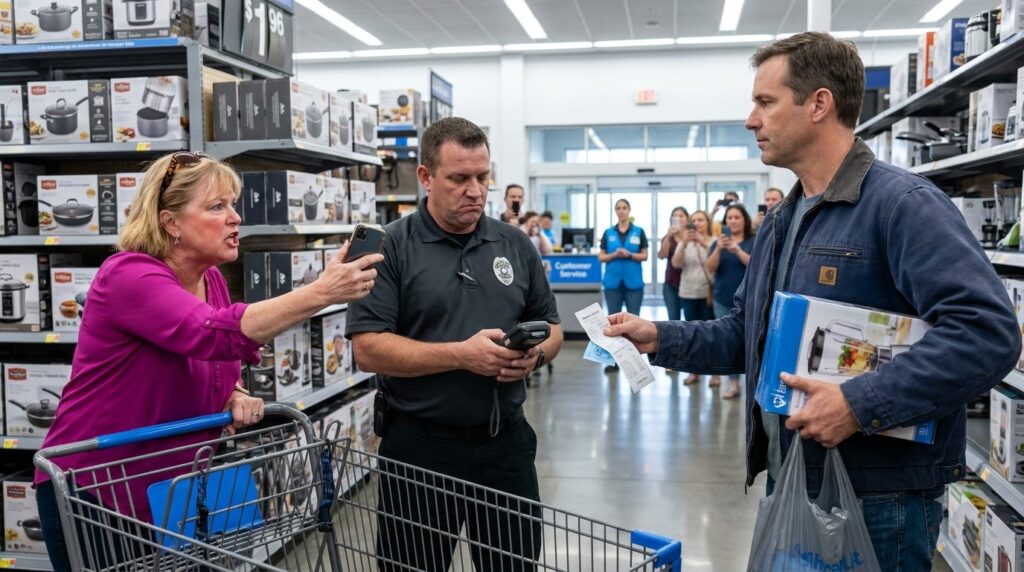
The steel wheel of the shopping cart didn’t roll; it ground sideways across the polished concrete, leaving a jagged gray rubber mark two inches from Marcus Vance’s work boots.
Marcus didn’t jump. Thirty years of adjusting diesel timing belts and listening to the high-pressure hiss of postal air brakes had trained his nerves to ignore sudden noise. He simply stopped, his right hand maintaining a firm, steady grip on the thick plastic handles of the store bag. Inside, the heavy box containing the commercial-grade blender settled with a dense, metallic thud.
“You aren’t taking another step toward those doors,” Brenda Hollister said. Her voice carried the harsh, grating frequency of an unlubricated pulley, cutting cleanly through the ambient hum of the store’s air handlers and the distant beep of scanning registers.
She stood behind the metal cart like a border guard at a checkpoint. Her bright magenta blouse was crisp, unwrinkled, and loud against the muted gray shelves of Home Goods. High on her crown, oversized tortoise-shell sunglasses caught the harsh glare of the overhead LED tubes, casting twin squares of white light over her forehead. In her right hand, her smartphone was already raised, its camera lens pointed squarely at the center of Marcus’s navy canvas jacket.
“Ma’am,” Marcus said. The word was low, flat, and worn smooth at the edges. “You’re blocking the main lane.”
“I am securing store property,” Brenda countered, her chin tilting upward as two shoppers pushing wire baskets slowed down five yards away. A young associate in a blue vest paused near an endcap display of cast-iron skillets, eyeing the standoff with hesitant eyes. “I saw you in the kitchen aisle. You picked up that hundred-and-fifty-dollar unit, walked right past the home department desk, and tucked yourself behind the display pillar. You think because this place is big, nobody’s paying attention?”
Marcus felt the familiar, dull pulse behind his temple—not anger, but the cold, heavy weight of an old routine. For fifty-eight years, his stoic posture, broad shoulders, and quiet habits had made him a target for people who mistook silence for guilt. He didn’t shift his stance. He didn’t reach for his wallet, nor did he attempt to push the cart aside. In the army, when an officer came looking for fault on the motor pool floor, you didn’t offer excuses; you stood by your work order and let the steel speak for itself.
“I paid at Register Four,” Marcus said softly.
“Register Four is a general checkout,” Brenda snapped, her manicured index finger tapping against the side of her phone casing. Her voice rose half an octave, deliberately pitched for the growing circle of onlookers. “High-ticket kitchen electronics are supposed to be ringed up at the specialty counter! You knew the cashier down front was backed up with groceries. You counted on her not checking the box!”
Behind her, near the customer service desk, a man in a dark charcoal polo shirt stepped out from behind the counter. A silver security badge gleamed against his chest, and a coiled black wire snaked up his neck into a clear earpiece. Asset Protection Controller David Owens had noticed the gathering crowd.
Brenda saw him coming and waved her left hand in a sharp, demanding arc. “David! Down here! I’ve got a runner held at the endcap!”
Marcus didn’t turn to look at the approaching officer. Instead, his thumb slid down inside the breast pocket of his work jacket, his calloused skin brushing against the thin, crisp edge of a thermal paper slip folded twice. But as his fingers adjusted around the paper, he felt something else wedged inside the fold—a small, blue-inked paper tab that hadn’t come from the cashier’s hand.

CHAPTER 2: THE TACTICAL DRAW
Controller David Owens’s dark polo shirt carried the faint smell of industrial carpet cleaner and stale coffee, a scent Marcus recognized instantly from thirty years of federal breakrooms. Owens didn’t rush. His heavy black work boots struck the polished tile in a slow, rhythmic cadence that signaled years of routine authority.
“What seems to be the problem here?” Owens asked, stepping cleanly between the edge of Brenda’s metal cart and Marcus’s left shoulder. His hand rested lightly near his belt, inches from the molded plastic radio holster, but his eyes were already scanning—reading the posture, the bag, the tension in the space.
“I caught a shoplifter red-handed, David,” Brenda announced, her smartphone dipping slightly as she gestured with her free hand toward Marcus’s blue plastic bag. Her voice rang out with the crisp, theatrical certainty of a prosecutor delivering a closing argument to a court of bored shoppers. “He bypassed the center registers in Home Goods entirely. Tucked a hundred-and-fifty-dollar commercial unit into a standard retail sack and headed straight for the double doors.”
Owens turned his gaze onto Marcus. He didn’t look angry; he looked tired. His eyes narrowed slightly, taking in the faded navy canvas of Marcus’s jacket, the dry concrete dust clinging to the soles of his work boots, and the complete lack of sweat on Marcus’s brow.
“Sir,” Owens said, his voice flat, professional, and trained to de-escalate. “Do you have a receipt for the item in the bag?”
“I do,” Marcus said.
He didn’t make a sudden movement. In a tight space surrounded by nervous eyes and recording phones, speed was an invitation for suspicion. Marcus pulled his hand from his breast pocket, bringing out the folded strip of thermal paper. But as he drew it into the cold fluorescent light, the second piece of paper—the small, blue-inked tab wedged inside the fold—flashed briefly between his calloused fingers before he smoothed it flat against his palm.
“I paid at Register Four eight minutes ago,” Marcus said, holding the main receipt out toward Owens. “Cash transaction. The cashier stamped the box tag.”
Brenda let out a short, sharp bark of a laugh that made a mother near the cookware aisle pull her child a step further back. “Oh, please! Register Four is a high-volume grocery lane! Anyone can pick up a dropped receipt off the floor from an earlier run, walk back into Home Goods, and slide a box into a bag! He’s playing the system, David! Look at him—he knows exactly what he’s doing!”
Owens took the slip from Marcus. The paper was smooth, slightly warm from being pressed against Marcus’s chest, and bore the crisp black ink of a thermal printhead. Owens reached to his utility belt, unclipping a heavy, rubberized handheld scanner. The device gave a dull electronic chirp as its red laser line swept across the barcode at the bottom of the slip.
On the scanner’s low-resolution monochrome screen, three lines of text popped up.
Marcus watched Owens’s thumb freeze over the plastic directional pad. The security controller’s eyebrows twitched, just a fraction of a millimeter.
“Register Four,” Owens read aloud, his voice dropping into a lower key. “Timestamp 14:12 PM. Total: $161.99. Paid in cash.” He looked up, his gaze shifting from the paper back to Marcus’s face. “The item matches. But the operator ID on this receipt isn’t a cashier code.”
Brenda’s posture straightened instantly, her eyes widening behind her tortoise-shell frames as if she had just watched a trap spring shut. “I knew it! What does the code say, David?”
Owens squinted at the small screen, his jaw tightening slightly. “It’s logged under Code 00-Override. That’s a temporary floor supervisor code. A manual drawer key.”
“A manual override!” Brenda crowed, turning her phone camera to capture Owens, then Marcus, then the circle of six or seven shoppers who had now formed a silent perimeter around the aisle mouth. “He didn’t pay a cashier at all! He got someone to throw a manual bypass or he found a voided ticket in the trash! He’s trying to walk out of this store with stolen hardware on a fake supervisor clearance!”
Marcus felt the cold air from the store entrance blow across the back of his neck as the automatic sliding doors opened for an incoming customer thirty feet away. He didn’t break eye contact with Owens. His fingers remained loose at his side, holding that tiny, blue-inked paper tab hidden against his leg—a tab that bore a hand-scribed set of initials and a stamp that didn’t match the standard retail layout.
“Check the register log, son,” Marcus said quietly, his voice steady against the rising noise of the store. “I’ve got all day. But your floor manager’s code didn’t get on that slip by accident.”
Owens didn’t respond immediately. He unclipped his shoulder microphone, his thumb pressing the talk switch with a heavy mechanical click that echoed down Aisle Seven.
CHAPTER 3: THE DECOY CODE
The radio mic hissed with a pulse of gray static that sounded like dry gravel shifting across corrugated iron.
“Control, Owens,” David Owens said into his collar, his thick thumb depressing the rubber lever. His eyes remained fixed on the scratched plastic screen of his handheld terminal. “I need an immediate verification on Register Four. Code 00-Override logged at 14:12 PM. Confirm who holds that key today.”
A quiet fell across the mouth of Aisle Seven. It was the heavy, suffocating silence of an audience waiting for a verdict. Three more shoppers had halted behind Brenda’s barricade of wire carts, their eyes moving between Marcus’s grease-stained navy canvas jacket and the crisp silver badge pinned to Owens’s chest. The air conditioning overhead blew a faint draft of dust and floor wax across Marcus’s forehead, but he didn’t blink.
The radio crackled back, the dispatcher’s voice tinny and metallic through the small speaker. “Owens, Code 00 on Register Four was issued to Floor Supervisor Miller at 13:45 for mid-day drawer audit. The key is flagged as active.”
Brenda Hollister took half a step forward, her phone camera coming within two feet of Marcus’s face. The bright ring light embedded in her casing reflected off the polished lens of his left eye. Her smile was sharp, tight, and triumphant.
“There it is,” Brenda declared, turning to face the row of watching customers as if addressing a crowded courtroom. “Did you all hear that? A mid-day audit code! That code is restricted to manager drawers for cash balancing! It is never, under any circumstances, used to process a public sale at a front register!”
She leaned over the metal handle of her shopping cart, pointing a manicured nail directly at the receipt in Owens’s hand. “He didn’t buy that blender! He found a supervisor’s printout slip sitting on an unattended register terminal while Miller was doing a drawer balance, picked it up, and walked over to Home Goods to grab the matching box! It’s a classic receipt-swap scam! He’s using an internal audit slip as a cover!”
Marcus felt a cold thread of tension pull tight across his chest, but his posture didn’t give an inch. He knew how these systems worked. In the postal garages, when a vehicle part went missing during a shift change, the man holding the paper order with the wrong supervisor stamp was always the first one brought into the front office. On paper, Brenda’s claim looked seamless. To anyone watching the surface, the supervisor code was the smoking gun.
Owens looked up from his handheld device, his expression darkening into a hard, professional mask. The tiredness in his eyes had been replaced by the sharp, calculating focus of a man who realized a simple transaction had just turned into a potential internal security breach.
“Sir,” Owens said, his voice dropping into a stern, measured register. “Code 00 is an administrative override code. Line cashiers don’t have access to it for standard sales. If you paid cash at Register Four eight minutes ago, why is this transaction stamped under an audit override instead of a standard register clerk ID?”
“Ask the supervisor,” Marcus said softly.
“Miller is currently in the back office completing the 14:00 cash reconciliation,” Owens replied, his hand shifting from his microphone back to his belt loop. “Until I clarify why an administrative override was used to generate a register receipt for a commercial appliance, I cannot clear this item to leave the floor.”
Brenda let out a loud, theatrical gasp of satisfaction, turning her phone screen toward the crowd. “Did you hear that? Held! He’s being detained! That’s what happens when you think you can pull a fast one in a store where people actually care about order!”
A murmur rippled through the gathering crowd. A young associate near the cast-iron skillet display leaned toward a cashier and whispered something under his breath. The balance of sympathy in the aisle, fragile from the beginning, began to tilt heavily toward Brenda’s narrative. To the shoppers holding their phones, the override code was the proof: Marcus Vance had been caught using a fraudulent receipt.
Marcus felt the weight of a dozen eyes pressing into his back. This was the moment where men usually broke—where they started shouting, where they reached for the bag, where they made the fatal mistake of trying to push past the metal cart.
Instead, Marcus slowly shifted his right foot back an inch, grounding his heel against the polished concrete. His left hand remained inside his jacket pocket, his thumb sliding against the second piece of paper—the small, blue-inked tab wedged behind his palm.
“You’re looking at the wrong log, Controller,” Marcus said, his voice cutting through the whispers with the flat, unyielding weight of cold iron. “You think that Code 00 was used to bypass a cashier. But you haven’t checked why Miller turned that key in the first place.”
Owens frowned, his finger pausing over his radio button. “What are you talking about?”
“Call Control back,” Marcus said, his eyes locking onto Owens’s badge. “Don’t ask them who holds the key. Ask them what time Asset Protection authorized the cash drawer override on Register Four.”
CHAPTER 4: THE CAMERA TAPE AND THE WITNESS TURN
David Owens didn’t lower his handheld scanner. For three seconds, the only sound in the aisle was the high-frequency whine of the overhead fluorescent ballasts and the nervous shuffling of seven pairs of shoes on polished concrete.
Brenda Hollister sneered, shifting her weight behind the shopping cart barricade. “He’s stalling, David! He’s throwing out technical buzzwords to confuse you! You think a guy wearing grease-stained canvas knows store security protocol?”
Owens ignored her. His thumb pressed firmly against the rubber talk-lever on his collar mic. “Control, Owens. Re-query Register Four log for 14:10 through 14:15. Check for an Asset Protection pre-auth clearance attached to drawer audit Code 00.”
The static on the line hissed, broken by two distinct chirps as the central monitoring room processed the request.
Brenda leaned closer, her smartphone camera hovering inches from Owens’s elbow. “Tell control to pull the main overhead feed from Home Goods instead! The camera over Aisle Seven will prove he carried that box straight out without touching a till!”
“Owens, Control,” the dispatcher’s voice crackled back, louder now, echoing out of the collar speaker so clearly that the entire front line of shoppers could hear every syllable. “Log confirmed. Asset Protection pre-authorized Supervisor Miller at 13:58 to run a live cash audit at Register Four while processing active customer lines to test drawer drawer-count balance under load. All sales during that fifteen-minute window were assigned Code 00.”
A ripple of low murmuring ran through the onlookers. The associate by the cast-iron skillets shifted his stance, his arms dropping from his chest as he looked from Owens to Brenda.
Owens’s jaw tightened. “Control, verify physical transaction for item ending in serial 4092.”
“Camera four, Register Four feed pulled,” the dispatcher replied instantly. “Timestamp 14:12 PM. Customer matching description—navy canvas jacket, dark denim, work boots—stood in line behind two grocery customers. Paid $161.99 in cash directly to Supervisor Miller. Miller stamped the internal box slip with the blue store stamp, handed him the register slip, and bagged the commercial blender. Transaction is 100 percent verified. No discrepancy.”
The silence that fell over Aisle Seven was absolute. It was the heavy, suffocating quiet that follows an explosion.
Every head in the aisle turned simultaneously toward Brenda Hollister.
The ring light on Brenda’s smartphone camera trembled. Her face, flushed pink seconds ago, drained of color until her skin looked as chalky and dry as unpainted drywall. Her lower lip twitched once, her fingers tightening around the rubber grip of her phone as she realized her entire broadcast had just captured a recorded, verified lie.
“I…” Brenda started, her voice cracking, losing its sharp, booming authority. She took a half-step back, her heels clicking against the tile. “I saw him behind the display pillar… he looked like he was hiding…”
“He wasn’t hiding, ma’am,” Owens said. His tone had lost all its professional hesitation. It was flat, hard, and backed by the full weight of the store’s legal authority. “He was waiting for his receipt.”
Marcus didn’t gloat. He didn’t raise his voice or smile. Slowly, deliberately, he pulled his left hand from his jacket pocket. Between his thumb and forefinger, he held out the second piece of paper—the small, blue-inked paper tab that Miller had stamped and tucked into his receipt fold during the audit.
“You were so busy looking for a thief, lady,” Marcus said, his voice low enough that only Brenda, Owens, and the front row of shoppers heard it, “you didn’t bother checking if the man standing in front of you had already done the work.”
A woman holding a young child near the cookware display let out a sharp, breathless laugh. Across the lane, two shoppers who had been recording on their phones angled their screens away from Marcus and centered them entirely on Brenda’s pale, trembling face. Whispers broke out like dry brush catching fire—shoppers pointing, floor associates shaking their heads, the public balance of power shifting completely in a single second.
Brenda reached out to pull her shopping cart backward, her hands shaking so violently the metal frame rattled against an endcap display. “I was only trying to protect the store’s inventory! As a preferred customer—”
“Ma’am,” Owens interrupted, his hand moving down to unclip a official printed pad from his utility belt. “Step away from that cart immediately.”
CHAPTER 5: THE WEIGHT OF IRON AND BLUE INK
Brenda Hollister froze, her hand still locked onto the rubber-coated handle of the shopping cart. The metal grid of the basket vibrated under her grip, transmitting the low, rhythmic hum of the store’s floor-scrubbing machine two aisles away.
“I have been a preferred customer at this location for seven years,” Brenda said, her voice dropping into a desperate, raspy whisper that barely registered against the ambient rustle of the crowd. She did not look at the shoppers holding their phones. She kept her eyes fixed on Controller David Owens’s silver badge, as if a sufficiently rigid stare could rewrite the digital log stored in the central server. “You can’t issue a trespass notice to someone who is actively monitoring community compliance.”
“Store policy does not recognize private monitors, ma’am,” Owens said, his voice dropping into the low, unyielding rhythm of an official warning. He pulled a yellow carbon-copy slip from the pad on his belt, his pen moving across the paper with three distinct, crisp scrapes. “You physically blocked an exit, created a public disturbance, and made a false accusation against a patron whose transaction was fully verified by Asset Protection. You are required to vacate the building immediately.”
He tore the yellow slip from the book with a sharp snap that echoed off the high corrugated ceiling of Home Goods. He held it out toward her. “Your membership is suspended for ninety days. If you return to this property before October twenty-fourth, city police will be dispatched to execute a criminal trespass warrant.”
Brenda’s manicured fingers twitched, but she didn’t reach for the slip. Her gaze flicked sideways, meeting the eyes of a mother holding a stroller five feet away. The mother didn’t look back with sympathy; she simply shifted her phone slightly to ensure Brenda’s face was centered in the frame. Across the aisle, a teenager in a faded work hoodie let out a low, appreciative whistle.
“Move the cart, ma’am,” Owens added softly. “Or I will move it for you.”
Brenda pulled her hand back as if the metal handle had suddenly grown scalding hot. She grabbed her leather shoulder bag, her sunglasses slipping crookedly across her forehead, and spun on her heel. Her low heels clicked in a rapid, erratic rhythm against the polished concrete as she headed straight down the main runway toward the double sliding doors, her eyes fixed strictly on the floor tiles ahead. She did not look back.
The assistant floor manager stepped forward immediately, taking the handle of Brenda’s abandoned shopping cart and wheeling it out of the center lane with a smooth, metallic roll that cleared the path to the exit.
A quiet murmur washed over the gathered onlookers—not a roar of applause, but the collective exhale of a room returning to its normal pressure. People lowered their phones, tapping screens to save video files before turning back toward the retail displays. The floor associates smoothed their blue vests and resumed their positions behind the counter lines.
Owens turned back to Marcus Vance. The security controller took a slow breath, his shoulders dropping two inches as the adrenaline of the confrontation drained out of his posture. He took the thin thermal receipt and the small blue-inked paper tab from his handheld scanner clip and held them out toward Marcus with both hands.
“I apologize for the delay, sir,” Owens said, his voice entirely free of corporate scripts. He met Marcus’s eyes with the straightforward respect of one working man acknowledging another. “You held your ground, and your paperwork was solid. Thank you for your patience.”
Marcus reached out and took the slips. His calloused thumb pressed against the rough fibers of the blue-inked tab, feeling the slight indentation where the supervisor’s pen had initialed the pre-authorization code. He didn’t smooth the paper or inspect it again; he simply folded the slips together once and slid them deep into the inner breast pocket of his navy canvas jacket, right over his heart.
“You handled your job right, son,” Marcus said quietly. “A man checks the log before he pulls the lever. That’s all anybody asks.”
Owens gave a single, firm nod, stepping back to leave the aisle wide open.
Marcus adjusted his grip on the plastic handles of the blue store bag. The heavy box inside shifted, its weight resting solid and balanced against his hip. He didn’t hurry his stride. He walked at the same steady, unbothered pace he had used when he first entered the store forty minutes ago.
As he crossed the threshold of the automatic sliding doors, the cool, artificial chill of the department store vanished, replaced by the thick, warm air of the late summer afternoon. The bright sunlight hit the windshields in the parking lot, throwing glints of yellow light across the dark asphalt.
Marcus walked toward his old pickup truck parked near the light pole. He opened the passenger door, set the bagged blender carefully on the bench seat, and closed the door with a heavy, satisfying iron latch sound that echoed across the quiet lot. Standing by the driver’s side, he took a deep breath of the hot, dry air, feeling the quiet satisfaction of a man whose dignity remained unblemished, protected not by loud words, but by the unyielding weight of truth and blue ink.