The Yellow-Line Ledger: How a Fake Badge and a Cold Street Corner Collapsed Under the Weight of True Proof

CHAPTER 1: The Weight of the Curb

The chill of the October morning had settled deep into the porous brickwork of the old mercantile block, carrying the faint, metallic scent of wet asphalt and scorched coffee grounds from the diner across the street. Arthur Vance stood beside the open rear doors of his cargo van, his calloused fingers hooked over the latch of a heavy wooden crate. His canvas work jacket, stiff with two years of salt stains and grease, offered little protection against the wind tunneling down the narrow service lane. But he didn’t shiver. For Arthur, the cold was just another constant, no different from the hum of the engine or the dull ache in his lower back.

Then came the whistle.

It was a sharp, piercing sound that set the pigeons scattering from the fire escapes overhead. Arthur paused, his knuckles resting against the rough grain of pine. Down the center of the yellow-lined delivery lane, a figure was cutting a violent path through the morning shadows.

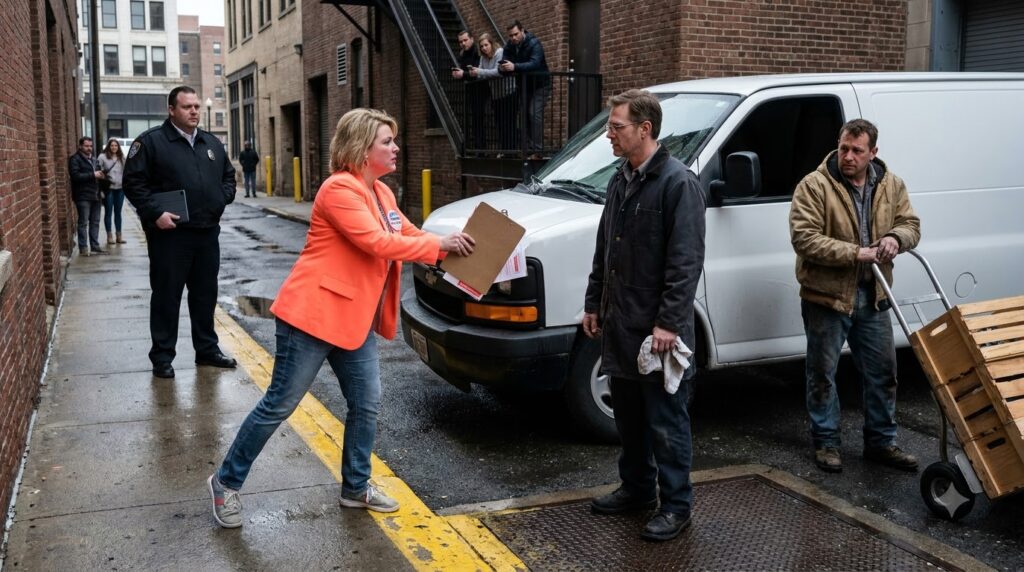
Brenda Caldwell didn’t walk so much as she cleaved the air. Her neon-orange blazer burned against the desaturated gray of the concrete, clashing violently with her oversized designer sunglasses and the frantic, rhythmic tapping of stiletto heels against the stone flags. Clutched in her right hand was a faux-leather clipboard, held like a truncheon. Pinned proudly to her lapel was a round, metallic disc that caught the weak morning sun—a prop-shop badge stamped with an imitation municipal crest.

Arthur let out a slow, measured breath through his nose, refusing to give her the satisfaction of a sudden flinch. He had spent ten years navigating the petty fiefdoms of suburban and downtown property managers, men and women who mistook a clipboard for a scepter. But Brenda carried a special brand of theater.

“Stop right there!” Brenda screeched, coming to a dramatic halt three feet from his front bumper. She jammed a manicured finger toward his grill. “You are in direct, flagrant violation of district retail code section twelve! This loading bay is reserved exclusively for premier boutique patrons and private delivery contractors registered with the executive board! Move this rust bucket off our asphalt this instant, or I will have your commercial license revoked before you can blink!”

Arthur didn’t drop his hands. He kept his weight balanced evenly over his boots, his gaze dropping briefly to the cheap plastic laminate of the badge on her lapel before rising to meet the distorted reflection in her dark lenses.

“Morning, ma’am,” Arthur said, his voice flat, rhythmic, and entirely devoid of panic. “This is a city-zoned commercial loading lane. The painted yellow stripe and the sign twenty feet back give open access to all registered couriers until noon.”

Brenda’s nostrils flared, her face tightening into a mask of mottled indignation. She slapped her clipboard against her thigh with a loud, hollow crack.

“Don’t quote municipal codes to me, you illiterate squatter!” she shrieked, stepping closer until she was well within his personal perimeter. “I run this block! I say what enters this alley and what gets towed to the impound lot! Move it now, or my security team will drag you out of that seat!”

The micro-tension in the air tightened like a plucked guitar string. Arthur felt the heavy weight of the crate behind him, a silent anchor reminding him of the schedule he had to keep, the mouths he had to feed, and the quiet dignity of honest labor against hollow noise. But as Brenda raised her smartphone, stabbing her thumb at the screen to summon her phantom enforcement crew, Arthur noticed a tiny, revealing detail: the edge of her clipboard was crammed with overdue utility past-due notices, their bright red collection headers peeking out beneath a fake memo sheet.

She wasn’t protecting a board. She was protecting a ghost.

CHAPTER 2: The Clipboard of Phantoms

The click of Brenda’s stiletto heels against the frost-dusted concrete did not retreat; instead, it grew sharper, shifting from a rhythmic tap to an erratic, angry cadence. Arthur did not look up from the cargo manifest clipped to his clipboard, though he could feel the heat of her glare boring into the side of his neck like a blowtorch.

“You think a piece of paper from the city clerk’s office grants you immunity?” Brenda’s voice cracked slightly, the practiced theatrical resonance slipping to reveal a thin, brittle edge of panic. She took two aggressive steps forward, her orange blazer catching the dim light of the alley’s brick overhang. “I have filed three formal injunctions against every independent transport outfit operating south of Ninth Street. This lane is private commercial property under the direct administrative custody of the Downtown Merchant Coalition. You are trespassing on assets that belong to us.”

Arthur turned slowly, keeping his movements deliberate and unhurried. He let the silence stretch between them for three long seconds—a calculated pause designed to let her words hang in the hollow air of the service alley until their emptiness became unbearable.

“Coalition,” Arthur repeated quietly, his voice maintaining its flat, gravelly register. “That’s a new one, ma’am. Last week when the plumbing supply truck rolled through here, you told the driver he was violating the historical district preservation charter.”

A low murmur rippled from the sidewalk where a pair of office workers had paused with their morning coffees, leaning against the cold iron railing of the stairwell. One of them suppressed a short, dry cough that sounded suspiciously like a laugh.

Brenda’s face flushed a deep, mottled crimson, her fingers tightening around the edge of her faux-leather clipboard until her knuckles turned the color of chalk. As she jerked the board upward to emphasize a point, the corner flipped back, exposing a flash of bright red thermal paper tucked clumsily beneath her fake memorandum sheets. The bold print was unmistakable even from ten paces away: FINAL NOTICE – MUNICIPAL UTILITY REVENUE DIVISION – PAST DUE BALANCE.

Arthur’s gaze lingered on the red header for a fraction of a second before lifting back to her eyes. The micro-mystery of her frantic morning crusade suddenly fell into sharp focus. The clipboard wasn’t a badge of office; it was a barricade against a collapsing world.

“You’re not on any board, Brenda,” Arthur said, his tone softening just enough to carry a dangerous, quiet authority. “You’re just trying to find someone else to pay your overhead.”

“How dare you!” she shrieked, her hand flying to her throat as if she had been physically struck. She raised her smartphone, stabbing her thumb furiously at the screen while her voice climbed an octave. “Security! Code Enforcement! Get down to the west service lane immediately! There is an aggressive, non-compliant intruder refusing to respect property boundaries!”

She was performing for an audience that wasn’t there, leaning heavily on the fantasy that her phone call would summon an invisible battalion of enforcers to validate her rage. But down the length of the narrow alley, the only response was the distant, rhythmic beep of a delivery van backing out of a loading dock three blocks away.

Arthur reached down, unhooked the latch of his second heavy wooden crate, and slid it smoothly onto the bed of his hand truck. The wheels creaked against the grit of the asphalt, a steady, mechanical sound that mocked her theatrical hysteria. He knew the rules of the street better than she ever would: bullies like Brenda only possessed the power you surrendered to them in the first five seconds of a confrontation. Keep your weight centered, keep your eyes on the work, and let the noise exhaust itself against your ribs.

“I’ve got twenty crates to clear before eleven,” Arthur said, turning his back on her as he began wheeling the load toward the mercantile store’s heavy steel threshold. “If you’re going to stand in the middle of a truck lane, I’d suggest stepping to the left. The garbage truck usually takes this turn blind at eight-thirty.”

Brenda let out a sharp gasp of pure outrage, her stiletto heel grinding violently into the asphalt as she lunged forward to block his path, her fingers clawing at the air.

CHAPTER 3: The Line in the Pavement

The stiletto heel caught on a ridge of cold asphalt with a dry, splintering crack. Brenda stumbled half a step to the left, her orange blazer swinging wide as she righted herself with a frantic grab at the brick wall. Her designer sunglasses slipped down the bridge of her nose, exposing eyes wide with frantic, unmoored fury.

“You do not walk away from me!” she screeched, her voice echoing off the high brick facades of the service alley. She whipped her smartphone back up, her thumb stabbing at the screen with such violence that the glass cracked across the bottom corner. “I am recording this entire interaction. You are committing an act of intimidation against an accredited officer of the commercial oversight board. This lane is closed to unvetted operators!”

Arthur kept his shoulders square, his hands resting naturally on the wooden handles of the hand truck. He didn’t turn back around immediately. Instead, he let the momentum of the moment stall, forcing her to look at the broad, impassive expanse of his canvas-clad back. Every second she spent screaming into a dead phone was a second he controlled the tempo of the alley.

“Ma’am,” Arthur said, turning his head just enough for his voice to cut through her tirade. “You’re standing on public city property, shouting at a man who’s been doing this route for eight years. If you’ve got an issue with the delivery manifest, call the precinct. Otherwise, let me past. You’re blocking the threshold.”

The office workers on the iron stairwell had stopped whispering entirely. Now they were leaning over the railing, phones held low and steady, capturing the precise angle of her stance and the aggressive thrust of her clipboard. One of them, a young man in a charcoal suit, whispered something to his colleague, and a sharp snort of laughter cut through the morning air.

Brenda heard it. Her head whipped around toward the stairwell, her face contorting into an ugly, blotchy sneer. “Mind your own business! This is a restricted zone! I’ll have your offices fined for civil disruption!”

“Lady, get real,” the man on the stairs called back, his voice flat and unimpressed. “That’s a city loading dock. My company’s legal team checked the deeds when we moved in two years ago. Nobody owns this concrete except the municipality.”

The direct contradiction hit Brenda harder than a physical blow. Her jaw slackened for a fraction of a second, the high-gloss enamel of her public performance chipping away to reveal the raw, desperate panic underneath. She wasn’t just losing an argument with a delivery driver; she was losing the fragile, manufactured reality she had spent the last six months constructing along this concrete strip. Ever since her boutique three doors down had been forced into silent bankruptcy, she had treated the alley like her own personal moat, demanding compliance tolls from every independent contractor who rolled through.

She spun back toward Arthur, her breath coming in ragged, shallow gasps. She raised the heavy faux-leather clipboard like a shield, the red past-due municipal collection notices fluttering slightly in the cold wind beneath the flap.

“You don’t understand,” she hissed, lowering her voice into a frantic, venomous whisper so the people on the stairwell couldn’t catch every syllable. “You think you’re clever with your permits and your manifest? This block belongs to the merchant pool. We paid into the maintenance fund before the crash. If I don’t control who unloads here, the whole district falls apart. You’re stealing my leverage.”

Arthur looked down at her—really looked at her—and saw past the neon blazer and the plastic badge. He saw the exhausted terror of someone drowning in debt, weaponizing petty rules because she had nothing left to lose. It didn’t excuse the malice, but it clarified the mechanics.

“Your leverage isn’t my problem, Brenda,” Arthur said quietly, his voice devoid of anger, carrying only the heavy, unyielding weight of truth. “Stepping in front of a delivery van doesn’t make you a director. It just makes you a hazard.”

Before Brenda could muster the breath for another screech, a low, authoritative voice echoed from the dim interior of the mercantile store’s freight entrance.

“Is there an issue with the morning drop, Arthur?”

Marcus stepped out from the shadows of the doorway, wiping his hands on a clean shop rag, his steady eyes locking onto the orange blaze of Brenda’s jacket.

CHAPTER 4: The Crowd and the Crest

The shop rag made a dry, rhythmic friction against Marcus’s palm as he stepped completely out of the dim threshold and into the harsh morning light. His eyes, pale and steady behind wire-rimmed glasses, bypassed Brenda entirely, locking instead on the heavy crates sitting securely upon Arthur’s hand truck.

“Everything on schedule, Arthur?” Marcus asked, his voice cutting through the damp morning air with unhurried authority.

“Right on time, Marcus,” Arthur replied, shifting his grip slightly on the wooden handles. “Just working through a slight administrative delay regarding the local air pressure.”

Brenda spun around so fast her neon-orange blazer whipped against the damp brickwork with a heavy snap. Her face, already flushed to a mottled crimson, contorted further as she recognized the store manager. She marched toward Marcus, her stiletto heels hammering the concrete like small arms fire, her hand thrusting the crumpled faux-leather clipboard forward as if it were a magistrate’s writ.

“Marcus! Thank goodness you’re finally out here!” Brenda shrieked, her voice scaling two full octaves into the narrow corridor between the brick walls. “This unauthorized interloper is refusing to comply with the district oversight code! He’s blocking the primary access lane, disrupting commercial equity, and openly mocking the board’s authority! Have your security personnel throw him off the property immediately, or I’ll add your storefront to the injunction list!”

Marcus did not flinch, nor did he take a step back. He simply lowered the shop rag into his coat pocket, folded his arms across his heavy chest, and looked down at her with a chilling, professional neutrality.

“Brenda,” Marcus said slowly, letting each syllable drop like lead weight. “There is no board. There hasn’t been a valid merchant association on this block since your boutique went under eighteen months ago. And even when there was, this loading zone was deeded to public commercial access back when the city paved Second Street.”

The words struck the alley like a physical shockwave. On the iron staircase overhead, the office workers leaned forward sharply, their phones tracking every twitch of Brenda’s face. Down at the mouth of the alley, a pair of pedestrians stopped walking, turning to watch the confrontation unfold.

For a heartbeat, Brenda looked as though she had been struck in the chest. Her mouth opened, a thin, dry sound escaping her throat before she slammed her jaw shut. But the desperation born of her mounting debts and shattered illusions would not let her surrender. Her panic converted instantly into toxic escalation.

“Liar!” she screamed, her voice cracking into a raw, metallic howl. She raised her phone high, her thumb hammering blindly at the screen. “You’re in on it! You’re harboring unregistered squatters and freight-dodgers! I’m calling the municipal authorities right now! I’m calling code enforcement, the sheriff, and the state tax division to audit every single crate coming off this truck!”

She began dialing frantically, pacing back and forth across the yellow line like a trapped animal, shouting fictitious violations into her dead or disconnected line about cargo smuggling and urban decay. The escalation had completely bypassed rational discourse; she was plunging headfirst into full public theater, daring the world to prove her wrong while praying her sheer volume would drown out the truth.

Arthur watched her, his muscles locked in steady tension, knowing that the trap was closing, but feeling the heavy, suffocating weight of her unyielding denial. She wasn’t going to break easily. She was going to drag everyone down into the mud with her until something forced her hand.

And then, turning the corner from the sunlit avenue into the mouth of the service lane, a familiar brass button glinted against a dark navy uniform. Officer Harris, the district transit and parking detail cop who usually grabbed a black coffee from the diner at eight-fifteen, strolled into the alley with his ticket book tucked neatly under his arm.

CHAPTER 5: The Badge and the Ledger

The brass button gleamed dully against the dark wool of Officer Harris’s uniform as he stepped past the rusted dumpster at the mouth of the alley. He didn’t rush. He had walked this commercial sector for twelve years, long enough to recognize the precise frequency of a panic-driven disturbance. His gaze swept over the scene in a single fluid motion: Arthur standing beside his laden hand truck with steady, grounded posture; Marcus leaning against the doorway with arms crossed; and Brenda, trapped in the center of the lane like a cornered animal, her phone still pressed frantically to her ear while her neon blazer vibrated with residual adrenaline.

“Morning, Marcus. Arthur,” Harris murmured, his voice cutting through the damp air as he tapped the corner of his digital citation tablet. He turned his heavy-set frame toward Brenda, his expression entirely neutral. “Morning, ma’am. I heard shouting all the way down at the intersection. You reporting an obstruction, or are you just working out your vocal cords?”

Brenda’s arm shot out, her index finger trembling as she pointed directly at Officer Harris’s chest with the aggressive urgency of a prosecuting attorney bringing forward a capital indictment.

“Officer! Thank God!” she screeched, her voice pitching up toward hysteria. “Arrest these men immediately! They are running an illegal freight operation, violating district commercial boundaries, and refusing to comply with the merchant council’s emergency ordinances! This man is an interloper squatting on private property!”

Harris didn’t blink. He lowered his tablet just enough to inspect the cheap plastic laminate pinned to her lapel, noting the amateur font and the absence of any municipal registry stamp. A faint, tired sigh escaped his lips. He had dealt with her type three times before during the summer when she tried to ticket the postal carrier for walking on the sidewalk.

“Ma’am,” Harris said evenly, stepping closer until he stood directly over the yellow line. “There is no merchant council. And this lane is a public commercial right-of-way designated by city ordinance nineteen-B. Unless you have a valid municipal obstruction permit signed by the commissioner’s office, you’re the one currently blocking active transit.”

The silence that rushed into the alley was absolute. The office workers on the iron stairwell leaned so far over the railing their knuckles turned white against the cold iron. Brenda’s mouth dropped open, her breath catching in her throat in a dry, ragged gasp.

“That’s—that’s a lie!” she shrieked, her voice cracking violently as she took two frantic steps backward, her stiletto heel catching on the rough seam of the concrete. “I hold the administrative charter! I issued the citations! Look at my clipboard! Look at the notices!” She shoved the faux-leather folder toward his chest, inadvertently exposing the bright red thermal past-due headers from the municipal utility division.

Harris glanced down at the papers, his eyes reading the bold print of the final collections notice before shifting back to her panicked face.

“Well, now,” Harris said quietly, tapping his screen with a stylus. “You’ve certainly got a lot of final notices here, Brenda. But none of them give you the authority to harass delivery drivers or impersonate a city official. In fact, interfering with commercial transit on a public right-of-way carries a rather steep fine.”

Panic, pure and unadulterated, washed over her features, sweeping away every trace of her theatrical arrogance. Her eyes darted wildly from Harris to Marcus, and finally to Arthur, who stood silently beside his cargo van, watching her empire of smoke and mirrors dissolve into nothingness. The resistance beat was shattering under the raw weight of verified reality, yet her fingers still clutched the clipboard like a drowning sailor gripping a splintered spar.

“You can’t do this!” she whimpered, her voice dropping from a screech to a pathetic, rattling whine. “I’m protecting the neighborhood value! If I don’t stop them, everything falls apart!”

CHAPTER 6: The Fall of the Orange Blazer

The finality of Officer Harris’s words hung in the narrow corridor of brick like the heavy, stagnant air before a summer squall. Brenda stood frozen, her fingers twitching uselessly against the faux-leather clipboard as if waiting for a phantom law to materialize and rewrite the scene. But the digital tablet in Harris’s hand remained steady, glowing with the irrefutable data of municipal zoning codes, and the crowd on the iron stairwell above leaned in with silent, unblinking intensity.

Arthur did not gloat. He did not step forward to press the advantage or offer a parting jab. He simply adjusted the canvas strap of his work jacket, reached down to his hand truck, and gripped the wooden handle of his second crate. The quiet mechanics of his labor were the ultimate counterweight to her noise. Every second she spent standing there, trembling inside her blinding neon-orange blazer, was a second the city moved forward without her permission.

“Brenda,” Officer Harris said, his tone softening with a weary, professional patience that stung worse than a direct accusation. “You need to clear the right-of-way. Now. If I have to write an official obstruction citation and log this prop badge into evidence, it won’t just be a past-due utility notice you’re dealing with.”

The threat of an official paper trail—the very thing she had tried to weaponize against others—seemed to snap the last remaining wire in her mind. Her eyes widened, darting from Harris’s steady gaze to Marcus’s impassive stance in the doorway, and finally to Arthur, who looked right through her as though she were already fading into the concrete shadows.

Without a word, without a final screech or a defiant gesture, Brenda crumpled.

The fierce, manufactured posture collapsed inward. Her shoulders hitched, her jaw went slack, and the plastic novelty badge pinned to her lapel seemed to lose its pathetic luster under the midday sun. She spun on her heel, her stiletto heel catching sharply in a shallow groove of the asphalt with a dry, splintering crack. She stumbled violently, nearly pitching forward into the brick wall, before catching her balance with a frantic, ungraceful lurch.

The plastic novelty badge tore loose from her lapel, clattering against the concrete and rolling into a narrow puddle beside the curb, where it drifted unnoticed in the gray runoff.

Without looking back, Brenda bolted. Her neon-orange blazer flashed like a dying ember against the desaturated walls as she scrambled down the length of the service lane, her heels clicking in a ragged, panicked rhythm until she reached her parked luxury SUV. She wrenched the driver’s side door open with both hands, flung herself into the seat, and slammed the heavy door shut.

Seconds later, the engine roared to life with an aggressive, stuttering growl. The tires screamed against the loose gravel, spitting small stones against the brickwork as the vehicle fishtailed out of the alley and vanished around the corner into the anonymous grid of downtown traffic, leaving behind only a faint, lingering plume of blue exhaust smoke and a thick, profound silence.

Arthur let out a long, slow breath, feeling the hard knot of tension in his lower back finally begin to loosen. He didn’t smile, but a quiet, steady warmth settled behind his ribs. He gripped the handles of his hand truck and rolled the heavy wooden crate forward across the threshold into the mercantile store’s interior, the wheels humming smoothly over the clean concrete.

Marcus stepped inside behind him, closing the heavy steel door just enough to shut out the street noise while leaving the fresh morning air circulating through the lower corridor. He clapped Arthur once firmly on the shoulder, his grip strong and grounding.

“Well handled, Arthur,” Marcus said quietly. “She’s been bleeding this block dry of its patience for over a year. Nobody ever had the stomach to make her stand still long enough to look at the ground she was standing on.”

“She didn’t lose because of us, Marcus,” Arthur replied, setting his clipboard down on the receiving desk as he unlatched the first crate. “She lost because she forgot that a uniform doesn’t make the road, and a clipboard doesn’t change the deed.”

Outside, the city resumed its ordinary, relentless rhythm. The delivery vans hummed in the distance, the office workers on the stairwell turned back toward their desks with quiet murmurs, and the yellow commercial line on the pavement sat clean, unbothered, and entirely free. Bullies only hold the keys to the kingdom as long as everyone else agrees to stay locked outside; once the door is pushed open, the walls are nothing more than dust and painted lines.

Similar Posts

Leave a Reply

Your email address will not be published. Required fields are marked *