The Weight of the Line: How Quiet Preparation Dismantled an Empire of Paper and Bluff

CHAPTER 1: The Line in the Asphalt

The smell of hot pine resin and scorched brake pads clung to the gravel shoulder, thick enough to taste. Julian Vance kept his pencil pressed against the grain of the rough-cut cedar plank, his thumb steady against the steel rule. He did not blink, nor did he shift his weight from the ball of his left foot.

“I am telling you, Mr. Vance, for the third and final time,” Brenda said, her voice ratcheting up half an octave to carry over the thrumming diesel engine of the flatbed truck. She tapped the corner of her silver-rimmed sunglasses against her clipboard. “Commercial deliveries of this scale are strictly prohibited on community-maintained arteries without a Class-Four board permit. Shut the engine off, back that flatbed out to County Road 7, and do it before I call code enforcement.”

The delivery driver, a young man with a sweat-stained collar and a laminated manifest gripped in one hand, looked back and forth between Brenda’s pastel linen blouse and Julian’s motionless stance on the porch steps.

“Boss,” the driver called out, his voice tight with defensive hesitation. “Do I move or stay?”

Julian finally lowered the pencil. He took off his wire-frame glasses, hooked them into the neckline of his faded canvas jacket, and wiped his palms clean on his denim thighs. He moved with a deliberate, maddening slowness, deliberately refusing to match the frantic, predatory energy radiating from the woman blocking the path.

“Leave the truck right where it is, Ben,” Julian said, his voice flat, pitched just loud enough to cut through the exhaust.

Brenda’s mouth tightened into a pale, hard slash. Her fingers gripped the edges of her clipboard until her knuckles whitened under her manicured nails. “You think you can operate outside the rules just because your grandfather managed to squat on this acreage before the county had zoning maps, Julian? This is an organized community. We share the infrastructure. We share the standards. And people who refuse to pay their share do not get to carve private kingdoms out of public convenience.”

Julian stepped off the bottom timber of the porch, his boots crunching softly into the limestone grit. He could feel the eyes of half a dozen neighbors from across the cul-de-sac, their silhouettes dark and motionless behind lace curtains and glass storm doors, watching to see if the structure would hold or if Brenda’s manufactured gravity would pull everything down.

“You call it shared infrastructure, Brenda,” Julian said, closing the distance between them until he could smell the expensive floral perfume masking the sour edge of her panic. “The county map calls it parcel C441B. Unencumbered. Private.”

“A piece of paper from 1961 doesn’t override modern association bylaws,” she snapped, stepping directly into his personal space, her chin lifted. “Marcus Webb drew up the addendum himself. It’s logged. It’s binding. And if that timber hits the ground today, I am filing an immediate injunction that will freeze every nickel of your renovation budget before the sun goes down.”

Julian looked past her shoulder, noting the way her left eye twitched—a microscopic tremor of genuine desperation hidden beneath the gleaming lacquer of her authority. She wasn’t just enforcing aesthetics; she was running out of time, and she needed his compliance to patch a hole she couldn’t afford to show anyone.

“File whatever you like,” Julian murmured, turning his gaze back to the idling truck. “Just make sure you bring a better pen next time. Your last notice forgot to include the county clerk’s seal.”

He walked past her without waiting for her reply, leaving her standing alone in the centerline of the gravel road as the truck’s air brakes hissed twice in the rising heat.


CHAPTER 2: The Weight of the Archive

The fireproof safe in the back room did not click when Julian turned the heavy chrome dial; it gave a dull, leaden thud, the sound of thick steel meeting a worn rubber gasket that had kept the air out since the Johnson administration.

Outside, the late afternoon sun was losing its bite, cutting long, cold shadows across the gravel lane where the delivery truck had idled hours earlier. Julian didn’t turn on the overhead fluorescent tube. He preferred the amber pool of light cast by the brass desklamp he’d pulled from his father’s workshop—a lamp with a weighted iron base that smelled faintly of old machine oil and copper dust.

He reached inside the dark, cool maw of the safe, his fingers brushing past a stack of tax receipts from the seventies before closing around the cardboard tube. It was stiff, yellowed at the open lip, and sealed with a brittle piece of amber tape that snapped like dry pine twigs under his thumb.

On the kitchen table, beneath the amber glare of the lamp, he unrolled the document.

It wasn’t just a deed. It was a complete cartographer’s packet from June 1961, drawn in stubborn black ink that had faded to a deep, bruised violet where the humidity had tried to claim it. Parcel C441B. Chester Mercer’s heavy hand had signed every margin, noting every oak tree, every drainage culvert, and every foot of the six-meter-wide gravel strip that pierced the pine thicket from County Road 7.

Julian’s thumb traced the precise boundary lines, feeling the tiny raised bumps where the pen had pressed too hard into heavy parchment. There was no mention of an easement. There was no mention of a community share. There was only a clean, unbroken rectangle of ownership signed off by a county surveyor who had been dead for forty years.

Yet, sitting right beside the original plat was something else—a small, cream-colored envelope he hadn’t opened yet, retrieved from his post box an hour after the confrontation with Brenda.

He didn’t tear it open. He used the edge of a steel letter opener, sliding it with a slow, deliberate hiss.

Inside was a formal assessment from the Kellerton County Land Records Office, sent in response to a routine query he’d filed three weeks ago regarding adjacent property incorporations. Julian slid the single sheet of heavy bond paper into the light.

The text was brief, clinical, and devastatingly clear. It noted that the newly formed Kellerton Lake Owners Association had referenced an attached “Addendum C-Prime” in their foundational incorporation filing—an addendum purporting to grant community management rights over all arterial access roads within the northern district. But the clerk’s marginal note, stamped in bright red ink just two days prior, told a different story: No matching original instrument located in county vault. Filing lacks statutory registrar signature. Origin unverified.

Julian leaned back, the leather of his chair groaning softly under his weight.

Brenda hadn’t just invented a rule; she had built an entire administrative fiction on top of a missing signature. And Marcus Webb, with all his corporate polish, had knowingly referenced a ghost document to give her empire the illusion of weight.

His phone buzzed once on the scarred wooden tabletop, the vibration sharp and sudden in the quiet room.

It was an unknown number, followed immediately by a text preview on the screen: Mr. Vance. This is Tom Bryce. I hear you’ve got questions about the road access for Clearwater Retreat. If you’ve got ten minutes tonight, I suggest we talk before Brenda files that injunction in the morning.

Julian stared at the illuminated screen, the blue light catching the sharp lines of his jaw. He didn’t reply. Instead, he picked up his pen, wrote a single note on the margin of the county assessment, and listened to the wind rattling the dry oak leaves against the windowpane.

CHAPTER 3: The Boardroom Ambush

The fluorescent lights overhead hummed with a low, parasitic frequency that made Julian’s temples throb before he even crossed the threshold of the Kellerton Community Annex.

Inside, the room smelled of damp commercial carpet, old floor wax, and the metallic tang of stale coffee brewed three hours too early. Brenda Sterling sat at the head of a folding laminate table that had been pushed into an aggressive V-shape, flanked on her right by Marcus Webb. The attorney didn’t look up when Julian entered; he was methodically turning a silver fountain pen between his fingers, his eyes fixed on a thick stack of blue-backed folders arrayed like defensive ramparts before them.

Roughly a dozen residents—people Julian had known by face or nod for over a decade—sat scattered across the folding metal chairs. Their posture was rigid, shoulders hunched forward, eyes darting between Brenda and the doorway. No one spoke. The room went dead silent the moment Julian’s boot heel clicked against the linoleum.

“Glad you could finally grace us with your presence, Mr. Vance,” Brenda said, not bothering to look at him as she adjusted her tortoiseshell glasses. “We were beginning to wonder if your renovation work required you to secede entirely from local accountability.”

Julian did not take the empty chair placed conspicuously at the center of the room. Instead, he walked past it, his canvas jacket brushing against the edge of the chalkboard, and leaned his shoulder against the pale cinderblock wall near the back exit. He kept his hands deep in his pockets, his posture loose, calculating the micro-expressions in the room. Brenda wanted an audience; she wanted a public trial where she could play the aggrieved magistrate.

“I received your agenda, Brenda,” Julian said, his voice flat, cutting effortlessly through the hum of the overhead lights. “Though I noticed a few items missing from the official posting. Like the ledger showing where the quarterly landscaping fees from the west sector actually went.”

Marcus Webb’s fingers froze around the silver pen. A fraction of a millimeter of tension rippled across the skin around his jaw, entirely invisible to anyone not looking for it.

Brenda didn’t flinch, but her voice sharpened, climbing an octave as she leaned forward over the table. “This meeting is about community standards, Julian, not your paranoid fantasies. The Kellerton Lake Owners Association has documented thirty-four separate violations on your northern parcel over the last six months. Unpermitted vehicle staging, failure to maintain drainage corridors, and most critically, willful obstruction of common access lanes.”

She slapped her palm against the blue folder nearest to her, a sharp crack that made two of the older residents jump.

“We have extended every courtesy,” Brenda continued, her gaze sweeping across the tense faces of the neighbors. “We offered a standardized infrastructure agreement. We offered a reasonable mediation window. But when a single property owner decides that his family name carries more weight than the collective well-being of sixty families, the board has an obligation to act.”

She looked straight at Julian, her eyes narrowed behind her lenses, daring him to interrupt, daring him to yell, daring him to give her the emotional outburst she needed for the record.

Julian stayed silent. He watched the way Marcus Webb subtly slid his left hand over the corner of the blue folder, shielding a handwritten post-it note scrawled on yellow legal paper. Julian’s eyes caught the exposed corner of the note—a string of account numbers and a bank routing code preceded by a handwritten line reading Cover deficit before audit.

The decoy was sitting right there in plain sight. Brenda wasn’t just trying to bully him into an easement; she was fighting to keep the association books from being subpoenaed by anyone who might look too closely at where the emergency reserve funds had vanished over the winter.

“You’re welcome to read whatever charges you like into the minutes,” Julian said quietly, pushing off the wall. He didn’t raise his voice; he didn’t need to. “Just make sure you attach a copy of the original county deed to the transcript. Otherwise, the next court reporter is going to have a very difficult time explaining why you’re fining people for walking on land you don’t even own.”

Brenda’s face drained of color for a single, stark heartbeat before a furious flush surged up her neck. “That matter is already settled by board resolution,” she snapped, her voice trembling slightly. “Meeting adjourned.”

Julian turned and walked out into the cool evening air before the echoes of her gavel could even die against the cinderblocks, leaving a heavy, suffocating silence hanging behind him in the room.

CHAPTER 4: Whispers in the Digital Gray

The dashboard clock glowed a sharp, cold amber in the dark interior of Julian’s truck: 4:14 AM. Outside, a heavy mountain mist clung to the windshield, smearing the amber streetlights of County Road 7 into blurred halos of pale grease. Julian didn’t wipe the glass. He stared instead at the glowing display of his phone resting on the center console, where three new notifications had just blinked into existence within forty seconds of each other.

The local community forum thread had exploded overnight.

Julian’s finger flicked upward, dragging through paragraphs of calculated public shaming. The author of the primary post used no name, but the handle—LakeView_Sentinel—shared a syntax that smelled entirely of Marcus Webb’s legal phrasing. The post didn’t mention Julian directly, but it didn’t have to. It spoke of an unidentified property owner on the southern rim who was deliberately sabotaging emergency drainage projects, holding community resources hostage, and operating commercial rentals without state licensing.

Worse than the forum post was the email sitting directly beneath it in his inbox: an automated formal warning from the county zoning board, triggered by an anonymous complaint filed late the previous afternoon. It cited a suspected commercial code violation on parcel C441B and demanded an immediate on-site inspection within forty-eight hours.

The trap was closing precisely as Brenda and Marcus had planned. They weren’t just fighting him in court anymore; they were weaponizing the digital noise and municipal bureaucracy to force an inspection before his timber work could be finished.

Julian didn’t curse. He didn’t pick up the phone to call Patricia at four in the morning. Instead, his jaw tightened, the muscle ticking once against his cheek as he calculated the timeline. An unannounced zoning inspection on short notice meant they had pulled strings inside the county building commission—using the fabricated community map as presumed evidence of shared public oversight.

He turned the key in the ignition. The old diesel engine caught with a harsh, heavy roar that chased the mist away from the front bumper. If they wanted an inspection, they would get one. But they would inspect a site governed strictly by sixty-year-old steel and ink, not by Brenda’s photocopied wishful thinking.

As he drove down the dark gravel lane toward the property line, the headlights swept across the rusted red stake marking the entrance—his grandfather’s marker, standing patient and ignored in the weeds. Julian slowed to a crawl, seeing the fresh track marks of heavy utility tires pressed deep into the shoulder where someone had attempted to scout the gate boundary under cover of darkness.

The digital whispers and fake code violations were only the prelude. The real pressure was arriving at dawn, and Julian shifted the transmission into low gear, ready for the impact.

CHAPTER 5: The PreInspection Breach

The low, bone-deep thrum of a heavy hydraulic diesel engine hit Julian in the chest before his boots even touched the damp limestone of the road edge. It was 6:00 AM sharp, and the morning air smelled heavily of wet pine needles, exhaust fumes, and the sharp, mineral scent of crushed gravel.

Julian stood beside his truck, his breath pluming in the gray dawn light as he watched two utility flatbeds and a tracked excavator roll past the mouth of County Road 7. Tom Bryce’s crew was moving early, attempting to secure the access corridor hours before the county fire marshal’s pre-occupancy inspection scheduled for later in the week. They weren’t waiting for permissions or legal rulings anymore; they were betting that physical momentum would smash through whatever hesitation remained.

As the first flatbed slowed, preparing to turn down the narrow gravel strip of parcel C441B, Julian stepped directly into the center of the road. He didn’t wave his arms. He didn’t shout. He simply planted his boots firmly into the damp grit, his canvas jacket zipped to the throat, his posture locked into an absolute, immovable wall of resistance.

The flatbed’s air brakes squealed with a deafening, metallic shriek, showering the margins with sparks of friction. The driver leaned out of the cab, his face twisted in frustrated disbelief, gesturing wildly toward the open acreage beyond the tree line where Clearwater Retreat stood finished and vacant.

“Move it out of the way, Vance!” the driver bellowed over the idling diesel. “We’ve got a schedule to keep and permits filed by the board! You can’t block a commercial right-of-way!”

Before Julian could answer, a sleek black sedan crunched onto the gravel shoulder behind the truck. Brenda Sterling stepped out, her pastel linen jacket stark against the dark morning brush, oversized sunglasses pushed up onto her styled hair despite the lack of sun. She marched straight toward him, her heels sinking slightly into the soft dirt, her face flushed with a desperate, triumphant malice.

“You are crossing a very dangerous line, Julian,” Brenda snapped, pointing a manicured finger inches from his chest. “Marcus already processed the emergency injunction. That gate you’re planning to put up is illegal, this road is public-private association property, and if you don’t step aside this second, I’ll have the county sheriff haul you off in cuffs for criminal interference.”

Julian didn’t blink. He reached slowly into his inner jacket pocket and pulled out a single, neatly folded document stamped with the raised violet seal of the Kellerton County Land Records Office—the definitive boundary proof Patricia had finalized the evening before.

“You can call whoever you like, Brenda,” Julian said, his voice dropping an octave, carrying the cold, dense weight of undeniable fact. “But before they get here, you might want to ask Marcus why the addendum you’ve been waving around for two years doesn’t have a registrar’s signature on file.”

Brenda’s hand froze mid-gesture. The triumphant sneer on her face flickered, replaced for a single, terrifying second by the cold realization that the paper tiger was finally turning to dust.

CHAPTER 6: The Deputys Ruling and the Collapse of Paper

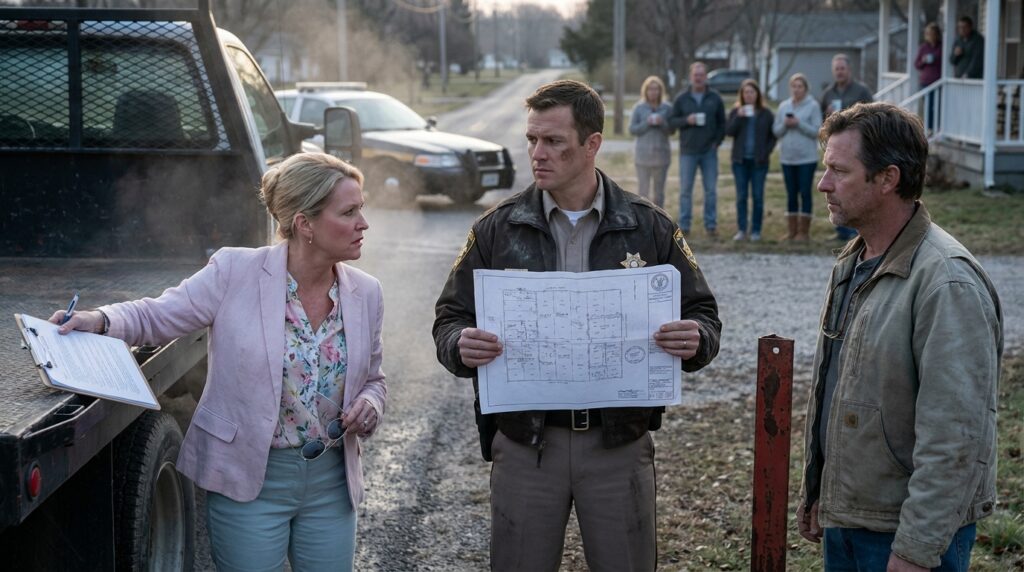
The county sheriff’s cruiser didn’t slow down as it swung off County Road 7; the tires crunched hard against the limestone shoulder, kicking up a white cloud of dust that settled instantly over Brenda Sterling’s pastel jacket. Deputy Marcus Vance stepped out before the rubber had even finished rolling, his hand resting casually against the heavy black leather of his holster as he took in the scene: the blocked delivery flatbed, the idling excavator, Brenda’s frozen, outstretched hand, and Julian standing motionless beside them with the uncreased county plat held steady in his fingers.

“Morning, Brenda. Morning, Julian,” the deputy said, his voice flat and calibrated to cut through the rising tension of the dawn air. He walked past the front bumper of the sedan, casting a brief, critical glance at the laminated fake notice taped to Brenda’s clipboard before turning his gaze toward the rusted red stake half-buried in the weeds at the corner. “Dispatch received a call about an unauthorized blockage on a public-private right-of-way. Looks like we’ve got a traffic hazard before the sun’s even cleared the ridge.”

“This isn’t a hazard, Deputy, it’s an illegal obstruction,” Brenda snapped, her voice spiking as she recovered her footing, her fingers tightening around her silver-rimmed sunglasses. She pointed a shaking finger at Julian. “Mr. Vance is intentionally violating the Kellerton Lake Owners Association charter. We have an emergency injunction pending, an active building permit, and a community standard that grants us absolute jurisdiction over this arterial lane.”

Deputy Vance didn’t answer immediately. He reached out, taking the document Julian offered him. It was a certified copy of parcel C441B from 1961, complete with the original registrar’s seal and an attached letter from the county clerk confirming that no subsequent easement, public transfer, or statutory addendum had ever been recorded against the property line.

The deputy flipped the heavy bond paper over, checking the raised stamp against the sun, then looked down at Brenda’s laminated packet.

“Brenda,” the deputy said quietly, his tone dropping all pretense of polite neighborly conversation. “This plat is stamped by the county recorder. It shows an unencumbered private road under single-family title. Where is your counter-instrument stamped by the state registrar?”

“It’s… it’s part of the foundational incorporation filings,” Brenda stammered, her color draining entirely as she took a half-step backward, her eyes darting toward the empty passenger seat of her sedan where Marcus Webb’s legal folders sat zipped tight. “Marcus handled the submission with the district office. Everyone in the association recognizes the board’s authority.”

“Recognition isn’t a deed, Brenda,” Deputy Vance replied, handing the county plat back to Julian with a sharp, respectful nod. He turned his attention to the delivery driver idling in the cab of the flatbed. “Driver, you’re free to roll forward onto the private property if the owner grants permission, but if you stay parked across this public shoulder blocking emergency transit, I’m writing a municipal citation for obstruction. Clear the road.”

The driver didn’t wait for a second invitation. The flatbed’s diesel engine roared into life with a thick plume of black exhaust, the transmission grinding as the heavy vehicle pulled forward, leaving Brenda standing completely alone in the center of the gravel lane.

Across the street, front doors clicked open one by one. Porch lights flickered off against the morning light. Neighbors who had spent months watching Brenda wield her clipboards and fake fine notices stood silently on their steps, their coffee mugs clutched tight in cold hands, watching the architecture of her manufactured authority dissolve into the damp morning fog.

By noon, the news had swept through the lake community with the merciless speed of dry timber catching fire. Seven distinct property owners who had paid Brenda’s unauthorized fees descended upon the community annex demanding an immediate independent audit of the association’s bank accounts, uncovering the missing funds funneled into her private real-estate ventures. Within forty-eight hours, Brenda’s board had resigned en masse, her corporate shell had collapsed under the weight of county subpoenas, and the Kellerton Lake Owners Association was nothing more than a bad memory written on worthless paper.

Julian drove out to the property line late that afternoon. The delivery trucks were gone. The heavy machinery had been towed back to the highway. On his side of the gravel strip, Chester’s old concrete marker stood exactly where it had always stood—its red paint faded to the color of rust, its worn lettering silent and unyielding in the evening wind.

He didn’t need to put up a gate. He didn’t need to shout, or threaten, or post an angry notice on a digital forum. He simply stood there in the quiet amber light, listening to the pines move along the water’s edge, knowing that true ownership was never a matter of how loud you could claim a space, but how deeply you had anchored the truth into the ground.

Similar Posts

Leave a Reply

Your email address will not be published. Required fields are marked *