The Inventory of Living Things and the Heavy Weight of Counter Two
CHAPTER 1: THE FRICTION OF THE FIRST STEP
The white marble floor of the Montgomery Department Store didn’t have any give to it. It was two inches of unyielding polished limestone that reflected the harsh, recessed LED spotlights from sixty feet above, turning every shopper’s silhouette into a sharp, gray shadow. Marcus Thorne adjusted the collar of his faded canvas field jacket, feeling the rough cotton graze his jawline. His boots—heavy, oil-tanned leather with double-stitched welts—made a distinct, slow thud against the stone that didn’t match the light, hurried click of the heels around him.
The air smelled of industrial wax and expensive lavender perfume, a combination he knew by heart. For thirty-one years, that specific scent profile had meant an early morning walk-through of an eastern division branch before the glass doors unlocked for the public. Today, it just tasted thin.
He stood at Counter Two in the leather goods section. The dark oak display cases were banded in heavy brass that had been polished until the grain was nearly invisible. A young floor associate with a silver name tag that read Elena was working on a crystal vase twenty feet away, her fingers moving with the mechanical caution of someone who knew the exact cost of a fracture.
Marcus kept his hands flat against the brass railing of the counter. On his left ring finger, the gold band felt loose, a consequence of six months of forgotten meals and gray mornings. The house on Elm Street hadn’t changed since Arthur’s things had been packed into the hall closets, but the silence there had grown teeth. Every floorboard had a specific note it hit when Marcus walked alone through the kitchen at 4:00 AM, looking for a reason to boil a fresh pot of coffee.
“Mr. Thorne?” Elena asked, stepping behind the register line. Her voice was small, trained to stay beneath the high-volume chatter of the weekend crowd. “The stockroom inventory shows the item was moved to the corporate hold bin on Wednesday. I have to pull it from the lower vault ledger.”
“Take your time,” Marcus said. His voice was gravelly, the product of three days without speaking to another living soul. “The alphanumeric sequence should be prefix zero-eight-four.”
He looked down at the customer terminal built into the counter’s wood veneer. The screen was a dull black, waiting for an active input. In his pocket, his fingers traced the edge of a plastic loyalty card, its magnetic strip scratched from decades of being slid through corporate card readers from Chicago to New York. It wasn’t a standard card; the plastic was a deep, unreflective gray, stamped with a signature that had been cleared by the board of directors before the inventory tracking software had even been upgraded to its current iteration.
A sharp, metallic click sounded to his right.
A woman in a tailored white linen blazer had stopped three feet from his elbow. Her oversized sunglasses were pushed up into her short, lacquer-fixed hair, and her fingers were wrapped tightly around a gold-cased smartphone. Her skin had the dry, tight texture of someone who spent their winters in desert resorts, and she smelled faintly of expensive citrus and salt. She didn’t look at Marcus; she looked at the empty space on Counter Two where the clerk had just been standing.
“Elena,” the woman said, ignoring Marcus completely as she tapped her fingernail against the display glass. “The regional office told me the saddle-leather piece was still in the building. My husband spoke with the commission liaison this morning. Why isn’t it on the floor?”
Marcus didn’t move his hands from the rail. He watched the digital terminal blink once, a single green line of text appearing at the base of the screen: System idle. Waiting for operator clearance.
The minor mystery was already there, hidden in the layout of the display behind the glass—a small, dark leather luggage tag with initials that weren’t his, tucked into the side pocket of a floor-model briefcase. It had a grease stain near the buckle, a tiny discrepancy that an ordinary customer would never notice, but to Marcus, it was a glaring failure of compliance.
“The piece is currently being cleared for a pre-paid pickup, Mrs. Vance,” Elena said, her voice dropping another notch as she returned carrying a heavy, green cardboard box sealed with reinforced paper tape.
Victoria Vance’s chin tilted up, her shoulders squaring under the linen fabric as her eyes slid down to Marcus’s oil-stained work boots. “I think there’s a routing error on your screen, Elena. People who dress for a construction site don’t buy four-thousand-dollar leather here. They slip it past the security tags.”

CHAPTER 2: THE ENFORCER ON THE MARBLE FLOOR
“Step back from the counter, sir,” Victoria Vance said, her smartphone held at chest height, its matte-black lens tracking Marcus’s steady hands. Her voice had the dry, rhythmic clip of a gavel hitting soft pine. “Elena, do not scan that voucher. If the system is lagging, it’s because the security firewall has already caught the discrepancy in his profile.”
Marcus didn’t alter his stance. His boots remained anchored against the limestone floor, his heels dead weight that refused to shift for her posture. He could hear the low, wet thud of the air-conditioning intake vents inside the pillar behind him—a rhythmic vibration that felt like a machine running on stripped gears. The marble under his palms was cold, filmed with a thin residue of daily chemical polish that left a gray grit against his skin.
“The terminal is updating its routing tables, ma’am,” Marcus said. His voice was flat, dry as old lime. He didn’t look at her screen. He looked at the edge of the brass rail where a tiny, rusted rivet had begun to work its way out of the grain. “It takes forty seconds for the legacy servers to register an executive pickup. I suggest you lower the lens before the metadata logs your device into the store’s active tracking loop.”
“I know exactly what the loop registers,” she retorted, her finger tapping the glass screen with a sharp, plastic snap. “My husband ran the code audit for the county infrastructure bonds. We know how people like you utilize obsolete employee overrides during the shift changes. Elena, look at the tag on that box. Is there a regional allocation stamp, or is it marked for salvage redistribution?”
Elena froze, her small, pale hands caught on the reinforced paper tape of the green box. Her silver name tag clicked against the brass button of her vest as her breath caught. “It’s… it’s a high-tier registry hold, Mrs. Vance. The system pulled it from the master vault in Chicago. It’s not on the floor ledger.”
Marcus watched the girl’s fingers. He saw the slight tremor in her thumb, the way her grip on the box shifted away from Victoria’s side of the counter. It was the standard defensive posture of a floor associate caught between two layers of pressure they didn’t have the institutional grade to understand. He had written the manual on employee protection protocols in ninety-eight; he knew that if she blinked twice, she was going to drop the inventory to avoid the confrontation.
“Elena,” Marcus said, his tone dropping into the quiet, heavy register he used for factory compliance checks. “The box stays on Counter Two. Do not return it to the slide. The transaction hold currently showing on your terminal isn’t an invalid code. It’s a standard system-generated audit protocol for legacy loyalty allocations. Let the timer clear.”
“It’s an unauthorized possession,” Victoria said, stepping closer until the scent of her citrus perfume cut through the lavender wax, sharp and chemical like floor stripper. She lifted her voice, letting the edge of it travel across the rows of glass display cases toward the glass-enclosed entrance forty yards away. “Officer! We have an active asset dispute at the leather counter. The individual is refusing to vacate the register space after a failed authorization.”
From the edge of his field of vision, Marcus heard the heavy, rubber-soled thud of municipal boots turning onto the marble. Officer Davies was twenty-eight, his navy uniform stiff from industrial laundry starch, his utility belt creaking with the weight of oil-blackened iron handcuffs and a heavy radio unit. His face was flushed from the noon heat near the street doors, his eyes shifting from Victoria’s sharp white blazer to Marcus’s stained canvas jacket.
“What’s the problem here?” Davies asked, his hand resting automatically on the square plastic casing of his radio. The leather of his belt holster made a dry, rasping sound against his shirt as he adjusted his weight.
“This man is attempting to clear a waitlisted luxury item using an unverified account signature,” Victoria said, her phone still recording, her arm extended like a iron rod. “The floor associate has already flagged the ledger hold. He’s obstructing the checkout lane and using corporate threats to bypass physical identity verification.”
Marcus turned his head slowly, his eyes meeting the young officer’s gaze. He saw the split-second calculation Davies was making—the visual inventory of his faded green sleeves, his calloused palms, the lack of a designer label on his chest. It was the same calculation every field officer made when they were dropped into an environment where the clothing was expected to match the currency.
“Officer,” Marcus said, keeping his hands open and visible against the polished wood of the register desk. “The ledger isn’t broken. It’s waiting for the secondary authentication loop. If you look at the serial block on Counter Two, you’ll see the terminal is currently running an internal compliance check. The transaction isn’t mine alone. It belongs to an estate registry that predates this entire branch.”
“He’s spinning a narrative, Officer,” Victoria said, her voice rising as two shoppers from the silk aisle stopped to watch, their faces blank and pale under the high LED lights. “Check his identification. He doesn’t have an active residential profile in this district. He’s a transient using old corporate credentials to exploit the system.”
Davies stepped between them, his boots leaving two dull gray smudges on the white limestone. He looked down at the terminal screen, where a small amber light had begun to pulse near the base of the keyway. “Sir,” the officer said, his voice dropping into the flat, transactional cadence of a state authority figure. “Take your hands off the counter and step away from the box. We’re going to verify the ledger status in the office behind the main floor.”
Marcus didn’t move his fingers. He felt the cold iron of the brass rail through his skin, stable and real against the sudden drift of the room. The amber light wasn’t an error code. He knew the specific frequency of that pulse; it was the legacy signal for an un-vaulted routing protocol, a message sent from an obsolete server that had been buried in the corporate basement before Davies had even learned to wear a badge. The decoy secret was about to click into place on the ledger screen, but the true reality—the thing Arthur had hidden in the code from his hospice bed—was still ticking in the dark behind the keys.
CHAPTER 3: THE THREAT OF THE FALSE LEDGER
Officer Davies stepped closer, the stiff leather of his tool belt grating against the heavy brass trim of Counter Two. The smell of cold sweat and industrial uniform starch pushed past the synthetic lavender wax of the display floor. He didn’t look at the screen yet; his hand remained wrapped firmly over the plastic cap of his radio unit, his fingers tapping an uneven, tense rhythm against the casing.
“Sir, I’m only going to ask you one more time,” Davies said, his jaw tightening until a small muscle twitched along his cheekbone. “Take your hands off the wood and step into the supervisor’s corridor. We have to clear the floor lane.”
Marcus felt the subtle shift in the room’s pressure. Behind him, the low chatter of the jewelry aisle had dropped into a dead, flat silence. Two floor walkers had stopped near the silk scarves, their faces pale and unmoving under the stark glare of the ceiling grids. Victoria Vance didn’t lower her arm; the gold edge of her phone case caught a sharp beam of light, reflecting a small, fractured glare across Marcus’s left sleeve. She was grinning, the corners of her mouth pulled back in a thin line of absolute certainty.
“He won’t move because he knows what happens when the central terminal processes that hold,” Victoria said, her words dropping with the heavy, calculated weight of an anvil. “Elena, force the system refresh. Let the officer see the lack of an authorized corporate signature on that line item.”
Elena looked up, her fingers trembling so violently they clicked against the grey plastic frame of the checkout keyboard. She didn’t look at Marcus. Her eyes were fixed on the glowing amber light that had begun to cycle faster now, throwing an oily yellow reflection across the polished glass display case. With a short, blunt strike, her index finger hit the return key.
The mechanical clatter of the keyway was loud in the quiet lane. The green text vanished. A three-line red block rolled onto the screen from the bottom registry margin: ACCOUNT ALERT. EX-REG-084 STATUS CRITICAL. TRANSACTION FLAGGED FOR INTERNAL REVENUE AUDIT. RELEASE REQUIRES DIVISION SUPERVISOR SIGN-OFF.
Victoria took a sharp, shallow breath, her chest rising beneath the white linen fabric of her blazer. “There it is. Officer, look at that output. It’s an unverified asset withdrawal. He tried to exploit an old corporate connection to pull an audited item before the system locked him out.”
Davies bent his head, his eyes scanning the red text block line by line. The gray light from the terminal reflected off the silver surface of his shield. “Alright, that’s enough. Sir, turn around and place your hands behind your back. We’re moving past an administrative dispute now. This is a flagged commercial asset violation.”
Marcus looked down at the red error text, but his internal calculation didn’t falter. He knew every layer of that specific error sequence. It was a decoy hold—the outer firewall of an archaic corporate ledger structure he had personally implemented in the late nineties to protect high-tier accounts from unauthorized terminal scans. To an outside operator, it looked like a failed transaction, an unverified account signature caught in a fraud trap. But Marcus’s eyes were focused three centimeters below the red alert block, where a tiny, blinking alphanumeric string was hidden in the terminal’s sub-routing margin: SYS-ID: ART-1964.
A sudden cold weight settled in Marcus’s chest, heavier than the limestone floor under his work boots. That identifier wasn’t a corporate branch number. It was Arthur’s initials, followed by the year they had first bought the small brick house on Elm Street. Arthur had built this specific routing block into the old system weeks before the cancer had taken his voice, hiding the purchase within the deep, un-audited layers of the legacy executive retirement registry.
“Officer,” Marcus said, his voice dropping into a flat, dry tone that carried no heat, only the absolute precision of a machine running on heavy gears. “The screen is showing a security hold, not an invalid transaction. The system is waiting for the master compliance keyway. If you touch my wrists before that code is entered, you are interfering with an active federal corporate registry.”
“Don’t let him touch that terminal!” Victoria shouted, her voice cutting through the space like a iron blade as she took a half-step forward, her heavy leather handbag slamming against the edge of the display glass with a loud, hollow crack. “He’s trying to wipe the log files. Officer, take control of his hands!”
Davies moved his arm, the heavy black leather of his forearm guard grazing Marcus’s shoulder as he reached for his cuffs. The friction of the uniform cloth was loud, a dry rasping sound that signaled the immediate end of negotiation. Marcus didn’t flinch away from the contact, but his right thumb was already moving, drifting toward the ancient, un-marked command button hidden under the lip of the Counter Two wooden console. The decoy secret had broken open in front of them, but the absolute truth of what Arthur had left behind was only five seconds away from striking the marble floor.
CHAPTER 4: THE MASTER CODE OVERRIDE
Marcus’s thumb found the underside of the mahogany console lip, pressing into a small, unpolished dip in the wood where a micro-switch had sat untouched for fifteen years.
The switch clicked—a small, dull sound of metal bridging copper that didn’t carry past the counter, but the terminal screen reacted instantly. The red alert block shuddered, pixelated, and died. In its place, the entire interface inverted from white to a deep, archaic terminal green, text scrolling downward in vertical bands so fast it threw a rhythmic, pulsing light across the young officer’s face.
Officer Davies’ hand froze an inch from Marcus’s left wrist, his fingers curled into a half-open grip. The metallic clink of his handcuffs, half-drawn from their leather pouch, died instantly against his utility belt.
“Step back, Officer,” a new voice said. It didn’t come from the checkout line. It came from the heavy security door behind the register banks.
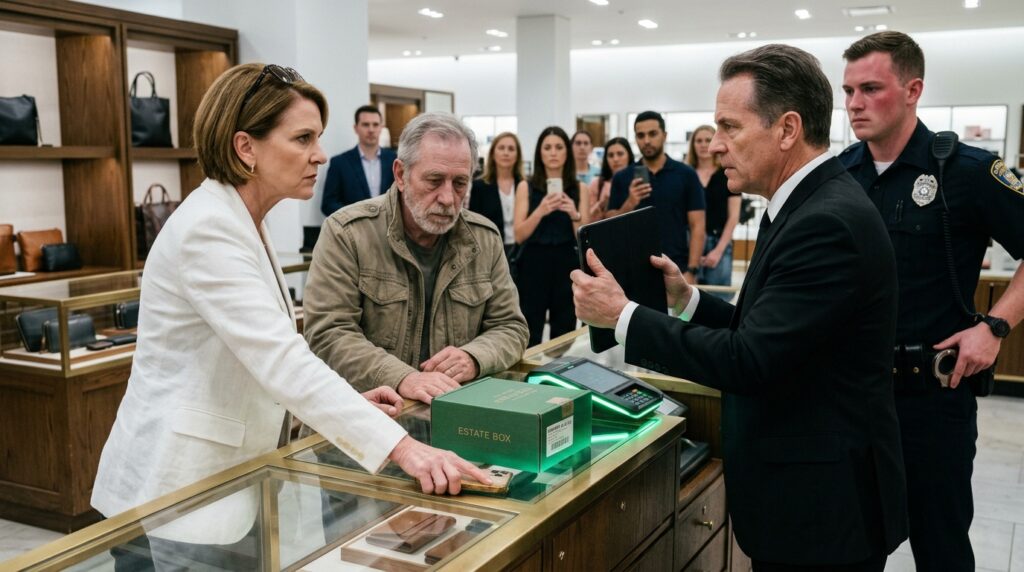
Mr. Vance, the store manager—unrelated to Victoria despite the regional surname pool—stepped onto the marble floor. His gray hair was cut with industrial precision, his black tailored suit completely unwrinkled, but his hands were white where they gripped the edges of a corporate tablet. Behind him stood the head of regional loss prevention, a thick-necked man in a dark blazer whose eyes didn’t look at Marcus, but rather at the terminal’s green diagnostic output.
“Mr. Vance,” Victoria said, her voice instantly rising into its familiar, high-pitched cadence of local entitlement as she lowered her phone an inch. “You arrived just in time. This transient is trying to force a system override on a waitlisted asset. The officer was about to remove him from the floor.”
The manager didn’t look at her. He didn’t look at her smartphone camera. He walked straight to the side of Counter Two, his polished oxfords leaving a sharp click on the limestone that sounded like a dry branch snapping. He reached out, his thumb hitting the tablet screen to sync with the counter terminal.
“Officer Davies, release his sleeve,” Mr. Vance said, his voice flat, dry, and entirely devoid of the retail warmth he usually offered weekend shoppers. “The individual at the counter isn’t unverified. The account signature currently displaying on that screen is a permanent executive charter.”
“What are you talking about?” Victoria demanded, her shoulder squaring as she moved her camera lens until it was inches from the manager’s face. “The screen was just red. It was flagged for fraud. I have the entire sequence recorded on this device.”
“The red block was an automated legacy partition, Mrs. Vance,” the store manager said, finally turning his eyes toward her. They were cold, gray, and completely blank. “It was programmed to trigger if anyone other than the primary trustee attempted to access the ART-1964 routing registry. It’s not an identity failure. It’s a security lock designed to protect an estate gift.”
Marcus looked at the green screen. The text had stabilized now, displaying a clean, line-item ledger that had been locked away in the corporate mainframes since the spring changeover: PRE-PAID VIA REGIONAL TRUSTEES OFFICE – OCTOBER 14 – ITEM #084 SADDLE-LEATHER BRIEFCASE. STATUS: CLEARED FOR IMMEDIATE DELIVERY TO M. THORNE.
Below the price block, written in the small, standardized syntax of old corporate memos, was a single note that Marcus hadn’t seen before—a note added by Arthur during his last week at the corporate office, long before the hospital bed had been delivered to the living room: For the girl’s desk. Keep the leather oiled, Marc.
The weight in Marcus’s chest didn’t lift, but it changed. It went from the cold, sharp edge of a sudden confrontation to the heavy, familiar grain of an old piece of timber. Arthur hadn’t just bought a bag; he had left a permanent marker inside the very architecture they had built together, a small piece of unyielding engineering designed to survive the noise of people like Victoria Vance.
“This is an administrative manipulation,” Victoria said, but her voice was cracking now, the rhythmic, confident gait of her speech fracturing into a series of sharp, desperate pauses. She turned back to Davies, her phone hand shaking so violently the camera frame was blurring against the light. “Officer, look at the timeline. They’re changing the registry entries in real time to cover a compliance breach. My husband sits on the commission—he will have this entire branch’s commercial license pulled by Monday morning.”
Davies didn’t look at her. He had already slipped the handcuffs back into their leather pouch, his thumb securing the brass snap with a distinct, heavy click. He looked down at the tablet screen the manager was holding out for him, his eyes scanning the corporate registration number and the official title stamped at the top of the ledger profile.
“Ma’am,” Davies said, his voice dropping into the hard, quiet register of an officer who realized he had been led onto a very thin piece of ice. “Put the phone down on the counter. We have a different set of log entries to look at now.”
CHAPTER 5: THE FINAL CLEARANCE OF COUNTER TWO
“The phone goes flat on the wood, ma’am,” Officer Davies said. His hand didn’t move fast, but it carried the unyielding weight of twenty-eight pounds of duty gear shifting as he stepped directly into Victoria Vance’s line of sight. The stiff leather of his belt casing rasped hard against his side. “Right now. We’re done with the recording.”
Victoria’s manicured fingers twitched, the gold-rimmed casing of her phone slipping slightly against her palm before she slammed the device face-down onto the mahogany counter. The glass impact made a sharp, hollow crack that vibrated through the empty register tray. “This is absurd. You are taking the word of a retired desk clerk over a verified merchant contributor? My husband—”
“Your husband’s office didn’t clear this ledger block, Mrs. Vance,” the store manager interrupted. His voice was entirely devoid of retail rhythm, cold and flat as a slate shingles. He didn’t look at her; his fingers were already tapping a secondary confirmation sequence into his corporate tablet, the screen casting a pale gray light across his tailored cuffs. “The regional security network has been tracking the unauthorized terminal requests from your personal loyalty token for three weeks. You weren’t waiting for a distribution list. You were attempting to force an administrative override on a pre-assigned estate asset.”
Marcus stood perfectly still, his weathered hands remaining anchored to the brass rail of Counter Two. He watched a single, tiny drop of sweat trace its way down Davies’ cheekbone, tracking into the blue collar of his uniform. The silence in the checkout lane had grown heavy, a dense, physical pressure that pushed the remaining shoppers back into the wide aisles of the perfume section. The smartphones that had been pointed at Marcus’s canvas jacket were all dropping now, their lenses turning away like iron sights being lowered.
Elena, her thumb finally steadying against the green cardboard package, used a steel box cutter to slide through the reinforced paper tape. The sharp, dry hiss of the blade severing the fibers was the only sound left under the high LED grids. She lifted the heavy lid, pulling the saddle-leather duffel from its tissue wrapping.
The scent of deep, oil-tanned hide and heavy brass hardware immediately cut through the synthetic lavender wax of the floor floor. Marcus didn’t look at the leather grain; his eyes locked onto the small brass zipper pull. There, tied with a thin, knotted piece of waxed twine, was an old, scratched copper coin—an unpolished token from the transit division where he and Arthur had spent their first winter in thirty-year-old boots, checking compliance plates in the sub-zero freight yards.
It was the true reality of the registry block. Arthur hadn’t just used an obsolete routing code to buy a graduation gift; he had buried his own final, physical signature inside the inventory tracking architecture, knowing Marcus would be the only compliance officer left in the state with the clearance to pull the keyway.
“Officer,” the store manager said, his eyes still fixed on the scrolling green columns of Counter Two’s diagnostic monitor. “The corporate compliance division has completed the multi-angle review. We have evidence of structural extortion and an attempted asset seizure via false representation. The store wishes to file formal charges for commercial disruption and initiating a fraudulent emergency response.”
Davies nodded once, his face tightening into the hard, transactional mask of the city precinct. He turned his body toward Victoria, his boots leaving another dark smudge on the limestone floor. “Ma’am, place your hands behind your back. We’re moving down to the precinct intake room now.”
Victoria took a half-step backward, her heels catching on the marble edge of the display island. Her face was completely devoid of its polished socialite coloring now, turned a pale, grease-slick white that made her oversized sunglasses look massive against her cheekbones. She reached for her leather clutch, her arm shaking so violently her keys let out a rhythmic, frantic jingle against the brass clasp. “You can’t touch my property. The commission liaison will have this entire section cleared by the county board—”
“The county board doesn’t own the registry, ma’am,” Marcus said. His voice was very quiet, but it hit the silent room with the dry, heavy force of an old ledger closing on a desk. He didn’t lift his hands from the rail. He simply looked at her through the dark reflection of the counter glass. “The system only records what has been paid for. The clothes don’t alter the time-stamp.”
Davies’ arm went out, his heavy black forearm guard pressing against Victoria’s shoulder with the blunt, mechanical indifference of an engine part. The metal links of his cuffs clicked twice as they cleared the leather pouch, the sound sharp and crisp against the polished stone. Victoria didn’t shout; she let out a small, wet gasp as her wrists were pulled back, her white linen sleeves wrinkling instantly under the officer’s grip.
Marcus didn’t watch them move her toward the glass entrance doors. He didn’t look at the small crowd of shoppers who were currently splitting into two separate, silent lines to let the officer pass. He turned his face back to Counter Two, where Elena was carefully smoothing the gold ribbon around the heavy green box.
“Your transaction is completely cleared, Mr. Thorne,” the store manager said, extending a hand to hand Marcus the printed validation slip. “The executive retirement profile has been reset to idle status. We are deeply sorry for the friction on our floor today.”
“The friction is part of the layout,” Marcus said, his gravelly voice dropping into his jacket collar as he took the paper. He didn’t shake the manager’s hand. He lifted the heavy green box by its twine handles, feeling the coarse, unyielding bite of the fiber against his calloused palms.
He walked away from Counter Two, his oil-tanned boots hitting the white limestone with the same slow, heavy thud that had brought him into the store. As he pushed through the heavy glass exterior doors and stepped into the cold, gray November air of Grand Avenue, the dry scent of industrial wax vanished, replaced by the clean, sharp smell of coming winter. The house on Elm Street would still be quiet when he got back, but the box in his arms felt real, stable, and completely accounted for.