
The Thermal Line of Proof and the Cold Weight of Public Honor
CHAPTER 1: THE ACCUSATION AT REGISTER 4
“Don’t move a muscle! I saw you slip that box into your bag without hitting the scanner, and police are already on their way!”
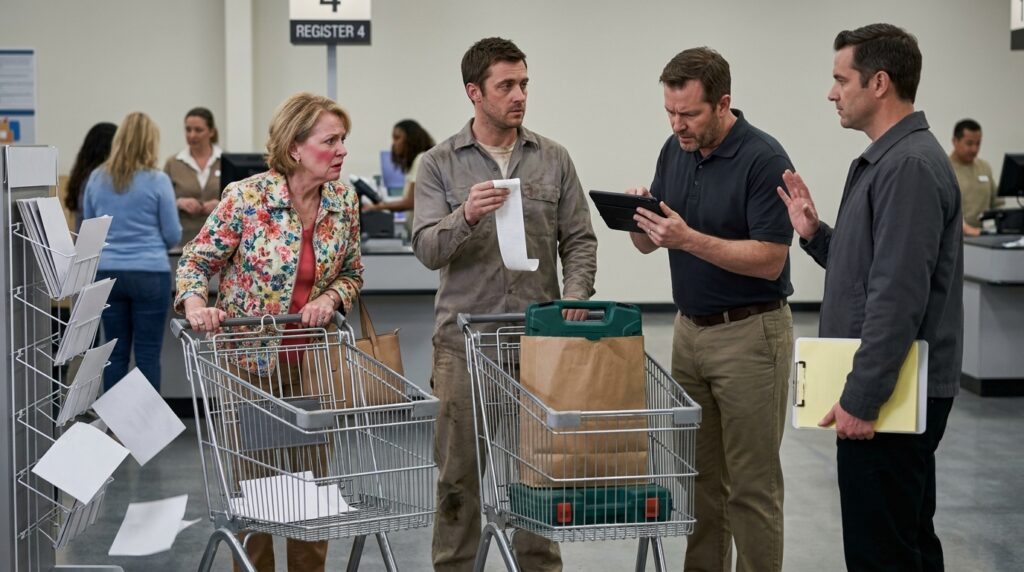
The beam of the smartphone flashlight hit Marcus Carver directly across the bridge of his nose, sharp and white against the dull fluorescent hum of MetroMart’s front lobby. He didn’t blink. He didn’t drop his hands. His right thumb remained pinned over the cold, waxy edge of the thermal paper receipt folded double between his knuckles.
Across the narrow concrete lane of Register 4, Brenda Halloway leaned her weight into the chrome handlebar of her shopping cart, jamming its front wheels diagonally into the steel frame of the magazine rack. The metal groaned under the force. The exit lane was choked shut. Behind her, a line of six shoppers carrying plastic baskets froze, the squeak of the rubber conveyor belt dying as the cashier hit the manual pause button.
“You think because you wear dirt on your boots you can walk out the front door with two hundred dollars of heavy hardware?” Brenda’s voice cut through the air, pitched high enough to rattle the plastic display racks of gum and gift cards. Her floral-patterned jacket puffed out as she shifted her weight, the heavy leather strap of her handbag dug deep into her shoulder. “I watched you. I watched you place the paper bag over the rotary box before the girl even hit the item key.”
Marcus felt the dry dust of drywall plaster settling into the creases of his palms. Nine hours on a commercial job site had left a dull ache behind his eyes, but his posture remained rigid. He didn’t step back into the register nook, nor did he reach into the paper bag to adjust the dark green metal case resting at the bottom.
“My items are paid for,” Marcus said. His voice was flat, carrying no more weight than the hum of the refrigeration units behind him. “The receipt is right here. Move the cart.”
“I am not moving a inch until security clears those bags,” Brenda said, stepping closer until the toe of her leather shoe touched the front wheel of his cart. She swung her phone toward the crowd of gatherers, bright screen catching the reflection of thirty pairs of eyes. “He’s trying to hustle his way past the turnstile! Look at him! He won’t even show what’s under the paper!”
Two cashiers at the neighboring register leaned across their counters, whispering into their shoulder mics. A man three places back in line hoisted his toddler higher onto his hip, stepping back toward the cereal aisle to clear a path for whatever was about to break.
Marcus looked down at the phone torch steady in his face. Beneath his thumb, he felt the tiny raised perforation along the top edge of the paper—the clean tear off the terminal cutter reel three minutes ago. He didn’t hand it across the cart. He didn’t raise his voice to match her register. He simply turned his wrist slightly, exposing the printed black ink of the store header to the overhead camera dome mounted twelve feet above their heads.
Then Brenda reached out. Her manicured fingers snapped forward, reaching directly for the top flap of Marcus’s brown paper bag.
Marcus shifted his forearm four inches to the left, his elbow locking into a solid vertical frame that blocked her wrist cold without making contact with her skin.
Brenda pulled her hand back as if burned, her face flushing dark red beneath her styled gray hair. “He just put hands on me! Everyone saw it! He assaulted me to protect the stolen goods!”
From down the main center aisle, the quick, rhythmic slap of rubber-soled dress shoes signaled the approach of store management. But as Manager Vance cleared the end-cap display with a clipboard tucked under his arm, Brenda pulled a second folded paper from her inner handbag pocket—a printout bearing the MetroMart corporate crest and a freshly stamped red barcode.

CHAPTER 2: THE PAPERWORK PARADOX
The red ink on the corporate crest was so fresh it glistened under the fluorescent bay lamps.
Marcus didn’t flinch as Brenda snapped the folded document open, its crease making a sharp thwack that silenced the remaining hushed whispers along the register line. She held it four inches from Manager Vance’s face, her thumb pressing hard against the margin, covering everything except a long string of alphanumeric code and a dark red confirmation stamp that read AUDIT LOSS PREVENTION – INTERNAL USE ONLY.
“Read it, Terrence,” Brenda demanded, her voice dropping from a public scream to a low, weaponized hiss. “I pulled the live API feed off the customer loyalty portal thirty seconds before I cut off his cart. The register register log for Lane 4 shows three items scanned between 5:12 PM and 5:14 PM. A gallon of whole milk, a two-pound sack of yellow onions, and a box of heavy-duty contractor garbage bags. Total bill: twenty-four dollars and eighteen cents.”
Manager Vance blinked, his tiredness momentarily hardening into confusion. He looked at the printed sheet, then at the heavy green metal case resting under the brown paper sacks in Marcus’s cart. The rotary drill kit alone carried a shelf tag of two hundred and forty-nine dollars.
“This is an official transaction audit,” Brenda continued, turning her head just enough to ensure the phone cameras held by nearby shoppers caught the paper in her hand. “The system registers what passes the scanner optic. If it’s not on the log, it didn’t hit the bill. He paid twenty-four bucks for three hundred dollars’ worth of store property.”
Marcus kept his posture locked, his weight centered over his dust-caked work boots. He didn’t look at the manager’s face. He didn’t look at Brenda’s floral jacket. His eyes remained fixed on the lower edge of the sheet in Brenda’s hand.
The paper was standard twenty-pound printer bond, slightly crinkled at the corners. But the MetroMart customer portal didn’t generate red ink stamps. The loyalty application offered digital receipts in plain gray text, optimized for mobile screens, not formatted with corporate loss-prevention headers and internal routing numbers.
Brenda hadn’t just checked a phone app while waiting in line; she had brought a pre-printed, stamped document into the store before Marcus had even walked up to the register conveyor belt.
“Let me see the receipt you’re holding, Marcus,” Vance said, his voice flat, cautious. He held out his left hand, keeping his right thumb hooked into the collar of his uniform polo.
“No,” Brenda interjected instantly, leaning her hips harder against the metal cart handle to keep Marcus pinned against the display rack. “Don’t let him swap it out! He’s had his hands in his pockets since he stepped past the belt. He could be holding any register slip from last week.”
“I haven’t touched my pockets since the cashier handed me my change,” Marcus said. His voice was a calm, low rasp, devoid of panic. He held the folded paper between his index and middle fingers, motionless in the air between them. “The timestamp on this slip says 5:14:22 PM. Register 4. Terminal ID 08. The drill kit is item code 409-22-B. It’s listed on line two.”
“He’s lying!” Brenda turned to the cashier behind the lane, a teenage girl with her hair tied back in a messy ponytail, who was staring wide-eyed at the standoff. “Jessica! Tell the manager! Did you scan that green box, or did he leave it tucked under his elbow when he pushed past you?”
Jessica shrank back against the register housing, her fingers hovering over the red emergency clearance key on her keyboard. “I—I scanned everything on the belt,” she stammered, her voice shaking under the pressure of twenty staring shoppers. “He put everything on the belt… I think. It was moving fast, Brenda. I was clearing the back-up.”
“She didn’t scan it,” Brenda announced loudly to the crowd, turning her back on Marcus as if the matter were already settled. “The employee just confirmed it. It was a distraction play. He stacked the paper bags over the high-value item so the optic couldn’t register the code.”
Vance shifted his weight, the leather of his shoes squeaking against the polished linoleum. He reached into his belt holster and pulled out his handheld inventory terminal—a ruggedized black tablet with an integrated laser optic.
“I’m not making a call on a paper sheet,” Vance said, looking directly at Brenda now, a flicker of irritation breaking through his executive composure. “If there’s a discrepancy between the POS terminal and the floor stock, I have to run the transaction query through the server hub at the customer service desk.”
“The server hub?” Brenda’s eyes narrowed slightly, her right hand tightening on her handbag until the leather groaned. “Why waste time walking back there when I have the loss-prevention log right here? Call the police cars waiting outside! I gave the dispatcher the plate number on his truck five minutes ago!”
Marcus registered the detail silently. Five minutes ago.
Five minutes ago, he was still standing in the queue behind an elderly woman paying in exact change. Brenda hadn’t called the police when she supposedly witnessed a crime at the register lane. She had called them while he was still standing in line, waiting his turn to pay.
“I’m not detaining anyone without checking our own system, Brenda,” Vance said sharply. He turned to Marcus. “Sir, stay right here by the lane. Don’t move the cart.”
“I’m not going anywhere,” Marcus replied, his voice unbothered, his eyes tracking the slight twitch in Brenda’s jaw as Vance key-coded his handheld unit to open a local system override.
Brenda stepped forward again, her floral sleeve brushing the metal frame of Marcus’s cart. She raised her phone once more, holding it sideways to capture Marcus’s face, his work shirt, and the brown paper bags in a single tight frame.
“Look at him, folks,” she sneered to the optic lens. “Caught red-handed, waiting for management to cover up another floor theft.”
Marcus didn’t hide his face. He simply stared directly into her camera lens, his expression carved from stone, holding the small folded paper flat against his chest like a shield waiting for the strike.
CHAPTER 3: THE BUREAUCRATIC TANGLE
Manager Terrence Vance’s heavy black dress shoes made a hollow, rhythmic thud against the polished concrete floor as he stepped between the shopping cart’s front wheels and the register counter. The handheld inventory tablet in his right hand hummed, its green laser optic sweeping once across the cold floor tile before he raised it to eye level.
“Stand back, Brenda,” Vance said. The exhaustion in his voice had burned away, replaced by the cold, clipped tone of an executive managing a active liability hazard. “I am running a line-item check on POS 08 directly from the main server. Store policy does not permit third-party audit documents to dictate physical detention on floor property.”
“Third-party?” Brenda snapped, her sunglasses slipping down the bridge of her nose as her head jerked toward him. “This comes straight off the MetroMart enterprise API! My brother-in-law sits on your regional compliance board, Terrence. I know how the data stream mirrors to the mobile portal!”
Marcus didn’t blink. He stood rooted beside his cart, his left hand resting flat against the metal top bar, his right thumb keeping the folded paper receipt pinched tight. He watched Brenda’s left hand as she adjusted her heavy leather shoulder bag. As her fingers twisted into the strap, the bag’s main magnetic clasp popped open under the strain.
Inside the dark leather lining, tucked beside a silver compact mirror and a bundle of yellow receipts, lay a second sheet of folded paper. It bore the exact same dark red ink stamp at the top margin, but the bold heading across the middle line didn’t read AUDIT LOSS PREVENTION.
It read NOTICE OF CIVIL ACTION AND TORT CLAIM — DRAFT.
Marcus’s eyes narrowed by a fraction of a millimeter. The name typed beneath the defendant header wasn’t MetroMart Inc. It was Carver, Marcus E.—followed by his home address on West 14th Street.
She hadn’t just printed a fake transaction log before walking into the store. She had already pulled his vehicle registration from his truck’s license plate in the parking lot and drafted a legal complaint before he even placed his paper bags onto the rubber conveyor belt.
“The server query is locked,” Vance announced, his thumb tapping the tablet screen. The device emitted a series of sharp digital beeps that cut through the low rumble of the store’s air handling system. “I’m pulling the transaction record for Terminal 08 between 5:10 PM and 5:15 PM.”
“You’re giving him time to stall!” Brenda shouted, turning her phone back toward the gathering ring of thirty shoppers. Her voice rose into a sharp, theatrical vibrato. “Look at this, everyone! Corporate management protecting a thief while the paying customers wait in line! He’s going to manipulate the server logs right in front of us!”
A couple standing behind the magazine rack shifted their weight, their faces drawn into tight masks of suspicion. A young man wearing a high-visibility construction vest pushed his way to the front of the crowd, his boots thumping hard against the floor.
“Hey, lady,” the worker said, pointing a calloused finger at Brenda’s cart. “Let the man show his paper. You’ve been blocking Lane 4 for ten minutes, and some of us have shift work to get to.”
“Mind your business!” Brenda shot back, her arm swinging out so violently her heavy handbag slapped against the metal frame of Marcus’s cart. “He stole three hundred dollars in commercial equipment! If you let him walk, your prices go up next week!”
“Vance,” Marcus said quietly. He didn’t turn his head. His voice cut beneath the noise like a steel cable pulling taut. “Scan the slip.”
Vance hesitated, his eyes flicking from the drafted legal paper bulging out of Brenda’s open bag to the steady, unmoving hand Marcus held extended across the cart handle. The manager took one step forward, extending the dark red laser grid of the inventory terminal toward the folded paper in Marcus’s fingers.
“Don’t touch that paper, Terrence!” Brenda shrieked, lunging forward with her left shoulder to slam into Vance’s arm before the laser grid could lock onto the printed barcode.
The collision forced Vance two steps sideways into the register counter. The handheld tablet jolted in his grip, its red optic beam sweeping across the ceiling before snapping back down. But Marcus didn’t step back. When Brenda’s arm swung toward the manager, her heavy handbag swung wide, catching on the corner of the magazine display rack.
The magnetic clasp tore open completely.
The stack of papers inside slid out, catching the draft from the main entrance doors, and scattered face-up across the polished grey floor right between Marcus’s work boots and Brenda’s leather shoes.
The top sheet landed flat under the harsh fluorescent lights. Printed in bold black ink, directly below the red stamp, was a pre-calculated itemization of damages: Pain and Suffering, Intentional Infliction of Emotional Distress, Unlawful Assault in a Public Venue — Total Claimed: $45,000.
The crowd went dead silent. The cashiers stopped their whispering. The construction worker in the high-vis vest leaned over, his eyes scanning the header printed on the floor.
Marcus looked down at the paper resting at his feet, then looked up into Brenda’s eyes. Her face had drained of all color, her manicured fingers trembling as she dropped her phone to her side.
“You printed the lawsuit before you bought your groceries,” Marcus said, his voice echoing in the sudden quiet of the front lobby.
Before Brenda could scoop the papers off the floor, the sliding glass doors at the main exit hissed open, and the sharp metallic clinking of a duty belt signaled the entry of local law enforcement.
CHAPTER 4: THE HARD DATA FLIP
Officer David Kowalski didn’t pause to let the ambient noise of the lobby settle. His boots hit the linoleum with a heavy, deliberate rhythm, his right hand resting flat over the snap of his belt holster. Behind him, Manager Vance finally recovered his footing, bringing the black inventory terminal up until the red laser optics lined up directly with the barcode held in Marcus’s steady grip.
“Nobody move,” Officer Kowalski instructed, his eyes sweeping across the scattered sheets on the floor before locking onto Brenda. “What’s the disturbance here, Terrence?”
“The customer reported a grand theft,” Vance said, his thumb pressing hard into the trigger of the handheld scanner. “I am verifying the physical receipt against the register log now.”
The red laser grid flashed three times across the thermal slip held between Marcus’s fingers.
CHIME.
The speaker on the inventory unit didn’t produce an error buzz. It emitted a single, high-pitched confirmation bell that rang out sharply against the high ceiling of the storefront. On the liquid crystal screen, bright green block text rendered instantly: TRANSACTION VERIFIED — REGISTER 08 — TIME: 17:14:22 — ITEM 409-22-B (ROTARY DRILL KIT) PAID IN FULL: $249.00.
The construction worker in the high-vis vest let out a short, barking laugh. “Told you. The man bought his gear.”
Brenda’s chest heaved. She scrambled down toward the floor, her manicured nails scraping against the tile as she tried to gather the scattered civil complaint forms before Officer Kowalski’s boots could pin them. “The system was tampered with!” she yelled, her voice breaking into a harsh screech as she clutched the paper stack to her ribs. “Look at the time! He couldn’t have checked out in two minutes! He had an accomplice at the register!”
“Check the ceiling optic, Officer,” Marcus said. He didn’t drop his hand. He pointed his thumb up toward the dark plastic hemisphere mounted directly over the conveyor belt. “Camera four. It’s got an uninterrupted line of sight from the moment I set the green box on the rubber to the moment the paper printed.”
Officer Kowalski turned to Vance. “Pull the buffer.”
Vance didn’t argue. He tapped the interface screen of his tablet, rotating the display so both the officer and the nearest ring of bystanders could see the live playback stream. The video was crisp, full-color, high-definition.
On the screen, the timestamp read 17:13:50. Marcus was visible standing quietly in his dusty work shirt, holding a single brown bag while the cashier scanned the heavy green rotary case. The red scanner light beneath the glass counter flashed once as the box passed over it. The cashier then keyed the total, Marcus tapped his card on the terminal reader, and the paper receipt fed out of the slot at 17:14:22.
There was no gap. There was no missing item. There was no distraction play.
Then the camera angle widened.
On the top left corner of the security feed, recorded three minutes before the transaction even occurred, Brenda Halloway was clearly visible standing near the exit doors. She wasn’t holding groceries. She was holding a pre-printed stack of legal forms in one hand and her phone in the other, her eyes fixed entirely on Marcus’s truck through the glass wall as he pulled into the parking lot.
The camera caught her stepping forward, deliberately shoving her cart into the narrow exit lane the exact moment Marcus turned away from the register.
“She was waiting for him,” Officer Kowalski noted, his tone dropping several octaves as he turned his full attention to Brenda. “She set up the roadblock before he even hit the belt.”
Brenda stood up slowly, her knees shaking under her floral jacket. The clutch bag in her hands slid slightly, exposing a bright orange notice tucked into the front sleeve. Printed in thick red lettering across the top was an urgent bank demand: ACCOUNT OVERDRAWN — NOTICE OF PENDING JUDGMENT AND REAL ESTATE ATTACHMENT.
Marcus took a step forward, his boot coming down inches from her cart. The decoy secret—the claim of a digital audit discrepancy—was completely dead, smashed beneath the weight of raw system logs and video timestamps. But the deeper truth lay exposed on the paper in her hands: she hadn’t misread the situation, and she hadn’t acted out of civic pride. She was broke, facing immediate financial collapse, and had deliberately targeted a solitary working-class man in a public venue, hoping to provoke a quick physical shove or a hasty corporate payout to settle her debts.
“You called the dispatch line from the parking lot,” Marcus said, his voice cold, razor-sharp, and unyielding. “You knew the receipt was real before I even took it out of my pocket.”
Brenda backed up half a step, her heel catching on the frame of her shopping cart, her eyes darting frantically toward the glass exit doors as Officer Kowalski unhitched the leather retention strap on his notepad.
CHAPTER 5: THE CITATION AND THE RESTORED LINE
The heavy silence across Lane 4 held a different weight now. It was no longer the tense, suffocating quiet of a crowd waiting for a working man to break under accusation. It was the sharp, clinical silence of thirty people watching a calculated trap disintegrate into raw paper and recorded time.
Officer David Kowalski stepped into the narrow gap between the chrome cart and the register counter. His gloved hand reached down, taking the scattered stack of civil draft forms directly from Brenda’s trembling fingers. He didn’t bend to inspect them fully; he simply turned the pages until the red corporate audit stamp aligned with the overdrawn bank attachment clipped underneath.
“Ma’am,” Kowalski said, his voice level, carrying the flat, unyielding authority of a sworn officer on a public record. “Turn off your phone camera and place your hands on the handlebar of this cart.”
“You’re not listening to me, Officer!” Brenda’s voice cracked, her heels skittering an inch backward against the polished linoleum. “He put his arm out! He physically impeded me when I attempted to preserve store property! That’s an assault! It’s right there in my statement!”
“I just watched thirty minutes of continuous server footage from terminal camera four,” Kowalski replied, taking a single step forward to narrow her exit angle. “You stood by the main doors for twelve minutes waiting for his vehicle to park. You blocked an exit aisle. You made a false 911 report claiming a grand larceny in progress while the cashier was still handing him his receipt. And you attempted to provoke a physical altercation while carrying pre-drafted tort litigation forms naming this gentleman as a defendant.”
Kowalski pulled a yellow citation pad from his tactical vest pocket, snapping the pen cap off with a sharp click.
“You are being cited for disorderly conduct, filing a false emergency report, and public nuisance,” Kowalski said. “And if Mr. Carver chooses to file a complaint for harassment and false imprisonment, you will be receiving a summons at your home address.”
Brenda turned her head frantically toward Manager Vance. “Terrence! Tell him! Tell him I’m a loyalty member! I’ve shopped here for twelve years!”
Vance didn’t look at her sunglasses or her floral jacket. He stepped behind the customer service counter, tapped three keys on his master keyboard, and retrieved a freshly printed yellow carbon sheet from the laser printer.
“As general manager of MetroMart Store 114, I am issuing a formal Notice of Criminal Trespass against you, Brenda Halloway,” Vance declared, his voice ringing crisp across the front lobby. “Effective immediately, your store membership is revoked. If you set foot on MetroMart property—the building, the garden center, or the parking lot—you will be arrested for trespass without further warning.”
He laid the yellow form flat on top of her cart, right next to her handbag.
A low murmur rippled through the checkout lines. The construction worker in the high-vis vest folded his arms and let out a long, slow whistle. Two women holding grocery baskets stepped out into the main aisle, their phones raised high, capturing Brenda’s wide, terrified eyes as Kowalski took her left wrist in a firm, professional escort grip.
“Move your cart out of the lane, ma’am,” Kowalski instructed smoothly, wheeling her metal barrier backward away from the magazine rack. “We’re going out to the cruiser to sign the citation.”
Brenda didn’t speak again. Her mouth worked silently, her face burning a deep, mottled red as the officer guided her down the main center aisle toward the sliding glass doors. The crowd parted clean down the middle, shoppers pulling their carts back to give the officer a wide berth. As she passed Register 4, the silence broke into the sharp, rhythmic clapping of two cashiers down the line, followed by the low, approving nods of the working men waiting in queue.
Marcus stood completely still until the automatic exit doors hissed shut behind Brenda and the patrol car lights began to flash outside through the dark glass.
He looked down at his right hand. The skin across his knuckles was dry from a day spent pulling wire through steel studs, but his grip remained rock steady. Held between his fingers was the thin strip of thermal paper—intact, crisp, and unwrinkled.
Manager Vance walked around the register counter, his face exhausted but his posture straight. He looked at the heavy green rotary drill case resting inside Marcus’s brown paper bags, then looked Marcus dead in the eye.
“Mr. Carver,” Vance said, offering his hand across the rubber conveyor belt. “I apologize for the delay and the disruption to your evening. Thank you for your patience.”
Marcus took the manager’s hand, giving it one firm, calloused shake. “You checked the data, Terrence. That’s all that matters.”
Marcus stepped around the edge of the magazine rack, his work boots thumping softly against the clean floor as he pushed his cart out through the double sliding doors into the cool evening air. The parking lot lights had just flickered on, casting long, sharp shadows across the asphalt.
He loaded the brown paper sacks and the green tool case into the back cab of his pickup truck, shut the tailgate with a solid metallic thunk, and slid the folded paper receipt neatly into his shirt pocket, right above his heart.







