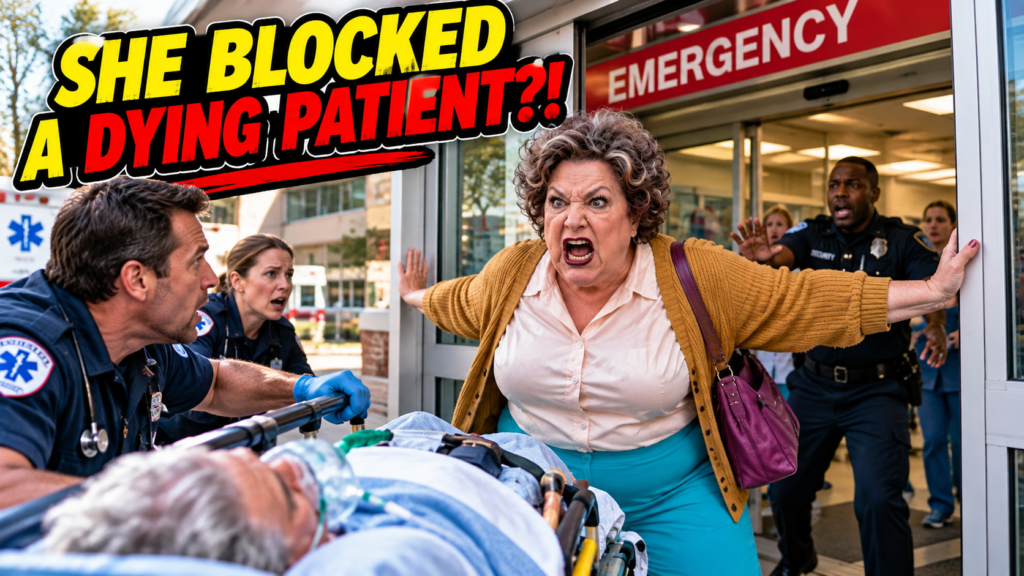
Chapter 3: The Waiting Room Nobody Had Mentioned
By morning, the emergency entrance incident had become more complicated than a rude confrontation.
Marlene had been moved to the outpatient waiting area, where Patricia found her sitting alone with her purple bag in her lap.
She expected another complaint.
Instead, Marlene handed her a phone.
On the screen was a text message from the hospital.
Please check in at the emergency entrance upon arrival.
Patricia read it twice.
That message had not come from the normal appointment system.
The hospital had no record of sending it.
“Where did you get this?” Patricia asked.
“It came to my phone.”
“Did you reply?”
“No.”
Patricia called the scheduling desk.
The answer came back quickly.
No one there had sent it.
Then Marlene showed them another message.
This one contained a name.
Not an employee.
A patient liaison.
Someone who had worked at the hospital several years earlier.
Patricia recognized the name immediately.
“Evelyn Shaw.”
Marlene nodded.
“She helped me after my husband’s surgery.”
Patricia’s expression changed.
Evelyn had left the hospital years ago.
Her account should have been inactive.
That afternoon, the hospital’s information-security team confirmed something unsettling: the message had originated from an old communication pathway that should no longer have been active.
Marlene had not simply wandered into the wrong entrance.
Someone—or something—had directed her there.
But the discovery didn’t excuse what she had done.
Daniel was still shaken by the confrontation.
He had been trying to get a patient through the doors while Marlene physically obstructed the path.
Later, Patricia brought the two of them together.
Marlene looked at Daniel.
For once, she didn’t interrupt.
“I thought I was being ignored,” she said.
Daniel nodded.
“I understand that.”
“But I was wrong about what was happening.”
“Yes.”
She looked down.
“I still don’t like being told I don’t matter.”
Daniel’s expression softened.
“You matter. But an emergency entrance can’t work on whose turn it feels like.”
That sentence stayed with her.
Then Patricia received a call.
The security team had found something else.
The same inactive communication account had sent messages to three other patients that week.
All three had been directed toward the emergency department.
And one of those patients had missed a time-sensitive procedure because of it.
The door confrontation was no longer an isolated argument.
It was evidence of a larger failure.