Chapter 2: The Building Had Rules
Harold lived on the fourth floor of Maple Ridge Commons, a well-maintained residential community built around a landscaped courtyard and two elevator banks.
The building had been designed with older residents in mind.
Wide hallways.
Automatic doors.
Handrails.
Low thresholds.
And elevators large enough for wheelchairs, walkers, mobility carts, and residents who simply needed more time to move.
Harold had never thought of those features as luxuries.
They were part of the reason he had chosen the building after his wife’s death.
He wanted a place where growing older did not mean becoming dependent on everyone around him.
That evening, his daughter Emily noticed something was wrong.
She had stopped by after work and found her father unusually quiet while putting groceries away.
He told her what happened.
Emily listened without interrupting.
Then she asked one question.
“Did she touch you?”
“No.”
“Did she threaten you?”
“No.”
“Then what bothers you?”
Harold closed the refrigerator.
“The fact that she thought she could decide whether I was allowed to use the elevator.”
Emily nodded.
She understood.
It wasn’t about the elevator.
It was about control.
The next morning, Harold went downstairs early.
He found a printed notice taped beside the elevator call buttons.
RESIDENTS MUST NOT OBSTRUCT ELEVATOR ACCESS OR DELAY OTHER RESIDENTS FROM ENTERING.
Harold stared at it.
The notice was official.
It carried the building management logo.
At the bottom was the name of the property manager, Linda Morales.
Harold had seen Linda around the building for years. She was calm, practical, and rarely dramatic.
He took a photograph of the notice.
He did not complain immediately.
Instead, he asked himself what he actually wanted.
He didn’t want Karen punished.
He didn’t want a public argument.
He wanted the rule to mean something.
That afternoon, Harold visited the management office.
Linda looked up when he entered.
“Morning, Harold.”
“Morning.”
He explained what happened.
Linda’s expression changed when he mentioned Karen’s name.
“Was this yesterday?”
“Yes.”
“Which elevator?”
“The one on the left.”
Linda leaned back.
“That elevator’s access-control system logged an interruption yesterday.”
Harold frowned.
“What kind of interruption?”
“I don’t know yet.”
She turned toward her computer.
The building had recently upgraded its elevators. Each one recorded door-open commands, emergency stops, service overrides, and access events.
Linda pulled up the previous afternoon’s records.
There were several entries.
At 4:17 p.m., the first elevator had received a door-open command.
At 4:18, the doors closed.
At 4:18 and 12 seconds, the system recorded another interruption.
Linda looked at Harold.
“That was probably when she held the door.”
Harold said nothing.
Linda continued scrolling.
Then she stopped.
“There.”
“What?”
“She entered the elevator at 4:19.”
Harold remembered seeing Karen disappear behind the doors.
Linda pointed to the screen.
“Then she selected the wrong floor.”
Harold almost smiled.
“So she really did get stuck going the wrong way.”
Linda shook her head.
“Not stuck. Just redirected.”
That distinction mattered.
The system had done nothing unusual.
Karen had simply made a mistake.
But there was something else.
Linda opened the building’s security camera system.
The lobby camera showed the elevator entrance.
She played the recording.
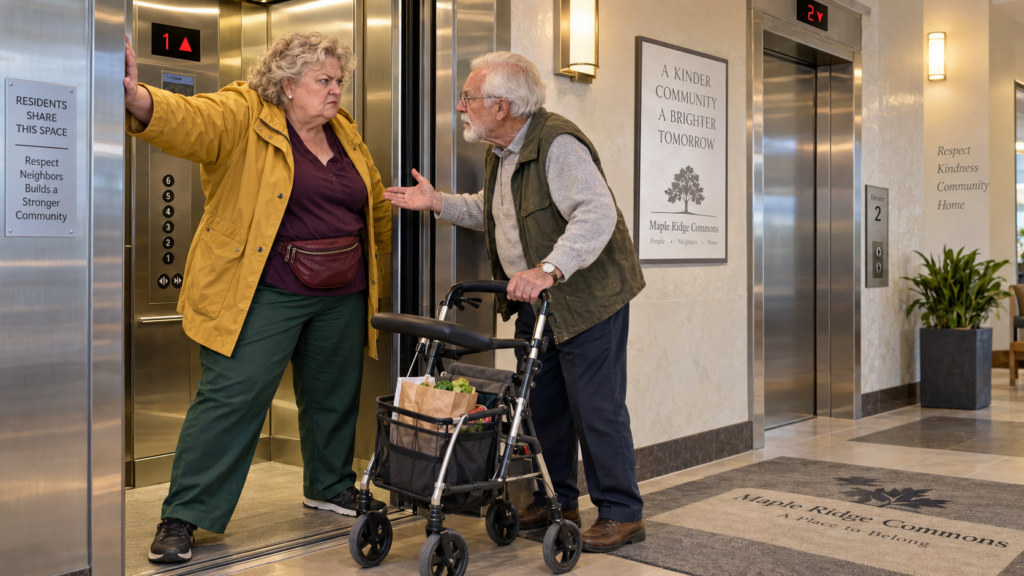
There was Harold.
There was the cart.
There was Karen stepping directly into the doorway.
Linda paused the footage.
Neither woman nor Harold spoke.
The image told the story without needing interpretation.
Karen had not accidentally delayed Harold.
She had positioned herself deliberately between him and the elevator.
Linda restarted the footage.
The doors closed.
Harold walked toward the second elevator.
Then something unexpected happened.
A resident entered the lobby thirty seconds later.
She looked toward the elevator.
And stopped.
Because Karen’s behavior had apparently not been a one-time event.
There was another resident who had seen it before.