
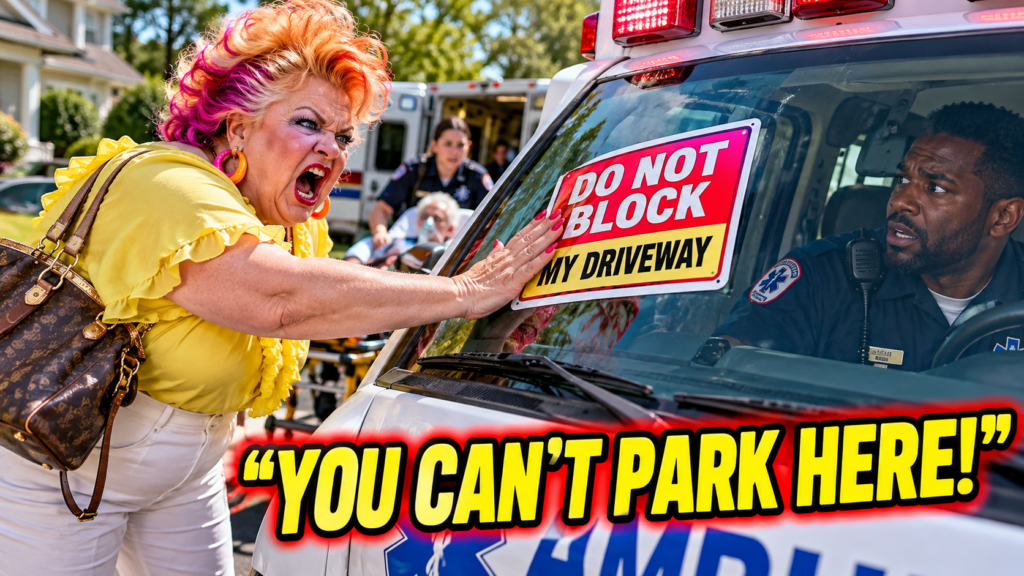
Chapter 4: The Line She Had Drawn
The city representative did not threaten her.
That surprised her.
He simply explained that emergency vehicles responding to active calls had different operational needs from ordinary vehicles.
Her driveway remained hers.
Her home remained hers.
But the public roadway was not an extension of her property simply because she lived beside it.
She listened with her arms folded.
“So you’re saying homeowners have no rights?”
“No,” he answered. “I’m saying emergency access has to remain possible.”
She wanted to argue.
Instead, she asked one question.
“What if it happens again?”
He looked at her.
“If there is another emergency, the same thing may happen again.”
That was the sentence she had been fighting from the beginning.
Not that ambulance.
Any ambulance.
Any fire truck.
Any police cruiser.
Any vehicle whose reason for being there could outrank her preference for an unobstructed view of her driveway.
She left the meeting angry.
But something had shifted.
That evening, Marcus received a message from the patient’s daughter.
Her father was home.
Weak, tired, but alive.
She sent a photograph of him sitting in a chair with an oxygen tube beneath his nose.
Marcus smiled.
Then another message arrived.
The daughter had seen the video.
She asked if the woman had been punished.
Marcus typed a response, then deleted it.
He finally wrote that he hoped everyone would simply understand what had happened.
Across town, the woman sat at her dining table.
The decal lay beside her handbag.
She had peeled it from the ambulance before leaving.
It looked ridiculous now.
Just a rectangle of adhesive-backed plastic.
But she kept staring at it.
Her argument had begun with property.
Now she was forced to consider something harder.
What happens when protecting your own boundary means forgetting why the boundary exists?








