
CHAPTER 6: The Dissolution of the Line
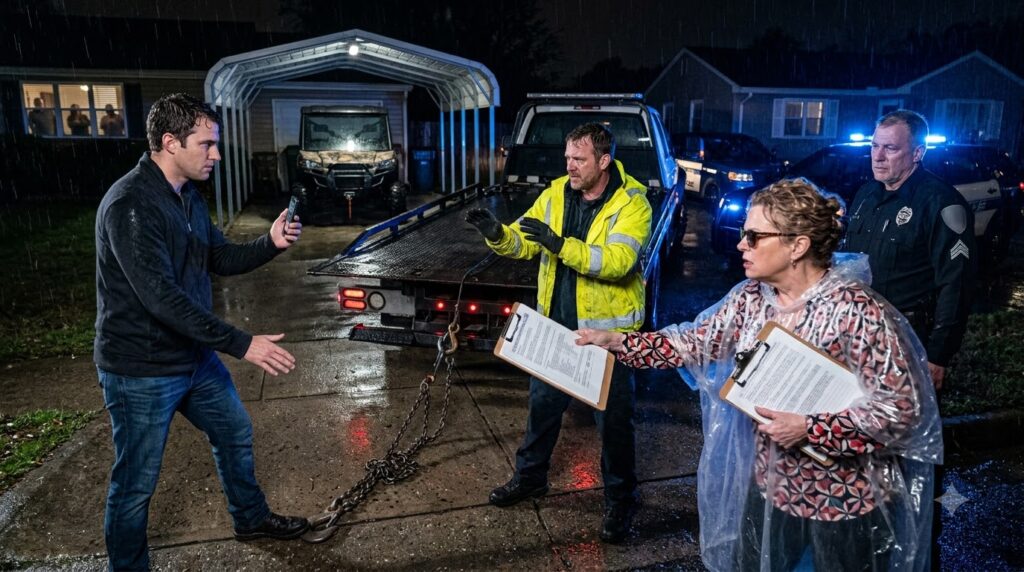
The blue light bars strobed silently against the wet aluminum siding of Julian’s house, casting rhythmic, pale pulses across the front window panes. The autumn rain had slowed to a heavy, greasy mist, sticking to the windshield of the tow truck where the driver sat frozen with both hands planted flat on the steering wheel, staring straight ahead through the glass. He had realized, with the sudden, cold clarity of a man whose livelihood depended on a clean license, that the document clutched in Brenda’s plastic-wrapped grip was not an official municipal warrant—it was an unverified, self-authored liability trap.
Brenda marched past the hood of the first patrol cruiser, her chin lifted with a brittle, defensive defiance that was beginning to crack at the edges.
“Officers, you are completely misinterpreting the local ordinance framework,” she announced, her voice rising in pitch as she thrust her laminated clipboard toward the senior deputy. “I am the designated administrative head of community standards on this street. This vehicle is in direct violation of sectional parking codes, and that resident has obstructed an authorized public removal.”
The officer, a weathered sergeant with graying temples and silver chevrons on his collar, didn’t reach for the clipboard. He didn’t even look at the plastic-encased paper. Instead, he kept his eyes locked on Brenda’s face, his expression flat, neutral, and heavy with institutional exhaustion.
“Ma’am, step back from the vehicle,” the sergeant said, his voice dropping into a register that brook no argument. “We checked the municipal dispatch registry before we rounded the corner. Your committee credentials were officially revoked by the county board three weeks ago following an audit of unauthorized fine collection. You hold zero jurisdiction over private residential property.”
The color drained from Brenda’s face in a single, violent shift, her skin turning the shade of old paper under the flashing blue strobes. Her lips parted, but no sound emerged; the administrative armor she had worn like a second skin for a decade had just dissolved into thin air. She looked wildly past the officer toward the neighboring houses, expecting the usual array of curtains to twitch in support, but the street was dead silent. Elm Street had watched from behind closed blinds, and for the first time, no one was stepping out to nod along with her performance.
The tow driver wasted no time. With a sharp snap of levers inside his cab, the hydraulic winch whined in reverse, slackening the heavy metal chains around the utility vehicle’s axle. He unhooked the clamps, tossed them onto the flatbed with a metallic crash, slammed his door shut, and pulled away from the curb with a sharp spray of gravel, leaving Brenda standing completely alone on the wet asphalt.
Julian stood on his porch, his hands steady in his pockets, watching the structural collapse of her authority. He didn’t gloat or raise his voice; he simply let the silence do the work.
The sergeant turned his head toward Julian, offering a brief, professional nod. “You want to formalize the trespassing and forgery charges at the precinct today, sir, or should we log the digital packet you submitted this morning?”
“Let’s log the packet,” Julian said quietly. “Make sure it includes the ledger records.”
Two officers stepped closer to Brenda, their hands resting lightly on their duty belts as they guided her away from the driveway toward the rear passenger door of the cruiser. She didn’t fight them; her shoulders slumped under the floral fabric, her heavy silver bracelets jingling in a dull, broken rhythm as she was guided into the back seat. The door clicked shut with a heavy, final thud.
As the cruisers backed down the wet street and disappeared around the corner, Julian walked back inside his house, closing the heavy oak door behind him. The hum of his computer monitors greeted him from the hallway—stable, functional, and entirely uninterrupted.








