
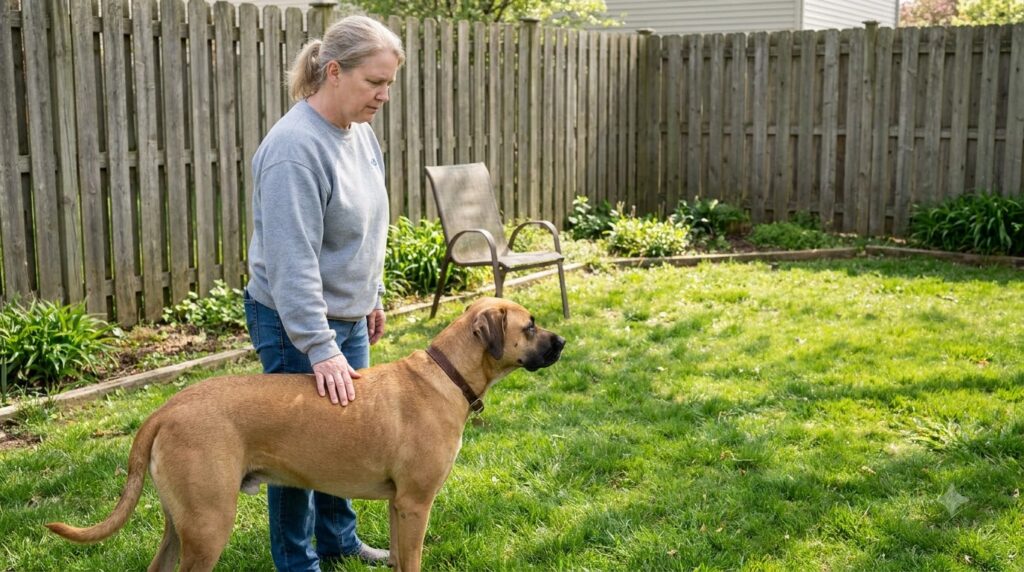
Beyond the Weathered Cedar: How a Suburban Line Driven into the Earth Unmasked a Silent Harassment Campaign
CHAPTER 1: THE TALL CEDAR AND THE WHITE PAPER
The heavy cedar gate hadn’t even clicked shut before the voice came over the fence line, sharp as a rusted nail through boot leather.
“That animal has three days, Clara. Three days before municipal control takes him off this street for good.”
Clara kept her hand flat against the latch, feeling the cold steel spring settle into its notch. Beside her jeans, Buster’s ribs expanded and contracted against her palm in a slow, rhythmic cadence. The medium-large tan dog didn’t growl. He didn’t even shift his paws in the damp morning grass. His dark muzzle swung toward the weathered cedar pickets, his ears pitched forward in quiet attention, but his weight remained anchored firmly against Clara’s shin.
Over the top of the six-foot fence, two oversized, dark-tinted sunglasses reflected the gray overcast morning. Mrs. Gable stood on the cinderblock step she had dragged against her side of the property line, her fingers—capped with bright coral polish—clutching a thick white envelope against the cedar trim.
“You can ignore the notes I left on your windshield,” Gable continued, her voice pitched high enough to carry across the manicured lawns of the cul-de-sac. “You can ignore the HOA guidelines on dangerous breeds. But you won’t ignore the city.”
Clara didn’t raise her chin. She adjusted the cuff of her gray crewneck sweatshirt, feeling the chill of the October air settling into her knuckles. “He hasn’t barked since we came out, Evelyn. He hasn’t barked all week.”
“He exists,” Gable snapped, leaning further over the rail until the cedar creaked beneath her weight. A bright floral pattern showed at her collar, vivid against the drab gray wood. “He exists, and he watches my kitchen window. I’ve logged six separate ordinance violations since Tuesday. Uncontained disturbance. Threat to public safety. The city clerk has the paperwork.”
With a flick of her wrist, Gable let the white envelope drop. It fluttered across the property boundary, skidding through the wet clover to land two inches from the brass survey pin driven into the dirt thirty years ago.
Buster looked down at the paper, then up at Clara, his tail giving one short, inquiring thump against the fence post.
Clara leaned down, her fingers brushing the cool clover as she retrieved the packet. The envelope wasn’t sealed with a official government sticker. Across the front, printed in jagged black ink, was a formal docket number and a red stamp that read IMMEDIATE MUNICIPAL NOTICE.
She pulled the single sheet of bond paper from the sleeve. The header bore the emblem of the County Animal Control and Public Safety Board, complete with a seal and a phone extension. Below it, typed in rigid block lettering, was a formal summons commanding the immediate surrender of an unregistered, aggressive canine following multiple verified neighborhood reports.
Clara turned the sheet over. The back was blank, save for a faint watermark visible against the gray morning light—a light grid pattern identical to the premium multi-use paper she’d seen stacked in fifty-sheet packs at the local office supply depot on Main Street.
She looked up at the sunglasses watching her over the fence. Gable’s lips were pressed into a thin, triumphant line, her phone held ready in her left hand, its camera lens aimed straight down at Clara’s face.
“Read it carefully,” Gable said softly, her voice dropping into a transactional purr. “They come with a van when the docket is marked urgent.”
Clara didn’t answer. She folded the paper once, sliding it into the pocket of her sweatshirt. Then, reaching down, she hooked two fingers through the brass ring of Buster’s collar and turned her back to the fence, walking slowly toward the rear porch.
As her foot hit the first wooden step, a sharp, metallic clack echoed from the boundary line behind them—the sound of a marble striking cedar. Buster paused, his ears twitching back, but Clara kept her hand steady on his collar, drawing him inside as the storm door clicked shut behind them.

CHAPTER 2: DRIVEWAY LINES AND COLD IRON
“I wouldn’t drive off if I were you, Clara!”
The screeched warning cut through the low rumble of Clara’s 2012 pickup as she turned the ignition. Through the side-view mirror, Mrs. Gable was already marching down the asphalt seam that divided their driveways. Her plastic-soled sandals slapped against the concrete with the rhythmic crack of a small caliber pistol, her floral blouse fluttering like a warning flag against the gray backdrop of the cul-de-sac.
Clara kept her left foot firm on the brake pedal, the truck idling rough beneath her palms. Beside her in the passenger footwell, Buster sat upright, his dark muzzle resting against the edge of the center console. His eyes were wide, fixed on Clara, his breathing steady and slow. He didn’t whine. He didn’t lean toward the window.
Clara rolled the driver’s side window down four inches—just enough to let the cold morning draft cut through the heater’s dry warmth.
“I’m heading to work, Evelyn,” Clara said, keeping her tone flat, stripped of heat or hurry.
Gable slammed a palm against the top rail of Clara’s side mirror. The glass vibrated, shifting the reflection of the row of pristine suburban split-levels behind them. Gable’s face filled the gap in the window, her breath smelling faintly of stale dark-roast coffee and peppermint. Behind her oversized sunglasses, her eyelids were raw, the skin drawn tight around her jawline.
“Work can wait when there’s an active municipal violation on your deed,” Gable said, her finger pointing violently down at the driveway seam. “Animal Control was notified at seven-fifteen. They have the log. If that dog is on this property when Officer Miller does his morning sweep, it’s a Class C impound. They don’t give you twenty-four hours for an unregistered predator, Clara. They haul the crate right out of your yard.”
Clara glanced down at Gable’s hand on the mirror casing. A thin streak of dark gray grease clung to the side of Gable’s thumb—not lawnmower grime or motor oil, but the graphite smudge left by high-volume laser jet toner.
“Officer Miller,” Clara repeated slowly. “The city dispatched Miller specifically?”
“He’s the lead enforcement officer for this sector,” Gable spat, her posture stiffening, her chin jutting out like a shelf. “I spoke to him directly on the administrative line. He agreed that the noise level alone constitutes an ongoing nuisance, to say nothing of the physical hazard to my property boundary.”
Clara reached into her sweatshirt pocket. Her fingers brushed the folded edge of the white paper she’d picked out of the clover ten minutes ago. She didn’t pull it out. Instead, she let her eyes drift past Gable’s shoulder, down the narrow gravel gangway that ran between their two garages.
At the far end of the gangway, partially obscured by a thick row of overgrown hydrangeas, sat Gable’s garden shed. It was a sturdy, green-painted wooden structure built six years ago on a poured concrete pad. From this angle, where the driveway asphalt met the dirt grade, the shed’s western corner looked strangely misaligned with the cedar fence—leaning almost three inches deep into the narrow strip of property Clara’s father had staked out with iron pins back in ninety-four.
Gable’s eyes tracked Clara’s gaze. Instantly, her grip on the mirror frame tightened so hard the plastic housing groaned.
“Look at me when I’m speaking to you!” Gable snapped, her voice cracking slightly as she stepped closer, blocking the view of the gangway with her shoulder. “You think you can play quiet with me? You think because you don’t answer the door that the city isn’t watching? That dog is a menace. I heard him pacing along the fence at two in the morning. Scraping at the boards. Trying to dig under.”
Clara looked at the dog. Buster hadn’t moved. His tan coat was entirely clean—no mud on his paws, no damp soil caked under his claws.
“Buster sleeps in the mudroom on a wool blanket, Evelyn,” Clara said gently. “The deadbolt is locked from eight at night until six in the morning.”
“Are you calling me a liar?” Gable’s voice rose an octave, striking the cold air with violent force. A garage door two houses down began to hum as a neighbor prepared to back out for the morning commute. Gable didn’t care; she stepped up onto the running board of Clara’s truck, bringing her face within inches of the glass. “I have video logs, Clara! I have timestamped audio! You want to take this to the magistrate? You want to pay the court costs on a municipal citation when you’re already two months behind on your exterior painting compliance?”
Clara felt a slow, cold settling in her chest—not panic, but the heavy, unyielding weight of an iron latch dropping into place. She shifted the truck into drive, keeping her foot pressed firmly on the brake.
“I’m going to work now, Evelyn,” Clara said. “Take your hand off my mirror.”
“Or what?” Gable sneered, leaning her weight harder against the door frame. “You going to set your attack hound on me?”
Clara didn’t argue. She didn’t raise her voice. She simply released the brake pedal by a fraction of an inch. The truck crept forward two inches, the heavy rubber tires crunching over the loose gravel at the edge of the asphalt.
The movement broke Gable’s balance. She scrambled backward off the running board, her sandals catching on the concrete lip as she stumbled into her own driveway, her phone almost slipping from her manicured fingers.
“You’ll see!” Gable yelled after the retreating truck, her voice echoing off the brick facade of her garage as Clara pulled out onto the suburban street. “When the van comes, don’t you dare come crying to me!”
In the passenger seat, Buster gave a soft, quiet exhaling sigh, resting his chin on Clara’s knee as she hit the turn signal. Clara kept one hand on the wheel and used the other to pull the folded white document from her pocket.
She unfolded it across the steering wheel at the red light.
The header seal—the official emblem of the County Animal Control Board—was crisp, but at the bottom corner, right beneath the printed signature line, was a tiny series of gray printer alignment dots. Clara ran her thumb over them. They were yellow and cyan micro-dots, typical of standard consumer-grade color laser printers designed to prevent currency counterfeiting.
Municipal offices used black-and-white commercial thermal presses for summons forms.
Clara turned the truck toward the hardware store on 4th Street, her jaw set tight. She didn’t need a lawyer yet. She needed a six-foot level, a fresh box of steel fence brackets, and a high-definition TrailGuard camera with an infrared night sensor.
As she pulled into the hardware store parking lot, her eyes caught something wedged in the rubber trim of her passenger window—a small, dark object that must have fallen from Gable’s hand when she struck the mirror.
Clara turned off the engine and picked it up. It was a heavy, glass-marbled sling pellet, sticky with dark oil and smelling faintly of crushed cedar.
CHAPTER 3: GRAIN AND IRON
The engine oil on the glass marble hadn’t dried by the time Clara pulled back into her driveway, the heavy iron surveyor’s rod and a three-inch box of galvanised brackets resting in the passenger footwell behind Buster’s paws.
She didn’t unhook the truck’s tailgate right away. The street was quiet, the neighborhood’s morning rush having cleared out toward the highway, leaving only the low hum of a distant lawnmower three blocks over. Clara stepped out into the cold air, her boots crunching over the gravel margin. Buster hopped down beside her, his nose immediately dropping to the damp tire tracks, his tail held low and level as he followed her toward the narrow side yard.
Over the top of the cedar fence, Mrs. Gable’s house was dark, the blinds drawn tight against the gray afternoon light. But as Clara reached the narrow corridor between the two properties, she heard the faint, rhythmic click of a metal latch on the far side of Gable’s garage—a quick, nervous sound, like someone repeatedly testing a padlock.
Clara walked straight to the fence corner where the wooden pickets met the rear property line.
She knelt in the cold clover, her knees soaking up the dampness of the earth as she pushed aside the matted grass. There, buried two inches beneath the soil line, was the cold top of the iron survey pin her father had driven into the earth thirty years ago. The brass cap was tarnished, greened by age and rainwater, but the cross-hatch mark stamped into its surface was sharp, clear, and unyielding.
Clara laid a six-foot aluminum spirit level flat across the top of the pin, lining its edge up with the weathered face of the cedar posts.
The fence line was straight for the first twenty feet. But as the level passed the midpoint—right where Gable’s green-painted garden shed stood on its poured concrete slab—the wood bulged outward by nearly three inches.
Clara leaned in closer to the cedar grain. Three inches above the soil, hidden behind the thick stems of the overgrown hydrangeas, someone had driven three fresh, heavy-duty timber screws directly through the bottom rail of Clara’s fence, pulling her wooden pickets flush against the back corner of Gable’s shed.
The cedar around the screw heads was raw, bright orange against the gray, weathered surface of the old wood. Fresh gouges ran along the grain where a pry bar had been shoved between the posts to force the alignment.
Buster stepped up beside her, placing his broad chest against Clara’s shoulder as he sniffed at the raw wood. He gave a short, soft puff through his nostrils, his ears pitching forward toward the shed.
“Someone’s been working in the dark,” Clara murmured under her breath.
She reached out, running her thumb over the jagged wood surrounding the top screw. The head wasn’t standard deck hardware. It was an industrial masonry anchor—the kind used to secure heavy steel frames to solid concrete foundations. Gable hadn’t just built her shed close to the boundary; the concrete pad itself had been poured directly over the line, and the bottom rail of Clara’s fence had been forcibly bolted to the structure to hide the overlap.
A floorboard creaked inside the shed.
Clara stood up slowly, her sweatshirt sleeves pulled down over her palms. “Evelyn.”
The creaking stopped instantly. For five long seconds, the only sound between the houses was the drip of condensation falling from the eaves onto the wet soil.
Then, a small wooden hatch near the top of the shed’s side wall clicked open two inches. Behind the wire mesh screen, the dark shape of Gable’s face appeared, her oversized sunglasses replaced by thick reading glasses resting on the tip of her nose.
“You’re trespassing on a active inspection zone, Clara,” Gable’s voice came through the mesh, muffled and tight. “I’ve already notified the county surveyor. Any alteration to those fence pickets will be documented as evidence of property destruction.”
Clara didn’t raise her voice. She stepped closer to the line, her hand coming down to rest lightly on the top of the aluminum level. “You anchored your slab to my posts, Evelyn. You pulled my fence three inches south to cover the pour.”
Gable let out a sharp, breathless laugh that sounded like dry leaves scraping over concrete. “That fence was installed in nineteen-ninety-four without a municipal variance! It straddles the easement! My contractor worked off the registered plot map provided by the city board!”
“Your contractor bolted a six-hundred-pound pad to my cedar posts,” Clara said flatly. “And you printed a fake Animal Control summons on a twenty-pound laser printer to keep me from looking at the line.”
The screen hatch slammed shut with a sharp clack.
Inside the shed, metal tools rattled against a pegboard—a heavy trowel or a crowbar sliding against steel. A second later, the side door of the shed unlatched, and Gable stepped out into the narrow gangway. She wasn’t wearing her floral blouse anymore; she wore a stained gray windbreaker, her hands shoved deep into her pockets, her knuckles bulging through the fabric.
“You listen to me, Clara,” Gable said, her voice dropping into a raspy whisper that barely carried across the five feet of cold air between them. “That dog is going to be gone by Friday. I don’t care how many iron pins your father hammered into the mud thirty years ago. The city has a zero-tolerance policy for nuisance animals and unauthorized perimeter structures. When Officer Miller comes out here, he’s not looking at wood. He’s looking at the complaint log. And my log is forty pages long.”
Buster didn’t bark. He simply sat down on the damp grass beside Clara’s left boot, his dark muzzle resting against the aluminum frame of the level, his eyes fixed steadily on Gable’s face.
Clara reached down into her sweatshirt pocket, pulled out the heavy glass marble she’d found in her truck window, and held it out in the palm of her hand.
“You dropped your sling shot pellet on my mirror, Evelyn,” Clara said gently. “The oil on it matches the grease on your printer toner.”
Gable’s eyes went wide behind her reading glasses. She stared at the dark glass marble for two full seconds, her throat working as she swallowed hard. Then, without a word, she turned on her heel, marched down the gangway, and slammed her back door so hard the glass pane in her kitchen window rattled against its frame.
Clara stood in the quiet yard for a long moment, the cold marble heavy in her palm. She looked down at Buster, who gave her knee a gentle nudge with his nose.
“Come on, boy,” Clara said softly, picking up the spirit level. “Let’s go set up the camera.”
CHAPTER 4: LENSES AND FORGED EMBLEMS
“It’s four screws into the soffit, Clara. If you drill into the fascia board, the roof warranty is void.”
Clara didn’t answer her father’s voice echoing in her memory. She kept her balance on the third rung of the aluminum stepladder, her back pressed against the rear corner of her porch overhang. Below her, Buster sat on the porch mat, his ears pitched straight up, his eyes tracking every movement of the matte-black camera housing in her hands.
The TrailGuard 4K lens hummed as its internal gyro settled. A tiny green LED flashed twice near the battery housing, confirming a live connection to the high-gain router sitting on her kitchen counter.
Clara tightened the last mounting bolt with her socket wrench, the cold steel biting into her palm. From this vantage point, twelve feet above the lawn, the wide-angle optic covered the entire three-hundred-foot stretch of the cedar fence, the back wall of Gable’s green garden shed, and the narrow dirt corridor where the iron survey pin sat buried in the clover.
She climbed down, her boots striking the wooden porch steps with a low, solid thud. Buster stood immediately, pressing his muzzle against her knuckles.
“Let’s see what the system records,” Clara said, stepping inside the kitchen.
She left the storm door unlatched. On her dining table, beside a half-empty mug of black tea, her laptop screen glowed with two distinct windows.
On the left was the live camera feed—crisp, color-calibrated, and timestamped in high-definition digital white text across the top margin. Every blade of grass along the property line was visible. On the right was the scanned PDF of the white summons Gable had dropped into the yard that morning.
Clara clicked the magnify tool, zooming in 400 percent on the official seal of the County Animal Control Board.
Under high resolution, the sharp lines of the crest broke down into fuzzy, jagged pixels. The state seal in the center wasn’t vector artwork; it was a low-resolution JPEG captured from a public website, pasted over an editable document template.
Clara opened a second browser window, navigating directly to the official county portal. She typed the docket number from the top of the paper into the municipal court search system: DOC-2024-8819-AC.
The search engine returned an immediate result: INVALID DOCKET NUMBER. NO RECORD FOUND.
Clara sat back in her wooden chair, the seat creaking beneath her weight. She picked up a magnifying loupe from her toolbox and leaned over the original paper she’d taken out of the clover. Near the top margin, where the paper feeder had gripped the sheet, was a faint embossed imprint—a secondary blind stamp left by whatever paper sat beneath it in the tray during printing.
She adjusted the desk lamp, angling the warm bulb until the raking light revealed the raised letters stamped into the fiber.
It wasn’t a court seal. It was a fragment of an old municipal building permit header: RE-SURVEY & SLAB APPROVAL — PENDING SETBACK VERIFICATION.
Clara’s thumb froze on the paper edge.
Gable hadn’t just fabricated an Animal Control complaint to intimidate her into surrendering Buster. The paper stock she’d used in her home office came from an old folder of property variance applications—documents Gable had kept since the year her green garden shed was built.
A sharp chime sounded from the laptop speakers.
Clara looked up. The TrailGuard motion sensor had triggered. On the live feed, the side door of Gable’s shed swung open.
Gable didn’t come out in her windbreaker this time. She wore a bright yellow raincoat, a oversized clipboard tucked under her arm, and a thick wooden yardstick held firmly in her right hand. She marched down her side of the fence, stopping right at the spot where the lower rail bulged three inches south over the survey pin.
Through the camera’s microphone, the audio feed picked up the rustle of Gable’s plastic coat and her sharp, shallow breathing.
Gable leaned over the fence pickets, looking left and right down the empty alley. Satisfied no neighbors were on their porches, she raised the yardstick and jammed it violently into the clover, right beside the iron pin, attempting to force the wooden marker deeper into the soft mud.
Buster gave one short, quiet huff from the open doorway. He didn’t run. He walked to the edge of the porch, stood in full view of the camera, and sat down on the top step, his tan chest square to the yard.
On the screen, Gable froze. She looked up, her eyes locking directly onto the black camera lens mounted under Clara’s eaves. The green LED on the housing blinked once, indicating active recording and cloud backup.
Gable’s mouth opened, her face flushing crimson beneath the yellow hood. She yanked the yardstick out of the dirt, turned on her heel, and retreated toward her shed, her boots slipping on the wet grass.
As she reached her door, she turned back, pointing the yardstick straight at the camera lens like a weapon.
“You think a camera protects you?” Gable’s voice came through the laptop speakers, crisp and distorted by the high-gain mic. “You think you can record me on my own easement? The magistrate gets this entire file tomorrow morning! Every frame!”
Clara didn’t shout back through the window. She sat at her table, clicked the save button on the camera interface, and locked the video clip into an encrypted cloud folder titled Property Line Evidence – July 31.
Then she reached for her phone, dialed the non-emergency administrative line for the county sheriff’s office, and asked for Officer Miller.
“Sheriff’s office, Miller speaking,” a flat, tired voice answered on the second ring.
“Officer Miller, this is Clara Vance at 414 Cedar Crest,” Clara said, her voice completely steady. “I have a timestamped video log of an ongoing boundary dispute, a forged municipal summons using your department’s header, and a live trespass on my survey pin. I’d like an officer on-site to review the physical evidence.”
There was a three-second pause on the line, followed by the heavy rustle of official paperwork.
“We’ll have a cruiser in your cul-de-sac in twenty minutes, Miss Vance,” Miller said. “Keep your animal inside until we arrive.”
Clara hung up, folded the paper with the printer alignment dots, and slid it into a clean plastic storage bag beside the glass marble.
Beside her, Buster laid his chin over her knee, his dark eyes watching her hand as she stroked his ears. The house was quiet, save for the rain that had finally begun to fall, tapping softly against the tall cedar pickets outside.
CHAPTER 5: THE FENCE LINE STANDOFF
“He’s loose! Officer, he’s uncontained and actively aggressive right now!”
Mrs. Gable’s voice pierced the wet afternoon air, carrying over the rhythmic thrum of windshield wipers as a white-and-black county cruiser rolled to a stop at the curb. Rain streamed off the yellow hood of Gable’s raincoat as she leaned halfway over the cedar fence pickets, waving her smartphone in one hand and pointing a trembling, red-manicured finger directly at the lawn.
“He’s right there! Look at him! He tried to jump the fence when I stepped onto my own property!”
Clara didn’t raise her voice, nor did she shift her feet in the damp grass. She stood five feet back from the boundary line, dressed in her gray crewneck sweatshirt and blue jeans, her hands loose and open at her sides. Beside her, resting his flank against her left leg near the wooden fence, Buster remained anchored to the sod. His medium-large frame was steady, his short tan coat slicked with light rain, his dark muzzle quiet and motionless. He didn’t bark. He didn’t lunge. He simply watched the flashing blue-and-gold strobe lights reflecting off the wet pavement with calm, undisturbed curiosity.
The cruiser door clicked open. Officer Miller stepped out into the drizzle, pulling his radio mic close to his collar before letting it click back onto his shoulder. A second vehicle—a beige municipal van bearing the Animal Control crest on its door panel—pulled up behind the patrol car, its engine idling in a low, diesel growl.
“Mrs. Gable, step back from the fence line, please,” Miller said, his voice flat and authoritative as he walked up the driveway seam. He adjusted his utility belt, his eyes immediately scanning the yard, the fence, and the woman standing beside her dog. “Miss Vance.”
“Officer,” Clara said, giving him a single, clear nod. “Thank you for coming out.”
“He’s posing a threat right now!” Gable shouted, her voice cracking as she slammed her hand against the top fence rail. “I called Animal Control three hours ago! He’s an unregistered, dangerous animal! He’s been barking continuously since six this morning!”
Officer Miller stopped at the edge of the lawn, three feet from the fence line. He looked at Gable, whose face was flushed crimson, her oversized glasses speckled with raindrops as she practically hung herself over the cedar pickets. Then he turned his head slowly and looked at Buster.
The tan dog sat completely motionless beside Clara’s knee. His tail gave one soft, single thump against the wet grass. The silence in the backyard was absolute, broken only by the steady drip of rain falling from the eaves and the distant idle of the municipal van.
“Ma’am,” Officer Miller said, looking back at Gable with a tired, unblinking stare. “The dog hasn’t made a sound since I pulled into the street.”
“Because she’s commanding him! She’s holding him back because you’re standing here!” Gable’s voice rose to a screech as she thrust her phone screen toward Miller’s face. “I have documentation! I have the official summons! I filed the paperwork with your department this morning!”
Clara stepped forward, pulling the clear plastic storage bag from her sweatshirt pocket. “Officer Miller, I believe Mrs. Gable is referring to this document.”
Miller took the bag, his gloved fingers unzipping the seal. He pulled out the folded sheet of paper, unfolding it beneath the brim of his rain cap. He read the header, then ran his thumb over the jagged, low-resolution seal at the top right corner.
Behind him, the Animal Control officer stepped into the backyard carrying a heavy plastic transport crate. He paused five feet away, taking in the scene: Gable screaming over the fence, Clara standing motionless in her sweatshirt, and the tan dog sitting calmly in the mud without a hint of tension.
“This docket number isn’t from our registry, Mrs. Gable,” Officer Miller said quietly, his thumb rubbing against the micro-alignment dots along the margin. “This was printed on an inkjet paper stock using a modified state emblem. This is a fraudulent document.”
“It’s a draft!” Gable stammered, her hands flying to her collar as her eyes darted toward the Animal Control officer. “It’s a formal notice of intent! The noise violations are real! Look at my fence! She pulled the cedar rails three inches out of alignment to let that beast dig under my shed!”
Clara didn’t argue. She pointed down at the base of the fence, where the aluminum spirit level still rested across the buried iron survey pin.
“The fence isn’t out of alignment, Officer,” Clara said, her voice cutting clean through the rain. “The concrete pad for Mrs. Gable’s garden shed was poured across the true property line. My bottom rail was forced three inches south and bolted to her concrete to hide the encroachment. That’s why she wants the dog gone. That’s why she wanted me off the boundary line.”
Gable’s face went instantly pale, the red flush draining from her cheeks as if struck by a physical blow. She staggered back off her cinderblock step, her sandals slipping in the mud as her eyes darted from Miller’s face down to the raw timber screws gleaming in the wet cedar wood.
Beneath the bottom edge of the shed’s concrete pad, exposed where the mud had washed away in the rain, a frayed piece of yellowed surveyor’s string hung tangled around an old, rusted iron stake—sitting four inches deep inside Clara’s legal yard.
Officer Miller looked at the paper in his hand, then down at the exposed concrete, and finally at Gable, his jaw tightening into a hard, rigid line.
“Mrs. Gable,” Miller said, his voice dropping an octave into a cold, official register. “I need you to step away from this fence right now and hand me your identification.”
CHAPTER 6: THE FLIP ON THE ASPHALT
“My identification is in my house, Officer! I am a member of the neighborhood zoning board!” Gable’s voice shook, her fingers clutching the front of her wet windbreaker as she stepped backward into her yard.
Officer Miller didn’t move toward her door. He unclipped a heavy steel flashlight from his belt, its beam cutting a bright, sharp cone through the falling rain. He aimed the light down at the base of the cedar fence, illuminating the spot where the lower rail bulged three inches south, pulled tight against the raw concrete pad of Gable’s garden shed.
“Officer Miller,” Clara said, stepping over the damp grass toward the rear porch steps. “The TrailGuard system caught her on video forty minutes ago attempting to drive a yardstick into the mud over my father’s survey pin. The live feed and cloud archive are open on my laptop inside.”
Miller looked up, his flashlight beam catching the matte-black camera housing under Clara’s eaves. The green LED blinked steadily in the drizzle.
“Let’s see the video,” Miller said.
Gable took two quick steps forward, her plastic sandals splashing through a puddle at the fence line. “You can’t review unverified home surveillance! That camera is aimed directly onto my private parcel! That is a gross invasion of privacy!”
“Ma’am,” Miller said without turning his head. “Your neighbor’s camera is mounted on her own roofline, covering her own boundary line. And right now, I am standing on her property investigating a report of a forged county summons and misuse of 911 emergency dispatch.”
The Animal Control officer set his empty plastic crate down on the wet grass with a soft, hollow thud. He looked down at Buster, who sat quietly beside Clara’s knee, his ears relaxed, his dark eyes following the movement of the flashlight beam. The officer pulled a small leather-bound logbook from his jacket pocket, made a quick notation, and closed it with a sharp snap.
“Animal Control is clearing the scene, Miller,” the officer said, stepping back toward the driveway. “There is no dangerous animal here. The canine is calm, restrained, and on its owner’s deeded lot.”
“Appreciate it, Dan,” Miller replied. He gestured with his flashlight toward Clara’s screen porch. “Lead the way, Miss Vance.”
Clara walked into the kitchen, the screen door clicking shut behind her. Buster followed close at her side, his paws leaving faint, damp prints on the linoleum before he settled onto his wool blanket near the pantry. Officer Miller wiped his boots on the mat and stepped inside, taking off his wet cap.
On the dining room table, the laptop screen displayed the four-minute video clip. Clara pressed spacebar.
On the 4K feed, the timeline was clear. The screen showed Gable stepping through her shed door in her yellow raincoat, holding the wooden yardstick. The video captured the exact second she leaned over the cedar pickets, jammed the stick into the clover near the brass-capped pin, and tried to pry the earth loose. Then came the moment she looked up, saw the camera, and held the yardstick toward the lens like a spear before fleeing back into her shed.
Miller leaned over the table, his face inches from the glass. He rewound the video three seconds, freeze-framed the image, and pointed a gloved finger at the bottom right corner of the screen.
In the background of the video, through the open door of Gable’s garden shed, a large metal filing cabinet stood pulled away from the back wall. Tucked between the cabinet and the concrete pad was a yellowed paper blueprint marked with a bright red municipal tag: NOTICE OF SETBACK VIOLATION — NON-COMPLIANT STRUCTURE.
Miller let out a long, slow breath through his nose.
“She poured that slab eight years ago without a permit,” Miller said softly. “When you got the dog and started walking the fence line, she panicked that a new survey would force her to tear down a four-thousand-dollar shed or face daily county fines.”
“She tried to use Animal Control to drive me off my own yard before I looked too closely at the wood,” Clara said, her voice even and quiet.
“It’s more than an HOA feud now,” Miller said, pulling out a carbon-copy citation book from his belt pocket. “Falsifying a county document with an official seal is a Class A misdemeanor. Trespassing on a marked survey boundary is a civil infraction.”
He turned and walked back out onto the porch, Clara following behind him into the cool rain.
In the driveway, Gable was standing near the cruiser, her shoulders hunched against the weather, her phone still clutched in her hand. The Animal Control van was already pulling away, its tires splashing down the cul-de-sac.
Miller walked straight down the driveway seam, stopping two feet from Gable. He didn’t raise his voice. He handed her a yellow carbon-copy slip from his pad.
“Mrs. Gable, this is a criminal summons for forgery of a public document and a formal warning for criminal trespass,” Miller said, his tone cold and unyielding. “You have a mandatory court appearance on the fourteenth. Furthermore, I am filing an incident report with the county building inspector regarding the illegal structure on the rear easement.”
Gable stared at the yellow paper in her hand. Her mouth opened, but no sound came out. Her oversized reading glasses slipped down her nose, reflecting the cold gray sky above.
Across the street, three neighbors had stepped out onto their front porches, watching the scene in total silence.
“You have until five o’clock tomorrow to remove those masonry screws from Miss Vance’s fence,” Miller added, turning back toward his patrol car. “If they are still in that cedar wood by Sunday morning, the county deputy will come out with a crowbar.”
Gable looked across the fence line. Clara stood on her lawn, her hands resting calmly in her sweatshirt pockets, Buster sitting quietly by her side.
Without a word, Gable turned her back, her sandals dragging through the wet grass as she walked slowly toward her front porch, the yellow citation trembling in her hand.
CHAPTER 7: THE UNBROKEN BOUNDARY
The ratchet handle clinked against the cold galvanized steel as Clara backed the first three-inch masonry anchor out of the cedar fence rail.
It was six o’clock on Saturday morning. The autumn rain had cleared overnight, leaving a crisp, pale amber light washing over the wet clover. The air smelled of damp earth, wood resin, and the quiet stillness of a suburban neighborhood that hadn’t yet stirred.
Beside Clara’s boots, Buster lay stretched out on the damp grass, his dark muzzle resting on his front paws, his eyes tracking the turn of the socket wrench with peaceful, unhurried focus.
On the other side of the fence, the windows of Mrs. Gable’s house remained dark, the heavy curtains drawn tight. Beside her garage, a bright yellow municipal warning sticker glowed on the side door of the green garden shed: NOTICE OF BUILDING CODE COMPLIANCE INSPECTION — PENDING PROPERTY SURVEY.
With a final metallic groan, the steel bolt slid free of the wood. The cedar picket, relieved of its eight-year tension against the illegal concrete pad, snapped back into place with a sharp, echoing thwack.
Clara set the socket wrench down on her aluminum level and stood up, wiping her palms on her gray crewneck sweatshirt.
The line of the fence was once again straight, clean, and unyielding—drawn precisely along the plane marked by the brass-capped iron pin buried in the dirt thirty years ago.
A soft click sounded from the side screen porch. Mr. Henderson, who lived two houses down at the mouth of the cul-de-sac, walked down his driveway carrying a steaming ceramic mug. He paused at the edge of Clara’s lawn, looking at the straight fence line, then down at the yellow warning tag on Gable’s shed, and finally at Buster lying on the grass.
“Morning, Clara,” Henderson said, his voice low in the quiet air. “Looks like the line is right where your dad set it.”
“Morning, Art,” Clara said gently. “It is.”
Henderson nodded slowly, taking a sip from his mug. He looked toward Gable’s darkened house for a long second, then back to Clara. “If you need a hand setting a second post along that back easement next weekend, I’ve got an auger in the garage.”
“I appreciate that, Art,” Clara said. “I just might take you up on it.”
Henderson gave a quiet nod, leaned down to pat Buster once on his flank, and turned back toward his porch.
Clara knelt back down in the clover. She took a small brass wire brush from her pocket and scrubbed the top of the survey pin until the cross-hatch mark stamped into its surface gleamed gold in the early morning sun. She picked up a fresh cedar picket, set it flush against the rail, and drove two stainless steel deck screws through the grain, sealing the gap for good.
Buster stood up, stretching his hind legs before stepping over to press his flank against her knee. Clara reached out, her fingers sinking into his thick tan coat, feeling the warm, steady rhythm of his breathing.
There were no more notes in the mailbox. No phone cameras pointed over the cedar pickets. No false municipal summonses printed on cheap laser paper.
Over the top of the fence line, the neighborhood stretched out in quiet, orderly split-levels under the rising sun. Clara picked up her toolbox in one hand, hooked two fingers into Buster’s collar with the other, and walked up the wooden porch steps into her home.
They stayed right there, on their side of the fence.







