
The Cold Boundary on Oakridge Drive: A Novel of Calculated Silence, Suburban Extortion, and Retribution
CHAPTER 1: THE DRIVEWAY THRESHOLD
The iron jaws of the wheel clamp hit the sun-baked asphalt with a heavy, metallic clang that echoed across the quiet lawns of Oakridge Drive.
Arthur Vance didn’t flinch. He stood on the concrete lip of his garage, his feet planted shoulder-width apart, the heat of the noon sun soaking into the shoulders of his crisp blue polo shirt. In his left hand, his thumb rested lightly on the edge of a worn brass tape measure tucked into his pocket—a habit carried over from twenty-two years of military logistics. In his right hand, his phone recorded silently, its lens tracking the stocky, bald head of Marcus Kane.
“You’re making a catastrophic mistake, Marcus,” Arthur said. His voice was low, flat, and stripped of heat.
“I’m executing Board Order 402, Arthur,” Marcus sneered, his dark green polo shirt stretched tight over his barrel chest. The large yellow lettering across his chest—OAKRIDGE ESTATES HOA BOARD—glistened with a thin sheen of sweat. Behind Marcus, four younger men in matching green shirts stepped onto the driveway, their boots scraping against the clean concrete. One carried a clipboard piled high with red-stamped foreclosure notices; the other three held heavy steel tire boots and a length of tow chain.
“This is private land,” Arthur said quietly. “You are three feet past the municipal easement line.”
“Your land belongs to the association the second you default on administrative assessments,” Marcus said, taking a deliberate step forward. He pulled a rolled paper notice from his back pocket and slapped it against the hood of Arthur’s pickup truck. “Fifteen thousand in unpaid fines, plus legal fees. The board authorized an immediate seizure of movable assets to satisfy the debt.”
Down the block, a lawnmower sputtered to a halt. Mrs. Higgins peered through her front porch railings, her knuckles white against the dark wood. Two doors over, a contractor on a stepladder lowered his hammer, watching the green shirts deploy across the driveway. The entire street had gone dead silent.
“You have ten seconds to clear your crew off my pavement,” Arthur said. His heart rate stayed steady at sixty-four beats per minute. He didn’t raise his hand. He didn’t advance. He simply watched Marcus’s eyes—the frantic, darting rhythm of a man who believed his title granted him immunity.
Marcus laughed, a short, barking sound meant for the benefit of the three neighbors watching from behind their curtains. “Or what, Arthur? You going to call the cops? The county sheriff sits on our advisory panel. We are the authority here.”
Marcus turned to the enforcer kneeling by the truck’s front tire. “Clamp it. If he touches you, it’s assault on an association officer.”
The man bent down, the heavy steel hinge squeaking as he opened the lock.
Arthur didn’t reach for his phone, and he didn’t step off the ledge. Instead, he raised his left hand, checked his watch, and tapped the screen once.
Far down Oakridge Drive, past the manicured brick homes and the pristine cul-de-sacs, the faint, high-pitched whine of heavy diesel engines cut through the humid afternoon air.
Marcus paused, his hand hovering over the truck’s side mirror. “What is that?”
Arthur didn’t answer. He simply kept his eyes fixed on Marcus Kane’s face as the sound grew louder—not the high siren of a local patrol car, but the low, synchronized rumble of heavy black armored vehicles turning into the subdivision at forty miles an hour.
The man with the wheel clamp froze, his fingers caught in the steel mechanism, as the first black bumper rounded the corner, its dark tinted windshield blinding in the midday sun.

CHAPTER 2: THE FIFTEEN THOUSAND DOLLAR THRESHOLD
“Fifteen thousand forty-two dollars and sixty cents,” Marcus Kane had said, three weeks before he brought the iron wheel clamps to Oakridge Drive. “Payable by cashier’s check to Oakridge Management Group LLC before five o’clock on Friday.”
Arthur had stood on his front porch, the morning sun casting a cold, angular glare across the cedar siding. The air had tasted faintly of exhaust and cut grass, damp with early dew. In Marcus’s outstretched hand was a single sheet of paper, twenty-pound white bond, crisp enough to slice skin.
“Your roof line exceeds the secondary covenant slope by two degrees,” Marcus had added, his stocky frame leaning into the porch railing until the wood groaned under his weight. “Plus an unapproved gravel border along the drainage line. Plus four years of interest on the community repaving assessment.”
Arthur hadn’t taken the paper immediately. He had looked past Marcus’s bald, gleaming head toward the cul-de-sac. Across the street, the neighborhood was still sleeping. The suburban quiet felt paper-thin, held together only by the fragile assumption that everyone played by the same set of rules.
“The repaving project was rejected by an eighty percent homeowner vote in November,” Arthur had said, his voice flat, steady, carrying no trace of the heat rising behind his ribs.
“The board overturned the vote under Section 4B,” Marcus replied, flashing a tight, predatory smile that didn’t reach his eyes. “Emergency authority. The asphalt was degrading. We chose the vendor, we set the fee, and we assigned the lien rights. You sign the acknowledgment, or we file the notice with the county recorder at eight a.m. Monday.”
Arthur had reached out and taken the sheet by its bottom edge. The paper was stiff, smelling of cheap toner and damp air. In the bottom right corner, partially obscured by Marcus’s thumbprint, sat a faded blue-ink stamp—not a standard notary seal, but a legal filing code: CLR-994-DOC. It didn’t belong to any municipal code Arthur had seen during his twenty years managing military logistics for the Army Material Command.
“You’re using an LLC registered out of Wilmington,” Arthur had observed, his eyes scanning the header. “The HOA charter requires all assessment funds to be deposited in a state-chartered credit union within county lines.”
Marcus’s smile had faltered for a fraction of a second, a minute tremor in the muscle along his jaw. “The board updated the treasury bylaws in executive session. You don’t get a vote on treasury management, Vance. You just pay.”
“And if I request a formal audit?”
“Then the fee doubles,” Marcus said, stepping down off the first porch step, his boots crunching on the gravel margin. “And we inspect your garage foundation for unpermitted footings. You’ve got until Friday, Arthur. Don’t make us turn your driveway into a construction zone.”
Arthur had watched Marcus walk down the concrete pathway, his stride broad and arrogant, the dark green polo shirt straining against his shoulders. He didn’t yell after him. He didn’t slam his front door. Instead, Arthur had carried the paper inside to his desk, laying it flat under the harsh white LED of his work lamp.
He ran his thumb over the CLR-994-DOC stamp. The ink was slightly raised, pressed into the grain of the page with heavy mechanical pressure.
Arthur opened his desk drawer, pulled out a yellow legal pad, and drafted three simple lines: the timestamp of Marcus’s visit, the exact phrasing of the threat, and the serial number on the blue seal. Then he opened his laptop, connected to a secure virtual private network, and initiated a search on the corporate registration of Oakridge Management Group LLC.
The company had been incorporated forty-eight hours after the previous HOA treasurer—an elderly retired accountant named Miller—had suffered a sudden, suspicious heart attack and sold his home to an anonymous buyer at a forty percent discount.
Arthur’s hands hadn’t shaken as he typed. In logistics, when a supply line diverts twenty percent of its tonnage without an official manifest, you don’t fight the convoy driver at the gate. You follow the bill of lading back to the warehouse.
He looked out his home office window at his driveway—clean, grey, uncracked concrete, laid with his own hands fifteen years ago. Marcus Kane thought he was threatening a house. He didn’t understand that he was trying to seize a grid coordinate defended by a man who had spent his adult life calculating the exact weight required to break an enemy’s supply chain.
CHAPTER 3: THE ARCHIVAL PATTERN
The basement reading room of the County Records Building smelled of stagnant limestone, ozone, and old paper decaying in metal drawers. Overhead, three fluorescent tubes hummed at a low sixty-hertz buzz that vibrated straight through the soles of Arthur’s leather shoes.
Arthur pulled the heavy steel tray out of Cabinet 14-B. The brass drawer pull cold against his palm. Inside sat eighty-two manila land registry folders, filed under the Oakridge Estates master plot number: PL-883-OK.
He didn’t search for his own name first. In a target-analysis sweep, checking your own position only reveals what the enemy wants you to see. Instead, Arthur pulled the file for 412 Oakridge Drive—the former home of Henry Miller, the retired accountant whose house had been sold off six months earlier following his fatal heart attack.
Arthur laid the folder flat on the scarred oak table under the green-shaded reading lamp. The paper was dry, yellowed around the margins, bearing the official stamp of the County Clerk’s Office.
He flipped past the original deed transfer from 1998, past the routine tax assessments, until he reached the document dated March 14 of last year. It was an expedited lien attachment filed by Oakridge Management Group LLC for $11,400 in “unpaid architectural maintenance fees.” Attached to the rear of the affidavit was a single sheet of transfer paper bearing the exact same blue-ink stamp he had seen on his own driveway notice: CLR-994-DOC.
Arthur pulled a small magnifying glass from his shirt pocket, unfolding the brass casing with a quiet click.
Under three-times magnification, the signature of the Deputy Clerk wasn’t a hand-inked flourish. It was a rubber stamp, misaligned by two millimeters to the left, overlapping a handwritten notation in red ballpoint ink: S.J. HOLDINGS – DEED MOD 04.
“You’re not allowed to make copies of those original registry books, sir.”
Arthur didn’t jump. He adjusted his glass, keeping his posture squared as a young assistant clerk in a wrinkled lanyard stepped up beside the table, a stack of blank filing slips in her hand.
“I’m not making copies,” Arthur said smoothly, his tone carrying the calm, unquestioned authority of a quartermaster inspecting a supply depot. “I’m cross-referencing serial numbers. Who stamped this deed transfer on March fourteen?”
The clerk frowned, leaning down to squint at the red pen mark. “That’s Deputy Clerk Vance’s desk stamp. But… Mr. Vance was on medical leave all of last spring.”
“Who filled in for him?”
“Nobody,” she said, her voice dropping a fraction as she glanced back toward the glass-enclosed supervisor’s office at the far end of the hall. “When Mr. Vance was out, those expedited files were processed directly through the Chief Administrator’s office. Deputy Clerk Sarah Jenkins handles all the HOA lien fast-tracks.”
S.J. Holdings.
Arthur turned the page. Below the red notation sat a second document—a non-judicial foreclosure waiver signed by Henry Miller three days before he died. The signature was a jagged, desperate scrawl, radically different from the firm, precise cursive Miller had used on his original 1998 mortgage.
More importantly, the notary seal stamped over Miller’s name belonged to Evelyn Sterling.
Arthur leaned back in his chair, the wood creaking under his weight. The mechanism wasn’t just local board spite. Marcus Kane wasn’t working alone in an executive committee bubble; he had an inside track through the county registry itself. Every time a resident refused to pay an arbitrary fine, Evelyn Sterling notarized a fraudulent lien affidavit, and Sarah Jenkins stamped the expedited deed modification directly into the county vault, stripping the homeowner’s redemption rights before the legal notice even hit their mailbox.
“Sir?” the clerk asked, her eyes darting to the clipboard in Arthur’s hand. “Are you filing an official dispute?”
“Not yet,” Arthur said softly, closing the folder with a deliberate, controlled movement. “If I file a dispute now, the paper moves to an administrative review closet where it sits for ninety days.”
He stood up, resting his fingertips against the oak table. “When a convoy is using a corrupted road map, you don’t complain to the surveyor. You wait until the trucks enter the choke point.”
He returned the file to Cabinet 14-B, sliding the steel drawer shut until the spring latch caught with a heavy, satisfying metallic thud. He pulled his legal pad from his leather briefcase, writing down two names beside the serial code: Sarah Jenkins and Evelyn Sterling.
The trap Marcus Kane believed he was setting on Oakridge Drive was far wider than a single driveway. But every time a corrupt system expands its operational footprint, it creates twice as many surfaces to strike.
Arthur walked out of the basement archives into the bright afternoon sunlight, his mind already calculating the exact bandwidth needed to catch both ends of the chain at once.
CHAPTER 4: THE BOARD MEETING TRIBUNAL
“Sit down, Arthur, or I’ll have security record you as an active disruption to executive session,” Evelyn Sterling said, her voice piercing the air of the Oakridge Community Clubhouse.
She sat behind the long laminate dais in her tailored, brilliant red pantsuit, her auburn curls framed against the beige cinderblock wall. Beside her, Marcus Kane adjusted his microphone, his thick fingers drumming an impatient, heavy rhythm on the table.
Arthur remained standing in the middle aisle, six feet from the public podium. Around him, forty neighbors sat in folding metal chairs, their shoulders hunched, their eyes fixed on the linoleum floor. The air in the room was thick, smelling of stale urn coffee and floor wax.
“The public comment period is thirty minutes by charter,” Arthur said quietly, his posture rigid, his voice easily carrying over the hum of the air conditioner. “I have two minutes remaining.”
“Your time was forfeited when you refused to state your residential lot number,” Evelyn snapped. She reached down, resting her manicured hand on a dark leather, velvet-lined binder sitting beside her water glass—a binder embossed with gold foil lettering that read COUNTY CLERK SPECIAL SERVICES. “We are voting on Resolution 88 now. Immediate administrative foreclosure authorization for non-compliant properties.”
Marcus leaned into his microphone, the feedback whining through the wall-mounted speakers. “You think you’re immune because you’ve got a military pension, Vance? We’ve already processed the preliminary lien filings through the county clerk’s office. The paperwork is stamped. The legal hold is active. By Friday, the sheriff’s office will receive the physical writ.”
A quiet gasp rippled through the second row. Mrs. Higgins looked up, her hands trembling as she clutched her handbag.
Arthur didn’t look at Marcus. His eyes stayed locked on the velvet-lined binder at Evelyn’s elbow. He saw the corner of a document protruding from the leather sleeve—a bright yellow expedite slip, identical to the ones used in the basement archives of Cabinet 14-B.
“You mean Sarah Jenkins stamped them,” Arthur said.
The room went dead silent.
Evelyn’s hand froze on the edge of the binder. The sharp, dismissive scowl on her face flickered, replaced for a single split second by a cold, calculating stillness.
“Excuse me?” she asked, her voice dropping an octave.
“Deputy Clerk Sarah Jenkins,” Arthur repeated, his tone conversational, as if reading a freight manifest. “Office of County Records. She processes your expedited deed modifications while Deputy Vance is away. She used stamp code CLR-994-DOC to alter Henry Miller’s land file before his estate cleared probate.”
Marcus slammed his hand down on the table, the water pitcher rattling against the glass tray. “That’s enough! Security, escort him out!”
Two hired guards in navy blue windbreakers stepped out from the side doorway, moving toward the aisle. Arthur didn’t retreat. He reached into his blue polo pocket, pulled out a folded white index card, and laid it face-up on the wooden podium.
“I didn’t come here to debate your bylaws, Marcus,” Arthur said, looking straight into Evelyn’s eyes. “I came to make sure you understood the scope of the paper trail. Every lien you’ve notarized in this clubhouse is logged under a single master registry folder in the county basement. When an administrative stamp is used to falsify a property transfer, it isn’t an HOA violation. It’s federal wire fraud.”
Evelyn didn’t call the guards. She raised one hand, halting the two men in windbreakers with a single jerk of her chin. Her face had gone completely pale, her red pantsuit suddenly looking absurdly bright against her drained skin.
“You don’t know what you’re talking about, Vance,” Marcus muttered, though his voice lacked its previous booming weight. His eyes darted nervously to Evelyn, waiting for a cue.
“You’ll find out on Friday,” Arthur said softly.
He turned his back on the dais, leaving the index card resting on the podium, and walked down the center aisle. The folding chairs parted before him as neighbors pulled back, watching him in stunned silence. Behind him, he heard the frantic rustle of paper as Evelyn Sterling opened the velvet-lined binder, her long nails tearing at the corner of the expedited lien files.
He pushed through the double glass doors into the cool night air. He had given them the decoy they needed to panic: he had made them believe his entire case hinged on Sarah Jenkins and the local county clerk’s stamp.
As Arthur walked across the asphalt parking lot, he pulled his phone from his pocket and pressed a single speed-dial button.
“Task Force Supervisor Miller,” a crisp voice answered on the first ring.
“They just opened the vault binder,” Arthur said, his boots clicking in a steady rhythm against the pavement. “Evelyn Sterling is destroying the local county paper trail right now. Move the intercept vehicles into position for Friday.”
CHAPTER 5: THE DINER MANIFEST
The neon sign of the Route 9 Diner flickered through the sheet of grey rain, buzzing with a high, metallic whine that cut through the idling rumble of long-haul semitrucks lined up along the asphalt shoulder.
Arthur sat in the rear corner booth, his back pressed against the cold vinyl bench. On the formica table between two heavy ceramic mugs of black coffee lay a manila envelope, sealed with reinforced fiberglass tape. Through the window, the headlights of passing cars cast long, strobing shadows across the dark laminate glass.
Task Force Supervisor Miller—a lean man in his late forties with sharp, tired eyes and a charcoal trench coat—cut into his hash browns with surgical precision, his fork scraping against the plate.
“The county clerk lead is clean,” Miller said, his voice barely carrying over the jukebox playing low near the door. “Sarah Jenkins had four offshore accounts flagged in Grand Cayman under a logistics shell. We served the subpoena on her bank three hours ago.”
Arthur reached out, his thumb resting against the reinforced edge of the manila envelope. “Then the warrant for Kane and Sterling is signed?”
“It’s signed,” Miller said. He took a slow sip of his coffee, but his jaw remained clenched. “Which means we take Kane and his enforcers when they step onto your property Friday morning. We let them attach the clamp, execute the physical seizure, and catch them in an active overt act under the federal wire fraud statute.”
“You have a reservation in your voice, Supervisor,” Arthur observed. His eyes didn’t leave Miller’s face. In logistics, when a tactical commander pauses before confirming an air-drop coordinate, it means the terrain map doesn’t match the aerial reconnaissance.
Miller set his mug down with a dull, heavy clink. From his trench coat pocket, he pulled a small black velvet pouch, opening it to reveal an encrypted USB data drive with a blue metallic casing. Stenciled along the side in laser-etched silver lettering were five characters: APEX-09.
“Jenkins isn’t the top of the chain, Arthur,” Miller said quietly, sliding the drive across the Formica table until it touched Arthur’s envelope. “When our financial analysts ran the wire routing numbers from the HOA’s shell account, we hit a wall. Oakridge Management Group LLC doesn’t just transfer funds to Jenkins. Ninety percent of the foreclosed property equity is being funneled into an automated real estate holding trust based out of Chicago.”
Arthur picked up the blue drive. The metal was icy against his palm, heavy for its size. “A syndicate.”
“A bulk-acquisition syndicate,” Miller corrected him, his eyes narrowing. “They aren’t trying to collect fifteen-thousand-dollar fines, Arthur. They’re using local HOA boards across three states to force artificial defaults on debt-free suburban parcels. Once the deed modification is stamped by corrupt clerks like Jenkins, the syndicate exercises tax-lien options and buys the entire neighborhood block at twelve cents on the dollar.”
Arthur’s thumb traced the sharp edge of the drive. The local corruption—Marcus Kane’s arrogance, Evelyn Sterling’s red pantsuit and loud threats—was merely the frontline distraction. The real threat was an invisible corporate engine quietly stripping the legal foundations of an entire residential corridor from three hundred miles away.
“Does Marcus know who he’s actually working for?” Arthur asked.
“Kane thinks he’s a big-city operator taking a cut of local fines,” Miller said, leaning forward. “He has no idea that the moment he executes that seizure on your driveway Friday, his own home is scheduled for automated lien acquisition under a cross-collateralization clause in his HOA president contract. They’re going to consume him the second he finishes pulling the trigger on you.”
A sudden flash of lightning illuminated the diner parking lot, turning the rain into sheets of falling silver.
“The raid stays as scheduled,” Arthur said, his voice dropping into the hard, unyielding register of a man who had commanded forward supply bases under mortar fire. “Kane and his men will be on my driveway at nine a.m. sharp with the iron clamps and the tow truck.”
“And Evelyn?”
“Evelyn won’t let Marcus have the spotlight,” Arthur said, sliding the encrypted drive back across the table into Miller’s hand. “She’ll come to enforce her authority. She’ll bring her fake power right into the middle of your perimeter.”
Miller took the drive, his fingers tightening around the metal casing. “If this fails, Arthur—if Kane gets wind of the federal warrants before he steps past your property line—he’ll pull the lien filings and bury the paper trail in civil court for five years. You’ll lose your home before the trial hits a docket.”
Arthur stood up from the booth, pulling a five-dollar bill from his wallet and laying it beside his untouched mug. He smoothed down the front of his blue polo shirt, his posture perfectly vertical against the dim diner lights.
“He won’t pull back,” Arthur said, looking down at the federal agent. “Arrogance is a single-track supply line, Supervisor. It only moves forward until it hits a wall.”
He turned and pushed through the heavy diner doors into the pouring rain, the cold water stinging his face as he walked toward his truck, readying the battlefield for Friday morning.
CHAPTER 6: THE TACTICAL AMBUSH
The morning sun had turned the concrete of Oakridge Drive into a glowing heat sink. Heat shimmers danced above the asphalt, warping the reflection of the manicured brick two-stories lining the cul-de-sac.
Marcus Kane stepped onto the driveway with the heavy stride of a man claiming an prize. Behind him, four enforcers in matching dark green polo shirts hauled the steel tow chain and two iron wheel clamps, the metal clinking with a sharp, heavy rhythm against the gravel border.
“Final notice, Arthur!” Marcus barked, his voice echoing off the garage door. He held a clipboard high in his left hand, the yellow foreclosure paper fluttering in the humid breeze. “You had until nine a.m. The board is taking physical possession of the vehicle and locking the driveway perimeter!”
Arthur Vance stood on the top step of his porch, dressed in his crisp blue polo and tan shorts. His arms rested loosely at his sides. His thumb touched the brass tape measure in his pocket.
“You’re executing a fraudulent seizure, Marcus,” Arthur said, his voice measured, devoid of fear. “You are standing on a federal evidence grid.”
Marcus let out a loud, mocking laugh, turning to his men. “Hear that? A federal grid! Clamp the front left wheel! Tow truck, back it in!”
The lead enforcer knelt, resting the heavy steel clamp against the truck’s rim. From his belt, he pulled a chrome lock key stamped with five small block letters: APEX ASSET SECURE. He slotted it into the mechanism with a harsh metallic click.
At that precise second, the quiet suburban morning shattered.
Down at the mouth of Oakridge Drive, three jet-black armored tactical vehicles rounded the corner at forty miles an hour, their tires squealing against the hot asphalt as they formed a sweeping wedge across the street, locking the cul-de-sac in a three-point choke hold. Their dark tinted windshields reflected the harsh morning glare, emergency strobes flashing red and blue across the manicured lawns.
“Police! Don’t move! Federal search warrant! Drop the equipment!”
The commands hit the driveway like physical impacts, delivered over low-frequency vehicle loudspeakers that vibrated through the foundation of Arthur’s garage.
Marcus’s clipboard slipped from his fingers, fluttering into the dust. “What the—”
From the side doors of the armored trucks, tactical officers clad in black helmets, body armor, and protective vests flooded the driveway lane. Their boots slammed against the pavement in synchronized, deafening thunder.
“Hands in the air! On the ground! Right now!”
The enforcer with the wheel clamp froze, his key still wedged in the lock, before two officers closed the distance, forcing his shoulders down and sweeping his legs out. He hit the concrete with a heavy grunt, his face pressed flat against the hot asphalt as white plastic zip-tie restraints were snapped around his wrists with sharp, ratcheting clicks.
The other three green-shirted enforcers dropped their tow chains, raising their arms high as tactical officers pushed them face-down onto the driveway in a disciplined, silent sequence of takedowns.
Marcus took two frantic steps backward, his face draining of color until it matched his bald, sweating scalp. “Wait! Stop! There’s a mistake! I’m the HOA President! I have administrative authority under County Statute—”
“Marcus Kane,” the Lead Tactical Officer called out, stepping through the tactical line, his black helmet visor casting a dark shadow over his eyes. “Hands behind your back. Down on the ground.”
“You can’t do this! I know Deputy Clerk Jenkins! The county sheriff knows about this—”
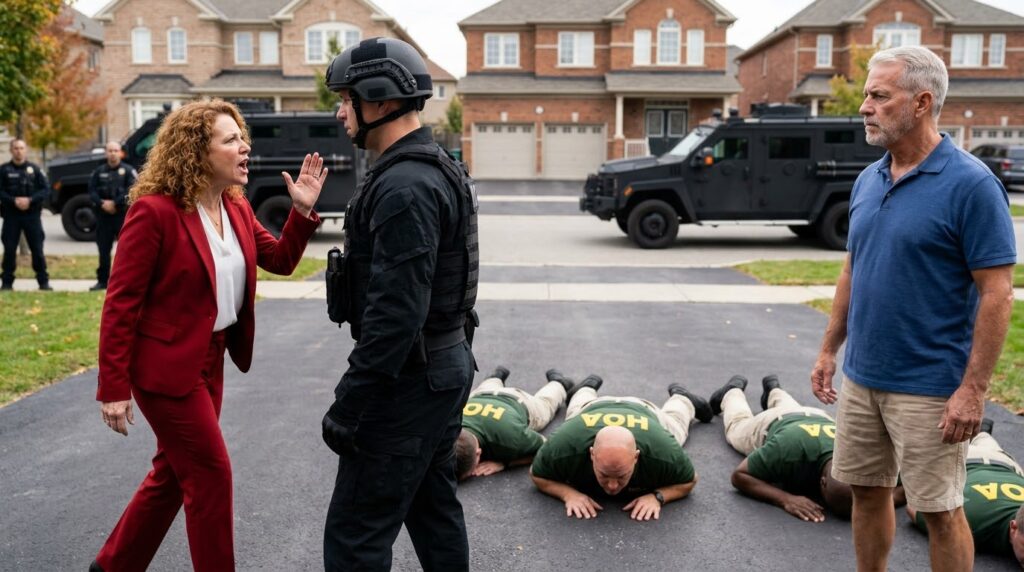
An officer stepped in behind Marcus, catching his shoulder line, forcing him down onto his knees before pressing him face-down onto the concrete. The yellow lettering on his dark green shirt—OAKRIDGE ESTATES HOA BOARD—pressed directly against the oil-stained concrete of Arthur’s driveway.
Beside Marcus’s left boot, the chrome APEX ASSET SECURE key lay abandoned in the dust, glinting under the blinding sun.
Arthur stepped down from his porch, his boots crunching on the driveway margin. He stopped five feet from Marcus, looking down at the struggling HOA president.
“Your authority came from a rubber stamp, Marcus,” Arthur said quietly, his voice cutting through the idling hum of the armored trucks. “And the stamp just ran out of ink.”
Down the sidewalk, a sudden commotion broke out as a woman’s sharp, panicked voice began screaming over the low rumble of the police engines. Dressed in her brilliant bright red pantsuit, her auburn curls shaking with outrage, Evelyn Sterling was charging past the parked lawnmowers, heading straight for the active police line.
CHAPTER 7: THE RED PANTSUIT AT THE PERIMETER
Evelyn Sterling’s high heels struck the concrete with sharp, erratic cracks that cut straight through the hum of idling diesel engines.
“You can’t arrest them like this, stop this right now!” her voice shattered the quiet street, high-pitched and laced with frantic, unyielding outrage.
She pushed past two neighbors standing near the lawn edge, her bright red pantsuit standing out like a flare against the dark asphalt and black tactical gear. Her auburn curls bounced violently around her neck. In her right hand, she clutched a gold-plated fountain pen—stamped along its barrel with the words CHICAGO TITLE & EQUITY SYNIDICATE—pointing it like a weapon toward the tactical line.
“I am the Vice President of the Oakridge Estates Governing Board!” Evelyn shouted, stepping over the concrete curb and advancing three fast, aggressive paces onto Arthur’s driveway. Her face was flushed, her chest heaving under her crisp white blouse. “This is an administrative property enforcement action authorized by municipal charter! You are interfering with a lawful debt recovery!”
Arthur Vance didn’t move. He stood three yards back on the concrete, his feet planted, his blue polo shirt perfectly smooth against the warm breeze. He watched her eyes—not the anger in her iris, but the wild, cornered panic fluttering behind her pupils. She wasn’t fighting for Marcus or the four green-shirted enforcers currently lying face-down in zip-ties on the driveway. She was fighting for the illusion that her title shielded her from federal jurisdiction.
Evelyn took two more fast steps, targeting the Lead Tactical Officer who stood between her and Marcus Kane.
“Step aside!” she demanded, her voice strident as she raised her pointed finger to his face. “I command you to release President Kane immediately and vacate this private neighborhood!”
The Lead Tactical Officer didn’t flinch. He didn’t reach for a weapon, and he didn’t raise his voice. Instead, he planted his heavy boots squarely into the driveway asphalt, shifting his shoulders two inches to the left to lock the entire width of the lane.
As Evelyn attempted to surge past his right flank, the officer brought his arm up in a low, disciplined open-hand posture, his thick Kevlar shoulder line forming an absolute wall against her momentum.
He didn’t grab her. He didn’t push. He simply occupied the physical space she needed to advance, stopping her forward movement instantly.
“Ma’am, step back now,” the officer said, his voice flat, heavy, and carrying the cold weight of unyielding federal authority.
The words hung in the humid air like a physical barrier.
Evelyn frozen mid-stride. Her right foot remained planted on the concrete, her pointed hand still hovering six inches from the officer’s chest visor. Her mouth stayed half-open, a protest dying in her throat as her eyes swept across his matte-black helmet, his tactical vest, and the federal badge gleaming against his chest.
Behind the officer’s boots, Marcus Kane lay pressed against the hot concrete, his cheek ground into the dust, his dark green shirt with its bold yellow HOA lettering soiled by oil drippings from the armored truck idling beside him. He looked up at Evelyn, his bald head glistening with sweat, his eyes hollow with the realization that no local phone call or legal loophole was going to lift him off the pavement.
Across the street, the silence was absolute. Mrs. Higgins stood on her porch railing, holding her breath. The contractor on the stepladder lowered his hammer entirely, watching from fifty feet away. Dozens of neighbors who had spent years cowering under fake violation notices, retaliatory fines, and foreclosure threats stood on their manicured lawns, watching the red-suited officer of false authority trapped at the police line.
“Your rules don’t override federal law, Evelyn,” Arthur said from the midground, his voice calm, clear, and carrying across the entire block.
Evelyn turned her head slowly, looking at Arthur. For five years, she had viewed him as a quiet retiree—a target to be squeezed, fined, and pushed out of his home to make room for corporate acquisition. Now, standing on his clean, unencumbered driveway, framed by three black armored trucks and a squad of federal agents, Arthur Vance looked like what he had always been: a commander standing over a shattered supply line.
Evelyn’s hand slowly dropped to her side. The gold-plated fountain pen slipped from her fingers, tumbling into the grass edge with a soft, unnoticed rustle.
“Task Force agents are serving a search warrant on the clubhouse right now, Evelyn,” Arthur added, stepping forward until he stood just behind the tactical officer’s shoulder. “Your velvet binder is already in an evidence bag.”
Evelyn’s red-suited shoulders sagged. The sharp, imperious posture that had terrified Oakridge Estates for a decade evaporated in a single second. Two female federal agents stepped up behind her, their movement quiet and efficient.
“Evelyn Sterling,” one agent said, pulling a set of steel cuffs from her belt. “You are under arrest for conspiracy to commit wire fraud and extortion.”
Evelyn didn’t scream. She didn’t offer a defense. She simply held out her wrists, her face completely blank, as the steel bracelets clicked shut over her cuffs in front of the silent, victorious neighborhood.
CHAPTER 8: THE UNENCUMBERED GROUND
The metallic clink of the handcuffs locking around Evelyn Sterling’s wrists echoed across the driveway, a final, sharp punctuation mark that brought five years of suburban tyranny to a dead stop.
The female federal agents guided Evelyn gently but firmly toward the rear seat of an unmarked black SUV parked at the curb. Her bright red pantsuit, once a sharp symbol of absolute authority, looked wrinkled and dim under the harsh afternoon sun. She ducked her head as the agent placed a hand over her auburn curls, steering her into the dark interior before the door clicked shut with a heavy, airtight thud.
Beside the rear tire of Arthur’s truck, Marcus Kane was hauled to his feet by two tactical officers. His stocky frame slumped, his chin resting against his chest, the bright yellow lettering on his dark green shirt covered in grey street dust. He didn’t look back at Arthur. He didn’t look at the neighbors staring from their lawns. As the officers led him away, his boots dragged lightly across the concrete, leaving two faint streaks in the dirt.
Down at the clubhouse at the end of the block, federal agents in navy windbreakers were already loading heavy cardboard file boxes into the back of a panel van. The velvet-lined binders, the financial ledgers, the fraudulent lien affidavits, and the master keys to the HOA treasury were being systematically packed, cataloged, and sealed under federal evidence tags.
Task Force Supervisor Miller walked up the driveway, his charcoal trench coat unbuttoned, his hands thrust deep into his pockets. He stopped beside Arthur, looking down at the chrome wheel clamp still lying loose against the truck tire, its lock key unlatched and useless in the dust.
“The Chicago syndicate’s regional director was taken into custody forty minutes ago at his office downtown,” Miller said softly, his eyes scanning the quiet street. “They hit his server farm before he could execute the automated lien transfers. Every fraudulent deed modification processed by Sarah Jenkins is being reversed by court order.”
Arthur didn’t take his eyes off the road. “And Henry Miller’s house?”
“His estate is being fully restored to his daughter,” Supervisor Miller replied. “The liens are voided. The title is clean.”
Miller extended his hand. Arthur turned, taking it in a firm, measured grip—two men who had quietly constructed an iron trap and watched it spring with mathematical precision.
“Good work, Vance,” Miller said. “Your logistics file saved three subdivisions from getting wiped off the county tax map.”
“It was just inventory control, Supervisor,” Arthur said flatly. “When an unauthorized party tries to claim a coordinate, you secure the border.”
Miller nodded once, turned, and walked down the driveway to join the departing convoy. One by one, the black armored tactical vehicles fired their heavy engines, their tires crunching over the street gravel as they turned out of Oakridge Drive, leaving the suburban block in quiet, unencumbered stillness.
The sun sat warm and bright over the rooftops. The air tasted clean, stripped of the heavy tension that had hung over the neighborhood for years.
Across the street, Mrs. Higgins stepped off her front porch, her hands no longer trembling. She walked slowly down her sidewalk path, pausing at the edge of her lawn to look at Arthur. Two doors down, the contractor picked up his hammer and resumed his work, the rhythmic, steady thud of nails driving into wood filling the afternoon air.
Neighbors began stepping out onto their driveways, speaking in low, quiet voices that held no fear. A few nodded toward Arthur—a silent, shared gesture of profound respect for the man who had stood on his ground and refused to yield an inch.
Arthur walked to the edge of his truck, picked up the discarded iron wheel clamp, and tossed it into the bed of his vehicle with a heavy, satisfying metallic crash. He reached into his blue polo shirt pocket, pulled out his brass tape measure, and ran his thumb over the worn, familiar surface.
He walked to the very edge of his property, where his grey driveway met the public street. He looked down at the concrete line he had poured with his own hands fifteen years ago.
The line was clean. The boundaries were clear. The land was his.
Arthur Vance stood tall under the open blue sky, his shoulders squared, his silver beard catching the warm sunlight, enjoying the absolute, unyielding silence of a home fully defended.







