Chapter 5: The Meeting Patricia Could Not Control
Emily reported the threatening note to the police through the appropriate nonemergency channel.
An officer documented the incident and advised her to preserve the note, security footage, and any future communications.
There was no evidence identifying who had left it.
Emily resisted the temptation to assume Patricia was responsible.
The camera had not captured the person’s face.
A hooded figure had approached from outside its clearest viewing angle.
That uncertainty frustrated Emily, but she knew the difference between suspicion and proof.
Meanwhile, the dispute over the damaged package continued.
Thomas Reed, the restoration specialist, submitted his written assessment.
The documented financial loss, including restoration work already performed and the value of damaged components, came to $2,460.
Emily also obtained an independent repair estimate for the remaining bottles.
The total potential loss was higher, but she decided to pursue only amounts she could reasonably document.
The emotional value of her grandmother’s work could never be measured by an invoice.
She consulted a local attorney, Susan Alvarez, who practiced property and homeowners association law.
Susan reviewed the governing documents, the video, and the notices.
Her preliminary assessment was straightforward.
Patricia’s position as HOA president did not give her a general right to enter Emily’s individually owned porch and destroy deliveries.
Whether the HOA itself could be held financially responsible would depend on additional facts, including whether Patricia was acting within her actual authority.
The fines also appeared vulnerable to challenge.
Susan advised Emily to keep communications in writing and avoid confronting Patricia alone.
She helped prepare a formal demand for withdrawal of the fines and compensation for the damaged property.
The letter was sent to Patricia and the other board members.
For several days, nothing happened.
Then the HOA announced a special meeting.
The meeting would address “resident conduct, safety compliance, and unauthorized surveillance.”
Patricia scheduled it for a Tuesday evening in the community clubhouse.
Emily arrived with Daniel, Ruth, Marcus, and her mother.
Nearly forty residents attended.
Some came because they had received fines.
Others came because they had heard rumors.
A few were longtime supporters of Patricia, convinced that strict enforcement protected property values.
Patricia sat at the front table beside the board secretary, Linda Foster, and vice president, George Talbot.
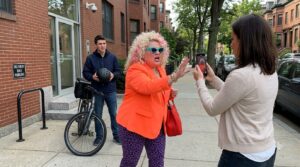
Her orange-red hair was arranged in its familiar rolled buns.
She wore a tailored purple jacket and an expression of practiced authority.
Emily noticed that Patricia had brought a thick folder of documents.
The meeting began with a lengthy statement about community pride.
Patricia described the HOA as the neighborhood’s first defense against disorder.
She warned that careless residents could undermine years of investment.
Then she turned toward Emily.
Without naming her initially, Patricia described a homeowner who had obstructed access, created a spill, and used surveillance equipment to intimidate association representatives.
Emily remained seated.
Susan had advised her not to interrupt.
When Patricia finished, Emily requested permission to present evidence.
George hesitated.
Linda looked uncomfortable.
Several residents asked to see the recording.
Patricia objected, arguing that it was private footage being used to embarrass a volunteer board member.
But George pointed out that the meeting had been called to discuss the incident.
The board could hardly evaluate it without reviewing the available evidence.
Emily connected her laptop to the clubhouse projector.
The recording began.
Patricia appeared on the screen, carrying her large package.
The room fell quiet.
Everyone watched her shove Emily’s first delivery onto the wet step.
Then came the unmistakable movement of her pink boot.
The cardboard collapsed.
Glass cracked.
Emily’s voice came through the speakers.
Patricia’s response followed.
Then the leaking box.
Then Patricia’s accusation about her boots.
When the video ended, no one spoke for several seconds.
Ruth lowered her eyes.
Marcus folded his arms.
George stared at Patricia.
Patricia claimed the video lacked context.
But the camera timestamp showed the full encounter from her arrival until her departure.
Emily then displayed the property plat.
She explained that the porch belonged to her and that the packages had been delivered there with her permission.
Thomas Reed’s written assessment followed.
Finally, Emily displayed the violation notice.
She highlighted Section 8.4.
Marcus stood and read the actual section aloud.
It concerned commercial signs.
A low murmur spread through the room.
George turned to Linda.
“Who approved this fine?”
Linda checked her notes.
There was no recorded vote.
Patricia insisted that emergency enforcement powers allowed her to act independently.
George asked where those powers were written.
Patricia searched through her folder.
She did not produce an answer.
Then Ruth stood.
She held up her own violation notice.
The same section number appeared on it.
A second homeowner produced another.
Then a third.
The room’s attention shifted away from Emily’s broken package.
The board was now facing a much larger question.
How many residents had been penalized under rules that did not apply?
And why had the other directors allowed it to happen?