Chapter 6: At Daniel’s Door
Karen stood in the hallway with her hands clasped tightly around the strap of her red handbag.
Daniel opened the door.
Neither spoke for several seconds.
Karen looked uncomfortable.
Not angry.
Not confident.
Just uncomfortable.
“I was wrong,” she said.
Daniel waited.
She continued.
“I thought if I acted like I belonged there more than you did, I wouldn’t have to think about why I was so uncomfortable.”
Daniel studied her face.
Karen looked down.
“I was angry at the chair.”
Daniel said nothing.
“And I was angry at myself.”
That sentence seemed difficult for her to say.
She told him about her husband.
About his final years.
About the walker.
About the wheelchair he eventually needed.
She had spent those years pretending nothing had changed.
When people offered assistance, she became defensive.
When someone moved slowly, she became impatient.
When she saw mobility devices, she saw something she feared.
Daniel listened.
But he did not excuse what she had done.
Finally, he said, “You don’t have to understand my life.”
Karen looked up.
“You just have to respect it.”
Her eyes filled with tears.
“I know.”
Daniel nodded.
The apology did not erase the humiliation.
It did not erase the complaint.
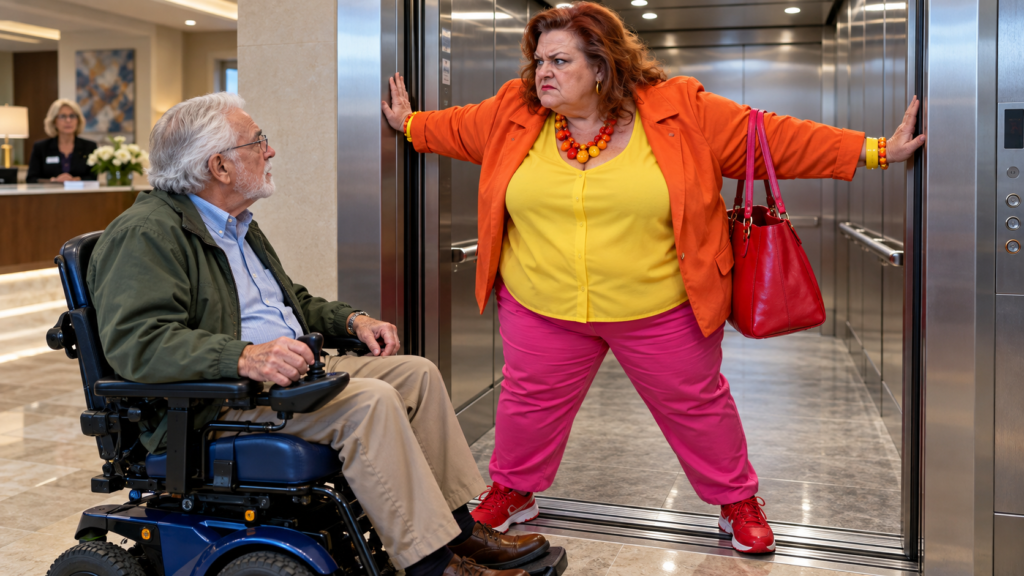
It did not erase the moment she had stood in front of an open elevator and told him to wait because his wheelchair took up too much space.
But it changed what happened next.
Karen agreed to attend the building’s accessibility workshop.
She also agreed to remove the altered notice from the resident communication board and publicly acknowledge that it had not been an official building rule.
Elena accepted her apology but made one thing clear.
The building would not treat the incident as a private misunderstanding.
The residents deserved to know what had happened.
At the next community meeting, Karen stood at the front of the room.
She looked at Daniel.
Then at the other residents.
“I told someone he had to wait because I thought my comfort mattered more than his access.”
The room was silent.
“I was wrong.”
No dramatic applause followed.
No one rushed forward to hug her.
That was appropriate.
Some things should not be repaired with a single emotional moment.
Instead, the building adopted a new accessibility agreement.
Clear paths.
No deliberate doorway blocking.
No unofficial rules.
No assumptions about who deserved priority.
And one simple principle:
If a shared space can reasonably accommodate everyone, no resident gets to exclude another simply because they dislike how that person uses the space.
Daniel signed the agreement.
So did Karen.
But the most important change came afterward.