
CHAPTER 3: The Managers Intervention
The sliding glass doors parted with a pneumatic sigh, spilling the humid afternoon heat across the polished concrete entry. Julian did not rush out to his truck. Instead, he lingered by the vestibule pillars, his fingers tracing the rim of the canvas grocery bag as he watched Brenda’s Lexus carve a sharp, erratic arc out of its parking stall. The tires spat a spray of loose gravel against the asphalt divider before the sedan disappeared toward the main arterial road.
“She’s been like that since the county re-zoned the west parcel last spring,” a dry voice muttered from beside the customer service partition.
Julian turned his head slightly. Store Manager Greg stood there, leaning against the grey laminate counter with a styrofoam cup of lukewarm coffee in one hand. Greg’s apron was stained with dried coffee rings, and his eyes carried the heavy, hollow look of a man who spent sixty hours a week mediating petty neighborhood feuds disguised as retail complaints.
“Doesn’t look like zoning stress,” Julian said, his voice flat. “Looks like someone trying very hard to make sure nobody looks too closely at the books.”
Greg gave a short, cynical bark of laughter, though there was no humor in it. He took a slow sip of his coffee, his gaze shifting across the empty expanse of the checkouts. “Books. That’s a funny word around Harmony Creek these days. You’re the carpenter who bought the old Miller place on the edge of the preserve, right? The one with the natural spring in the back?”
“That’s me.”
“Keep your fences high, Mr. Caldwell,” Greg murmured, tapping the rim of his cup against the counter. “And keep your receipts digital. Brenda doesn’t just manage the architectural committee. She handles the maintenance allocations for the entire association reserve. Or at least, she’s supposed to. Lately, the supply vendors have been calling here asking why checks are bouncing or getting routed through private consulting shells.”
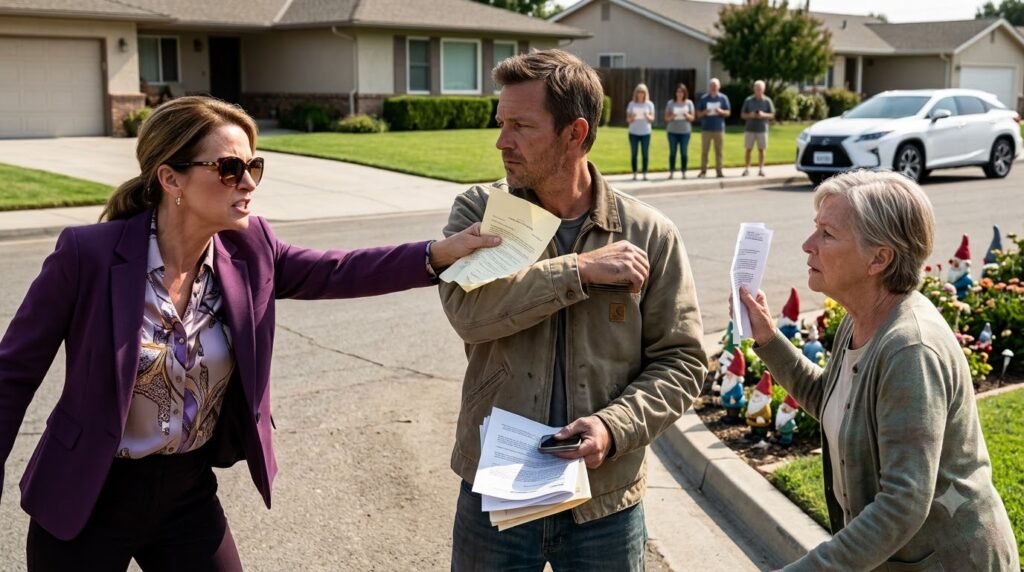
Julian didn’t answer immediately. The memory of that bright yellow municipal notice—the one peeking out from Brenda’s leather folder with its Final Warning header—flashed across his mind. It lined up too cleanly with the erratic panic in her posture, the desperate need to exert total control over a grocery aisle because her wider world was quietly collapsing under financial scrutiny.
“Appreciate you stepping in back there,” Julian said, shifting the canvas bag to his other hand. “Toby looked like he was about to drop the scanner.”
“Toby’s a good kid; he just needs the paycheck,” Greg replied, shaking his head. “As for Brenda, she thinks because she’s been on the board three terms, she owns the pavement from the entrance sign to your front porch. She’s got half the neighborhood terrified of fines and the other half too tired to care. But pressure like that? It usually cracks right at the seam when someone stops playing her game.”
Julian nodded once, a sparse, economical gesture. He thanked the manager again, pushed through the double doors, and walked out into the glaring parking lot heat.
The cab of his truck was an oven. He tossed the groceries onto the passenger seat, climbed in behind the wheel, and turned the key. The engine caught with a low, reliable rumble, vibrating through the chassis. But instead of shifting into drive immediately, he sat there for a long moment, staring through the windshield at the heat shimmer rising off the distant line of oak trees.
The encounter at the checkout lane wasn’t an isolated flare-up. It was a pressure test. If Brenda was stretched this thin—juggling fake code violations, threatening neighbors over garden gnomes, and running interference on community funds—then her hold on the board was maintained entirely by intimidation. And intimidation, as Julian had learned layout after layout on commercial jobs, only worked until someone refused to step back.
He put the truck in gear and pulled out onto the road, heading back toward the property line where the cool, steady gurgle of the artesian spring waited beneath the willows. The real work wasn’t defending the water anymore; it was waiting for the rest of the structure to cave in under its own weight.








