Chapter 6: The Meeting
Three weeks after the fire, the neighborhood association held its monthly meeting.
Karen almost skipped it.
She expected criticism.
Instead, the first item on the agenda was emergency access.
The fire department had been invited to explain how residents could help emergency crews during fires, medical calls, and other urgent situations.
Karen sat near the back.
The captain spoke briefly.
He did not mention her.
He did not need to.
He explained that emergency routes sometimes crossed private driveways, lawns, sidewalks, or other areas residents considered personal property.
During an emergency, those spaces could become access points.
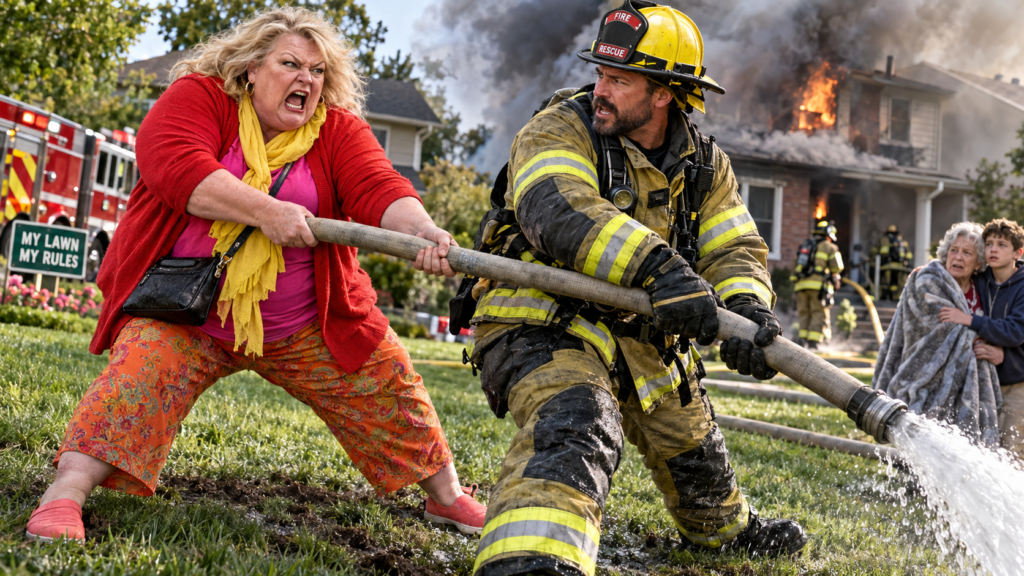
Then he showed a photograph.
Karen recognized it immediately.
Her lawn.
The hose.
The smoke.
She felt every eye in the room turn toward her.
But no one laughed.
No one applauded.
The captain continued.
“The lesson isn’t that property doesn’t matter. Property matters. Homes matter. Gardens matter. The places people spend decades building matter.”
Karen looked down.
“But when there’s a person trapped inside a burning home, the priority is getting people out.”
Silence.
Then June stood.
She had come with Ethan.
“I’d like to say something.”
The room quieted.
June looked toward Karen.
“That day, Karen made a mistake.”
Karen’s stomach tightened.
“But so did I.”
Several people looked surprised.
June explained that she had gone back inside for her purse.
She had believed she would be inside for only a few seconds.
She had not understood how quickly smoke could make a familiar home impossible to navigate.
“I thought I knew my house,” she said. “But fear changes everything.”
She turned toward Karen.
“And anger changes things too.”
Karen looked at her.
June smiled.
“We both learned something.”
The meeting ended without drama.
No vote was taken against Karen.
No public humiliation followed.
Instead, the association approved a simple emergency-access policy.
Residents would be notified that emergency crews could temporarily use necessary portions of private property during active emergencies.
The department would document property damage where appropriate.
And residents were encouraged to keep emergency access routes clear.
Karen supported the policy.
She even volunteered to help maintain the neighborhood’s emergency-access map.
Martha looked at her afterward.
“You?”
Karen shrugged.
“I know where everyone keeps their lawn equipment.”
Martha laughed.
“So you finally found a useful way to be nosy.”
Karen smiled.
“Don’t push it.”
Outside, the evening air was cool.
Karen walked home slowly.
She passed her lawn.
The grass was green again.
But she no longer saw it exactly the same way.
It was still her lawn.
She still cared about it.
She still wanted it neat.
She still disliked people stepping across it.
But now she understood that ownership came with limits.
And sometimes the greatest act of respect for your home was knowing when to move aside.