
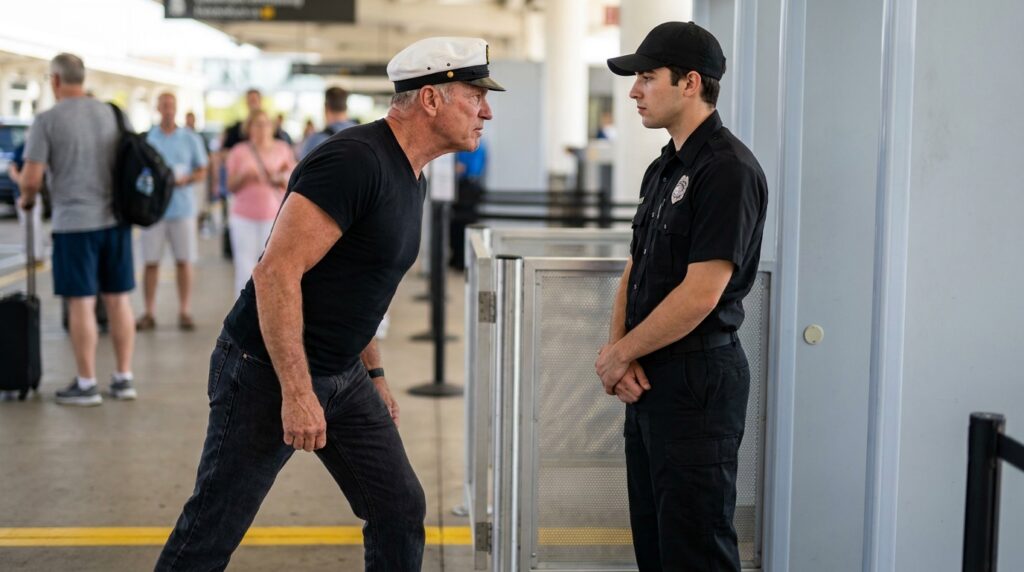
The Weight of Salt and Iron: A Tactical Study in Sovereign Command
CHAPTER 1: THE TACTICAL BOUNDARY
The air off the shipping channel tasted of wet iron and heavy sulfur, a thick, greasy mist that clung to the chain-link perimeter like oil on a turbine blade. Every twelve seconds, the distant, rhythmic thrum of a container ship’s low-speed diesel engine vibrated upward through the cracked asphalt, settling directly into the marrow of Thomas Vance’s shins. He stood exactly two inches from the yellow painted boundary line. His boots, polished to a dull, functional sheen that didn’t catch the glare of the sodium floodlights, remained perfectly parallel.
The contract guard was young—barely twenty, Vance calculated, noting the unblemished weave of the standard-issue black synthetic uniform and the way the kid’s shoulders hitched every time a pneumatic air brake hissed in the adjacent truck lane. The boy’s name tag read Miller. He held his right hand extended, fingers splayed stiffly, a rigid barrier of corporate meat and fabric dividing the old man from the piers he had seen poured before Miller’s parents had even met.
Vance did not reach for his pocket. He did not offer the leather credential wallet tucked against his ribs. To move now was to concede the rhythm of the engagement. Instead, he let his weight settle into his heels, his broad, octogenarian frame expanding slightly within the tight constraints of his black fitted shirt.
“Sir, you’re in the restricted lane,” Miller said, his voice carrying the brittle, high-register edge of a boy trying to sound like a brick wall. “The sign back at the turn-around point applies to civilian foot traffic. Turn around and use the administrative bypass.”
“Look at the manifest, son,” Vance said. His voice didn’t rise; it had the low, scraping gravel of a ship’s anchor dragging across a shale bottom. It was a sound trained by forty years of speaking over the roar of North Atlantic gales. “Lane four. Seventeen-hundred hours. Captain T. Vance.”
“I don’t have a Vance on the digital register,” Miller replied, his eyes finally flickering upward to the crisp, white captain’s hat. He dismissed it instantly—a prop, a bit of old man’s vanity bought from a surplus store. He reached down, his thumb hooking into his duty belt, a tactical posture learned in a three-week certification course. “And if you don’t have a modern biometric bar-code card, you don’t exist to the system. Step back.”
Vance took a breath. Inside his dark jeans, his right knee joint gave a quiet, grinding pop—the legacy of a fractured kneecap suffered in a dry dock mishap off Subic Bay in ’84. He ignored the hot flare of pain. He dropped his center of gravity three inches, shifting his hips forward.
In a single, fluid motion that defied the rust in his spine, Vance closed the distance. He didn’t strike; he simply occupied the space Miller believed belonged to the state. He rose back to his full height, his chest nearly brushing the guard’s extended palm, crowding the boy’s line of sight until the white brim of his hat cast a deep shadow across Miller’s twitching jaw.
Miller’s breath hitched. The smell of the old man—stale coffee, gun oil, and the cold, mineral scent of deep water—flooded his senses. The boy’s hand trembled against the sudden pressure of Vance’s proximity.
“Don’t think I’m that easy to push around,” Vance murmured, his eyes locking onto Miller’s pupils. He could see the microscopic pulse throbbing in the boy’s left eyelid.
A civilian worker in a high-visibility orange vest paused ten yards away, a clipboard balanced on his thigh, his jaw slightly slack as he watched the massive, gray-haired figure pin the armed guard to his own security booth using nothing but mass and posture. Behind them, the low hum of the shipyard administrative building seemed to die, replaced entirely by the slow, metallic click-clink of the stopwatch ticking inside Vance’s pocket.
Miller’s fingers crept closer to his holster, his face flush with the sudden, agonizing weight of a public choice.

CHAPTER 2: THE ANCHOR EXCLUSION
“Stand down, guard. You’re blind to the weight of the silver on his cover.”
The voice cut through the damp harbor fog like a heavy-gauge cable snapping under tension. It came from the gravel walkway behind the security kiosk—sharp, military-crisp, and carrying the unassailable weight of true institutional power.
Miller’s thumb froze on the polymer retention hood of his holster. The microscopic tremor in his eyelid ceased, replaced by a sudden, draining pallor that turned his jaw the color of wet sailcloth. His splayed hand, still hovering inches from Vance’s chest, dropped instantly to his seam.
Vance didn’t turn his head. He didn’t break eye contact with the boy. He kept his boots fixed to the weathered asphalt, letting the cold shadow of his white brim remain planted across Miller’s face until the boots behind them ground to a halt on the yellow paint line.
Commander Harris, the Port Director, stepped into the floodlight’s cone. His uniform was immaculate, the gold braid on his sleeves catching the sharp edges of the sodium glare, but his chest was heaving slightly from a hurried march across the administrative quad. His eyes weren’t on the guard; they were locked onto Vance’s broad, unyielding shoulders with an expression that balanced professional panic with ancient, deeply drilled deference.
Harris snapped his hand upward, his fingers locking into a flawless, rigid salute that vibrated with a lifetime of conditioning. “Captain Vance, sir. The gate manifest was delayed at the primary terminal. My apologies for this security breakdown.”
The silence that followed was heavy, broken only by the low, subterranean rumble of a container ship clearing the outer breakwater. The civilian worker with the clipboard stood completely still, his eyes darting between the legendary commander in jeans and the senior base official holding a salute on the damp concrete. Miller’s chest rose and fell in shallow, terrified cycles; his rigid posture had dissolved into a panicked slump, his ears flushing dark crimson against the black band of his security cap.
“Your sentry is thorough, Harris,” Vance said, his gravelly voice dropping an octave as he finally shifted his gaze away from the boy. He didn’t look at Harris yet. He looked down at the guard’s small stainless-steel desk inside the open kiosk window. Resting on top of the digital terminal was a physical, leather-bound paper logbook—an archaic secondary backup used for commercial steel shipments. Stamped across the active page was an indigo ink seal: a double-ringed maritime anchor with a central serial number that had been crudely struck through with a red grease pencil.
The sight of that struck-through seal sent a cold, familiar calculation through Vance’s mind. It wasn’t standard port bureaucracy. It was an exclusion mark.
“The boy was following directives, Captain,” Harris said, lowering his hand only after Vance offered a terse, nominal nod of acknowledgment. Harris stepped forward, his leather shoes clicking sharply on the iron drain cover between them. He reached past Miller without looking at him, his fingers striking the hydraulic gate toggle. “The new vessel is moored at Pier 9. The engineering team is waiting for your inspection. We can bypass the biometric scan entirely.”
“No,” Vance said. The word was a flat iron bar. He reached into his fitted black shirt, his thick, calloused fingers extracting a small, unlabeled black aluminum casing no larger than a cigarette lighter. He laid it flat on the paper logbook, directly over the struck-through anchor seal. “We run the credentials. We log the access. I don’t move through side doors on a federal contract, Commander.”
Harris’s eyes twitched down to the aluminum drive. For a fraction of a second, the Port Director’s professional mask slipped, revealing a tight, defensive muscle bunching at the corner of his jaw. “Of course, sir. Miller, scan the Captain’s hardware. Now.”
The young guard’s hands shook as he took the drive, his fingers fumbling with the USB interface on the side of the ruggedized terminal. The machine let out a short, high-pitched chime, and a series of encrypted code blocks began cascading across the green monochrome screen. Vance watched the reflections in the glass. He didn’t care about the clearance status; he was watching Harris’s reflection. The Port Director was staring at the terminal screen with the rapt, desperate intensity of a lookout watching a torpedo wake in a dark sea.
“Clear, sir,” Miller whispered, his voice cracking slightly as he handed the drive back to Vance. He wouldn’t look the old man in the eye. “Lane four is… logged. My apologies, Captain.”
Vance took the drive, the cold metal edges sliding back into his palm. “Authority isn’t given by a black uniform, kid,” he said, his voice level and devoid of anger, which only made the weight of it heavier. “It’s earned by the lives you protect. If you’re going to hold a line, make sure you know exactly what’s behind you.”
He stepped past the barrier, his boots striking the gravel beyond the yellow paint. Harris immediately fell into step beside him, matching the older man’s deliberate, slightly uneven stride as they headed down the long, unlit corridor of shipping containers toward the black water of Pier 9.
The shadows here were longer, sharper, cast by the massive gantry cranes towering overhead like iron skeletons against the gray sky. The salt spray was getting thicker, carrying the distinct, oily stench of a vessel fresh out of dry dock—paint solvents, burnt zinc anodes, and the clean, terrifying scent of unprimed iron.
“You didn’t mention the vessel’s registration was flagged under the domestic material exclusion act, Harris,” Vance said after they cleared the hearing range of the gate. His internal stopwatch clicked again, the rhythmic clink keeping time with his steady steps.
Harris cleared his throat, his hand coming up to adjust the brim of his dress cap. “A minor administrative hiccup with the supplier, Captain. Nothing that affects the hull integrity. The shipyard supervisor has the full structural certification waiting in the wardroom.”
Vance kept his eyes fixed on the dark silhouette of the ship rising at the end of the pier. The hull was massive, a matte-black wall of steel that seemed to absorb the light from the facility’s perimeter floods. But as they drew closer, his eyes—trained by decades of identifying structural stress in submarine bulkheads—caught the slight, uneven ripple along the seam of the second strake. The weld line was too wide, the metal pitted with microscopic fissures that had been hastily covered by a thick layer of industrial gray primer.
It wasn’t a minor hiccup. It was the physical signature of cheap, high-sulfur domestic scrap steel—the kind that brittle-fractures when the hull hits four degrees Celsius in a heavy swell.
“We’ll see what the wardroom says,” Vance murmured, his fingers tightening around the encrypted drive in his pocket. The decoy secret was already in his hands, but as he looked at the tense, rigid posture of the commander walking beside him, he knew the real threat hadn’t even shown its face yet.
CHAPTER 3: THE DECOY DEVIATION
The companionway ladder was steep, ice-cold to the touch, and angled down into a throat of raw, unpainted metal. Every step Vance took echoed with a dull, hollow metallic ring that vibrated straight through his boots into his bad knee. Above him, the heavy hydraulic hatch shut with a definitive, mechanical hiss, sealing off the gray harbor fog and replacing it with the high-pressure whistle of a newly pressurized auxiliary boiler.
Harris hadn’t followed him down. The Port Director had stopped at the threshold of the primary staging deck, his fingers resting casually on his uniform belt, offering a smooth excuse about verifying the harbor master’s log. Vance hadn’t argued. In the tactical architecture of a ship’s bowels, a companion who checked his watch every forty seconds was a liability, not an asset.
Vance reached the foot of the ladder on Deck Four. The air here was thicker, saturated with the biting, chemical tang of fresh zinc primer and hot lubricating grease. The illumination was sparse—stringers of temporary yellow cage lights that cast long, geometric shadows against the exposed structural ribs of the hull.
He didn’t head toward the wardroom where Harris claimed the documentation was waiting. Instead, his boots ground against the steel floor plates as he pivoted toward the auxiliary machinery space. If a ship was built with fraudulent, high-sulfur scrap, the evidence wouldn’t be sitting in a leather folder under a desk. It would be written in the seams closest to the high-vibration stress zones.
He reached into his pocket, his thick fingers brushing the cold, rectangular edge of the encrypted black drive before closing around his internal stopwatch. Click-clink. The steady mechanical beat inside his palm kept his focus clean.
He moved down a narrow corridor lined with uninsulated steam pipes. The edges here were sharp, the welds intentionally unground to save contract hours. Vance stopped beside a structural bulkhead reinforcing the starboard fuel bunker. He bent low, his powerful, muscular frame tightening within his black shirt as he ran a calloused thumb across the main vertical joint.
The metal felt wrong. It lacked the smooth, uniform density of cold-rolled marine steel. Under his touch, the surface was microscopic sand, slightly porous, and chilled beyond the ambient temperature of the room. It was cheap domestic rebar scrap, melted down and recast without the proper chromium stabilization.
Then his eyes narrowed. Mounted directly to the bulkhead was a standard emergency damage-control locker. The glass face was unbroken, but the yellow steel sealing clip had been snipped through with wire cutters. Inside, the bracket meant to hold a heavy-duty thermal cutting torch—the kind used to slice through jammed steel doors in a catastrophic flooding event—was completely empty. Only a greasy, dust-free outline remained on the red backing plate.
Vance stood up slowly, his joints protesting with a dry, internal friction. A missing piece of salvage equipment wasn’t an oversight. In a restricted yard, tools were tracked by the ounce.
“You’re not supposed to be down in the bilge, Captain.”
The voice came from behind the manifold of the primary ballast pump. It wasn’t Harris. This voice belonged to a man who lived in the grease—low, raspy, and accompanied by the heavy, rhythmic clanking of an adjustable spanner wrench against an iron palm.
A man stepped out from the shadow of the overhead pipes. He wore a frayed canvas mechanic’s jacket with no name tape, his face smeared with black graphite grease that highlighted the deep, cynical lines around his mouth. He didn’t drop his wrench. He held it by the lower shaft, using the weight to balance his posture as he measured Vance.
“The Port Director said the structural certs were in the wardroom,” Vance said, his own voice dropping into its habitual, gravelly command register. He didn’t shift his feet. He let his arms hang loose, his hands resting inches from his waist, broad and steady. “But the starboard stringers tell a different story. Who signed off on this weld profile?”
The mechanic let out a short, dry sound that might have been a laugh if there was any humor in his eyes. “The computer signs the sheets, Captain. The people just turn the valves. If I were you, I’d take Harris’s word, get back on the launch, and let this tub clear the three-mile limit.”
“The three-mile limit is international water,” Vance said, his mind instantly locking the pieces together. The chess board was rewriting itself. “Once she’s in the channel, jurisdiction shifts. The structural failure isn’t an accident. You’re waiting for the sea trial to let the seams crack.”
“I didn’t say that,” the mechanic countered, his eyes flickering for a fraction of a second toward the empty damage-control locker behind Vance. He took a single, deliberate step forward, the heavy spanner wrench lifting slightly. “I just said the bilge is a dangerous place for a veteran who doesn’t have a modern security pass.”
Vance didn’t back away from the advancing line. He adjusted his center of mass, preparing for the physical friction he knew was coming, his internal stopwatch accelerating its silent rhythm. He had uncovered the physical secret—the fraudulent steel manifest on his drive matched the brittle alloy under his fingers—but the mechanic’s lack of surprise meant something far more devastating. The decoy was perfect: a ship built to fail for an insurance or regulatory scam. But as a loud, definitive mechanical thud echoed from the deck plates above, followed by the distant sound of the primary access hatches locking from the outside, Vance realized the failure wasn’t meant to happen out at sea.
It was meant to happen right here, with him inside it.
CHAPTER 4: THE ULTIMATE BOUNDARY
“The hatches don’t cycle from below, Captain,” the mechanic said. The heavy spanner wrench in his hand shifted an inch lower, its cold iron weight a clear extension of the ship’s own locked architecture. “Harris didn’t just walk back to the administration building to check a logbook. He walked back to wash his hands.”
Thomas Vance didn’t flinch as the echo of the pneumatic locks settled into a dull, vibrating silence across Deck Four. He let his fingers release the pocket stopwatch. The internal ticking in his mind didn’t stop, but it grew cold, translating the structural rhythm of the ship into a fluid matrix of immediate risks. He had spent half his life trapped in iron hulls under three hundred atmospheres of black ocean; a locked maintenance gate on an uncommissioned vessel was just another perimeter to cross.
“The three-mile limit wasn’t the delivery point, was it?” Vance asked, his voice cutting through the hiss of the auxiliary steam line with a flat, predatory resonance. He didn’t look at the wrench; he kept his eyes on the mechanic’s greasy forehead, tracking the micro-expressions under the yellow cage lights. “The hull isn’t meant to sink in international waters. It’s meant to settle right here across the primary deep-water shipping lane. One catastrophic structural failure during the harbor trials. The entire port grid gets choked for six months.”
The mechanic’s mouth tightened into a hard, defensive line, his posture stiffening as he realized the old commander wasn’t calculating a retreat—he was calculating an assault. “You’ve got the drive, Captain. You know about the steel. If the yard uses sub-spec contractor plates, the company takes the hit, the insurance covers the maritime write-off, and everybody gets a clean ledger.”
“The ledger isn’t clean if Harris signed the maintenance override before the inspection manifest even crossed my desk,” Vance countered. He took a slow, calculated step forward, the leather of his boots biting into the grit on the steel floor plates. He let his broad, muscular chest crowd the narrow companionway space, using the exact spatial dominance he had deployed against the young guard at the outer boundary. “A budget deficit doesn’t get resolved by scrap steel insurance payouts. It gets resolved when a foreign commercial carrier pays a premium to redirect their container fleet to a private terminal twenty miles up the coast while this channel is blocked.”
A sharp, metallic hiss rattled through the overhead pipes as the auxiliary line pressure surged. The cold truth stripped away the final layer of the decoy. The fraudulent steel manifest wasn’t a corporate cutting of corners; it was the physical mechanism for an intentional infrastructure sabotage, orchestrated by the one man who held the keys to the entire sector. The young guard at the gate hadn’t been an arrogant kid protecting a corporate perimeter; he had been the first line of an intentional delay protocol, ordered to keep Vance from seeing the hull stress signatures until the auxiliary lines were fully pressurized.
“You’re an old man, Vance,” the mechanic muttered, his knuckles whitening around the iron shaft of the wrench as the distance between them shrank to less than three feet. “You don’t have a command anymore. You don’t have a crew. You’re just a name on a retirement plaque in the administrative quad.”
“I am the man who designed the internal compartment protocol for this exact class of hull,” Vance said. The words were quiet, but they carried the crushing weight of forty years of unyielding naval absolute. “Every isolation valve behind that bulkhead responds to a mechanical bypass that doesn’t run through Harris’s digital terminal.”
With a sudden, explosive shift of his weight that drove a flare of heat through his damaged knee, Vance didn’t move away from the mechanic—he slammed his mass directly into the man’s center of gravity. His broad shoulder caught the canvas jacket, the sheer physical momentum of his veteran frame pinning the technician against the main manifold of the ballast pump. The iron spanner wrench clattered against the deck plates with a loud, ringing strike, sliding into the dark pooling water of the bilge below.
Vance didn’t strike. He held the man fixed against the vibrating pipe with one calloused, unyielding hand locked onto his collar, his gray hair catching the harsh glare of the sodium bulb above. With his free hand, he reached into his shirt, extracting the small black drive and pressing it flat against the mechanic’s chest.
“You’re going to open the manual auxiliary line to the primary sea chest,” Vance commanded, his breath steady and cold against the man’s face. “We drop the pressure in the forward tanks before the weld seams reach critical load. Then you and I are going to have a conversation with the base commander’s internal affairs unit.”
The mechanic stared into the unshakeable, slate-gray eyes beneath the white captain’s hat. The defiance in his face dissolved, replaced by the profound, panicking realization that the legendary commander standing over him couldn’t be broken by an environmental trap or an iron tool. The authority wasn’t in the locked hatches or the security uniforms; it was in the absolute, terrifying discipline of the man who knew every rib of the ship he was prepared to save.
“The bypass valve is behind the secondary collector panel,” the technician whispered, his head sinking back against the structural iron. “The override code… it’s the same one stamped on Harris’s private log. Seven-two-zero.”
Vance let the man down slowly, his fingers remaining near his pocket as the mechanic reached for the manual wheel. The metal plates beneath their feet groaned as the internal pressure began to bleed back into the harbor basin, the structural stress on the brittle hull receding with a long, metallic sigh. The trap had failed. The true boundary had been held.
CHAPTER 5: THE QUADRANT ESCAPE
The emergency pressure lever on the secondary terminal hatch resisted with the stubborn, grinding friction of ungreased iron. Vance threw his shoulder against the crossbar, using the full leverage of his muscular frame to break the hydraulic seal. With a sharp, metallic clack, the heavy circular door swung outward into the midnight air, letting the biting, salt-rimed wind of the outer harbor flood the dim ladder well.
The mechanic, his face pale underneath the graphite grease, scrambled out onto the gravel walkway first, his boots skidding on the loose stones. Vance followed him with a deliberate, smooth step, his eyes sweeping the administrative quad before his boots even settled on the pavement.
The shipyard had changed during the two hours he had been in the bilge. The yellow sodium floods were gone, killed at the main breaker. In their place, the cold, sweeping white beams of high-intensity halogen spotlights cut through the low-hanging fog from the roofs of the surrounding container offices.
“Movement by the electrical substation,” Vance muttered, his gravelly voice dropping below the roar of the distant harbor generators. He grabbed the mechanic’s canvas collar, pulling him back into the deep shadow of the auxiliary intake housing.
Fifty yards across the open asphalt, three white utility trucks were parked in a tight, defensive wedge blocking the primary road to the administrative building. The men moving between them didn’t wear the standard black contract uniforms of Miller’s shift. These men wore desaturated gray tactical vests over unmarked dark clothing, their faces obscured by the brims of low-pulled baseball caps. They carried short, compact sub-carbines on tactical slings—not standard port security gear.
Vance focused on the closest figure. Attached to the man’s shoulder strap was a tactical radio, its small digital screen flashing an amber frequency loop: 462.575. It was an unencrypted commercial band used by private maritime logistics contractors—the kind hired to move high-value, off-the-books cargo through federal channels.
“Those aren’t port authority boys,” the mechanic whispered, his teeth clicking together from a mix of freezing spray and raw adrenaline. “Harris brought in his own line handlers. If they find us out here with that drive—”
“They won’t find us,” Vance said. His hand reached into his jeans, his calloused thumb testing the edge of the encrypted drive before shifting back to his brass stopwatch. Click-clink. The steady, rhythmic strike inside his pocket was a tactical counterweight to the frantic flashing of the amber radio screens across the quad. “Harris knows the bilge pressure dropped. He knows the hull didn’t fracture on schedule. He’s running out of minutes before the dawn shift arrivals.”
Vance looked toward Pier 9’s secondary slip. Moored against the creosote-soaked pilings was a twenty-six-foot harbor patrol launch, its twin diesel outboards idling with a low, wet chug that was masked by the larger ship’s generator. The boat’s navigation lights were dark, but the high-gloss fiberglass of the console caught the sweeping glare of the roof-mounted spot.
“The launch,” Vance said, his finger pointing through the sharp edges of the iron crane supports. “The key switches on those commercial hulls are mechanical rotary systems. They don’t run through the gate’s biometric network.”
“We’ll have to cross twenty yards of open asphalt,” the mechanic protested, his eyes tracking the sweeping halogen beam. “The moment that light hits the gravel, they’ll have the carbines on us.”
“Then don’t look at the light,” Vance said.
He didn’t wait for the mechanic’s nerves to settle. Vance adjusted the bill of his white captain’s hat, dropping his center of gravity into his heels as he stepped out from the shadow of the intake housing. He didn’t run—running created an erratic silhouette that caught the periphery of a sentry’s vision. He moved with a heavy, rhythmic stride, keeping his broad shoulders parallel to the shipping containers, using the massive iron structures as a physical shield against the trucks.
The halogen beam swept across the gravel three feet behind his heels, illuminating the crushed white stone with a blinding, clinical glare.
“Hey! Lane four exit! Hold position!”
The shout came from the utility trucks. A car door slammed with a loud, hollow crack. Vance didn’t turn to look. He caught the mechanic by the arm, propelling him forward through the narrow gap between the pier deck and the launch’s gunwale.
Vance dropped down onto the rubber-matted deck of the boat, his bad knee taking the impact with a hot, sickening flare of pain that he crushed down through sheer force of will. He reached the helm console in a single, fluid extension of his arms, his thick fingers bypassing the digital ignition screen and reaching under the molded plastic dash to find the heavy copper emergency starter solenoid.
Behind them, the gravel exploded into small fountains of dust as the first warning shots struck the edge of the pier. The sharp, whip-like cracks of the carbines echoed off the iron hull of the uncommissioned ship, followed by the frantic shouting of Harris’s private security detail running toward the water.
Vance twisted the solenoid wires together. The twin diesels roared to life with a thick cloud of blue exhaust, the props biting into the black harbor water before the mechanic could even find a cleat to untie.
“Cut the lines!” Vance roared over the engine wine, his hands slamming the mechanical throttles forward into the hard stop.
The launch leaped forward into the dark channel, its bow lifting as it tore through the oily surface, leaving the sweeping lights and the flashing amber radios behind in a wake of white foam. The hunt was no longer contained within the gate; the entire harbor was now the board.
CHAPTER 6: THE CHANNEL INTERCEPT
The cold spray off the hull tore over the low fiberglass windscreen, hitting Vance squarely in the face with the force of thrown gravel. The launch took a heavy, shuddering leap over a massive, unlit wake left by an inbound tugboat, its twin outboards screaming as the propellers briefly cleared the black water before biting down again with an iron jar. The steering wheel thrummed violently against Vance’s calloused palms, but his grip remained frozen into a locked, tactical brace.
Beside him, the mechanic clung to the aluminum grab rail, his knuckles stark white under the passing sweep of the outer breakwater beacon. “The primary radar sector is going to flag us!” the younger man yelled, his voice torn apart by the rhythmic, deafening thrum of the engine wall at full throttle. “Harris controls the port terminal transponder feed! He’ll have the intercept boats waiting before we clear the inner lane!”
Vance didn’t adjust his course. His eyes were focused three miles ahead, where the sprawling, illuminated grid of the Coast Guard sector command pier rose out of the dark water like a floating fortress. Between them lay the deep-water shipping channel, congested with the massive, towering shadows of three stacked container vessels waiting for their harbor pilots.
He glanced down at the small, glowing marine radar screen on the dash. A sharp amber dot was closing fast from the starboard quarter—a heavy-duty twin-hull interceptor vessel belonging to the private yard’s corporate response team. It didn’t flash blue lights; it moved with a silent, aggressive momentum that meant Harris had cut the safety limit overrides entirely.
“Look at the transponder frequency on the screen,” Vance barked, his low, gravelly voice effortlessly dropping beneath the vibration of the fiberglass deck plates.
The mechanic squinted at the small liquid-crystal panel. “It’s showing seven-four-zero. That’s… that’s an outdated naval civilian auxiliary channel. It doesn’t register on the primary port authority manifest.”
“Harris isn’t running his communications through the municipal port grid,” Vance said, his gaze returning to the black water ahead as he cut the wheel hard to port, ducking the launch beneath the massive, rusting overhang of an anchored grain ship’s stern. The hull scraped against a trailing mooring line with a sharp, screaming hiss that tore a strip of white gelcoat from the gunwale. “He’s tracking us using a legacy military frequency loop left over from the old sector command. He thinks I don’t know the dead zones in my own basin.”
Vance reached down, his thumb striking the toggle switches on the launch’s navigation panel. He cut the running lights, the anchor light, and the digital instrument backlights with three rhythmic, heavy clicks. Instantly, the boat became a silent, desaturated shadow running blind through the towering corridors of steel hulls.
Behind them, the amber dot on the screen began to zigzag erratically, its internal tracking loop scrambled by the massive magnetic mass of the anchored grain vessel. Harris’s private security team had the speed, they had the weapons, but they didn’t have forty years of navigating the thermal drafts and shallow shoals of this specific channel.
But the victory was a false flag. As Vance brought the launch around the final marker buoy, his chest tightening within his black fitted shirt, a sudden, piercing white light erupted from the Coast Guard sector pier. It wasn’t a standard harbor beacon; it was a high-powered searchlight that pinned the launch against the dark water with absolute, blinding precision.
Over the public address system across the water, a voice boomed, amplified by three horn speakers until it shook the air inside Vance’s chest. “Vessel approaching sector pier nine, cut your engines and prepare for immediate boarding by regional port authority order. You are in violation of a restricted channel closure.”
Vance looked at the pier. Standing at the edge of the concrete walkway, surrounded by three uniformed federal officers who had their sidearms unholstered, was Commander Harris. The Port Director’s immaculate white cap was pulled low, his arms crossed over his chest with the cold, self-assured stance of a man who had already rewritten the official narrative before his targets could even touch dry land. He had used his own administrative authority to flag Vance’s launch as a stolen civilian asset, turning the base’s own security grid into an iron wall of defense for his infrastructure cover-up.
“We’re done,” the mechanic whispered, his hands dropping away from the rail as his knees buckled against the deck plates. “He’s got the whole sector locked down. There’s nowhere left to run the hardware.”
Vance didn’t slow the throttles. He kept his fingers clamped to the vibrating wheel, his eyes fixed on the young contract guard who was standing just behind Harris’s shoulder—Miller, the twenty-year-old kid from the gate, brought along as a witness to validate the false flag report. The final boundary wasn’t just a physical gate anymore; it was the institutional memory of the base itself.
Vance’s internal stopwatch let out one final, cold click inside his head. He had the physical evidence of the sabotage on his drive, but to make them look at it, he would have to slam his momentum straight into the center of the base’s active defense zone, risking everything on the one factor Harris couldn’t control: the absolute discipline of the ranks.
CHAPTER 7: THE REVERSAL TERMINUS
The launch didn’t back down. Vance jammed the mechanical throttles into reverse at the absolute last fraction of a second, the propellers cavitation-screaming against the black harbor wash as the bow slammed violently into the heavy rubber timber bumpers of the pier. The impact sent a shuddering shockwave through the fiberglass deck plates, throwing the mechanic forward into the console moulding with a dull groan. Vance caught his balance with one thick, tensed arm wrapped around the windshield frame, his broad shoulders locking against the sudden momentum as the boat ground to an agonizing, scraping halt against the concrete wall.
The searchlight was a physical weight, blinding and hot, pinning him against the steering wheel. Above him, the three federal officers pulled their service weapons into a low, tactical hold, their boots striking the iron edge of the dock line with sharp, rapid clicks.
“Step off the vessel with your hands visible!” the loudest officer barked, his silhouette dark against the halogen wash.
Harris stood directly behind them, his hands tucked neatly into his uniform belt, his face a smooth mask of bureaucratic victory. “The drive in his possession is stolen yard property, Lieutenant,” Harris said, his voice flat, carry over the idling engine whine. “The suspect forced his way through lane four and compromised the auxiliary compartment of the uncommissioned ship. Secure the hardware immediately.”
Vance didn’t move his hands to his belt. He rose to his full height on the unstable deck, the sea spray dripping off the crisp, white brim of his captain’s hat. He ignored Harris entirely. His eyes tracked across the uniforms of the three federal guards, noting the small, polished brass anchors pinned to their left lapels—the mark of veterans who had served under the regional sector command before the private contract transition.
Then he looked at Miller. The twenty-year-old contract guard was standing at the edge of the light, his black cap pulled low, his hands gripping his corporate utility belt with a stiff, anxious tremor. The boy’s face was pale, his eyes darting from Harris’s rigid back to the massive, gray-haired figure standing on the wet launch deck.
“Miller,” Vance said. The gravel in his voice didn’t rise, but it filled the concrete gap between the boat and the pier with the absolute weight of a command deck. “Tell this officer what is logged on the secondary paper register at lane four.”
Harris’s jaw tightened. “The suspect is attempting to deflect. Lieutenant, remove him from the boat.”
“Sir,” Miller’s voice cracked through the fog, thin and uncertain. He took a single, short step forward, his eyes fixed on the white hat Vance wore. “The… the Captain is right. The entry was logged under the domestic material exclusion code. I ran the biometric pass myself before the Commander arrived at the gate.”
The lieutenant with the service weapon didn’t move his arm, but his head turned a fraction of an inch toward the young guard. “Miller, what are you talking about?”
“The secondary register,” Vance said, his calloused hand finally coming out of his pocket, holding the small black aluminum casing up into the direct path of the searchlight. “It matches the structural serial numbers on the starboard bunker seams of the ship currently sitting at Pier 9. Harris didn’t bring me in to inspect a hull. He brought me in because his private logistics contractors needed a legendary signature on the clearance manifest before the vessel was intentionally scuttled in the deep channel.”
The silence that hit the pier was total, broken only by the rhythmic, heavy sloshing of the tide against the launch’s raw hull.
Harris’s professional posture collapsed. His arm shot out toward the federal officer’s shoulder. “He’s a civilian vagrant playing with surplus gear! Secure that drive!”
But Vance was already moving up the iron ladder rungs built into the concrete face of the dock. His bad knee ground with every step, a sharp, white-hot reminder of forty years of service, but his broad frame rose over the edge of the pier with an unyielding, rhythmic momentum that made the closest officer instinctively take two paces back.
Vance stood exactly two inches from Harris. The shadow of his white cap brim fell across the Port Director’s twitching eyes. He didn’t drop the drive. He laid it flat on the concrete block at the lieutenant’s feet, his thumb tracing the cold metal edge.
“Authority isn’t given by a golden braid, Harris,” Vance said, his voice a low, scraping rasp that left no room for bureaucratic defense. “It’s earned by the lines you hold when everything else breaks. You forgot what this basin was built to protect.”
The lieutenant looked down at the drive, then up at Harris’s pale, sweat-slicked face. The gold pins on the officers’ lapels caught the searchlight glare as they slowly shifted their target line away from the launch, their weapon vectors pivoting toward the man with the clean uniform and the dirty ledger.
Vance turned his back on them before the first plastic zip-tie could click around Harris’s wrists. He walked past Miller, his thick hand coming down for a brief, heavy second on the young guard’s shoulder.
“Keep your eyes on the logbook, kid,” Vance murmured, his boots striking the asphalt as he headed toward the base gate. “The line’s yours now.”
The internal stopwatch in his pocket let out one last, quiet clink as the outer perimeter lights of the harbor began to flicker back to life in the distance. The final boundary had been held, and the salt air tasted clean again.







