
The Friction of Standing Ground When the Entire World Demands a Rushed Step
CHAPTER 1: THE FRICTION OF WEIGHT
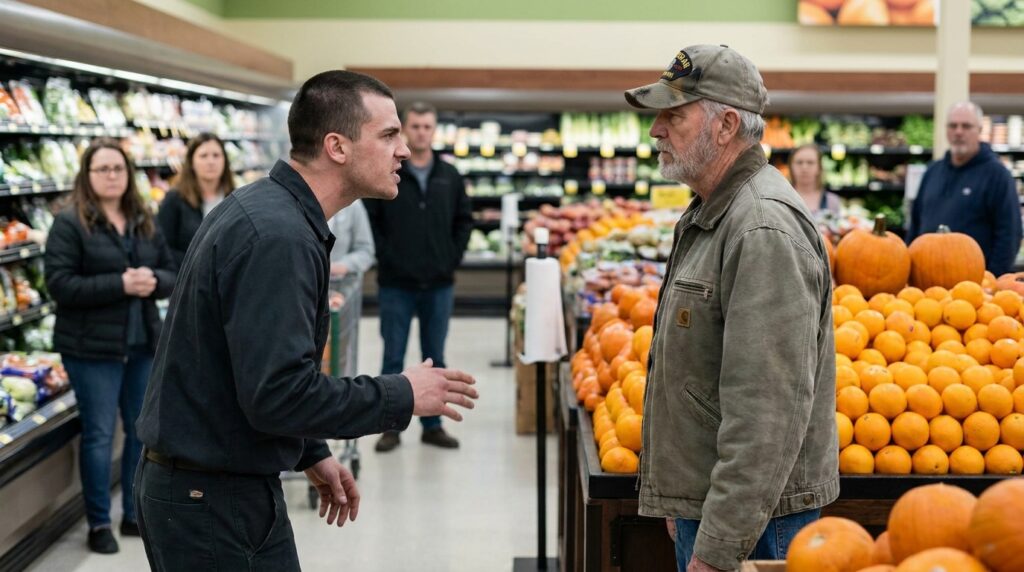
The fluorescent tubes overhead vibrated with a low, cyclic frequency that settled directly behind the eyes. It was a sterile, midwestern light, throwing desaturated shadows across the scuffed linoleum floors of the supermarket aisle. The old man did not look up. His thumb, split at the knuckle and grayed by decades of motor oil, tracked the printed numbers on a cardboard box of oats. Nine cents more than the previous Tuesday. The market didn’t care about a fixed pension, nor did it care about the structural fatigue of the men who built the county roads outside its double doors.
He adjusted the brim of his navy blue veteran cap. The gold lettering—faded, the thread fraying at the edges of the “V”—sat heavy against his brow. It was an anchor, nothing more. A habit of gravity.
To his left, the rubber-soled shoes of the younger man squeaked against the polished floor, a sharp, rhythmic sound that spoke of unspent adrenaline and tight muscles. The challenger had been trailing two paces behind since the dairy section, his dark crewneck sweatshirt catching the cold light like a smudge on a clean pane of glass. He was broad-shouldered, late twenties, his jaw set with the specific, restless arrogance of a local gatekeeper used to people clearing a path out of sheer convenience.
The old man moved toward the citrus bins. His boots, heavy-soled and unpolished, left faint, dusty prints on the floor. Every step was deliberate, a calculated expenditure of physical capital. He reached for an orange, his hand steady despite the sudden shift in the air behind him.
“You’re taking up the whole lane,” the younger man said, his voice dropping into the low, transactional register of a threat. He stepped into the old man’s peripheral vision, his shadow cutting off the reflection of the bright citrus. “Some of us have places to be. Move.”
The old man didn’t flinch. He kept his fingers on the rough, dimpled skin of the fruit, feeling the cool weight of it. In his right jacket pocket, the edge of a folded paper—the crisp, heavy stock of a legal notice—pressed against his hip. The developer’s name was printed at the top of that page. The same name stamped on the side of the truck he’d seen the young man driving three mornings ago near his perimeter fence.
The surrounding aisle seemed to lose its noise. A mother two bins down froze, her fingers hovering over a bag of salad. A stock boy stopped mid-reach, a crate of greens suspended in the gray air between them. The supermarket had become a small, rigid court, and the silence was waiting for a plea.
The old man slowly turned his head. His eyes, nested in deep folds of weathered skin, locked onto the younger man’s throat, right where the pulse beat rapid against the dark collar. He didn’t look at the flexed forearms or the aggressive tilt of the chin. He looked at the structural weakness.
“You really want to make this your problem today?” the old man asked. His voice was dry, flat, carrying the scratch of a engine that had run too long without grease. It wasn’t a challenge. It was a ledger, open and waiting for an entry.
The young man’s nostrils flared, the skin around his knuckles whitening as his hands closed into fists. He took a short, violent step forward, the distance between them dissolving into the smell of cheap laundry detergent and cold sweat.

CHAPTER 2: THE ANGLE OF REACTION
The younger man’s boots shifted on the scuffed floor, the small, sharp screech of rubber against linoleum signaling a transfer of weight. He didn’t drop his hands. Instead, his shoulders squared, blocking out the light from the dairy coolers at the far end of the row. On his right thumb, a thick, notched steel ring caught the cold fluorescent glare. The metal was rough-edged, the grooves packed with the gray, industrial grease of heavy equipment—the same grease currently staining the hydraulic lifters of the earthmovers parked three miles out on the county line.
The old man watched that ring. He didn’t look at the eyes, which were wide and bright with a local, short-fused anger, nor did he look at the chest expanding beneath the dark casual fleece. He looked at the thumb. A notched ring on a right hand meant a man who operated levers, someone who spent ten hours a day dragging a blade through limestone and hard clay until his joints grew thick and his patience ran thin.
“You’re an old man,” the challenger muttered, his voice dropping into a tighter, rougher slot. He didn’t look at the veteran cap; he looked past it, treating the faded gold lettering as nothing more than a piece of discarded cloth. “You’ve got no business standing in the middle of the road when the trucks are running.”
The old man didn’t move his hand from the citrus display. Beneath his fingers, the small, dimpled orange felt solid, cold, a tiny weight that anchored him to the wooden bin. In the small of his back, beneath the stiff canvas of his work jacket, the folded legal summons felt like a patch of dried mud—dry, stiff, and prone to cracking under direct pressure. The developer’s name on that document was Vance Corporate Holdings. The logo on the fleece across from him was the same three-bar Chevron.
“The road’s wide enough for a man who knows how to steer,” the old man said. He didn’t raise his voice. He kept it level with the low hum of the refrigeration units, a sound like gravel rolling through a metal chute.
The young man didn’t answer with words. The space between them, less than two feet of stale air smelling of floor wax and old celery, evaporated as the challenger’s left shoulder dipped. It was a standard, uncalibrated opening—a heavy, forward-leaning crowd designed to force an older body back against the shelving until the spine met metal and the spirit broke under the weight of the audience.
The old man didn’t go back. He rubbed the small, deep-grooved scar on his left thumb against the rough canvas of his pocket, calculating the friction. He knew the structural limits of a frame that had spent forty years under load. If he took the impact full-chested, the grease-stained jacket would split, the papers would scatter, and the small authority of his silence would dissolve into a messy, public scramble on the floor.
From the corner of his eye, he saw the witness layer tighten. The woman with the salad bag had retreated three inches, her shopping cart forming a small, metal bulkhead between her kids and the aisle. The stock boy had lowered the crate of greens, his palms resting on the plastic rim, his eyes fixed on the young man’s forward boot. They weren’t going to help. In this county, a dispute in a store was like a engine fire on the shoulder of the highway—you watched the smoke from your cab, but you didn’t waste your own water.
The young man’s right hand came up, the notched steel ring clearing the line of his hip. It wasn’t a punch; it was a rough, open-palmed push intended to catch the old man by the collar and pull him out of the narrow lane. The movement was fast, but it carried the flaw of all heavy things: it was committed to a single trajectory before it even crossed the centerline of the aisle.
The old man waited until the fingernails of the young man’s hand were six inches from the weathered canvas of his lapel. Then, with a motion so small it looked like a man shifting his feet to avoid a puddle, he dropped his right heel back two inches and let his weight settle onto his hip. He didn’t swing. He didn’t raise his arms to block. He simply altered the angle of resistance by the width of a standard nut.
The young man’s palm struck nothing but air, his fingers brushing the coarse, oil-scented fabric of the jacket without finding purchase. His own momentum—the three hundred pounds of force he’d generated by throwing his chest into the lunge—carried him past the old man’s shoulder. His left work boot skidded on a patch of wet linoleum near the lettuce misting racks, the tread losing its grip with a sharp, wet hiss.
The old man didn’t watch him go. He kept his eyes on the citrus bin, his hand still resting on the orange he had chosen three minutes ago. He heard the sudden, heavy crunch of a body hitting timber before he saw it—the dull, flat sound of a shoulder meeting the structural corner of the main orange display. The wood didn’t break, but the impact sent a shudder through the entire tier of stacked fruit.
The top row of oranges, balanced in neat, concentric pyramids, began to roll. First two, then a dozen, then a whole cascade of bright orange spheres dropped from the upper shelves, hitting the floor with a rhythmic, hollow rattling that sounded like large hail falling on an old tin roof. They bounced off the young man’s boots, rolled into the dark corners beneath the vegetable racks, and scattered across the wide white lane, filling the small space with the sudden, sharp scent of ruptured citrus skin.
The young man lay across the edge of the bin, his dark sweatshirt dusted with dry splinters from the rough wood, his right hand still extended toward the empty air where the old man had been standing a micro-second before. His breath came out in a short, ragged grunt, the sound of a man who had hit the earth harder than he’d ever intended.
The silence returned, heavier this time, thick with the smell of iron and crushed fruit. The stock boy hadn’t moved. The woman with the cart had stopped her retreat, her eyes fixed on the scattered oranges that were now resting against her shoes. The young man stayed pinned against the timber for three full seconds, his face darkening as the realization of the room’s total attention settled into his neck.
The old man slowly turned his head to look down at him. He didn’t smile, and he didn’t offer a hand. He just stood there, upright beneath his faded cap, his boots planted firmly between two rolling oranges that had stopped against his leather toes.
“You’re dropping your shoulder on the turn,” the old man said, his voice flat, the tone completely devoid of malice or triumph. “You’ll ruin the machinery that way.”
The young man’s fingers twitched against the wood, the notched steel ring scraping against the grain, leaving a small, raw line in the softwood of the display.
CHAPTER 3: THE FRICTION OF BOUNDARIES
The young man didn’t move. He remained draped over the timber edge of the citrus bin, his chest heaving in short, shallow hitches that sent a tremor through the remaining rows of oranges. The sound of rolling fruit had faded, replaced by the heavy, rhythmic dripping of the misting system two aisles over. Every shopper in the produce section had become a frozen statue, their collective judgment pressing into the air like a rising tide.
“Clean it up,” the stock boy said, his voice cracking. It wasn’t an order; it was a plea for the world to return to its rigid, predictable tracks.
The old man didn’t look at the boy. He kept his eyes on the back of the challenger’s neck, noticing the way the skin had turned a mottled, angry crimson. The grease-stained ring on the young man’s thumb was buried deep in the wood of the bin, a small anchor of steel against the softwood. The old man felt the paper in his pocket—the court summons from Vance Corporate Holdings—and wondered if the boy even knew whose boots he was trying to fill.
“He didn’t hit you,” a woman whispered from behind a pyramid of apples. Her voice was thin, carrying the sharp edge of a witness who had seen the physics of the thing but couldn’t find the malice. “You just… you just fell.”
The challenger finally moved. He pushed off the bin with a grunt of tactical exhaustion, his boots sliding through a mashed orange that left a slick, pulpy streak across the white floor. He stood upright, but the symmetry of his arrogance was gone. His dark sweatshirt was smeared with dust and citrus juice, and his left shoulder hung an inch lower than his right—a classic mechanical failure of the rotator cuff, the price of overextending a committed load.
He didn’t look at the crowd. He looked at the old man, his eyes narrowed into slits of dark, desaturated light. The rage was still there, but it was being suppressed by the overwhelming friction of public shame. In this county, a man could survive a fight, but he couldn’t survive being made to look like a clumsy amateur in front of the people he intended to rule.
“You think this changes anything?” the young man spat. The words were transactional, a desperate attempt to regain the centerline of the interaction. “You’re still sitting on a lot that doesn’t belong to you. You’re just a ghost in a cap, holding up progress.”
The old man reached down and picked up a single orange that had come to rest against the toe of his boot. The skin was ruptured, a small tear leaking clear, sticky juice onto his calloused palm. He didn’t answer immediately. He felt the weight of the fruit, the way the structure of it had collapsed under the sudden impact.
“Progress usually has a cleaner face,” the old man said. He tossed the ruptured orange onto the bin. It landed with a wet thud. “And better balance. You’re working for Vance, aren’t you? Driving that yellow 938 out by the creek?”
The young man stiffened. The mention of the machinery—the specific model of the front-end loader—acted like a physical strike. It pulled the interaction out of the anonymous space of a grocery store and into the gritty, industrial reality of the land dispute. The “Sovereign Protector” lens of the old man was fully engaged now; he wasn’t just defending his space in the aisle, he was defending the perimeter of his history.
“What I drive is none of your business,” the challenger said, though the lie was visible in the way his eyes flicked toward the store exit. “What matters is the notice. You got it. You know the date.”
“I know the date,” the old man replied. He adjusted his veteran cap, the frayed gold thread catching the clinical light. “And I know the soil. You’re digging into a legacy you don’t understand, son. You’re just a lever for a man who’ll replace you the second your joints start to creak like that shoulder.”
The witness layer was beginning to shift. The curiosity was being replaced by a low-level anxiety as the conversation turned toward the local politics of land and eviction. In a town where everyone’s mortgage was tied to the same three banks, the word notice carried the weight of a funeral bell.
The stock boy stepped forward, a plastic broom in one hand, but he kept a three-foot radius between himself and the young man. “Please,” he muttered. “I just have to clear the lane.”
The challenger looked at the broom, then back at the old man. The silence in the aisle had become a vacuum, demanding a resolution that neither man was ready to give. The young man reached into his pocket and pulled out a set of keys on a heavy steel carabiner. They rattled with a sharp, metallic friction that echoed off the cold walls of the supermarket.
“We’ll see how your balance holds up when the fences start moving,” the young man said. He turned on his heel, his boots clicking against the floor in a sharp, defensive rhythm. He didn’t look back. He walked toward the automatic doors, his stride forced and heavy, leaving the scent of crushed citrus and unspent violence in his wake.
The old man stood his ground until the doors hissed shut. He felt the pulse in his split thumb, a rhythmic reminder of the friction he had just survived. He wasn’t relieved. A victory in the produce aisle was a false flag; it was a tactical reprieve in a war that was rapidly moving toward his front porch.
He looked at the oranges scattered across the floor—a messy testament to a failed escalation. The woman with the salad bag finally moved, steering her cart around the pulpy remains of the fruit without saying a word. The grocery store began to hum again, the normal sounds of commerce rising up to bury the incident, but the texture of the air had changed. It was grittier now.
The old man turned back to the bin and selected three more oranges. He placed them carefully in a plastic bag, the crinkle of the film loud in the lingering quiet. He needed to get home. He needed to check the markers on the north ridge. If the boy was driving for Vance, and if the boy had a notched ring like that, he wasn’t just a messenger. He was the one who would be sitting in the cab when the blades finally touched the dirt.
As he walked toward the registers, he noticed a small, oily smear on the sleeve of his canvas jacket—the industrial grease from the young man’s ring. He rubbed it with his thumb, feeling the grit of it. It was a micro-mystery, a discrepancy he couldn’t quite place. That specific grease was only used on the older hydraulic systems, the ones the military had sold off in the nineties.
He stopped at the end of the aisle, his eyes narrowing. Vance didn’t run old equipment. Vance ran new, shiny, lease-protected machinery.
The old man looked at the smear again. The friction was increasing. The threat wasn’t just corporate; it was personal, and it was tied to a ghost he hadn’t seen in thirty years.
CHAPTER 4: THE ANGLE OF ALIGNMENT
The old man laid his plastic bag of oranges down on the black rubber conveyor belt of the register lane. The belt moved with a jerky, complaining shudder, its internal gears screaming for grease that had dried out a decade ago. The cashier, a girl with tired eyes and a name tag that read Brenda, didn’t look up as she dragged the barcodes across the red laser light. The scanner beeped—a thin, flat sound that cut through the low, ambient murmur of the front end of the store.
“That’ll be four dollars and twelve cents, Mr. Miller,” she said, her voice matching the rhythm of the machine.
He reached into his pocket, his calloused thumb rubbing against the split edge of his knuckle before passing over the crisp, folded stock of the Vance Corporate Holdings summons. He pulled out a worn canvas billfold, its cloth frayed at the seams where his hip pocket had rubbed it bare over twenty years of hard labor. He placed four single dollar bills and two dimes on the plastic divider beside the register. The metal coins slid against the surface, ringed with a small scratch that sounded like iron filings sliding across a workbench.
“He’s been around the north ridge all morning,” Brenda muttered, her fingers pausing over the open till. She didn’t name the young man, but her gaze flicked briefly toward the glass entry doors where the automatic sliders were still settling into their tracks. “My cousin works the fuel truck out by the creek. Said Vance brought three older scrapers out from the county yard last night. Not the new lease units. The heavy ones with the rusted blades.”
Miller adjusted his navy blue veteran cap, the stiff buckram behind the faded gold lettering pressing a cold line into the skin of his forehead. He picked up his bag of citrus, the plastic film crinkling in his fist like dry leaves under a winter boot. “Those scrapers have twelve-foot moldboards?” he asked.
“The big ones,” she nodded, dropping the coins into the register drawer with a sharp metallic clink. “The ones they used to clear the old grade before the county sold off the maintenance lot. They’ve been sitting in the weeds behind the old quarry since ninety-four.”
The old man felt a subtle hitch in his shoulder, the mechanical calculation clicking into place behind his eyes. The scrapers behind the quarry weren’t commercial property. They were surplus—old military-spec diesel rigs left behind when the reserve unit disbanded at the end of the Cold War. If Vance was running those specific machines, they weren’t paying a lease on them, and they weren’t tracking a corporate asset. They were using unrecorded weight to move dirt where the state engineers hadn’t cleared the markers.
“Thanks, Brenda,” he said, taking his bag.
He walked out through the double glass doors, the hot June air hitting his face like the back-draft from an exhaust manifold. The concrete apron of the parking lot was desaturated, the aggregate stone showing through the worn tar in gray patches that resembled salt on wood. His truck, an eighty-two long-bed with primer-gray spots along the wheel wells, sat fifty yards out near the perimeter chain-link fence.
As his boots met the gravel at the edge of the asphalt, he stopped. The young challenger was standing beside a yellow Vance Corporate service truck parked three slots down. The young man’s back was turned, his dark sweatshirt pulled taut across his shoulder blades as he reached into the open utility box on the side of the truck bed. The steel door of the box hung open, its hinges squeaking with a dry, metal-on-metal friction that Miller could hear across the wind.
The young man pulled a heavy grease gun from the tool rack. He didn’t look back toward the store, but his left shoulder was still hitched lower than his right—the physical penalty of his mistake in the aisle still lingering in his muscle memory. He clamped his thumb down on the lever of the pump, forcing a thick, dark bead of lubricant onto the nozzle.
The old man didn’t change his vector. He walked toward his long-bed, his boots kicking up small puffs of limestone dust from the unpaved margin of the lot. His eyes remained locked on the grease gun. The lubricant coming out of the nozzle wasn’t the clean, red lithium grease used by modern corporate fleets. It was black, sulfurous, and thick with the smell of old mineral oil and graphite—the exact surplus compound the old man had used to pack the wheel bearings of his platoon’s transport trucks forty years ago in the mud.
The young man turned suddenly, his boots scuffing the loose gravel as he caught the crunch of Miller’s approach. He didn’t drop the tool. He held the grease gun by the iron barrel like a club, his knuckles turning pale against the greasy metal. The notched steel ring on his thumb was covered in a fresh film of the black graphite, the edges of the notch catching the harsh midday sun.
“You’re still looking for a place to break down, old man?” the challenger said, his voice carrying a defensive rasp that didn’t match the heavy tool in his hand.
Miller stopped ten feet away, his body aligned perfectly with the rear bumper of his own truck. He didn’t look at the iron barrel. He looked at the young man’s wrist, noting the small, white line of a circular scar right below the joint—the kind of mark left by an old military-issue identification tag chain when it gets caught in a steering column.
“That’s a lot of graphite for a modern machine,” Miller said, his voice flat as a dry board. He pointed his chin toward the open utility box. “Vance doesn’t allow that mix in the new cylinders. It scores the chrome rods.”
The young man’s jaw tightened, a muscle jumping along the line of his throat. He lowered the tool an inch, but his fingers didn’t relax. “I told you to stay out of the machinery. The notice is signed. The company has the title from the state.”
“The company has a piece of paper signed by a clerk who never walked the line,” Miller countered. He took one step closer, his boots pressing into the gravel until the stones ground together under his weight. “And you’re using your grandfather’s grease to turn the pins on a blade that doesn’t belong to the corporate office. Who gave you the keys to the quarry lot, son?”
The challenger’s eyes went wide for a micro-second, the dark pupils shrinking under the glare of the sky. The arrogance didn’t leave his face, but the structure of it became brittle, like old iron left out in the rain. He didn’t answer. He turned his back to Miller, slamming the steel door of the utility box shut with a sound that rattled every wrench in the truck bed. The latch caught with a dry, rusted click.
The old man didn’t follow him as the young man climbed into the cab of the yellow truck. He stood in the dust as the diesel engine caught, coughing out a thick plume of gray smoke that smelled of sulfur and old storage tanks. The truck backed out of the slot with a roar of uncalibrated power, its tires throwing a shower of gravel against the chain-link fence as it tore toward the northern exit.
Miller didn’t move until the sound of the engine died away down the county road. He reached into his pocket and pulled out the folded court summons, his gray-bearded chin sinking toward his chest as he unfolded the sheet. He didn’t look at the legal language at the bottom. He looked at the description of the property line—the coordinates that defined his home.
The boundary marker Vance wanted to clear wasn’t the boundary of the farm. It was the old foundation wall where the reserve unit had stored its technical manuals during the transition in ninety-four. The young man wasn’t just clearing land for a developer; he was clearing evidence.
The old man folded the paper back into his pocket, his hand steady but heavy with the weight of labor. He walked to the driver’s side of his long-bed, his hand closing over the rusted iron handle of the door. The friction wasn’t in the supermarket anymore. It was in the dirt under his feet, and the person holding the shovel had the same blood as the man who had ordered him to hold the line forty years ago.
He climbed into the cab, the springs of the vinyl bench seat groaning in familiar protest under his weight. He turned the key, and the old V8 shook the dashboard with a low, metal-on-metal rumble that sounded exactly like the beginning of a long road.
CHAPTER 5: THE DEFENSIVE PIVOT
The V8 engine dropped into a rough, low-idle cough as the truck bounced across the washboard ruts of the north ridge road. The steering wheel, wrapped in cracked electrical tape that left a sticky adhesive residue on Miller’s palms, jerked sharply against his grip. Every stone that struck the wheel wells sounded like a ball-peen hammer hitting an empty drum. He pulled the gear lever down into second, the transmission grinding in dry, metallic protest before the gears finally locked.
To his right, the plastic grocery bag slid across the cracked vinyl bench seat, an orange tumbling out to lodge itself against the rusty mounting bracket of the floor shifter. He didn’t reach for it. His eyes were trained on the line of scrub oak marking his northern property boundary, where the yellow dust of a heavy diesel engine was already settling into the dry weeds.
He pulled the truck off the main track and brought it to a halt beside a collapsed section of cedar-post fencing. The rusted barbed wire lay snarled in the wild mustard like dry briars, its orange-red corrosion transfering to the hem of his canvas trousers as he swung his leg out of the cab. The smell of hot engine oil and parched limestone dust filled the small clearing, thick and dry enough to catch in the throat.
Miller walked toward the old foundation wall. It was a low, square perimeter of poured gray concrete, cracked by decades of hard frost and half-buried under a carpet of dry pine needles. In ninety-four, it had carried a corrugated tin roof and a heavy steel door with a military-issue padlock. Now, the roof was gone, but the heavy iron frame of the door sill remained, bolted straight into the aggregate stone.
The yellow Vance service truck was parked fifty yards away at the foot of the ridge, its engine ticking quietly as the block cooled down. Beside it, the young challenger stood with his back to the old man, his broad shoulders leaning hard into a four-foot iron pry-bar. The tip of the bar was wedged beneath the rusted hinges of the old vault box buried in the floor of the foundation.
“That’s county property until the court rules on the easement, son,” Miller said. His boots ground into the dry limestone chips, the noise flat and heavy in the midday heat.
The young man didn’t jump. He froze, his hands locked onto the iron bar, his head turning slowly until his profile was framed against the bright, bleached sky. The notched steel ring on his thumb was scratched down to the raw silver metal, the black graphite grease from the parking lot smeared across his right forearm like an old bruise.
“The county sold the scrap rights to Vance three weeks ago,” the challenger spat, his breath coming in short, transactional hitches. He didn’t lift the bar. He shifted his hips, bracing his boots against the concrete edge to maintain his leverage. “Everything from the road to the old baseline belongs to the developer. The manuals, the lockers, the steel. It’s all on the manifest.”
“Manifests don’t clear an iron title,” Miller said. He stepped onto the concrete slab, his shadow falling across the rusted surface of the vault box. “Your grandfather knew that. He sat in that ordnance trailer for four months in seventy-two checking the serial numbers on every crate that went down the river. He used the same graphite mix you’ve got on your sleeve to keep the locks from freezing.”
The young man’s weight shifted, the iron bar groaning as the tip slipped an eighth of an inch against the rusted weld. A line of sweat cut through the gray dust on his cheek, his teeth bared in an uncalibrated strain that showed the limits of his composure. “Don’t talk about my grandfather. You don’t know anything about what he left behind. Vance is the only one paying out on the old timber leases. My family needs those checks to clear before the winter.”
“Vance isn’t paying out on timber,” Miller countered, his voice dropping into the steady, unblinking register of a command. He reached down and caught the chain of the old vault lock between his oil-stained fingers. The links were heavy, square-cut iron, pitted with thirty years of red rust that bit into his skin like coarse sand. “They’re paying you to pull these plates before the state surveyor arrives on Thursday. Look at the link behind the eyelet.”
The challenger paused, his shoulders dropping an inch as his gaze flicked down to Miller’s hand.
Attached to the square-cut chain was a small, oblong brass tag, half-covered in green oxidation. The letters stamped into the metal were faint, but the regulatory numbers were still readable under the grime: US-ORD-72-A. It wasn’t a county scrap mark. It was an active federal asset registration—the kind that never expires under local real estate transfers.
“He didn’t leave this to the county,” Miller said, his thumb tracking the grooved numbers. “And he didn’t sell it to Vance Holdings. He left the ledger inside this box because he knew the developer was going to buy the road commissions. He wanted the markers to stay exactly where they were put.”
The young man’s face went white under the sun, his fingers twitching against the iron pry-bar. The illusion of his corporate authority was breaking down, leaving nothing but the raw friction of a family secret that had been mismanaged for a generation. He raised the iron bar, his athletic frame tightening as if he intended to drive the metal through the old man’s boots.
“He’s dead,” the challenger yelled, his voice echoing off the dry limestone ridges. “The old troop disbanded before I was born. There’s no one left to check the books but the people who hold the bank notes.”
He brought the bar down with a violent, reckless lunge, targeting the rusted eyelet of the vault box. It was a desperate, unguided strike meant to shatter the chain and end the argument through force alone.
Miller didn’t draw back. He didn’t raise his hands to meet the iron. As the bar descended, he shifted his left hip back three inches, his heavy work boot anchoring his weight into a small depression in the concrete. The movement was minimal, a disciplined realignment of his frame that allowed the iron bar to miss his knee by the width of a standard bolt.
The bar struck the concrete slab with a deafening, metallic ring that jarred up through the younger man’s wrists. The iron tip skidded off the aggregate stone, sparks flying in a bright, brief shower as the tool lost its trajectory entirely. The challenger’s momentum carried him over the box, his hands losing their grip on the smooth metal as his shoulder slammed into the old iron door frame of the sill.
He hit the rusted iron structure hard, his breath leaving him in a sharp, guttural hiss. The notched steel ring on his thumb scraped against the bolted flange, leaving a raw, bright streak of silver on the orange rust before he tumbled onto the dry pine needles outside the wall.
The old man stood over the box, his boots unmoved between the sparks and the scattered concrete dust. The silence returned to the ridge, heavy and thick with the smell of iron and scorched stone. The young man lay in the weeds, his dark sweatshirt torn at the elbow, his face pressed into the dry dirt as he nursed his vibrating wrists.
Miller looked down at him, his gaze level and empty of malice. “The ledger stays in the stone, son,” he said, his voice flat as the gray concrete under his feet. “Get your truck off my ridge before I call the reserve desk at the post.”
The young man didn’t answer. He stayed in the dirt, his fingers curling into the loose limestone gravel as the true weight of his miscalculation settled into his spine. The corporate notice in Miller’s pocket was a false flag; the real line was written in the iron beneath their feet, and it wasn’t going to move for a tractor.
CHAPTER 6: THE SILENT JURY OF COLD IRON
“The post desk doesn’t take calls from dead men, Miller,” the young man said from the dirt. He didn’t rise. He stayed on his side in the wild mustard, his left hand hooked into his dark sweatshirt to anchor his cracked shoulder against his ribs. His breathing came in short, raspy cycles that stirred the gray limestone dust around his mouth. “Vance owns the exchange. They own the wires down the valley. You’re talking to a dial tone.”
The old man didn’t move away from the iron frame of the door sill. His shadow stretched long across the poured concrete slab, cutting the midday heat into two distinct zones of light and gray slate. He reached into the small utility pocket of his heavy canvas work jacket, his thumb rubbing the brass edge of an old five-pin cabinet key. It was a small piece of metal, light and thin compared to the iron pry-bar lying three feet away, but it carried the specific balance of property that had been kept under oil for thirty winters.
“The wires don’t change the voltage in the ground,” Miller said. His voice was flat, level with the low, dry rattle of the wind through the dead scrub oak. He didn’t look down at the challenger’s face. He kept his eyes on the heavy iron vault box, where the tip of the pry-bar had left a bright, jagged scar across the rusted seam of the lid. “Your grandfather left three hundred boxes of grease-packed parts under these plates when the county yard closed down. He didn’t put them on the company ledger because they weren’t corporate stock. They were the reserve replacement depot for the whole northern line.”
The young man let out a wet, coughing laugh that ended in a sharp intake of breath. He pushed his heels into the gravel, dragging his body back an inch until his spine met the rough bark of a cedar fence post. “You think Vance wants old tractor gears? They want the right-of-way, Miller. The rail link goes straight through this ridge. If the foundation is still on the survey map by Thursday morning, the state pulls the permit. The whole lease goes dark.”
The old man knelt. The movement was a slow, mechanical collapse of his joints, his knees hitting the dry pine needles with a soft, dusty crunch. He didn’t reach for the iron bar. He took the brass key from his pocket and inserted it into the small, hidden keyway beneath the brass registration plate of the vault box. The lock didn’t turn with a clean, smooth click; it required a small, backward pull—a four-ounce adjustment that only a man who had cut the cylinders himself would know to make.
The internal tumblers dropped into place with a heavy, leaden thud that vibrated through the concrete slab under his boots. The lid didn’t pop open. It was too heavy for springs, four hundred pounds of steel plating reinforced with structural angle-iron. Miller gripped the welded handle with his split thumb, his boots grinding into the limestone chips as he hauled the dead weight up six inches.
The scent that rose from the dark interior was immediate, cold, and thick—the sulfurous, black bite of old graphite grease mixed with the dead, dry air of a sealed bunker. It didn’t smell like commercial oil. It smelled like ninety-four.
Inside the iron tray, resting on top of three grease-packed hydraulic pumps, lay a flat, leather-bound logbook. The cover was cracked, the pigskin stained with green copper oxidation from the brass corner-guards, but the white paper label pasted to the center was clear under the mountain sun: PROPERTY LOG: RESERVE ENGINE DIVISION 4.
The young man braced his good hand against the fence post, his neck straining as he tried to see past the iron rim of the box. The arrogance had drained from his features, replaced by a brittle, defensive desperation that made his athletic frame look hollow. “That’s just an old maintenance book. It’s got no legal standing in a local court. The company has the deed from the land office.”
“The land office didn’t check the title of the man who poured the slab,” Miller said. He didn’t lift the book. He turned the first page with the edge of his calloused thumb, his eyes tracking the blue ink lines written in a precise, blocky hand. “Your grandfather didn’t sign this over to the county, son. He signed it as the resident engineer for the federal reserve. Look at the signature on the third row.”
The challenger leaned forward, his boots sliding through the loose limestone gravel as he dragged his injured shoulder toward the edge of the foundation wall. His eyes flicked down to the page, then froze.
The ink was old, faded to a desaturated purple, but the name was written with the same rigid, unblinking alignment as the layout of the road commission trucks: Captain Marcus Vance, US Army Reserve.
The young man’s mouth remained open, but no sound came out past his dry lips. The three-bar chevron logo on his dark casual fleece—the symbol of Vance Corporate Holdings—suddenly looked like a cheap imitation of the military stamp on the leather cover. The false flag of the developer’s eviction notice had been shattered by the physical reality of the name written in the stone.
“He didn’t build the company with corporate capital,” Miller said, his voice dropping into the low, transactional register of a final ledger. “He built it with the surplus tools the reserve unit left behind when the base went cold. He gave the county the road easements, but he kept the title to the foundation ridge because he knew the corporation would try to sell the land out from under your family if the timber dried up. You’re trying to evict the person who holds the only clear deed to your father’s yard.”
The young man collapsed back against the cedar post, his fingers curling into the dry pine needles until his nails were white with the strain. The silence returned to the north ridge, heavier this time, thick with the desaturated gray light of an afternoon that had run out of time. The yellow truck down the hill ticked in a steady, rhythmic cycle, a mechanical clock marking the hours until the state surveyor’s arrival on Thursday.
Miller slowly closed the book. The heavy leather cover came down with a flat, muffled slap that sealed the smell of graphite back into the dark iron tray. He didn’t pull the key from the lock. He left it sticking out of the cylinder, a small piece of brass against four hundred pounds of steel.
“He didn’t leave you a fortune, son,” the old man said, his gaze level and unblinking beneath the faded gold lettering of his cap. “He left you a boundary. And you brought a pry-bar to move it.”
The young man didn’t move. He stayed in the weeds, his eyes fixed on the rusted iron frame of the door sill, his posture small and broken under the true weight of the ridge.
CHAPTER 7: THE RECKONING OF STONE AND STEEL
“He never told us,” the young man whispered. The words came out thin, stripped of the unearned weight he had carried through the grocery store aisles and the gravel tracks. His hand dropped away from the cedar fence post, his fingers leaving gray streaks of dust in the rough bark. He stared at the faded violet ink on the old ledger page, his breath whistling through his teeth in short, shallow cycles. “He told my father the ridge was an old state easement. He said the county took it for back taxes after the reserve split up. He never said he signed it himself.”
Miller didn’t answer with words. He reached down into the iron vault box, his fingers sliding beneath the leather-bound log to trace the cold, heavy edge of a secondary steel plate welded to the floor of the box. The metal was pitted, coated in a thick layer of old graphite grease that rubbed off onto his skin like grease-paint. Beneath that secondary shield sat a narrow zinc cylinder, its cap sealed with lead wire that had been twisted shut with a standard pair of lineman’s pliers in ninety-four.
The old man didn’t break the seal. He left the cylinder in the dark groove of the iron, his eyes tracking the way the young challenger’s shoulders had caved inward, his athletic build shrinking against the dry weeds until he looked less like an opposing force and more like a tool that had been badly calibrated for the job.
“He didn’t tell your father because your father was already selling the timber rights to the syndicate before the old man was even out of the uniform,” Miller said. His voice was flat, carrying the mechanical finality of a dry sprocket catching a tooth. “He knew that if the family got the deed to the ridge, the corporation would have the rail link through the valley before the state could check the water markers. He left the log here because he knew I’d keep my boots on the line until the county yard ran out of lime.”
The young man looked down at his right hand, at the notched steel ring buried in the grime of his thumb. The silver metal looked raw, exposed by the deep scrape he had taken when his lunge failed against the old door frame. “Vance isn’t just buying the road commission. They’re calling in the notes on my dad’s yard on Friday. If I don’t deliver the clearing manifest for this slab by five o’clock tomorrow, the scrapers move onto our property. They’ll take the shop, the trucks, everything.”
The realization settled into the clearing like the smell of a hot manifold. The “Sovereign Protector” lens through which Miller viewed the ridge wasn’t just about his own fence line anymore; the true target of Vance Corporate Holdings was the destruction of the very family that had founded the engineering unit. The young challenger wasn’t the master of this gate; he was the currency being used to buy it.
“They’re using your own blade to cut your throat, son,” Miller said. He slowly rose from his knees, his joints popping with a dry, splintering sound that matched the cracking cedar around them. He didn’t offer a hand, but his body moved into a position that blocked the young man from the iron bar lying on the slab. “The manifest you signed doesn’t cover the foundation. It covers the maintenance shed down by the creek. If you drop the blade on this stone, you’re breaking a federal line, and Vance will let you take the fall before the surveyor even opens his book on Thursday.”
The young man’s jaw worked, a hard, desaturated knot of muscle tightening beneath his chin. He looked toward the yellow service truck down the hill, its diesel exhaust still shimmering in the heat waves rising from the hood. “Then I’m done anyway. If I don’t move the marker, the company defaults the note. We don’t have the cash to clear the line.”
“You have the log,” Miller said. He pointed his thumb toward the iron tray. “And you have the registration tag on that chain. Vance Holdings can’t default a note on a yard that sits inside a federal reserve reservation until the congressional committee clears the scrap manifest. Your grandfather didn’t leave you money because money can be spent by a bad manager. He left you an unmovable boundary.”
The witness layer—the silent trees, the dry wind, the steady, rhythmic ticking of the cooling truck block—seemed to narrow down to the single space between them. The young man stood up, his boots sliding through the loose limestone gravel as he adjusted his lower shoulder, the physical reminder of his public failure in the store still catching in his movement. His face was dark with sweat and the gray dust of the ridge, but the reckless, short-fused anger had been replaced by a heavy, pragmatic fatigue.
He looked at Miller, his eyes scanning the faded gold thread on the veteran cap, then down to the split knuckle of the old man’s thumb. He didn’t reach for the pry-bar. He took a slow, deliberate step back, his boots clearing the concrete edge of the slab.
“Maybe I misjudged the weight of this place,” the young man said, his voice dropping into a strained, subdued register that marked the final collapse of his leverage.
“The weight’s been here since seventy-two, son,” Miller replied. He reached down, gripped the handle of the four-hundred-pound steel lid, and let it drop.
The impact was a massive, dead thud that shook the limestone chips around the foundation, sending a small cloud of dry dust puffing out from the seams. The sound rolled down the ridge, flat and heavy, sealing the book and the graphite grease back into the stone. The old man didn’t take the brass key out of the cylinder; he left it buried in the iron, a permanent marker for anyone who came back with a tool.
The young man turned toward his truck, his stride slow, off-balance, and heavy with the consequence of a generational debt that had finally come due. He didn’t look back as he pulled the door of the yellow cab open, the squeak of the hinges loud against the silence of the ridge.
Miller stood on the concrete slab until the truck’s engine caught, the gray diesel smoke drifting through the scrub oak before disappearing into the bright, empty sky. He felt the paper notice in his pocket—the false title from Vance—and knew that tomorrow morning the scrapers would still come up the creek road. The victory on the ridge was nothing but a shift in the alignment of the friction; the real trial would be when the blades met the iron markers at dawn.
He turned back toward his long-bed, his boots finding the path through the broken barbed wire. He had three hours of light left. He needed to clear the brush around the north marker so the state surveyor could see the brass head from the road. The ledger was open, and he was the only active driver left to hold the line.
CHAPTER 8: THE LAST LINE IN THE DUST
The edge of the iron shovel struck a buried stone with a sharp, singing note that vibrated through the grease-stained canvas of Miller’s sleeves. He didn’t curse. He didn’t even stop. He simply adjusted the angle of the blade, his calloused thumb pressing into the wood of the handle, and pried. The soil on the north ridge was a desaturated mix of limestone grit and dry clay, a stubborn medium that had held its secrets for better than half a century.
He worked with a mechanical, low-idle rhythm. Every thrust of the shovel was a calculated expenditure of the physical capital he had left. To his right, the long-bed truck sat in the lengthening shadows of the scrub oak, its rusted long-bed cooling with a series of metallic tics that sounded like a clock winding down. The bag of oranges still sat on the vinyl seat, a small, vibrant splash of color in a world of gray aggregate and rusted iron.
Miller cleared a patch of wild mustard and tangled barbed wire, the red-orange corrosion of the metal staining his knuckles. Beneath the layer of dry pine needles and thirty years of accumulated rot, he found it. A circular brass head, three inches across, bolted into a concrete pillar that sank six feet into the bedrock. It was the north marker—the survey point that defined where the federal reserve ended and the county road began.
He knelt, his joints popping like dry kindling. He reached into his pocket and pulled out the Vance Corporate summons, using the back of the legal paper to wipe the grime from the brass. The green oxidation came away in flakes, revealing the stamped coordinates and the single, heavy eagle of the Reserve Corps.
The sound of a heavy diesel engine began to roll up the valley floor, a low, tectonic vibration that he felt in his knees before he heard the air brakes hiss. The state surveyor was early, or the corporate scrapers were moving before the light failed. Miller stood up, his upright posture steadying as he gripped the shovel like a staff.
A white state pickup truck pulled to a stop at the edge of the clearing, followed by a yellow Vance service rig. The young challenger was driving the yellow truck, but he didn’t get out with a pry-bar this time. He sat behind the glass, his face a pale, desaturated blur. The man who climbed out of the passenger side was older, wearing a tailored suit that looked out of place against the limestone dust. Vance.
“You’re obstructing a state-cleared easement, Mr. Miller,” the suit said, his voice carrying the smooth, frictionless tone of a man who bought his way through boundaries. He didn’t look at the foundation; he looked at the watch on his wrist. “The scrapers are already at the creek. If that slab isn’t marked for removal in the next ten minutes, the county sheriff will be here to enforce the default.”
The state surveyor, a man with a transit tripod and a face like weathered leather, stepped toward the concrete wall. He looked at the suit, then at Miller. “I need to find the primary benchmark before I sign off on the clearing manifest. If the foundation is outside the county line, the corporate deed is void.”
Miller didn’t point. He didn’t move. He simply shifted his weight, his boots planted in the dry dirt, and let the shadow of his shovel-head fall across the brass marker he had just cleared.
The surveyor knelt, his eyes narrowing as he read the stamped brass. He pulled a thick, leather-bound volume of state records from his bag and flipped through the pages, the dry paper crackling in the wind. The silence that followed was heavy, thick with the smell of iron and the rising scent of the evening’s dampness.
“This isn’t a state easement,” the surveyor said, his voice flat and final. He stood up, looking directly at Vance. “This is a federal reserve anchor. The coordinates on your deed are shifted twelve feet to the south. You’ve been trying to evict a man from property that the Department of the Interior hasn’t released since nineteen-ninety-four.”
Vance’s face went the color of parched limestone. He turned toward the yellow truck, his eyes searching for the young man in the cab. “Get the pry-bar. Move the marker.”
The young challenger didn’t move. He opened the door of the truck and stepped onto the gravel, his injured shoulder hitched low. He didn’t look at his boss. He looked at Miller, then at the iron vault box where the brass key still stood in the cylinder. He looked at the notched steel ring on his thumb, the silver metal shining in the last of the sun.
“It’s signed in stone, Mr. Vance,” the young man said, his voice raspy but clear. “My grandfather signed the ledger. The boundary doesn’t move.”
The suit let out a sharp, guttural sound of disgust and turned back toward his truck, the friction of his polished shoes on the gravel sounding like a desperate retreat. The state surveyor began to fold his tripod, his eyes lingering on Miller for a second of quiet, professional respect before he climbed back into the white pickup.
Miller stood alone on the ridge as the dust settled. The yellow service truck stayed behind for a moment, the young man standing by the open door. He didn’t offer an apology, and Miller didn’t ask for one. They were two men separated by forty years of bad blood and one honest ledger, and the ridge was the only thing they both understood.
The young man gave a short, stiff nod—a ghost of a salute—and climbed back into his cab. The diesel roared, and the truck pulled away, leaving Miller in the growing dark.
The old man walked back to his long-bed. He climbed into the cab and picked up an orange from the bag. He peeled it with his split thumb, the sharp, acidic scent of the citrus cutting through the smell of oil and dry dirt. He sat there for a long time, watching the stars come out over the north ridge, his back against the vinyl seat, his feet flat on the rusted floorboards.
The line was held. The friction had settled. He finished the orange and threw the peel into the limestone dust, a small, organic debt paid back to the earth he had spent his life defending.







