
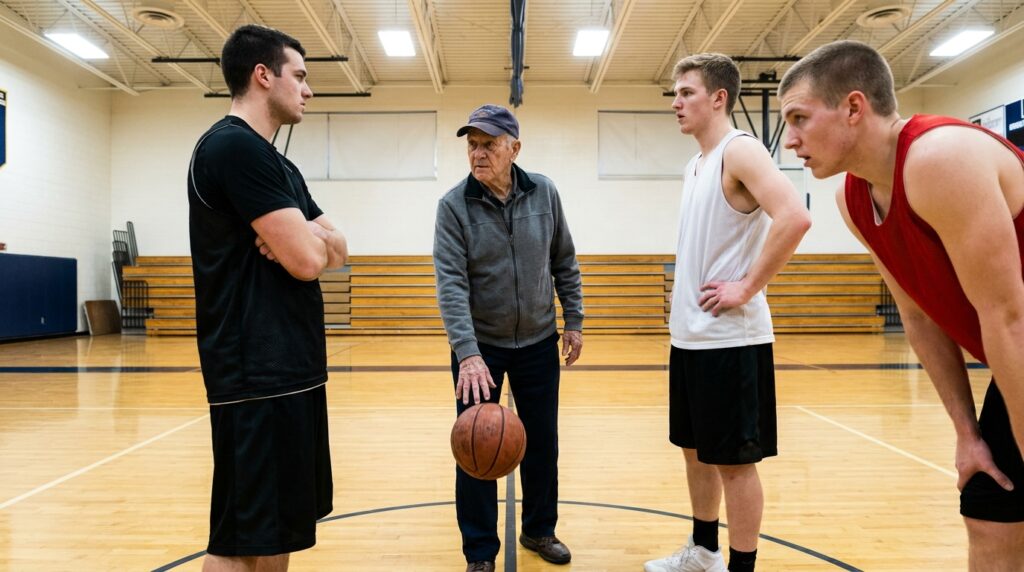
The Weight of Cold Iron and Brittle Asphalt Under the Harsh Light of a Dying Sun
CHAPTER 1: THE DUSTY GRAY
The chain-link fence rattled as the wind came off the shipping canal, smelling faintly of rusted iron and dead river water. The Elder Challenger kept his hands deep inside the pockets of his gray zip jacket, his thumb tracing the jagged, oxidized teeth of the brass key hidden against his hip. Every step across the park perimeter felt heavy, his boots grinding into the brittle, sun-baked asphalt where weeds pushed through the cracks like splintered bone. He did not look at the court, but he counted the beats. Thud. Thud. Thud. The ball was heavy, under-inflated, hitting the concrete with a flat, transactional rhythm that he had heard in motor pools and supply depots forty years ago.
The light pole overhead didn’t shine so much as it buzzed, a high-frequency drone that vibrated in the fillings of his teeth. It cast a sharp, cone-shaped glare directly over the center circle, leaving the edges of the park in a desaturated, smoky dark.
He felt the shift before he saw it. The flat rhythm of the ball stopped. A shoe rubber skidded—a sharp, aggressive screech that cut through the low whistle of the canal wind.
“Old man, you’re in the wrong lane,” the boy in the black jersey said, his shoulders leaning forward, casting a long, predatory shadow that stretched across the painted boundary line. “Get off our court before you get hurt.”
The elder didn’t stop his stride, but his eyes narrowed, calculating the distance. Three of them. Black jersey at the center, red jersey flanking left, white jersey drifting toward the baseline like a spotter in a ditch. They had the tight, lean musculature of young men who lived on adrenaline and short tempers. The air between them tasted of iron filings and stale sweat.
The ball came then. It wasn’t a pass; it was a low, hard drive aimed directly at his shins, meant to trip or force a clumsy scramble.
The elder’s boot didn’t shift. He simply extended one leg, letting the dead weight of the ball strike the thick rubber of his sole. It stopped instantly, trapped against the grit of the ground. The silence that followed was total, save for the rattle of the wire fence.
“You dropped your toy,” the elder said, his voice a low, gravelly rasp that sounded like gravel being turned over with a shovel. He didn’t look down at the ball. He looked directly into the black jersey’s eyes, noting the slight, involuntary twitch in the boy’s left jaw—the universal tell of an amateur who had never been hit by someone who meant it.
The red jersey stepped up, his fingers curling into the fabric of his shorts. The trap was closing under the yellow light, the circle tightening until the smell of their youth was a physical pressure against his chest. In his pocket, his fingers pressed so hard against the sharp edge of the brass key that the metal bit into his skin, leaving a cold, pale indentation. He had spent thirty years avoiding this exact density of air.
“I told you to move,” the black jersey whispered, stepping across the white line into the circle, his hand rising, fingers hooked like iron talons ready to catch the elder’s collar.

CHAPTER 2: THE UNWRITTEN LAWS
“You’re breathing my air, son,” the Elder Challenger said, his voice flat, retaining a heavy, unyielding density that didn’t rise or fall with the wind.
He didn’t pull his hand from his pocket. His thumb remained anchored against the sharp, notched teeth of the brass key. He stood precisely where he had landed his boot, the dead weight of the under-inflated basketball pressed firmly under his heel. The rubber of his sole grated against the surface, a dry, rasping crunch that seemed to fill the narrow pocket of space between them.
The black jersey didn’t back down. His fingers remained hooked, suspended inches from the gray fabric of the elder’s collar, casting a jagged shadow that fractured across the old man’s chest under the yellow glare of the light pole. The young man’s chest rose and fell in quick, shallow cycles, his skin wet with the greasy film of playground sweat and urban dust.
“Your air?” The black jersey spit onto the asphalt, the dark spot blooming instantly on the gray concrete. “This court belongs to the people who bleed on it. You’re just a ghost walking through a fence. Pick up your foot.”
To the left, the red jersey shifted. The friction of his sneakers against the grit sounded like a match striking flint. He was angling toward the elder’s blind spot, his shoulders low, arms loose—the posture of a flanker waiting for the lead dog to bite first. Further back, near the un-netted iron rim that rattled in the canal breeze, the white jersey stayed quiet, his eyes darting toward the street corner, checking the parameters of the fence. They weren’t just playing a game; they were maintaining a perimeter. In their eyes, this concrete square was an island, the only piece of the city where their names carried any weight, and the presence of an old, silent outsider was an act of displacement.
The elder felt the cold iron of the neighborhood’s logic. It was the same territorial math he had seen in every broken outpost from Georgia to Germany—young men with nothing but a patch of dirt and the pride required to die for it. He understood the moral necessity behind the boy’s anger; it was the desperate preservation of the only sanctuary they had left. But understanding didn’t alter the physics of a threat.
“I’ve seen better perimeters held by dead men,” the elder murmured. He didn’t shift his gaze to follow the red jersey’s movement. He kept his eyes locked on the black jersey’s pupils, watching the small, dark circles dilate as the boy’s patience frayed. “You think because the net is gone, you own the posts?”
“I think you’re three seconds away from the grass, old man,” the black jersey growled. His wrist twitched, the muscles in his forearm tightening as he prepared to close the gap and drive his palm into the elder’s chest. “Take the ball and walk. Or don’t walk. See what happens to old bones when they hit this grit.”
Beneath the elder’s foot, the basketball shifted slightly as the pressure of his weight increased. He could feel the lack of pressure inside the bladder, the canvas threads structural but brittle. It was a minor thing, a piece of neglected leather, but it was an anchor.
“The grit doesn’t care about your age, son,” the elder said, his hand slowly sliding upward inside the gray zip jacket, his fingers releasing the brass key but remaining flat against his ribs, calculating the exact trajectory the boy’s arm would take. “And it doesn’t care about your jersey either. If you reach for me, make sure you’re ready for the lesson that comes with it.”
The red jersey took another half-step inward, his shadow now overlapping with the elder’s boots. The space had shrunk to nothing. The smell of copper, sweat, and the damp mold of the nearby river canal hung heavy between them under the low, rhythmic hum of the dying transformer overhead. The world had narrowed down to the white paint of the center circle, a border that was about to be crossed with the weight of absolute momentum.
CHAPTER 3: THE CENTER CIRCLE
The boundary line beneath the elder’s boot was not mere chalk; it was white municipal paint, thick and deeply blistered by decades of frost and salt. The black jersey’s fingers didn’t just hover—they dropped, a sudden snapping motion intended to grab the zipper of the gray jacket and wrench the older man off balance before he could plant his heels.
The Elder Challenger didn’t pivot. He let his left shoulder drop half an inch, an economy of motion that took his frame out of the direct line of force. The boy’s hand caught only the sliding metal tooth of the zipper, a sharp, metallic ping echoing off the wire mesh of the park fence. The momentum was already wrong. The young man’s weight was carried forward, his center of gravity shifting over his toes as his sneakers scraped against the grinding asphalt grit.
“The lane is closed, son,” the elder said. His voice remained flat, the delivery almost procedural, devoid of the performative anger that filled the playground.
He moved his right foot, releasing the deflated basketball. The leather ball rolled precisely three inches until it struck the rusted steel support base of the light pole, the impact muffled by the flat hiss of its leaked air. As the ball settled, a small patch of nylon netting tangled around its valve stem revealed a wedged object—a heavy, heavily pitted metal whistle, oxidized to the color of dried liver. It lay half-buried in the grime of the leather seams, a relic carried into the game by an entirely different history.
The black jersey didn’t look down at the whistle. His focus was entirely short-range, his recovery violent as he used his athletic frame to crowd the older man, his chest slamming against the elder’s left shoulder check. It was a classic street-court foul disguised as a defensive stance, the wet, hot smell of his skin mixing with the stale river dampness of the canal. To his left, the red jersey moved in parallel, his arms coming up to create an unyielding wall of muscle, effectively boxing the elder inside the white perimeter of the circle.
“You don’t talk to me about lanes,” the black jersey muttered, his face close enough for the elder to note the tiny fracture lines in his lower lip, the skin white with stress. “You don’t know what this circle cost. You don’t know who cleared this dirt when the city left it to rot.”
The elder’s left hand remained flat against his own lower ribs inside the jacket pocket. His thumb was no longer on the brass key; it was anchored against the tough tendon of his thigh, a structural brace. He felt the vibration of the municipal transformer overhead—the low, five-cycle hum that signaled a dying grid. It was the exact pitch of the old industrial generators that used to run behind the brick walls of the decommissioned facility three blocks north.
“I know who built the fence,” the elder murmured, his eyes sweeping across the white jersey, who had now moved into an anchor position near the baseline, his boots locked into the cracked asphalt. “And I know how many tons of gravel went under this court before they poured the topcoat. It was twenty-eight tons of crushed limestone, hauled out of the river docks in seventy-four. The state paid for the stone, but the boys from the district did the grading.”
The black jersey froze for a fraction of a second, his fingers tightening into an involuntary fist against his thigh. The reference wasn’t just old; it was localized. It was a piece of institutional arithmetic that didn’t belong in the mouth of a random wanderer. The tension in the circle didn’t break—it thickened, the air turning dense with the friction of two opposing logics grinding together under the yellow glare.
“Who are you?” the boy asked, his voice losing its rhythmic playground swagger, dropping into a harder, more suspicious register. He didn’t back away; instead, he leaned his weight into the elder’s frame, using his size to assert a physical leverage that was increasingly fragile. “My brother told me about the people who shut the gates. He said they wore gray jackets and didn’t leave names.”
The elder didn’t answer with a name. He shifted his weight back onto his right heel, his posture tightening until his spine was as straight as a surveyors’ transit line. The rusted whistle on the basketball gleamed faintly under the yellow light, its pea long since frozen by corrosion, a silent pocket of authority that had outlived its original purpose.
“The gates were shut because the inventory was empty, son,” the elder said, his hand slowly sliding out of the gray jacket pocket, the palm flat, the skin dry and crosshatched with old scars that looked like fine white thread against the gray fabric. “And the people who shut them didn’t leave names because the ledger was already closed. Now take your hand off my zipper.”
The red jersey lunged then, his movement triggered not by malice, but by the sudden, unnerving collapse of his leader’s confidence. His shoulder came forward in a low, blunt-force tackle designed to drive the elder out of the white circle entirely, his sneakers tearing a gray furrow into the brittle crust of the concrete.
CHAPTER 4: THE ANCHOR INCIDENT
The red jersey’s boots tore a gray furrow through the brittle crust of the concrete, his shoulders dropped low in a blunt-force tackle meant to drive the Elder Challenger out of the white circle entirely. The momentum was a heavy, unguided weight, carrying the full kinetic density of an athletic twenty-year-old body under the yellow lamp.
The elder did not jump back. He did not brace for impact with an equal measure of brute force. Instead, his right boot shifted back precisely three inches, his weight sinking into the hard, unyielding geometry of his heel. As the red jersey’s shoulder met the fabric of his gray zip jacket, the elder used the boy’s own velocity against him. His left hand came down—not as a strike, but as a clean, swift guide across the red jersey’s collarbone, a brief defensive movement that redirected the trajectory of the rush.
At the exact same micro-second, the black jersey lunged forward to complete the box, his hand snapping out to secure the elder’s right wrist. The grip was tight, wet with sweat, but the elder’s forearm remained loose, absorbing the initial pull. With a sudden, disciplined balance shift, the elder rotated his wrist against the weakest point of the boy’s grip—the structural gap between the thumb and index finger. The mechanical release was immediate and absolute. The friction of the skin left a pale, heat-burned streak across the black jersey’s knuckles, but the hold was broken.
The red jersey, unable to check his own forward momentum after the elder’s redirection, stumbled into the empty pocket of air where the older man had been standing a heartbeat prior. His sneakers lost their traction on the loose grit. With a heavy, metallic thud that rattled the chain-link fence behind the rim, his frame went down, his hip sliding across the rough asphalt until his momentum died near the base of the light pole.
The black jersey was already off balance from the broken wrist release. Before he could reset his feet, the elder stepped inside his guard, his posture completely upright, utilizing his center of mass like a heavy plumb line. He didn’t throw a punch. He simply placed the palm of his dry, scarred hand against the center of the black jersey’s chest—precisely over the sternum—and delivered a short, measured counter-push. It wasn’t a show of explosive power; it was a pure calculation of leverage against an ungrounded opponent.
The young man’s feet left the paint. He hit the ground hard, his basketball jersey catching on the grit as he skidded three feet backward, his arms flailing to find a purchase on the smooth, cold surface of the court. Beside him, the observer player in the white jersey froze entirely, his arms suspended mid-air, his boots glued to the baseline as the total collapse of their physical dominance occurred in less time than a single bounce of the ball.
The park fell into an unyielding, heavy silence, save for the low, five-cycle hum of the transformer above. The three young men were left sitting defeated on the court, their breathing ragged, staring up in stunned, silent disbelief. The black jersey’s mouth remained open, no longer moving with playground swagger, his chest heaving as he tried to process the absolute ease with which his size had been neutralized.
The elder stood directly beneath the bright light pole, completely unfazed, his breathing rhythmic and deep. He did not look at his hands, nor did he check his clothes. His dark cap remained pulled low over his eyes, casting a sharp shadow that masked the weathered texture of his face. He reached down slowly, his fingers brushing the deflated basketball resting against the steel base. As his hand cleared the leather, his state-issued identification card—thick, laminated plastic with the faded seal of the regional logistics command—slipped from the unzipped inner pocket of his jacket, landing face-up on the concrete right between the frozen whistle and the black jersey’s hand.
The elder didn’t look at the card. He looked down into the black jersey’s eyes, his voice dropping into that low, gravelly rasp that cut through the night breeze like an ungreased hinge.
“You wanted proof,” the elder said, his shadow stretching long and dark across their low positions. “Now you have it.”
CHAPTER 5: THE MEASURED CORRECTION
“Get your card off my asphalt,” the black jersey said, his voice scraped raw by the impact of the concrete, but his eyes stayed fixed on the faded blue laminate that lay between them. His fingers didn’t move toward it. They twitched, scraping against the fine gray sand that coated the center circle like a layer of industrial salt.
The Elder Challenger kept his hand outside his jacket, the fingers dry, perfectly steady. He didn’t look down at the plastic card either. His gaze remained level, tracing the perimeter of the court where the park bench shadows had grown long and dense against the fence. The surrounding neighborhood observers had stopped moving entirely. The two teenagers who had been watching from the rusted swings sixty feet away stood frozen, their hands gripping the iron chains, their phones held low against their thighs with the screens dark. The casual noise of the evening—the shouting from the bodega across the canal, the rattle of the aggregate trucks on the bridge—seemed to die against the unyielding wall of the park’s silence.
“It isn’t your asphalt, son,” the elder said. The gravelly rasp of his breath was the only consistent rhythm under the yellow lamp. “And the card stays where it dropped until the count is clear.”
The red jersey was pushing himself up onto one knee, his palms dragging over the grit with a dry, splintering sound. A long, dark scrape had torn through the fabric of his red shorts, exposing skin stained gray by the carbon dust of the court coat. He didn’t look back at the elder; his shoulder was hooked inward, his chin tucked into his collar like a soldier checking his harness for structural damage after a mortar strike. Near the baseline, the white jersey had stepped entirely out of the light cone, his back pressed against the wire mesh, his breathing audible—sharp, rhythmic gasps that smelled faintly of stale soda and copper.
The black jersey shifted his weight, his heels digging into the white boundary line until the rubber of his soles groaned. The arrogance had been thoroughly stripped from his posture, replaced by a cold, calculating vigilance that belonged to a much older man. He looked at the card, then at the frozen whistle wedged into the basketball’s split seam, his brow furrowing as the two pieces of iron evidence began to align in his mind.
“Logistics Command,” the boy muttered, reading the faded block lettering on the laminate without touching it. His voice lacked the rhythmic swagger of the playground now; it was thin, flat, carrying the historical weight of a neighborhood that had been systematically hollowed out before he was old enough to walk. “The regional pool. The people who signed the warrant for the brickwork on Section Four.”
The elder’s thumb found the brass key inside his pocket again, the cold metal teeth pressing into his skin with the familiar, grounding friction of an old tool. “Section Four was graded for five thousand tons of weight,” he said, his voice dropping into the lower register that always signaled a formal entry into the log. “They put down six inches of slag, four inches of binder, and two inches of wear-course. The contractor was out of the third district. He cheated on the oil content in the mix, which is why this crust is splitting like dry cedar.”
The black jersey’s face went completely pale under the yellow glare of the light pole. The details weren’t just archival; they were structural flaws that only two types of men knew—the men who paid for the fraud, and the men who were ordered to cover it up with gravel.
“My brother was in that motor pool,” the boy whispered, his hand finally closing over the plastic card, the edge of the laminate clicking against his fingernail with a sharp, brittle sound. He didn’t pull it away. He held it down against the concrete, his arm trembling slightly from the lingering shock of the counter-push. “He was nineteen. He spent three months digging the drainage ditch behind the armory before the trucks came in the night and locked the chain on the main gate. He left his gear in the locker because the clerk told him the unit was moving to the interior. He never came back from the interior.”
The elder didn’t move a muscle. The sulfurous wind from the shipping canal caught the edge of his dark cap, making the fabric hum, but his boots remained planted in the center circle like two iron stakes. The information was a direct hit to the decoy secret he had allowed the boy to read—the card was a link to the closure, a piece of administrative spite that explained the gray jacket and the quiet walk. But the ultimate reality—the name on the ledger of the final transport out of Section Four—remained locked behind the smooth, silent wall of his teeth.
“The interior didn’t have a ledger, son,” the elder said, his hand slowly sliding out of the pocket, the fingers open, reaching down to reclaim the deflated ball. “And the clerk who told him that was reading from an unnumbered order. The trucks didn’t go north. They stayed in the yard until the fuel ran out.”
The black jersey looked up, his jaw tightening as the paradigm shifted beneath his boots. The defeat on the asphalt wasn’t just a physical humiliation anymore; it was the opening of a vault that had remained buried under twenty-eight tons of crushed limestone for thirty years, and the old man standing beneath the dying lamp was the only person left who held the key to the rust.
CHAPTER 6: THE DISCOVERY ON THE CRUST
The blue laminate of the identification card did not remain a shield. As the black jersey’s hand shook against the concrete, his fingers accidentally caught the edge of the deflated basketball, forcing the dead leather to roll sideways over a deep, oil-starved fissure in the topcoat. The movement was minor, but the sudden structural shift caused the wedged metal whistle to dislodge from the rotting strands of nylon netting. It dropped into the crack with a dry, hollow clink that sounded exactly like an empty shell casing hitting a firing line.
The Elder Challenger instinctively reached down to intercept the object, his fingers extending before his brain could enforce its customary discipline. His boots remained anchored, but his center of gravity wavered for a fraction of a second. In that single micro-second of physical vulnerability, the black jersey didn’t attack—he lunged horizontally, his palms slamming flat onto the asphalt right over the veteran’s dropped wrist, pinning the elder’s forearm against the rough, flaking crust of the court.
The leverage was entirely gone. The elder’s skin ground into the sharp limestone aggregate, the friction tearing the lower seam of his gray zip jacket. The pain was immediate, cold and localized, but it wasn’t the gravel that made his lungs seize. It was the position of the whistle. Now fully exposed in the glare of the municipal light pole, the reverse side of the oxidized cylinder revealed a deep, hand-stamped inscription into the brass: UNIT 04 – SUPPLY SGT. M. VANCE.
The boy stared down at the stamp, his breathing freezing in his throat. His fingers tightened over the elder’s gray sleeve until the plastic zipper teeth buried under the fabric bit into the old man’s forearm. The silence that came off the shipping canal was no longer administrative; it was an active chokehold, heavy with the smell of sulfur and wet iron.
“Vance,” the black jersey whispered, his knuckles turning the color of skimmed milk against the dark gray cloth. He didn’t look up at the elder’s face; his eyes were glued to the stamped name, his pupils contracting until they were nothing but pinpricks under the yellow lamp. “Marcus Vance. That was his whistle. He carried it on his lanyard when he worked the night shift at the motor pool gate. He never parted with it. He told me the tone was unique—that he could wake an entire barracks with one breath.”
The elder didn’t try to wrench his arm free. He let his forearm remain flat against the grit, his muscles loose, absorbing the weight of the boy’s grip without offering a counter-pressure that would escalate the hold into violence. His thumb, hidden within the torn pocket, pressed against the cold, jagged notches of the brass key until his own skin split slightly, a thin line of red staining the lining. The decoy secret—the assumption that he was merely a distant bureaucratic clerk who signed the closure orders—was completely shredded on the concrete. The whistle was field-grade evidence. It placed him inside the yard, at the gate, on the exact night the chain was locked.
“The tone was a three-cycle pitch,” the elder said, his rasp dropping into a dry, automated monotone that sounded like a mechanical telegraph tape. “It was ordered from the ordnance depot in sixty-nine. Marcus Vance took delivery of fourteen units on the eighth of November. He signed the ledger with a blue grease pencil because the inkwell in the guard shack had frozen through.”
The red jersey had crawled back to his feet, but he didn’t advance. He stood five feet away, his arms hanging down like dead weights, his eyes shifting from the stamped brass to the old man’s face with a heavy, uncomprehending horror. Near the chain-link perimeter, the observer player in the white jersey let out a low, shuddering breath, his hands sliding down the wire mesh until his fingernails scraped against the rust. The neighborhood crowd behind the fence had stopped breathing; the small, red indicator lights of two cell phones vanished as the observers lowered them into their pockets, realizing the recording had passed from a playground dispute into an unsealed graveyard.
“You didn’t just close the gates,” the boy said, his grip tightening until the elder’s bones ground together against the stone topcoat. His voice cracked, the playground rhythm entirely destroyed by the cold reality of the name. “You were the officer on the line. You were the one who gave the order to shut down the engines while they were still in the cabs. He was inside the third truck. I found his grease pencil in his drawer at home, but I never found the whistle.”
The elder looked down at the boy’s hands, noting how the young skin was already scarred along the knuckles—the identical pattern of labor that had marked Marcus Vance’s fingers before the unit was dissolved. The ultimate reality—the reason why the trucks stayed in the yard until the tanks went dry, and why Marcus Vance had handed him the whistle before the final gate-chain was secured—remained locked behind the unyielding wall of his teeth. He had spent thirty years letting the neighborhood believe the state had simply abandoned them, choosing to carry the reputational stain of a bureaucratic executioner rather than let them know what had actually happened inside the cabs before the grease pencil ran out.
“The engines were shut down because the line ahead was gone, son,” the elder murmured, his right hand slowly curling into a loose fist against the asphalt, the grit embedding into his skin like small black seeds. “And your brother didn’t stay in the third truck. He stayed at the post.”
The black jersey didn’t release his hold, but his weight shifted backward, his center of gravity collapsing as the failure of his understanding hit him with the physical force of a heavy blow. The discovery on the crust hadn’t solved the mystery of Section Four; it had simply destroyed the ground he was standing on, leaving the old man beneath the buzzing lamp as the only solid object in a landscape that was turning back into dust.
CHAPTER 7: THE RECOVERY AND THE SILENCE
“He didn’t leave the gate because he was the one holding the chain,” the Elder Challenger said, his voice dropping below the steady, low-frequency drone of the dying transformer.
The compression on his arm didn’t change, but the nature of the weight did. The black jersey’s fingers remained locked into the gray fabric of his sleeve, but the mechanical tension had gone out of the muscles. The young man’s frame was suspended under the yellow light pole, his chest motionless, his face fixed in a state of suspended animation as the final, un-ledgistered truth of Section Four filtered through the cold air.
The elder slowly drew his pinned arm upward. He did not use force; he adjusted the angle of his elbow by a fraction of an inch, using a simple leverage shift against the boy’s ungrounded palms. The boy’s hands slipped off the gray cloth, his fingers trailing across the rough limestone aggregate until they rested flat on the freezing concrete, inches from the flaking brass of the whistle.
Time seemed to dilate under the yellow lamp. The wind from the shipping canal had dropped to a thin, iron-scented whistle, but the silence inside the center circle felt dense, structural, like the thick concrete walls of the abandoned bunker three blocks north. The elder reached down with his right hand, his scarred fingers closing over the cold, pitted cylinder of Marcus Vance’s whistle. He didn’t lift it quickly. He felt the weight of the brass, the small flakes of oxidized green sticking to his skin like old rust seeds.
“The order to dismantle the pool didn’t come from the district, son,” the elder murmured, his eyes looking straight through the dark cap shadow into the boy’s face. “The trucks were empty because the fuel had been diverted to the civilian hospital transport lines during the hard freeze of seventy-six. The state didn’t abandon the unit. The unit volunteered to stay behind so the local boilers wouldn’t run dry. Your brother wasn’t left in a locker. He gave me this whistle at the gate and told me to keep walking until the ice broke.”
The black jersey looked down at the empty space on the asphalt where the whistle had been. His mouth opened slightly, but no sound came out. The historical weight of the neighborhood’s anger—the forty years of cultivated betrayal, the graffiti on the brick walls, the generational rage against the gray jackets—collapsed into a single, quiet pocket of local sacrifice. The villain they had constructed to justify their own isolation was just an old man who had spent three decades keeping a promise to a dead supply sergeant.
To the left, the red jersey had backed entirely out of the light cone, his hands flat against his sides, his head lowered as the institutional reality settled over his shoulders. Near the fence, the observer player in the white jersey let his fingers slip from the wire mesh, his boots turning toward the park exit without a word. The gathering crowd on the benches had dissolved into the dark edges of the park; the faint, yellow lights of the streetlights across the canal were the only markers left in the landscape.
The elder slowly slid the whistle into the inner pocket of his jacket, letting it rest beside the heavy brass key. He reached down one last time, his fingers catching the worn grain of the state-issued identification card. He slid the laminate back into the fabric slot, his movements deliberate, entirely procedural, as if he were closing a logbook at the end of a shift.
He looked at the three young men sitting on the split topcoat of the court. They weren’t challengers anymore; they were just tired boys with a basketball and a patch of concrete that had suddenly grown too large for them to hold.
“We’re done here,” the elder said, his voice a low, gravelly rasp that carried no residue of the conflict. He gave a short, restrained release gesture with his right hand, a brief flick of the wrist that cleared the lane. “Get up.”
The black jersey didn’t move immediately, but his chin rose, his eyes tracking the elder as the older man turned his back to the light pole. The veteran’s boots ground into the grit with that same flat, transactional rhythm, his hands deep in his gray jacket pockets, his shoulders square against the freezing canal wind. He walked out of the circle, across the white paint, and through the opening in the chain-link fence without looking back, his figure slowly fading into the desaturated gray of the urban night, leaving the court completely silent under the dying lamp.







