
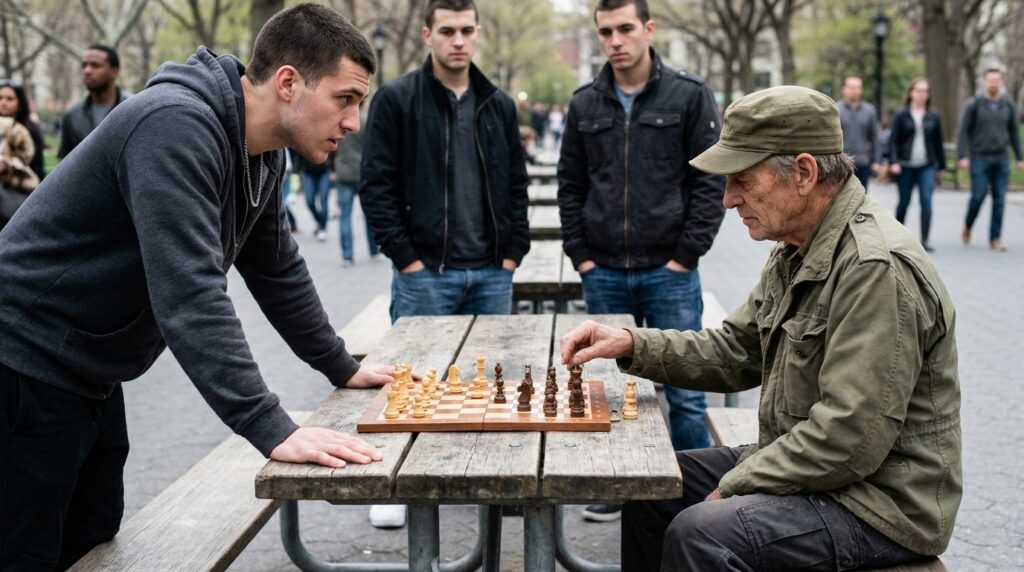
The Measured Weight of an Unbroken Row after Long Silences and Fading Sun

CHAPTER 1: THE WEIGHT OF A KNIGHT

The wood was old pearwood, seasoned until the grain turned the color of dried liver, and the lead weights inside the bases had broken their glue ten winters ago. Every time Marcus lifted the black knight, he could feel the dull, internal metallic thud against the palm of his hand—a small, loose clink that smelled of linseed oil and forty years of pocket lint.

He didn’t look up at the courts. He didn’t need to. The rhythm of the afternoon was already etched into the soles of his boots through the cold concrete of the park bench: the heavy, syncopated thunk-thunk of an under-inflated basketball against rusted chain-link, the smell of sweet tobacco smoke drifting from the bus stop on Fourth, and the dry, scraping sound of sycamore leaves rolling down the asphalt like old currency.

To his right, the cardboard box that held his pieces sat propped against a water stain on the concrete table. It was an old military-issue ledger wrapper, its corners bound in frayed canvas tape that had turned grey from grease. A young man with a shaved head and a bright white sports jersey passed the table, his sneakers making a sharp, squeaking protest on the pavement. The boy didn’t look down. People in the ward rarely looked down at the tables unless they were looking for something someone had dropped. Marcus preferred it that way. The invisibility was a form of weather he had learned to navigate; it was thick, it was reliable, and it kept the wind off his neck.

He placed the knight on C3. The felt on the bottom was gone, replaced by a circle of green flannel he’d cut from an old work shirt during the first year of the strike. The wood hit the painted square with a soft, flat sound.

A shadow fell across the board then, not with the slow, drifting logic of the afternoon clouds, but with a sharp, heavy drop that smelled of cheap laundry detergent and synthetic winter jackets. The shadow didn’t move. It stayed fixed over the white squares on the king’s side, blocking the thin, late-October sun that had been warming Marcus’s left wrist.

“Hey old man, move faster, you’re wasting everyone’s time.”

The voice was too loud for the park’s four o’clock lull. It had that thin, metallic edge of an engine running without enough oil—an unearned velocity that wanted everyone within thirty yards to stop and check their pockets.

Marcus kept his fingers on the head of the knight. He didn’t look up at the silver chain swinging two inches above his pawns, nor did he look at the dark fabric of the hoodie crowding the edge of the concrete grid. He watched the shadow of the chain instead. It looked like a small, iron pendulum swinging across the white paint of the table, regular and small. Behind the boy, two sets of larger, wider boots shifted on the gravel, their soles grinding the small stones into gray powder. The chorus was waiting.

Marcus let his thumb trace the small, circular brass blemish where the lead had been resealed into the wood. The metal was cold. The park around them seemed to pull its breath in, the basketball on the court hitting the rim once, twice, then rolling out into the grass where nobody went to fetch it.


CHAPTER 2: THE ANATOMY OF A CROWD

The silver chain didn’t just swing; it hummed. It was a cheap, hollow-linked thing, probably bought off a rotating rack at the pharmacy on Eleventh, but close enough to Marcus’s nose that he could smell the faint, sour tang of copper beneath the plating. The boy leaning over the concrete grid was named Trey—Marcus had seen the name scrawled in blue grease-pencil across the heel of an oversized basketball three summers ago—though here, under the pale, lukewarm slant of the autumn light, names didn’t carry the same weight as three inches of unearned clearance.

Marcus kept his left palm flat against the green flannel circle beneath his knight. The fabric was thin enough that the raw, pitted aggregate of the concrete picnic table bit directly into the meat of his thumb. He didn’t pull back.

“I’m talking to you, old head,” Trey said. His breath smelled of red licorice and winter wind, sharp and dry. He shifted his weight forward, the cracked vinyl of his high-tops grinding against a patch of dried moss between the pavement stones. To Marcus’s left, the first companion—a taller boy with salt-stained denim cuffs and hands buried deep in his pockets—took a half-step sideways. It wasn’t an attack; it was a flanking maneuver designed to cut off the lane toward the water fountain. It was the way people moved when they wanted to see if an old fence would give if you leaned on it.

“You’ve been sitting on this line since noon,” Trey muttered, his fingers twitching near the edge of the board. A small, notched zinc token, the kind used for industrial laundry mats or old turnstiles, was threaded through the knot of his hoodie’s drawstring. It swung like a plumb bob, nearly nicking the top of Marcus’s white rook. “We got forty dollars on the three-on-three behind the benches, and we need the table space for the book. Move your wood.”

Marcus observed the zinc token. It had three parallel notches filed into the rim—not factory work, but done with a triangular file, the cuts deep and dark with pocket grease. A counting tool. The boys weren’t just clearing a table for a game; they were clearing a ledger.

“The square is occupied,” Marcus said. His voice didn’t rise above the low, rhythmic thunk-thunk of the game behind them. It had the dry, flat texture of a cellar door that hadn’t been oiled since the factory closures.

“Not for long it ain’t,” Trey said. He reached down, his thumb and forefinger forming a pincer just above Marcus’s black bishop. His skin was smooth, uncalloused, the nails clipped clean—the hands of someone who hadn’t yet spent twenty years turning iron valves or dragging crates across a cold dock. He was all leverage, zero ballast.

Behind Trey, the second companion didn’t move, but his eyes flicked toward the street, where a city bus was idling, its diesel exhaust turning the yellowing sycamore leaves a greasy shade of charcoal. The neighborhood was wide awake, but it was looking elsewhere. The indifference of the street was a familiar weight; it was the same silence that had sat in the weeds outside the railyards in ’75, when the shifts ended and the gates were chained shut without a whistle.

Marcus let his gaze travel past Trey’s shoulder, focusing on the gray canvas tape that bound the corners of his chess box. Beneath that box, tucked into the shallow hollow where the concrete bench met the pedestal, was the black oilcloth ledger. It was safe for now, tucked away like an old tool beneath a workbench, but Trey’s forward lean was changing the center of gravity in the square. If the boy knocked the table, the box would shift. If the box shifted, the corner of the ledger would show.

“You’re leaning into the wind, son,” Marcus murmured, his hand remaining steady on the pearwood knight. “And you haven’t got enough iron in your boots for it.”

Trey laughed, but the sound was short, snapping off before it could reach his friends. His fingers lowered another eighth of an inch, his shadow completely swallowing the king’s file, turning the pale painted squares into a single, dark block of concrete.

CHAPTER 3: THE COLD CORNER OF THE GRID

Trey’s fingers hovered, casting a small, dual-pronged shadow over Marcus’s white king’s pawn. The kid didn’t drop his hand into a grab, but the distance between his skin and the old lacquer was less than an inch. A man could build an entire life out of less space than that, Marcus knew; he’d seen squads partition a clay trench with nothing but two sandbags and an unuttered agreement not to look each other in the eye while eating lard.

“You’re an old head who doesn’t hear so good,” Trey said. His knuckles were gray-white against the charcoal fleece of his cuffs, the salt-rimed denim jacket he wore over his hoodie rustling like dry corn husks. When he leaned, the blue wool of his sleeve turned up slightly, exposing a pale square of skin near the inner wrist where someone had scratched a tiny circle crossed with an asymmetrical lines—a crude chalk marker or an old tattoo done with a sewing needle and ink from a ballpoint pen. It matched the three notches on his zinc token.

Marcus let his gaze stay dead on that small, ink-bitten cross. It wasn’t the signature of the local gangs on Fourth, nor was it the tagging he saw sprayed along the side of the warehouse docks near the river. It was an older type of shorthand—the kind of ledger mark the city rail workers used to scribble on the sides of grain cars to show a brake line was weeping oil.

“I hear the court,” Marcus said, his throat clicking on the dry air. He didn’t lift his fingers from the pearwood knight. “The ball is still hitting the iron. Nobody’s playing for forty dollars on a rim that’s missing half its hooks.”

Behind Trey, the tallest of the two companions let out a dry, rattling cough that ended in a throat-clearing grunt. His hands remained deep inside his oversized work-pants pockets, his shoulders hitching against the autumn draft that came off the river basin. “Trey, look at the block,” he muttered, his eyes shifting toward the far corner of the park where the old iron flagpole stood without a rope. “The bus is turning around early. The regular driver isn’t on the three-fifteen.”

The boy didn’t look back, but his chin twitched. The forward lean stayed fixed, his center of gravity hung over the concrete painted squares like an unexploded mortar shell caught in a low branch. He wanted the table because the table was the only piece of the terrace that didn’t have a direct line of sight from the street corner where the transit cops parked their cruisers. It was a pocket—a blind spot created by the gnarled trunk of a ninety-year-old sycamore and the cracked brick wall of the old city maintenance shed.

“The bus isn’t our business, Leon,” Trey said, though his voice dropped a fraction of an octave, losing some of its gloss. He looked back at Marcus, his jaw shifting as if he were chewing on a piece of tobacco he’d found in his pocket. “The old head knows the rules. You want to sit here, you pay the rental or you play the house. That’s how Mr. Miller set it up before they boarded up the clinic across the way.”

Marcus didn’t answer. He took his hand off the black knight, leaving the piece precisely between the C3 square and the faded white boundary line. He reached slowly into the side pocket of his olive-drab jacket, his fingers brushing past three spare brass screws, a stub of blue carpenter’s chalk, and a small strip of emery cloth. He pulled out a box of paper matches—the cheap, sulfury ones given away with tobacco pouches at the corner grocery before the windows were sheeted with plywood.

He laid the matchbox on his side of the concrete table, right on the black square of A1.

The box wasn’t empty. It had a weight to it that didn’t match twenty wooden splints. When it hit the aggregate, it gave off a heavy, leaden thump that made the box of chess pieces shift an eighth of an inch to the left. The grease-stained canvas tape on the corner of the box scraped against the stone, revealing just a sliver of the oilcloth book hidden underneath.

Trey’s eyes dropped to the matchbox. He didn’t touch it, but his mouth went tight at the corners. He recognized the sound of dead weight. In the ward, a lead-lined matchbox meant one of two things: it was either a scale-weight for balancing portions of unrefined tallow from the butcher’s yard, or it was the kind of anchor an old merchant marine used to keep his tally sheets from blowing into the bilge water when the hatches were cleared.

“Mr. Miller’s been in the home on Grand since the frost came two years ago,” Marcus said softly, his thumb resting on the matchbox’s striking strip. “And he didn’t leave any receipts for this corner. I know because I helped him pack his trunk when the county van came for his mattress.”

The second companion, the one who hadn’t spoken since they crossed the gravel path, took his hands out of his hoodie pocket. He wasn’t looking at Marcus; he was looking down at the small oilcloth corner that had appeared under the chess box. His forehead bunched into three thick ridges above his nose. “Trey,” he said, his voice flat as a wet plank. “That’s the book from the yard office. The one with the green strings.”

Trey didn’t move his hand away from the bishop, but his fingers uncurled. The athletic posture—the wide-stanced, forward-tilting loom that had dominated the picnic table for five minutes—seemed to lose its spring, the fabric of his hoodie settling heavily against his ribs. The silence between the four of them grew thick, smelling of coal dust and old river water, while behind the maintenance shed, a crow came down onto the rusted rim of the basketball hoop with a solitary, dry snap of its wings.

CHAPTER 4: THE BREAKING EDGE OF THE SQUARES

“Trey,” the second companion repeated, his voice dropping into that wet-plank flat rhythm. He moved his foot back an inch, his boot heel scraping against a discarded plastic bottle cap. “That’s the yard book. The old one with the heavy linen back. My uncle had one just like it before they sold the spur line to the shipping company.”

Trey didn’t look back at him. He didn’t let his hand fall away from Marcus’s white king’s pawn either, but the small zinc turnstile token suspended from his drawstring hit the head of the piece with a tiny, dead clink. The arrogance hadn’t left his shoulders, but it had stiffened, turning from the loose, swaying weight of a boy walking a fence into the hard, rigid brace of someone who had just found a crack in the foundation he was standing on.

“Leon said your name was Marcus,” Trey murmured. He leaned lower, his athletic frame casting a cold, dark wedge across the entire center of the concrete board, completely extinguishing the last pale yellow glint of the sun on the wood. “My brother told me about you. Said you used to sit by the old weighing platform when the grain trucks were still line-backed up to Twelfth Street. He said you kept a list of every plate that came through the gate.”

Marcus didn’t give him an inch of movement. His left hand remained anchored over the circle of green flannel at C3, his thumb resting lightly against the grain of the pearwood knight. The concrete underneath was drawing the heat right out of his skin, a steady, old-iron cold that he’d known in every motor pool from Fort Dix to the central lowlands.

“Your brother was named David,” Marcus said. His throat felt dry, like he’d been swallowing dust from a grain silo all afternoon. “He wore a silver ring with a square face he’d ground down from a brass union nut. He used to sit on the third step of the maintenance shed when the late shift was blowing its whistle. He didn’t talk much either.”

Trey’s fingers went dead still. The small cross tattooed on the soft flesh of his inner wrist twitched as the tendon in his forearm tightened. “He didn’t need to talk,” Trey snapped, his voice gaining that thin, high-friction rattle again. “He got five years in the state farm because someone handed a ledger to the transit office on Fifth. A ledger with blue pencil marks all over the margins.”

The tallest companion, the one with the salt-stained denim cuffs, took his hands out of his pockets entirely. His right hand was short two fingers at the knuckles—old machinery work from the wire mill down by the canal—and he used the stump to nudge Trey’s shoulder. “The bus is at the curb, Trey,” he said, his eyes scanning the long shadow of the sycamore tree where it reached across the gray gravel path. “The doors aren’t opening. The driver’s just sitting there looking at his wheel. That’s three minutes now.”

The silence that followed was different from the normal lull of the park. It wasn’t the absence of sound; it was the gathering of it. The thunk-thunk of the basketball behind the maintenance shed had stopped completely, replaced by the low, regular rattle of a diesel engine idling three blocks away near the old warehouse terminal. The neighborhood was holding its breath, the way a horse holds its ears back when it smells grease on a hot axle.

Trey ignored the nudge. He looked down at the matchbox Marcus had laid on the black square of A1, then his eyes traveled back to the corner of the black oilcloth ledger protruding from beneath the canvas-bound box. To a boy like Trey, that ledger was a map—a physical record of every delivery route, every unregistered truck, and every small-scale shipment that had passed through the rail-yards before the county chained the fences. It was the only thing that could show who had been moving the tallow crates before the transit police cleared the loading bays.

“Give me the book, old head,” Trey said. It wasn’t a shout; it was the heavy, low demand of a collector at a service window. He reached his hand out, his palm turning flat-up across the white squares, his fingers hooked slightly as if he were waiting for a tool to be dropped into his grip. “My brother’s still doing his time, and that book doesn’t belong to the park department. You don’t have a license to keep state property in a cigar wrapper.”

Marcus let his gaze stay on the boy’s open palm. The skin was pale in the fading light, the lines across the center deep and clean, unmodified by twenty winters of grease or iron. He thought of the ledger hidden beneath his box—the blue-lined pages that didn’t contain transit routes or shipping weights at all, but rather the names of forty-two local boys who had crossed the gravel path of this park between the winter of ’68 and the spring of ’72, names that the city had never bothered to cast into bronze or carve into the limestone walls of the courthouse downtown.

“The ledger stays where it’s bedded,” Marcus said softly. His voice had the flat, unyielding weight of an iron sleeper laid under a main line.

He didn’t move his hand from the knight, but he shifted his boots against the gravel under the bench. The gnarled, thick soles of his old work shoes planted themselves firmly into the gray dust, his shoulders squaring under the worn olive-drab field jacket as he prepared to break the stillness of the table.

CHAPTER 5: THE RISE OF THE ANCHOR

The shift didn’t begin with a shout. It began in the gnarled rubber of Marcus’s soles, the deep, cross-hatched treads of his old work shoes biting into the gray park grit until the small stones flattened under his ballast. His knees, which usually gave off a dry, wooden crack when he rose before noon, moved in absolute silence.

He didn’t pull his hand back from the pearwood knight. Instead, he kept his fingers curved over the smooth lacquer of the piece, using the slight, front-weighted tilt of his torso to press the green flannel circle deeper into the C3 square. Then he stood.

He didn’t jump or spring like the boys who played the baseline behind the brick shed. He went up with the slow, unhurried mechanics of an old warehouse hoist—one link of the chain settling into the tooth of the sprocket at a time, loud and heavy and thick. His shoulders, hidden beneath the grease-softened seams of the olive-drab field jacket, squared themselves against the cold draft coming off the river basin until the fabric drew tight across his shoulder blades.

Trey didn’t step back immediately, but his open palm, which had been extended over the white squares to receive the ledger, tilted upward by two inches. His fingers curled back toward his wrist like dry leaves reacting to a sudden frost. The boy was athletic, built out of clean lines and quick muscle, but his clearance was gone. Standing eye-to-eye with Marcus, the top of Trey’s army-style cap was level with the youth’s forehead, but the mass was different. Marcus had forty years of salt-bacon, boiler smoke, and iron-piling under his skin; he didn’t sway when the transit bus shifted its gears three blocks away.

“Your brother David didn’t know how to finish a row either,” Marcus said. His voice was lower now, falling into that rhythmic, low-frequency hum that old mechanics used when they were talking over the rattle of a loose belt line. “He’d get three boxes into the spur car and then he’d sit down on the step to look at his knuckles. He thought the train would wait because he was young and his shoes were clean.”

Trey’s mouth opened, then snapped shut so hard his silver chain gave off a tiny, metallic ring against the zipper of his hoodie. The small zinc turnstile token suspended from his drawstring swung wildly, nicking the edge of the cardboard chess box. “You don’t talk about David,” Trey muttered. The skin around his nose had gone a pale, chalky gray, the tiny ink cross on his inner wrist shaking against the cuff of his sleeve. “You don’t know nothing about what he was doing with those marking sheets.”

“I know he didn’t read the bottom line,” Marcus said softly, his gaze remaining locked on Trey’s eyes. He didn’t look down at the board, nor did he look at the two companions who had gone completely still on the gravel path. “He thought the blue marks were for the shipping office. He thought he was tracking crates of lard for Mr. Miller’s store.”

To Marcus’s left, the tallest companion—the one with the two missing fingers on his right hand—let out a short, blowing breath through his teeth. He didn’t nudge Trey this time. His arm stayed glued to his side, his thumb twitching against the salt-rimed denim of his thigh. “Trey,” he whispered, his eyes fixed entirely on the faded unit patch sewn above Marcus’s left pocket—a small, dark shield with three olive leaves that had been scrubbed so many times the green thread had turned the color of river moss. “Trey, leave the head alone. That’s the jacket from the terminal gate. The one from the old yard guard.”

The park around them had dropped its regular sounds one by one. The basketball behind the shed didn’t bounce; the boy in the white sports jersey was standing near the water fountain, his hands dangling at his sides as he watched the picnic table from twenty yards out. Even the crow on the rim had stopped its wing-snapping, its head tilted toward the concrete grid like an old clerk waiting for a voucher to be stamped.

Marcus didn’t use the silence to push. He simply held his position beside the table, his hand resting on the pearwood knight with the light, unthinking pressure of a driver holding a loose steering wheel on a straight road. He could feel the cold of the concrete bench radiating through the air between them, a pale, fraying winter chill that smelled of dead grass and wet gravel.

“The book doesn’t have any names you want to find, son,” Marcus murmured, his eyes unblinking under the shadow of his cap brim. “And if you touch the binding, you’re going to have to carry the weight of every line that’s written in it. You haven’t got the shoulders for that kind of ledger.”

Trey’s hand stayed caught in the air between them, his fingers hovering above the king’s pawn like a bird that had forgotten how to land on a wire. The arrogance was still there, stamped into the sharp curve of his jaw and the tight draw of his dark hoodie, but the momentum had broken. The spatial logic of the terrace had turned over; the boy was no longer crowding an old man at a public bench—he was standing in front of an iron gate that hadn’t been oiled in thirty years, and the keys were in the old man’s pocket.

CHAPTER 6: THE RETREAT OF THE CHORUS

Leon took his hand out of his jacket pocket, and for the first time since they had crossed the gravel path, his three good fingers didn’t form a fist. They hung loose, gray-skinned and thick from winter moisture, the stub of his middle knuckle twitching against the seam of his thigh. He didn’t look at Trey’s profile. He didn’t look at Marcus’s eyes either. He looked strictly at the dark shield of the unit patch sewn over Marcus’s left pocket, his chest dropping as he let out a slow, unhurried whistle through his teeth.

“Trey,” Leon said. His voice had lost that dry, rattling snap it carried when they were standing near the basketball benches. It sounded wet now, softened by the cold river draft until it was thin as tissue paper. “Trey, we’re off the line. My uncle told me about the gate guards from the north terminal. They didn’t work for the transit authority. They worked for the federal yard office before the rails went under.”

The second companion didn’t wait for Trey to turn his head. He took a long, flat step backward, his high-top sneaker grinding a piece of yellowed sycamore bark into the gray grit. His hands stayed tucked into his waistband, his elbows pinned tightly against his ribs as if he were trying to make his athletic frame fit into the narrow shadow of the maintenance shed behind them.

The circle was breaking. It wasn’t an explosion; it was a slow, systemic erosion of leverage, like a stack of loose cedar shingles sliding off the back of a flatbed when the handbrake drops.

Trey didn’t move his hand away from Marcus’s white pawn, but his fingers had gone completely rigid, the tips turning the color of dry salt against the dark wood. The small zinc turnstile token suspended from his drawstring had stopped its wild swinging, hanging perfectly straight over the painted concrete grid. The boy was isolated now—not by distance, but by the sudden, heavy silence of his own crowd.

“Leon, shut your mouth,” Trey muttered, though his jaw didn’t move with the same wide, loose swagger it had five minutes ago. His chin remained tucked into the collar of his fleece hoodie, his breath coming in short, foggy bursts that clouded the surface of the black pieces on the king’s side. “The old head’s just talking. He’s trying to pass a bluff because he knows he can’t clear the table before the streetlights come on.”

Marcus didn’t break his stance. He stood with his hands resting lightly on the corners of his cardboard chess box, his old work shoes planted so deeply into the dust under the bench that he looked like an iron mooring post left behind after the wharf had rotted away. The faded olive fabric of his jacket gave off the faint, sour smell of damp cotton and ancient wool—the scent of blankets that had spent three years in an army locker before being dragged out to face a county winter.

“It’s no bluff, son,” Marcus said softly. His voice didn’t carry past the sycamore trunk, but within the three feet of concrete separating them, it had the density of a lead sinker dropped into a bucket of grease. “Your brother thought he was moving lard because the manifests were printed on the back of the grocery warehouse sheets. He didn’t check the serials on the crates. If he’d looked at the zinc plates under the latches, he’d have seen the department seals.”

Trey’s eyes flicked down to the corner of the black oilcloth ledger. His brow split into two sharp vertical ridges between his eyebrows, his nostrils widening as he tried to find the thread of his original demand. He wanted the book because the people behind the three-on-three game—the ones who had put up the forty dollars on the rusted rim—had told him that the old man’s ledger was the only thing that could clear David’s name at the transit station on Fifth. They’d told him it was a tracking log, a record of the trucks that had cleared the loading bays before the gates were chained.

“If the seals were on the crates, then the gate guard knew,” Trey said, his voice dropping into a tight, transactional rasp that sounded like iron filings sliding down a tin chute. “The guard let them load. He took the vouchers and he didn’t log the plates.”

Marcus let his gaze rest on the tiny ink cross scratched into the skin of Trey’s inner wrist. The lines were jagged, the blue ink fading into a sickly shade of slate-gray under the pale evening light. “The guard logged every name that went through that turnstile, Trey,” Marcus murmured. “But he didn’t log them for the transit company. He logged them so their mothers wouldn’t have to go down to the river morgue to identify a jacket by the lining.”

Leon took another step back, his boot heel hitting the rusted iron base of the old maintenance shed wall with a dull, hollow clank. He didn’t say another word. He simply turned his shoulder away from the table, his eyes fixed on the city bus that was still idling at the far curb, its red brake lights casting a long, bloody smear across the wet asphalt of Fourth Street.

Trey stayed caught in the space between his companions’ retreat and the unyielding mass of the old man across the grid. The arrogance had stiffened into something brittle, a thin crust of pride that was cracking under the weight of an old war patch and a story about a brother who hadn’t checked the latches on his crates.

CHAPTER 7: THE COLLAPSE OF THE SHADOW

The spatial weight between the two bodies over the concrete table didn’t snap; it thinned out until there wasn’t enough air left to carry a threat. Trey’s arm stayed suspended, his athletic build no longer a loom but a brace against a fall. The small zinc turnstile token hanging from his drawstring gave one last, microscopic twitch, then died out, resting flat against the cotton fleece of his chest like a dead leaf pinned by cold rain.

“David didn’t tell me about any turnstile,” Trey whispered. The sharp, brassy glare in his eyes had unraveled, leaving them wide and dark, reflecting the first violet smear of the streetlamps clearing the sycamore branches behind the courts. His hand dropped down onto the cold grid, his knuckles grazing the black square of B2 with a dry, sweeping sound. “The people at the corner said the old head has a tracking ledger. They said if we brought it to the house behind the spur line, David’s paper would get torn up by the county clerk.”

Marcus didn’t lessen his stance. His fingers remained flat over the grey canvas tape binding his box, his shoulders held square under the stiff, salt-faded seams of the olive field jacket. The wind was coming straight up from the river terminal now, carrying the dense, wet odor of coal slag and cold tallow—the exact draft that used to rattle the iron windowpanes of the yard shack when the night shifts were running.

“The people at the corner don’t carry the boxes, son,” Marcus said. His voice was a flat, low-frequency rumble that didn’t bounce off the concrete. “They give you a zinc token and a chalk mark because those are cheap things to lose when the gate closes. They don’t tell you that the name in the binding is the only thing that stays in the ward after the county van takes the mattress away.”

Trey’s gaze sank down into the painted black and white squares. His shoulders lost their high, aggressive curve, his chest dropping as he let his breath out in a single, ungreased rattle. To his left, Leon was already twenty yards down the gray gravel path, his hands shoved so deep into his salt-rimed denim pockets that his elbows looked like two broken sticks pinned to his waist. The second companion was right behind him, his high-tops squeaking in rhythmic, flat intervals as they moved toward the idling city bus on Fourth.

Trey stood alone inside the pocket of the sycamore shadow. The unearned velocity that had brought him to the edge of the picnic table at four o’clock had run out of grease, leaving him stranded in front of an old man who knew the name of his brother’s ring and the shape of his brother’s mistakes.

“The book isn’t a route sheet?” Trey asked, his voice losing its transactional rasp, turning thin and dry as a cedar shaving. He looked at the sliver of black oilcloth protruding from beneath the wooden chess box. “If it ain’t the yard manifest, what’s it doing under the knights?”

“It’s a registry, Trey,” Marcus murmured, his thumb moving a fraction of an inch across the matchbox striking strip at A1. “A registry for the ones who didn’t get their names stamped on the courthouse limestone downtown. Your brother David’s name is on page sixteen, written down in the same ink they used for the spur line logs before the switches were spiked shut.”

The youth’s head turned slightly toward the street, where the red brake lights of the bus were casting long, oily ribbons across the wet asphalt. His jaw shifted twice, his fingers curling inward until his knuckles turned the color of river gravel under the failing light. The pride hadn’t turned into a apology yet, but it had broken its alignment; it was no longer a tool he could use to clear a table or hustle an old soldier out of his afternoon line.

“Alright sir,” Trey said, his voice dropping into a tight, muffled register that barely reached the edge of the concrete board. “Alright. I understand.”

He took a slow, flat step backward, his sneaker heel sliding through the grey grit until he cleared the corner of the picnic bench. He didn’t reach for the white king’s pawn again. He didn’t look back at the basketball courts or the rusted rim behind the maintenance shed. He simply turned his shoulder into the violet dusk, his athletic frame shrinking as he followed the long, dark trail his companions had left in the gravel path.

Marcus stayed standing until the sound of the high-tops had faded entirely into the low, regular rattle of the diesel engine pulling away from the curb at Fourth. The park was completely clear now, the air smelling of sulfur from a dropped match and the cold, old-iron stillness of a city that had forgotten how to count its own dead.

CHAPTER 8: THE RESET ON THE CONCRETE GRID

The tail-lights of the city bus didn’t blink so much as they bled through the rising exhaust smoke, two oblong smears of wet crimson that stained the gravel path before the chassis dropped behind the warehouse wall on Fourth. The low, heavy rumble of the diesel engine flattened out, bouncing twice off the corrugated siding of the old wire mill, then unraveled into the regular, distant hiss of the belt line.

Marcus didn’t sit back down immediately. His knees remained straight, his posture anchored beside the concrete picnic table with the stiff, unhurried rigidity of an iron switch-stand left out in the weeds. The wind coming off the river basin had shifted toward the north, carrying a sharp, salt-crusted tang of early frost that turned his breath into short, white tufts against the collar of his jacket.

He looked down at his left hand. The thumb was still resting over the head of the pearwood knight, his gnarled joints white from the pressure of holding the piece against the painted aggregate square. Slowly, one knuckle at a time, he uncurled his fingers. The wood didn’t tip. The circle of green work-shirt flannel beneath the base held the grain perfectly balanced between the black line and the pitted stone, but when he lifted his palm, the internal lead cylinder inside the piece shifted against the wall with that dull, unmistakable clink.

The silence of the terrace was absolute now. The boy in the sports jersey was gone from the water fountain; the basketball behind the maintenance shed remained stranded in the high weeds where the chain-link met the dirt. Even the crow had cleared the rim, leaving nothing on the iron hook but a tiny streak of gray down. The park had pulled its corners in, the vast, fast-moving city outside the fence lines running on its own slick grease while the three feet of concrete between the benches stayed cold.

Marcus reached out with his right hand, his thumb and forefinger catching the greasy edge of the canvas-bound box. He slid it back three inches across the painted grid, covering the sliver of black oilcloth ledger that had been exposed during Trey’s demand. The movement was small, a quiet, administrative gesture that closed the gate on the names hidden inside the wrapper.

He didn’t open the book to check page sixteen. He didn’t need to see the blue ink strokes that spelled out David’s name, nor did he need to trace the forty-one other entries that filled the lined spaces between the old rail-yard logs. To the people at the terminal office, those boys had been manifests—numbers on a voucher sheet that could be cross-indexed against a missing crate of lard or a shipment of unrefined tallow. To Marcus, they were the ones who had sat on the steps of the shed while the late shift was blowing its whistle, the ones whose mothers had waited on the porch until the streetlamps turned from violet to gray.

He let his hips settle back onto the cracked aggregate of the bench, his old work shoes making a soft, scraping protest on the grit as his weight found the stone. The olive fabric of his field jacket rustled against his ribs, the faded unit patch over his pocket catching the last pale, lukewarm glint of the sky before the horizon turned the color of an iron pipe.

He picked up the box of paper matches from the black square of A1. It had that same leaden, surrogate weight against his palm—the anchor he used to keep the sheets from drifting when the wind came through the broken panes of the yard shack. He tucked it deep into his side pocket, past the brass screws and the blue carpenter’s chalk, until it rested flat against the seam.

The world didn’t move on Trey’s clock, and it didn’t move on Marcus’s either. It simply ran down, one afternoon at a time, like a clockwork hoist that had lost its spring in the middle of a long winter.

Marcus reached into his pocket and pulled out his pocket-knife—the one with the stag-horn handle that had been ground down until the rivets showed through the bone. He didn’t open the blade. He used the flat, smooth brass bolster to press a tiny flake of dried sycamore bark off the white square of E4. The wood of his white king’s pawn was split near the base, a small, silver-thin line where the winter damp had gotten into the grain after the strike of ’79, but it was still standing.

He took the black knight from C3. He didn’t place it in the cardboard box; he held it between his palm and his third finger, letting the loose lead weight slide back and forth in its cavity as he looked at the open squares of the king’s side. The game wasn’t finished. The pieces were still scattered across the concrete grid in the same asymmetrical row they had held before Trey’s shadow fell across the board—a patient, silent calculation that didn’t require an audience or a voucher to preserve its logic.

He placed the knight back on its square, ensuring the circle of green flannel was aligned perfectly with the white border. The metal clinked once inside the wood, then went still.

Marcus pulled the brim of his army cap down until the violet reflection of the streetlamps was blocked out by the dark canvas. He leaned his elbows on the rough edge of the concrete table, his eyes tracing the gray lines of the painted grid as the dusk turned into a solid, unblinking slate-gray across the ward.

Similar Posts

Leave a Reply

Your email address will not be published. Required fields are marked *






