
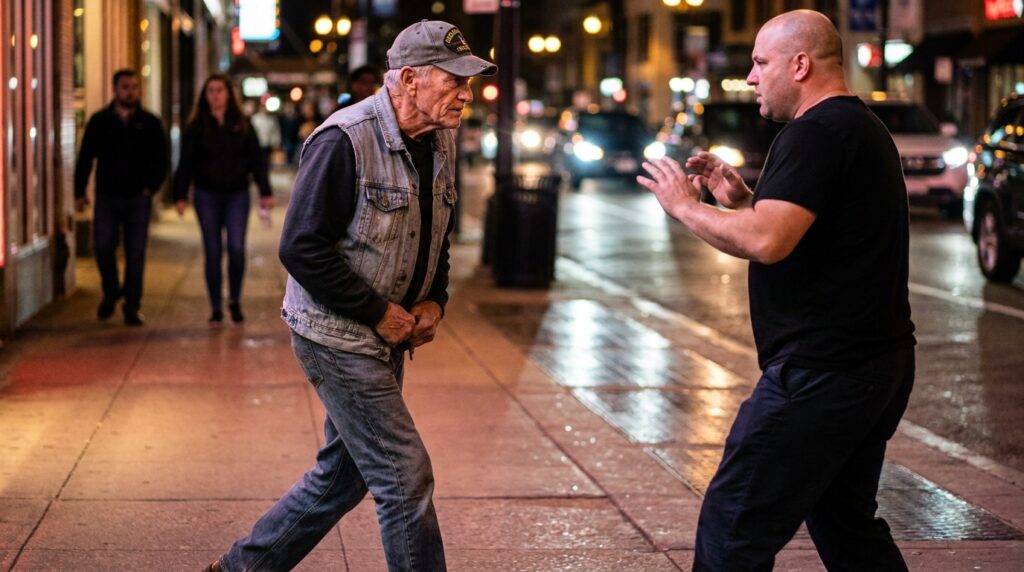
The Iron Stance of a Forgotten Command Found on the Rusted Urban Concrete
CHAPTER 1: THE WEIGHT OF THE WALK
The yellow sodium light overhead hummed with a low, cyclic vibration that vibrated straight through the iron eyelets of his boots. It was a gritty, industrial cold that settled over the city block, the kind of dampness that made the old iron railings along the storefronts sweat a thin layer of grime. He didn’t look up at the sound of the light. He didn’t look at the cracked concrete either, though his feet knew exactly where the fissures were, navigating them with the rhythmic, unhurried cadence of a man who measured distance in pacing steps rather than city blocks.
Beneath his denim vest, his shoulder blades felt stiff, the legacy of a damp climate and old steel shrapnel that liked to remind him of its presence whenever the humidity crossed eighty percent. His right hand stayed tucked into the pocket of his jeans, fingers lightly resting against the cold, notched gears of an old brass regulator valve he’d pulled from the salvage yard down on Fourth. It had weight. Everything tonight had weight—the air thick with the smell of river diesel and stale asphalt, the heavy canvas of his veteran cap pressed low against his brow, the steady, scraping breath of someone closing the distance behind him.
He didn’t quicken his pace. To change the stride was to give up the baseline, and he had spent forty years learning that a man who controls his own momentum dictates the geography of the room. The footsteps behind him were sloppy, flat-footed, scraping the moisture off the pavement with an aggressive, wide-tracked gait.
When the shadow finally stretched past his left shoulder, blocking the faint reflection of the neon diner sign across the street, the air shifted. A thick, bald man in a dark cotton shirt cut sharply across the curb, his stocky frame tilting inward to lock the old man against the dark brick facade of an abandoned hardware store. The smell of cheap liquor and cold sweat arrived a microsecond before the voice.
“You think you own this sidewalk, old man? Move out of the way before I move you.”
The bully’s chest was already forward, his chin tucked, his mass leaning in to run a standard intimidation play against a frame he assumed would fold from age alone.
He didn’t fold. The veteran stopped, his weight instantly dropping three inches as his knees absorbed the center of gravity, anchoring his boots into the grit of the concrete like iron pilings. He didn’t reach for a weapon; his calloused hands simply floated upward to the beltline, fingers loose, palms turned slightly inward—a position that looked like hesitation to the untrained eye but carried the absolute readiness of an uncoiled spring. He didn’t look at the bully’s chest or the heavy fists rising near the black shirt. He looked directly into the man’s pupils, tracking the slight, involuntary twitch of the iris that always preceded a physical rush.
The younger man took one more aggressive step, his shoulder dipping to crowd the space, expecting the old man to shrink back against the brick. Instead, the veteran surged. It wasn’t a swing or a wild scramble; it was a singular, perfectly weighted tactical advance—one explosive step forward into the centerline that completely overrode the bully’s perimeter. The sudden, dense mass of the older man’s movement acted like a physical wall. The stocky aggressor’s momentum broke instantly, his boots tangling as he was forced to stumble backward two full steps to keep from falling.
The sidewalk went entirely silent. A lone driver at the curb slowed his sedan, the window rolling down a mere three inches, the tires cutting through the wet asphalt with a faint hiss.
“You picked the wrong man to push around tonight,” the veteran said. His voice didn’t rise in pitch; it remained low, gravelly, carrying the flat, terrifying indifference of an old diesel engine turning over in the frost. He didn’t let the distance open up. He took another half-step forward, narrowing the gap just enough to keep the bald man from regaining his balance or his nerve. His gray cap remained perfectly level, his gaze locked like a sights-set rifle on the bully’s face. “Back off now, or you’ll regret taking another step.”
The stocky man’s forward-leaning posture evaporated. His chest deflated, his shoulders rounding as his hands came up, open-palmed and trembling slightly against the damp night air. His eyes darted once toward the dark alleyway, then back to the older man’s face, searching for a weakness that wasn’t there.
“Alright, I’m done here,” the bully muttered, his voice tight, stripped of its weight as he took two careful, retreating steps into the shadow of the awning. But as he turned to slink away, a thick, black leather ledger slipped from the inner lining of his heavy jacket, hitting the wet concrete with a dull, heavy thud right at the veteran’s feet.

CHAPTER 2: THE DROPPED LEDGER
The heavy, oil-tanned leather of the notebook slapped the wet asphalt with a dense, flat sound that had no bounce in it. It stayed exactly where it landed, inches from the square toe of his left boot. A thick brass clip bound the spine, rusted green at the rivets, catching the sickly yellow glare of the sodium vapor lamp overhead.
He didn’t bend down to pick it up. Not yet. His eyes remained fixed on the bald man’s throat, watching the heavy vein right above the collar of the black shirt pulsing like a trapped worm. In the alleyways of this district, a dropped item was the oldest misdirection in the manual. You lean down to clear the deck, and a heavy work boot meets your jaw before your fingers can even touch the leather.
The bald man took another full step backward, his boots scraping through the gritty puddles near the mouth of the alley. His hands were still up, fingers splayed wide against the cold air, but the aggressive tilt of his spine had completely vanished. He looked smaller now, his stocky frame leaking its artificial gravity under the weight of the old man’s unblinking stare.
“I said I’m done,” the bully repeated, his voice dropping into a hoarse, defensive rattle that barely carried across the damp sidewalk. He glanced down at the book between them, his jaw tightening for a fraction of a second, then looked back up, his eyes wide with a sudden, sharp calculation. “Keep it. It’s nothing. Just old yard tallies.”
“You’re lying,” the veteran said. His tone didn’t carry the heat of an accusation; it was simply a statement of fact, cold and unyielding as a iron ledger plate.
He didn’t move his feet from their anchored stance, but his fingers slipped out of his pocket, leaving the brass regulator valve behind. His right thumb hooked into the heavy canvas seam of his vest, right over his ribs, where his old service patch used to sit before the thread rotted away thirty years ago. He could feel the small, hard ridge of a scar underneath the denim—a reminder of what happened to men who left their flanks unguarded in a hostile sector.
The bald man didn’t stick around to argue the point. He took a final, lunging step backward, his shoulder checking the rusted iron frame of an old fire escape before he turned and bolted down the length of the dark passage. His heavy soles clattered against the wet brick walls, the sound echoing upward into the narrow gap between the buildings until the darkness swallowed his silhouette entirely.
The street settled back into its heavy, industrial silence. Across the four-lane asphalt, the neon sign of the diner flickered once, its red tubing whistling with a faint, high-frequency hum that died as quickly as it started. The lone sedan that had slowed down near the curb accelerated with a sharp chirp of rubber against wet concrete, its taillights smearing twin streaks of red across the damp pavement as it disappeared around the corner.
The veteran waited until the sound of the car’s engine faded below the city’s distant background rumble. Only then did he drop his weight into a deep, disciplined crouch, his left knee clicking with a sharp, dry pop that felt like a needle driving into the joint. He ignored the flare of arthritis, his hand reaching out to scoop the heavy ledger off the wet concrete.
The leather was slick with grease and road grime, the corners frayed down to the gray cardstock beneath. As his thumb brushed against the rusted brass corner clip, his skin caught on a jagged indentation. He tilted the book toward the sodium light. Someone had used a hardened steel awl to scratch a five-digit serial number into the metal—77-Delta—the old military logistics prefix for heavy ordnance transport.
His chest tightened, a familiar, cold weight settling behind his ribs. That wasn’t a street gang’s mark. That was a military-grade inventory stamp, the exact kind used by the supply depots out at the old county terminal before the line went dark in the late nineties.
He slipped the book inside the deep inner pocket of his denim vest, the cold leather pressing flat against his shirt. The weight of it altered his center of gravity, a physical reminder that his simple walk home had just crossed an invisible border into an entirely different type of engagement.
A door clicked open behind him.
He didn’t spin around. He simply shifted his heels, rotating his torso by twenty degrees to bring the new source of movement into his peripheral vision while keeping his back protected by the abandoned hardware store’s brick pillar.
An older man in a grease-stained white apron stepped out from the side door of the diner across the alley, holding a heavy galvanized bucket filled with gray dishwater. The cook froze, his eyes transitioning from the dark mouth of the alley to the veteran standing alone beneath the humming lamp. The cook’s gaze lingered on the gray cap, then dropped to the calloused hands still hanging loose at the old man’s sides.
There was no speech between them. In this part of the city, words were expensive and left a paper trail. The cook simply lowered his head, poured the dirty water into the iron grate of the storm drain with a loud, splashing rush, and stepped back inside. The heavy steel door slammed shut with a sharp, metallic echo that reverberated down the block, the deadbolt clicking home with absolute finality.
The veteran adjusted the brim of his cap, pulling the damp canvas low enough to shadow his eyes from the overhead glare. He reached back into his right pocket, his fingers wrapping around the brass regulator valve once more, using its cold, mechanical weight to anchor his thoughts. He had three more blocks to cover before he reached the small, gravel-strewn lot where his trailer sat beneath the highway overpass.
He took his first step forward, his boot grinding a fragment of broken glass into the wet asphalt. He knew the bald man wouldn’t stay gone for long. Men like that always went back to the person holding their leash, and whoever owned that 77-Delta stamp had more than enough leverage to send him back out into the dark with a larger crew.
As he reached the edge of the light’s yellow circle, his boot caught on something small and metallic that hadn’t been on the sidewalk two minutes ago. He looked down. A bright silver shell casing, a clean 9mm parabellum with no firing pin strike on the primer, lay glistening in the gutter, reflecting the red flicker of the distant neon sign like a fresh drop of blood on the rusted iron grate.
CHAPTER 3: THE TRACKS IN THE SHADOW
The silver brass was cold against the calloused meat of his thumb. He pinched the unspent 9mm casing from the wet iron grate, tilting the rim toward the sickly amber hue of the overhead streetlamp. No firing pin indentation scarred the primer. It was clean, slicked with a light layer of preventative machine oil that hadn’t yet been washed away by the city’s acid mist.
A round dropped without being cycled meant someone had racked a slide in a hurry, clearing a chamber out of pure panic, or someone was carrying an unlatched sidearm in a poorly fitted holster. He rolled the metal between his fingers, feeling the microscopic friction of the casing’s stamp. It was standard defense load, not ordnance stock, but the proximity to the 77-Delta ledger wasn’t a coincidence.
He rose slowly from the gutter, his hips giving a faint, grinding protest against the damp air. The weight of the ledger pressed into his chest from the inner lining of his vest, a stiff square of leather that forced him to adjust the alignment of his shoulders. The street remained empty, but the silence had changed; it felt thin now, like old canvas stretched too tight across a frame.
Instead of continuing along the main avenue toward the highway overpass, he turned his heels toward the lip of the alleyway where the bald man had evaporated. To go home now was to drag a line of grease straight to his own doorstep, and he hadn’t survived thirty years of civilian drift by leaving an open trail behind his flank.
The alley smelled of wet soot and rotting produce from the diner’s grease traps. The brick walls on either side rose four stories, blocking out what little ambient light the night sky offered, leaving only a desaturated gray channel cutting through the core of the block. His boots moved without the heavy scuffing of a casual pedestrian. He kept his stride narrow, his soles landing flat to minimize the wet slap of water against concrete, his eyes scanning the low-level horizon where shadows pooled against the foundations.
Ten yards in, the concrete gave way to old, uneven cobblestones—remnants of the city’s early industrial shipping lanes that had never been covered by modern blacktop. Here, the moisture pooled in deep, irregular tracks. He stopped beside a rusted iron dumpster that leaned heavily against a loading dock.
The flaking green paint of the bin was scraped raw down to the orange primer, the gouges fresh and showing bright metallic silver beneath. Someone had thrown their weight against it recently, hard enough to shift the four-hundred-pound steel box an inch to the left, leaving a clean crescent line in the dark slime of the cobblestones.
He reached into his vest, his fingers finding the edge of the leather notebook. He didn’t pull it into the open air. Instead, he worked his thumb past the heavy brass corner clip, feeling the texture of the internal pages by touch alone. The sheets were thick, heavy-bond paper that felt stiff from moisture exposure, the edges swollen and soft.
He could feel the raised indentations of a ballpoint pen driven deep into the fibers on the first three leaves—lines of structured tabular data, columns that repeated with mechanical regularity. His mind mapped the spacing; those weren’t numbers for scrap tallies or salvage weight. They were dates and percentages, structured precisely like an old company manifestation log.
A faint scuffle from the far end of the passage made him freeze. It was the sound of loose mortar crumbling from a joint, followed by the dry, synthetic rustle of heavy nylon sliding against old brick.
He dropped his frame behind the lip of the loading dock, his back pressing into the cold, textured iron of the warehouse door. The metal was pitted with decades of rust, the scales biting through the denim of his vest, anchoring him to the structure. He didn’t breathe through his mouth; he let the air cycle slowly through his nose, keeping his jaw loose to sharpen his auditory perimeter.
“He didn’t take the avenue,” a voice muttered from the exit of the alley. It was low, raspy, carrying the flat vowels of the north-side shipping wards. It wasn’t the bald man. The pitch was higher, thinner, carrying the ragged cadence of someone who spent their nights running errands for an authority that didn’t like to show its teeth in the light.
“He’s an old man,” a second voice replied, further down the cut. “He’s got nowhere to go but the yard under the bridge. Just check the avenues.”
“The book isn’t on the avenue, Miller. If the Captain finds out the manifest is sitting in a gutter because Marcus couldn’t handle an old-timer, we’re the ones who go into the logistics ledger.”
The veteran’s fingers tightened around the brass regulator valve in his right pocket. The Captain. The title wasn’t gang slang; it was delivered with the rigid, institutional weight of a man referring to a commanding officer or a precinct supervisor. The mention of the manifest confirmed the data etched into his chest lining. This wasn’t a random mugging or a localized turf dispute; it was an organized extraction route, and the bald man had been carrying the operational proof.
He watched the mouth of the alley where the two silhouettes leaned against a rusted chain-link gate. One of them adjusted a heavy canvas jacket, the movement revealing the short, blocky outline of a standard-issue radio receiver clipped to his beltline. The green indicator light blinked rhythmically, a tiny spark of color against the desaturated gray of the brick.
They weren’t moving toward his position yet. They were searching the peripheral exits, treating the block like an uncontained sector that needed a standard sweeping pattern. The veteran calculated the distance to the gate—twelve yards through open shadow with no intermediate cover except three rusted oil drums and an abandoned utility spool. His knees felt cold, the fluid in the joints thick and sluggish, but his core remained perfectly balanced.
He didn’t wait for them to initiate the sweep. He reached into his pocket, pulled out the silver 9mm casing he’d retrieved from the gutter, and flipped it with a short, flicking motion of his wrist toward the far side of the iron dumpster.
The tiny cylinder of brass struck the metal rim with a sharp, high-pitched ping that cut through the alley’s low ambience like a razor blade.
Both silhouettes spun toward the sound, their postures instantly dropping into a low, forward-leaning stance as their hands moved toward their waistlines. The guy in the canvas jacket took two rapid, uncoordinated steps toward the dumpster, his eyes locked on the shadow behind the bin, leaving his left flank completely exposed to the loading dock where the veteran stood waiting in the iron dark.
CHAPTER 4: THE INTERSECTION OF FORCE
The metallic ring of the casing against the dumpster rim had barely dissolved into the brickwork before the man in the canvas jacket committed his weight. He lunged toward the dark rear corner of the bin, his boots throwing up a spray of grit from the wet cobblestones. His right arm was tucked close to his ribs, his hand already gripping something heavy beneath his coat.
He never reached the corner. The veteran stepped down from the loading dock with a short, sliding drop that made no more noise than a wet rag hitting timber. He didn’t rush his entry. He targeted the gap left by the man’s overextended stride, closing the four-yard interval while the tracker’s focus remained locked entirely on the false trap behind the dumpster.
The second man, Miller, was still three steps behind, his boots caught in the thick puddle by the chain-link gate. He saw the old man’s gray cap cut across the dim light, but his reflexes were sluggish, corrupted by the belief that he was dealing with an octogenarian vagrant.
“Hey—” Miller started, his arm rising to point.
The veteran didn’t answer with words. He reached the first man just as the guy realized the space behind the dumpster was hollow. Before the canvas-jacketed tracker could rotate his hips, the veteran’s left hand shot forward, fingers locked into a rigid spade that drove directly into the soft meat beneath the man’s jawline. It wasn’t an anatomical strike meant for permanent damage; it was a pure physics calculation—disrupting the skull’s equilibrium to break the structural alignment of the spine.
The man’s head snapped backward, his breath leaving him in a wet, whistling grunt. His hand slipped from the heavy object inside his coat as his knees uncoupled. The veteran didn’t let him drop to the gravel where the impact would cause an unmanageable racket. He stepped into the man’s falling mass, catching the shoulder of the canvas jacket with his right hand while his left forearm hooked under the armpit, guiding the hundred-and-eighty-pound body down into the dark recess between the oil drums with a heavy, muffled slide.
“Miller!” the canvas jacket wheezed from the dirt, his fingers clawing uselessly at the cold gravel as his nervous system tried to reset. “He’s—”
Miller didn’t wait to hear the diagnosis. He pulled a short, matte-black utility iron from his waistband, his thumb hunting for the slide release as he scrambled backward toward the gate. The rusted wire of the fence rattled violently against its steel posts as his shoulder hit the frame.
The veteran didn’t chase him down the length of the brick channel. His knees were screaming, a deep, hot ache blooming behind his right kneecap from the weight of the catch. Instead, he simply reached down, his calloused fingers wrapping around the blocky radio receiver that had unclipped from the first man’s belt during the fall.
He didn’t speak into the grid. He held the small plastic box flat against his palm, his thumb resting over the transmit toggle while his eyes remained fixed on Miller’s retreating figure twenty feet away.
The radio speaker crackled, a sharp burst of static that sounded like dry gravel shifting down a chute. A voice came through—clear, institutional, and entirely devoid of street inflection.
“Unit Two, report status on the Third Avenue perimeter. Marcus is at the precinct office. He says the old man has the log.”
Miller froze at the sound of the radio. His utility iron was raised, but his head was tilted toward his own beltline, his brain attempting to process why his partner’s unit was broadcasting from the dark shadow of the loading dock. The green indicator light on the small plastic housing blinked once, casting a faint olive glare onto the veteran’s calloused thumb.
The veteran looked down at the unit, then back up at Miller. The space between them was filled with the low, rhythmic thrum of the highway overpass two blocks over—a constant reminder of the world that didn’t care about what happened in the dark spaces between the walls.
“Tell him you found it,” the veteran said to Miller. His voice was flat, devoid of the gravelly heat from the sidewalk confrontation. It was the tone of an evaluator checking an inventory sheet.
Miller looked at the utility iron in his hand, then at the dark mass of his partner groaning among the oil drums, and finally at the old man who hadn’t even raised his hands into a fighting guard. The stocky build beneath the denim vest didn’t look like an old man’s frame anymore; it looked like an obstruction that couldn’t be cleared without a caliber of force he wasn’t authorized to use on a public street.
“You’re Miller,” the veteran stated, taking one slow, measured step out of the loading dock’s shadow. The sodium light from the avenue caught the faded silver division pin on his cap, the tiny eagle’s wing gleaming for a fraction of a second against the gray wool. “Your father was in the Fourteenth Logistics out of Fort Meade. He used to handle the terminal manifests before they turned the yard into a scrap dump.”
Miller’s jaw didn’t just drop; his entire posture went rigid, his heels locking against the damp cobblestones as if he’d just been called to attention by a voice he hadn’t heard since his enlistment physical.
“Who the hell are you?” Miller whispered, the gun lowering by two inches as his fingers lost their white-knuckled grip on the polymer frame.
The veteran didn’t answer. He reached inside his vest, his fingers gliding past the rusted brass clip of the leather notebook until they touched the very back page. His fingernail traced a rough, hand-carved notch in the cardstock—a mark that didn’t belong to any corporate ledger or precinct registry. Beside that notch, written in faded purple indelible ink that had bled into the fibers over twenty winters, was a single surname: Vance.
The radio in his hand crackled again, louder this time, the static dropping out to reveal the sharp, rhythmic clicking of a teletype machine running in the background of the precinct office.
“Unit Two, acknowledge. Captain wants a visual on the target now.”
CHAPTER 5: THE PRICE OF EXPOSURE
“Who the hell are you?” Miller’s whisper hung in the damp air between them, thin and brittle. The muzzle of his black utility iron remained dipped, pointing toward the puddles, but his fingers were twitching against the polymer guard.
The radio in the veteran’s palm cut off any chance for an explanation. The speaker didn’t hiss this time; it shrieked with a high-pitched spike of frequency modulation that meant the transmitter at the precinct office had just increased its output wattage.
“Unit Two, we have a beacon tracking error on your position,” the dispatcher’s voice boomed from the small plastic grille, no longer indifferent. It was sharp, military-exact, and overridden by a gravelly bark in the background. “Miller, report your grid immediately. Captain is on the net.”
The veteran didn’t look at the radio. He looked past Miller’s shoulder toward the street entrance of the alleyway. A pair of headlights cut across the wet brick opening, the twin beams sweeping through the dark channel like searchlights across a perimeter fence. A heavy utility vehicle—an unmarked city cruiser with reinforced steel rims—idled at the mouth of the cut, its engine a low, rhythmic growl that vibrated through the old cobblestones.
“Get up,” the veteran commanded, his voice sinking into a hard, transactional register. He didn’t look back at the man groaning among the oil drums. He kept his weight forward, centered on his boots, his eyes never leaving the glare at the end of the passage. “Miller, drop the iron into the bin. Now.”
Miller hesitated, his gaze swinging from the approaching headlights to the old man’s weathered face. “The Captain… he knows the log didn’t go down the drain. Marcus told him.”
“Marcus is an amateur who runs over old citizens for pocket money,” the veteran said, his stride opening up into a steady, flat-footed advance that closed the distance between him and the gate. “Your father didn’t teach you to hold a perimeter by looking at the lights. Drop it.”
With a dull, plastic click, Miller’s weapon hit the rusted interior of an abandoned utility cart. But before the younger man could turn toward the rear exit, the steel door of the idling cruiser slammed shut out on the avenue.
Footsteps approached the mouth of the alley—not the sloppy, dragging steps of Marcus or the uncoordinated rush of the trackers, but the rhythmic, synchronized strike of heavy service leather. Two figures stepped into the yellow fringe of the streetlamp glare, their long dark coats flaring slightly as they cleared their sidearm holsters.
The veteran didn’t retreat toward the warehouse door. He reached inside his vest, his calloused fingers wrapping around the thick leather of the manifest book to check its placement. But as his weight shifted to dodge a low-hanging rusted pipe, his knee buckled with a sudden, vicious flare of fluid compression. The joints simply refused the load. He stumbled forward, his shoulder hitting the corroded zinc mesh of the perimeter fence with a violent, metallic rattle that echoed down the entire block.
The impact was enough to break his leverage. The internal pocket of his denim vest twisted under the strain, and the heavy leather ledger tore through the frayed lining. The notebook fell, but it didn’t hit a flat puddle this time; it struck the jagged, upright teeth of a discarded iron engine block resting against the fence.
The sound was a sickening, dry rip. The rusted brass clip that bound the spine sheared completely off its rivets, dropping into the dark water of the storm drain beneath with a faint, oily splash. Without the clip, the moisture-swollen sheets of the log exploded outward across the gritty mud—the columns of names, the precinct numbers, and the long rows of tabular data scattering under the rain-slicked wind.
“Visual on the target!” a voice shouted from the alley entrance. A high-intensity tactical beam lit up the passage, its white light turning the floating soot and mist into a solid wall of glare. “Hold your position! Hands on the cap!”
The veteran stayed on one knee in the grit, his fingers scraping through the wet gravel as he tried to pin down the loose pages. His hand closed over the back sheet—the one with the handwritten name Vance scrawled across the cardstock—but the paper was already turning to gray mush under his thumb. The list of precinct extortion payouts, the physical proof he’d spent twenty minutes securing, was disintegrating into the sludge of the city’s drainage network right before his eyes.
He looked up into the blinding white core of the tactical light. He could hear the distinct, rhythmic click of three service slides being drawn back in unison. The decoy secret—the belief that he could simply walk out of this sector with a book of names and force a precinct cleanup—was completely dead. The system wasn’t tracking an old ledger; they were clearing a sector.
Miller was already flat against the brick, his hands laced behind his head, his face pressed into the cold mortar.
The veteran slowly raised his palms, keeping his fingers open and visible beneath the light, his chest rising and falling in a slow, calculated cycle. The brass valve was still in his pocket, a useless piece of scrap iron against three barrels, but beneath his denim vest, his heart maintained its steady, dangerous pace. He had lost the ledger, but as the heavy boots stopped inches from his face, smelling of fresh polish and wet asphalt, he knew the names didn’t matter. The names were just the inventory. The logistics ring went all the way back to the terminal line, and they had just shown him exactly how much they were willing to spend to keep the line dark.
CHAPTER 6: THE DISMISSAL OF WITNESSES
The white light didn’t fluctuate. It pinned his hands to the air, casting long, skeletal shadows of his fingers back against the corrugated zinc of the fence. The slush beneath his knee was freezing, an oil-slicked mud that saturated his denim trousers and bit into the raw joints. He kept his palms open, his chest rhythmically rising and falling to keep his pulse from spiking into the red zone.
“Get him up,” a voice commanded from behind the glare. It wasn’t the dispatcher or Marcus. This voice had a dry, institutional clip—the flat tone of an auditor verifying a disposal.
Two sets of heavy service leather closed in from his flanks. Calloused hands grabbed the shoulder seams of his denim vest, hoisting his frame out of the mud with a rough, uncoordinated jerk that sent a sharp spike of arthritic fire straight through his lower lumbar. They didn’t check him for weapons with a standard professional pat-down; they simply ripped his pockets open, scattering the cold brass regulator valve and a few loose washers onto the wet gravel.
The brass valve rolled two inches before stopping against the boot of the man who had spoken.
A taller silhouette stepped into the focal point of the tactical light. He wore a long, water-repellent trench coat that smelled of fresh dry-cleaning and burnt premium fuel. As he reached down to pick up the valve, the light caught a heavy silver ring on his right ring finger—a chunky, blocky band of tarnished metal engraved with the stylized propeller of an army aviation depot.
The veteran’s eyes narrowed behind the glare. Depot stock. The same supply chain that had stamped the ledger clip.
The tall man flipped the brass valve in his palm, checking the weight, then dropped it into his coat pocket with a faint click against his keys. He looked past the veteran toward the brick wall where Miller was pinned, then down at the gray slush where the loose sheets of paper were dissolving into black pulp.
“The log is gone, Captain,” one of the leather coats reported, his boot heel grinding a scrap of the cardstock into the mud. “Spine clip broke on the old block. It’s in the drain.”
The Captain looked at the gray mush floating over the iron grate. His jaw didn’t tighten; his face remained perfectly smooth, a mask of bureaucratic indifference that had spent years learning how to erase mistakes before they became public record.
“Then there is no manifest,” the Captain said. He turned his eyes toward the veteran, his gaze lingering on the faded silver division pin on the gray cap. The light caught the deep lines around the elder’s mouth, the absolute lack of panic in the weathered gray eyes. “And there is no target. Just an old-timer who lost his way from the shelter under the overpass.”
“What about Miller, sir?”
The Captain didn’t look back at Miller. “Miller is going back to the motor pool. He has an early shift tracking parts shipments from the terminal.” He stepped closer to the veteran, the smell of his premium cologne mixing uncomfortably with the stench of the alley’s grease traps. “And this one doesn’t have the teeth to make a statement that anyone in a courtroom would read twice. Look at him. He can barely stand.”
The veteran didn’t defend his posture. He let his shoulders slouch slightly, playing into the assessment, though his weight remained perfectly balanced over his heels. He could feel the empty space inside his vest where the leather book had been—a physical loss that felt like a punctured perimeter. The paper proof was dead, washed down into the city’s subterranean pipes, leaving him with nothing but his own memory and the name Vance turning to silt beneath his boots.
“Clear the avenue,” the Captain ordered, turning his back on the loading dock. “Leave the vagrant. Marcus can handle the street cleanup once his head clears. We’re done with this sector.”
The tactical lights swung away, the sudden movement plunging the alley back into a desaturated gray gloom that felt heavier than the dark. The twin beams of the unmarked city cruiser backed out of the cut, their red taillights illuminating the brick walls for three seconds before the vehicle accelerated onto Third Avenue, its engine rumble dying behind the steady hum of the highway traffic.
The leather coats vanished with the car, leaving the alley empty save for the groaning tracker by the oil drums and Miller, who was still shaking against the mortar.
The veteran didn’t chase the cruiser’s exhaust. He dropped back down into a crouch, his fingers searching the cold mud around the engine block. The paper was gone, completely shredded by the iron teeth, but his thumb caught on a small fragment of hard gray cardstock that had wedged into a rusted bolt hole.
He pulled it free. It was a corner piece of the back cover—less than two inches wide—but the ink hadn’t fully bled out. A single letters-and-numbers sequence remained legible beneath the grime: Terminal Gate 4.
He rose, slipping the wet fragment into his shirt pocket, right against his skin where his body heat would dry the fiber. The decoy secret—the idea that this was a simple precinct extortion ring run by local cops—was totally shattered. The Captain wasn’t protecting a neighborhood shakedown; he was protecting the terminal routing line itself, the entry point for everything moving through the district.
He turned toward the mouth of the alley, his boots grinding through the grit without a sound. He didn’t look at Miller as he passed the gate. The time for names and files had expired on the concrete. The quiet elder adjusted the brim of his gray cap, pulling it down against the cold mist that was beginning to turn into a steady, freezing rain, and began his long, heavy march toward the river docks.
CHAPTER 7: THE GEOGRAPHY OF THE TERMINAL
The freezing rain didn’t fall so much as it drifted sideways, driven by the sour wind coming off the river channels. It turned the coal dust and iron filings on the pavement into a black grit that chewed at the welt-seams of his boots with every step. He kept his head down, the bill of his gray veteran cap serving as a narrow shield against the glare of the low-pressure sodium lamps illuminating the fence line of the terminal district.
He wasn’t walking like an old man who had lost his bearings anymore. The loose, slouching posture he’d shown the Captain in the alley vanished the moment he crossed beneath the highway overpass. His stride opened into a steady, flat-footed march, his hips swinging low to minimize the vertical bounce that aggravated his knee.
He reached into his shirt pocket, his fingers pressing against the scrap of wet cardstock he’d fished from the engine block. It had dried against his skin, the fiber stiffening into a rough, salty crescent. Terminal Gate 4. The destination was three hundred yards down the lateral line of the rail spur, past a row of decommissioned grain silos that bled orange rust from their rivet lines whenever the moisture rose.
The fence here was different from the commercial district. It was ten-foot industrial chain-link, the wire heavy-gauge and heavily encrusted with a dull white coat of zinc-oxide that flaked away in gray scales wherever the salt air from the estuary had eaten into the core. Behind the mesh lay the dark shapes of flatbed railcars, their steel beds pitted and scarred from decades of timber and iron haulage.
He stopped forty feet from the perimeter shack of Gate 4, dropping his frame behind the chassis of a rusted shunt engine that had been left to rot on a spur line. The locomotive’s skin was cold, the flaking paint revealing deep pits of dark purple corrosion that smelled faintly of unrefined petroleum and old scale. He let his back rest against the drive wheel, the massive counterweight providing a solid five inches of solid iron protection between his spine and the open lane.
The perimeter shack was small, its corrugated iron panels vibrating in the wind with a low, tinny rattle. A single utility light hung over the entry gate, its lens clouded by years of diesel exhaust until the beam was nothing more than a greasy amber smudge in the rain. Beside the door, a heavy black utility vehicle sat idling, its exhaust pipe pulsing white plumes of steam that smelled of high-cetane fuel—the exact same refined scent that had filled the alley twenty minutes prior.
The door to the shack groaned on its hinges.
A man stepped out into the amber smudge, wearing a heavy canvas deck jacket with a reflective orange cross stitched across the shoulder blades. It wasn’t Marcus or Miller, but the way he carried his weight—arms hanging wide from his ribs, his chin tucked into a thick wool collar—carried the unmistakable rhythm of an active-duty depot gatekeeper. He held a clipboard beneath a square of clear plastic, his thumb clicking a heavy zinc-plated pen over the paper.
“We have three more manifest lines crossing the bridge before the shift change,” the gatekeeper said toward the interior of the shack. His voice was loud, raspy, competing with the distant hum of the river tugs. “The Captain’s office said Unit Two had a data breach on Third, but the sector’s cleared now. Marcus is cleaning the lane.”
A second voice answered from inside, muffled by the rattle of the iron walls. “Did they recover the logs?”
“The sheets went down the drain on the block. The old-timer tore the spine out on an engine casing. Nothing left to log.” The gatekeeper spat into the wet gravel, the white globule disappearing into the black silt between the ties. “But the Captain wants the Gate 4 routing changed to the southern rail terminal anyway. Just in case someone tries to track the numbers from the Meade depot.”
The veteran didn’t shift his boots. He stayed pinned to the iron drive wheel, his thumb tracing the rough edge of the cardstock fragment in his pocket. The decoy secret—the assumption that the leather ledger was the only prize—was completely gone. The book had just been a secondary ledger, a local copy used to pay off the precinct guards who protected the lanes. The real mechanism wasn’t a list of names; it was the physical terminal gate itself, the routing point where military ordnance supplies from the old national logistics depots were being reclassified and filtered into the civilian black-market network.
He looked at his hands, the callouses dark with engine grease and old rain. He didn’t have a weapon, and his joints were stiffening from the hours spent in the freezing damp. The brass regulator valve that had served as his weight anchor was sitting in the Captain’s pocket two miles away.
But as he looked at the gatekeeper’s clipboard, he noticed a specific, small detail that the men in the trench coats had missed. Attached to the corner of the gate shack’s security padlock was a small, lead-wire shipping seal—the round, stamped disc used by the Army Supply Service to verify uncompromised cargo loads. The lead was bright, unoxidized silver, showing it had been cut and replaced within the last hour.
The logistics ring hadn’t just used the old names; they were using the active military transport lanes that his own unit had mapped out during the reconstruction era. The name Vance on the back cover wasn’t a target—it was his own old platoon sergeant’s registry mark, a ghost system that had been resurrected by a generation of corrupt administrative officers who thought the veterans had all gone soft or died in the county wards.
He stood up from the iron wheel, his knees making a dull, wet crunch in the gravel as the weight settled back onto his heels. He didn’t turn back toward his trailer under the highway overpass. To go back now was to leave the line open, and his platoon hadn’t left an open line since the winter of ninety-two.
He took his first step toward the side entrance of the rail yard, his fingers finding a long, rusted steel drift pin left behind by a track maintenance crew. The iron was heavy, six inches of pitted tool steel with a flat head, its surface flaking into red scales against his palm. He closed his fingers around it, testing the balance, his face settling into the same unblinking composure that had broken the bald man on the sidewalk. He had lost the ledger, but he had found the gate, and the gate didn’t have an option to delete its record.
CHAPTER 8: THE SHIFT ON THE TERMINAL FLOOR
The six-inch steel drift pin was freezing in his palm, its layers of red rust flaking off under the direct pressure of his calloused skin. He didn’t tighten his grip to the point of white knuckles; he kept his wrist loose, his thumb resting over the flat, struck head of the tool to balance its weight. The wind off the river channel brought a heavy spray of salt mist that froze instantly upon the black iron tracks, turning the entire yard into a treacherous pane of micro-friction.
He stepped clear of the shunt engine’s massive drive wheel, his boots moving through the coarse ballast gravel with the narrow, sliding gait he’d practiced across two hemispheres of operational service. The gatekeeper by the corrugated shack had his back turned, his zinc-plated pen clicking rhythmically against the plastic clipboard shield.
The veteran reached the corner of the security shack in four pacing counts. He didn’t use the steel pin for a strike. He slid the flat edge of the tool directly into the small, three-inch gap between the heavy doorframe and the sliding iron bolt of the main gate mechanism. With a single, short levering motion that relied entirely on the alignment of his hips rather than his aging shoulder muscles, he sheared the lead-wire military shipping seal. The round disc popped free, landing in the salt-crusted mud without an audible splash.
The gate keeper heard the sudden change in the wind’s rattle against the corrugated panels. He began to rotate his shoulders, his clipboard tilting downward. “Who’s—”
The veteran closed the remaining two feet of distance before the man could clear his throat. He didn’t use an open hand or a fist. He drove his right elbow straight into the heavy canvas collar of the deck jacket, pinning the gatekeeper’s mass against the cold iron of the shack’s exterior wall. The clipboard fell, the clear plastic sheet cracking across the frozen gravel as the papers inside fluttered into the wet mesh.
“You’re going to open the manifest ledger for the southern line,” the veteran said. His voice was an unhurried, flat register that stayed below the frequency of the wind. He didn’t look at the man’s eyes; he kept his gaze on the door of the utility cruiser idling twenty feet away. “Not the one you showed the Captain. The active transport registry for the 77-Delta stock.”
The gatekeeper’s breath was short, his wool collar choking off his response as his heels skidded through the grease-slicked gravel. “There’s no… there’s no registry here, old man. It’s just yard tallies. The Captain cleared the block.”
“The Captain cleared the shakedown,” the veteran stated, his forearm tightening against the man’s throat just enough to lock the vertebrae against the iron siding. “The shakedown was just the grease for the gate. The gate belongs to Vance.”
The mention of the name caused the gatekeeper’s frame to go completely slack, the resistance leaking out of his boots just as it had with Miller in the brick channel. He looked down at the faded silver eagle’s wing pin on the gray cap, his lips parting in a dry, silent realization that had nothing to do with the physical threat of the iron pin in the old man’s right hand.
“Vance is dead,” the gatekeeper whispered, his fingers losing their grip on the shack’s latch. “He died in the terminal fire back in ninety-eight. The registry was retired.”
“The registry was stolen,” the veteran corrected him. He loosened the pressure of his elbow by an inch, allowing the man to slide down the corrugated wall until his boots found a stable purchase on the ties. “And his logistics platoon didn’t clear the line for a precinct shakedown crew. Open the box.”
The gatekeeper reached out with a trembling hand, his fingers hunting for the secondary padlock hidden beneath the iron lip of the utility counter. The steel clicked open with a heavy, wet snap that seemed to dilate the time inside the gate circle.
Inside the small wooden cabinet lay three fresh, unsoiled shipping manifests—not leather-bound notebooks from the street, but clean, white federal logistics logs stamped with the official watermark of the national supply depot. The top line of the first ledger carried the exact serial sequence from the broken brass clip, but the destination column didn’t list a local scrap yard or a civilian warehouse. It listed the hull numbers of three transport vessels currently idling at the deep-water river docks two miles downstream.
The veteran didn’t take the books. He didn’t need to. The ultimate reality was locked into the white pages beneath the greasy amber light. The shakedown on Third Avenue, the bald man’s intimidation routine, the Captain’s systemic erasure of the paperwork—it wasn’t about extortion. The entire district was being utilized as a blind conduit to siphon national ordnance reserves onto international shipping hulls, using the dead registry of his old platoon sergeant to mask the paper trail from the Meade depot.
The heavy black utility cruiser at the curb shifted its gears, the transmission giving a sharp, metallic whine as its reverse lights illuminated the wire fence behind them. The Captain hadn’t gone back to the precinct office. The vehicle had tracked the loop around the rail spur, its reinforced steel rims cutting through the frozen slime of the lane as it blocked the only exit from Gate 4.
The veteran looked down at the white pages, then back at the approaching headlights. His denim vest felt light without the weight of the old leather book, but his center of gravity was entirely restored. He had spent twenty-five years believing his platoon’s final assignment had been erased by a common warehouse fire; tonight, on the rusted concrete of the shipping wards, he had found the true ledger.
He didn’t run toward the dark spaces between the flatbed railcars. He reached down, picked up the gatekeeper’s zinc-plated pen from the gravel, and drew a thick, unswerving line through the active routing code on the clipboard sheet—the exact tactical cancellation mark his unit had used to freeze supply trains during the mobilization era.
He stepped back into the amber smudge of the light, his boots anchored flat against the wet iron rail, his face entirely composed as the cruiser’s doors opened once more into the freezing rain. The proof wasn’t on paper anymore. It was standing on the terminal floor, and he was fully prepared to hold the line until the registry was clear.







