
The Fraying Weight of Quiet Crowns and the Heavy Grace Left Standing on Broken Concrete

CHAPTER 1: THE DESCENT INTO THE STATIC

“You don’t have to keep the cap on, Grandpa,” Chloe murmured, her fingers tightening around the canvas strap of her backpack. “The air down here is heavy enough.”

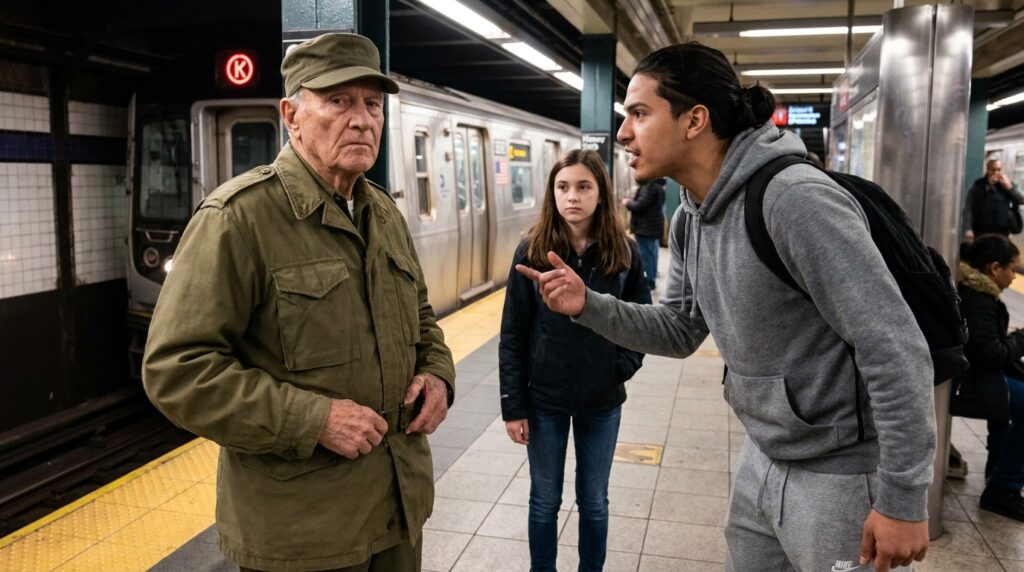
Frank Vance didn’t adjust the brim. His thumb, thick and patterned with ancient, faded grease scars, remained Hooked into the coarse webbing of his belt. The subterranean heat of the transit system rose to meet them in damp, iron-scented waves, carrying the low, rhythmic thrum of the 14th Street tracks deep within the concrete basin. Around them, the evening rush hour moved like a sluggish, indifferent tide—fatigued commuters with eyes locked onto glowing screens, their heels clicking sharply against the gray terrazzo floor.

He felt the weight of his advanced years in the stiff hinges of his knees, but his spine remained stubbornly straight under the olive-drab transit coat. The uniform didn’t carry the silver oak leaves or the polished brass pins of his youth; it was standard-issue city weave, slightly frayed at the cuffs, meant to project an authority that the modern crowd routinely ignored. To them, he was merely an administrative ghost, a slow-moving elder occupying a corner of a world that had outpaced him.

“The cap stays where it belongs, Chloe,” Frank said. His voice was a low, gravelly drone that barely cleared the static of the station’s overhead intercom. “The uniform isn’t theater. It tells people where the line is.”

They stepped past the turnstiles, where a cluster of teenagers stood near the concrete pillars. One of them, a slim youth with long dark hair tied back in a messy knot, leaned against the rusted emergency exit gate. He wore an oversized gray fleece hoodie that smelled faintly of cheap tobacco and damp asphalt. His dark eyes didn’t slide past Frank; they lingered, tracking the slow, measured pace of the veteran’s black leather boots.

Frank noticed the slight shift in the boy’s shoulders—the subtle tensing of the jaw that preceded a boundary test. He didn’t alter his stride. He guided Chloe toward the center of the platform, where the yellow safety tiles were worn down to a smooth, non-textured finish by millions of passing shoes. The train platform was a narrow island of concrete trapped between two dark tunnels, and the air was beginning to whistle with the pressure of an approaching locomotive.

A small, tarnished brass pocket watch shifted against Frank’s ribs inside his coat pocket, its glass crystal cracked directly down the center. It ticked with a heavy, uneven friction that seemed to match the low rumble beneath his feet.

As they neared the edge, the boy in the gray hoodie detached himself from the pillar. He didn’t walk around Frank. He moved directly into the interaction lane, his sneakers squeaking against the concrete as he cut off the path to the train doors. Chloe noticed first; her shoulder hitched, and she instinctively moved half a step behind Frank’s sturdy frame, her gaze dropping to the floor.

Frank stopped exactly eighteen inches from the young man. The space between them grew instantly cold, filled only by the thick, mechanical idling of a stopped train further down the line. The boy sneered, his fingers sinking deep into the pouch of his fleece hoodie, pulling the fabric taut against his chest.

“You’re in the way, old man,” the boy whispered, the words sharp and deliberately loud enough to make a nearby commuter freeze.

Frank looked at him through eyes narrowed by years of harsh sun and forgotten deployments. He didn’t reach for his radio. He simply stood square, his center of gravity shifting back into his hips, anchoring his boots to the concrete.

Beneath the boy’s frayed sleeve, Frank caught a glimpse of something old and metallic—a scarred military-issue identification tag dangling from a cheap key ring tucked inside the gray pocket.


CHAPTER 2: THE ENCROACHING SHADOW

“You’re in the way, old man,” Marcus Fletcher repeated, his voice dropping into a register that was meant to slice through the ambient hiss of the 14th Street tunnels.

Frank didn’t shift his boots. The rubber soles of his security issue footwear remained firmly planted across the seam of two concrete slabs, right where the yellow tactile plating began its warning line. The station air was thick, tasting of old oil and the metallic dust scraped from thousands of daily braking pads. It was a faded texture he had known for forty years, long before the city transit authority had changed the color of their uniform patches from silver to this muted, uninspired olive.

“The platform is wide enough for a man with eyes, son,” Frank replied. He kept his hands low, the fingers relaxed but curled slightly inward, a heavy habits-of-the-service positioning that kept his center of gravity uncommitted. “The train doors open in thirty seconds. Step back into the lane.”

Marcus didn’t retreat. Instead, he leaned forward, using the loose, shifting mass of his gray fleece hoodie to mask the narrow frame beneath it. He smelled of cold asphalt and cheap tobacco, an aggressive, frantic heat radiating from his skin that spoke of hours spent drifting through the upper mezzanines. Behind Frank, Chloe’s fingers dug deeper into the canvas strap of her bag, her small knuckles turning the color of chalk. Frank could hear her breathing—shallow, rhythmic hitches that rattled against the damp roar of the oncoming train.

“I don’t see a lane,” Marcus said, his eyes scanning the faded brass button on Frank’s collar. His smile was small, thin, and entirely devoid of warmth, the calculated smirk of a boy who knew the crowd would rather record a tragedy on their small screens than step into the friction to stop one. “I just see a lot of old cloth that needs to get out of the light.”

The distant commuters had already begun to form the circle—the silent, non-participatory witness layer of the city. They didn’t move to help; they simply slowed their paces, their heels making a dull, scraping cadence against the terrazzo as they adjusted their paths to maintain visibility. A few hands slid toward pockets, the familiar, dark rectangles of smartphones peeking out from wool coats. They were waiting for the old man to break, for the fragile authority of the transit patch to dissolve under the weight of modern indifference.

Frank ignored them. His focus remained locked on the small space between Marcus’s chin and the frayed drawstrings of his hood. But his peripheral vision, trained in darker fields than these concrete tubes, caught the rhythmic swing of the key ring tucked inside Marcus’s fleece pocket. The scarred military identification tag bounced against the dark fabric, its stamped aluminum surface showing deep, jagged gouges that looked like they had been made by a survival knife or concrete friction. It wasn’t surplus. The serial number sequence was old—the prefix belonged to a logistics company out of Fort Bragg, the same unit Frank’s company had supported during the tail-end of his final deployment.

“You’ve got people watching you, kid,” Frank said, his gravelly voice dropping an octave, carrying the heavy weight of a command that didn’t need to shout to be felt. “They aren’t looking at you because they respect you. They’re looking because they want to see how hard you hit the floor when the momentum changes.”

Marcus’s jaw tightened, the smirk vanishing behind a sudden, sharp tensing of the throat muscles. To his left, one of the teenagers from the emergency gate called out—a short, high-pitched whistle meant to signal that the transit police hadn’t cleared the turnstiles yet. The platform was an island, and for the next twenty seconds, the rules belonged entirely to the two men standing on the yellow tile.

“You think you’re still something, don’t you?” Marcus whispered, stepping another three inches into Frank’s personal space, his shoulder checking the air just enough to brush against the stiff fabric of Frank’s sleeve. “You’re just a uniform the city forgot to throw away.”

Frank felt the watch in his breast pocket tick against his ribs—one loud, uneven thud that felt remarkably like a warning. The air coming out of the dark mouth of the tunnel was turning hot, pushing a wave of trash and dry paper before it. The train was coming. The yellow safety bumps beneath his boots began to vibrate, a low-frequency hum that traveled up his legs and settled into his lower back.

He didn’t look back at Chloe. He didn’t need to. He knew exactly where she was standing, her small frame shielded by his mass, her eyes wide with the terror of a child discovering that the world didn’t care about the silver oak leaves her grandfather kept in a velvet box at home.

“The uniform stays,” Frank said, his eyes never leaving Marcus’s pupils. “And you’re about to run out of platform.”

Marcus didn’t answer with words. His right hand came out of the fleece pouch, the fingers shifting into a rigid, clawed hook that targeted the center of Frank’s olive lapel—a kinetic invitation designed to pull the old man forward, to break his posture before the crowd could see what was coming next.

CHAPTER 3: THE THREAT AT THE BOUNDARY

Marcus’s fingers never found the coarse weave of the olive lapel.

The movement was loud in its intention but slow in its execution, a telegraph born of street bravado rather than the brutal, economic geometry of survival. To Frank, whose perception of conflict had been forged in environments where an unhedged inch cost a life, the reaching hand looked like an object drifting through stagnant water. He didn’t flinch. He didn’t step back onto the yellow warning bumps where the train’s massive steel body was already slicing through the hot subterranean air, screaming its arrival with a high, mechanical shriek.

Instead, Frank adjusted his weight by a fraction of an inch, sinking his hips into the cold, vibrating foundation of the platform. His left hand came up—not to strike, but to intercept. His palm, rough and leathered by decades of manual labor and service grip, met the inside of Marcus’s wrist. The contact was a dull thud against the roar of the incoming locomotive, a localized friction where two generations rubbed raw against one another.

“Step back from the line, son,” Frank said.

The words were spoken directly into the pocket of dead air between them, completely unhurried, even as Marcus’s shoulder twitched with the realization that his forward momentum had been met by a stone wall. The boy’s fingers curled into an empty claw just inches from Frank’s chest, the gray fleece bunching at the elbow.

Chloe let out a sharp, choked breath behind them. Her small hands found the back of Frank’s heavy coat, anchoring her trembling frame to the only stable object in the entire underground basin. Frank could feel her terror through the stiff wool—not just a fear of the aggressive boy in front of them, but the deep, foundational panic of a child watching the fragile order of her world threaten to split open on the edge of a concrete drop-off.

“Let go of me, you old bastard,” Marcus hissed. He tried to yank his arm back, his sneakers sliding a fraction of an inch into the thin layer of grime covering the terrazzo floor. But Frank’s grip wasn’t an act of anger; it was a mechanical lock, the unyielding application of center-of-gravity physics that treated Marcus’s wrist like a structural joist.

The witness layer had completely crystallized now. The distant commuters didn’t look like people anymore; they were a wall of dark winter coats and pale, upturned faces, illuminated by the rhythmic flashing of the train’s warning lights as it began to clear the tunnel mouth. The smartphones were held high, their lenses catching the cool fluorescent glare of the overhead strips. They were silent, a collective jury waiting to see the old man dragged into the dirt, expecting the fraying seams of his late-career uniform to give way under the kinetic energy of youth.

Frank didn’t look at the cameras. He looked at the scarred identification tag dangling from the key ring inside Marcus’s pouch pocket, which was bouncing erratically as the boy struggled against the hold. Up close, the faded textures of the gray fleece revealed details that the dim station lighting had previously hidden—small, grease-stained smudges along the hem that matched the industrial lubricants used in the maintenance bays of the lower yard, the same bays where Frank spent his morning inspections.

“You’re breathing too fast,” Frank told him, his gravelly voice maintaining its low, steady cadence despite the howling screech of the train’s iron brakes just fifty feet away. “Your weight is entirely on your heels. If I let go of this wrist right now, you’re going to fall into the side of the second car.”

“I said, get your hands off me!” Marcus lunged forward with his opposite shoulder, using his entire slim mass to drive his elbow toward Frank’s jaw. It was a desperate, undisciplined correction—the reaction of a boy who had never faced a force that didn’t negotiate with noise.

Frank’s eyes didn’t track the swinging arm. He felt the shift in the air pressure, the heavy iron-scented draft of the approaching engine hitting them full in the face, blowing the brim of his weathered veteran cap upward just enough to expose the deep, pale scar across his forehead. The pocket watch against his ribs gave another dull, uneven thud, a rhythmic baseline that seemed to measure the absolute expiration of the interaction lane.

He didn’t use force. He used Marcus’s own frantic acceleration, twisting his own torso by three degrees to let the boy’s weight carry him into the empty space where the old man’s shoulder had been a micro-second before.

CHAPTER 4: THE REDIRECTION OF MASS

The boy’s forward rush carried the frantic, unweighted desperation of someone who had never known the grounding density of an iron line.

As Marcus drove his weight forward, Frank’s response was neither a strike nor a jagged contest of muscle. It was a silent, mechanical translation of mass. His left heel pinned itself to the gray terrazzo floor, absorbing the friction of the platform’s vibration, while his right palm found the soft crease of Marcus’s elbow. With a single fluid, descending spiral that utilized the boy’s own frantic acceleration, Frank broke the trajectory. He did not pull; he simply ceased to be an obstacle, redirecting the momentum downward toward the cold concrete slabs.

The mechanics of the movement were ancient, stripped of theatrical display, a mundane physics lesson executed in the damp, iron-scented draft of the incoming cars. Marcus’s sneakers lost their purchase on the thin layer of platform grime. His loose sweatpants bunched as his knees buckled, his torso twisting through the empty air where Frank’s chest had been a micro-second prior. The air gave way with a sharp, hollow whoosh as Marcus hit the concrete, his hip and shoulder sliding across the yellow textured safety bumps just as the lead subway car roared platform-side, casting a blur of cool fluorescent light across the scene.

The impact was a dull, heavy slap that seemed to absorb the ambient noise of the station. Marcus did not bounce; he stayed down, his long dark hair spilling across his eyes, his breathing instantly turned into a ragged, disoriented gasp. The aggressive posture that had defined his slim frame for the last three minutes vanished, replaced by the awkward, splayed geometry of a fallen child.

Behind them, the train ground to a groaning halt, its massive steel brake shoes squealing against the rails, throwing a cloud of warm, dry air over the platform edge. The doors slid open with a synchronized hiss, but no one stepped out. The passengers inside the car remained frozen behind the glass panels, their faces pale under the interior lights, their gazes locked onto the old man in the creased olive uniform who still stood perfectly square to the tracks.

Frank’s hand remained low, his fingers relaxed, his pulse steady beneath the coarse wool sleeve of his coat. He felt the heavy, uneven tick of the cracked pocket watch against his ribs—one, two, three muffled thuds—before he allowed his gaze to drop to the floor. The weathered veteran cap remained level on his head, the brim casting a deep shadow across his lined face that obscured the ancient scar on his brow.

“You’re done with the lane, son,” Frank said. His gravelly voice didn’t rise above the idling hum of the train’s compressor, yet it carried an absolute, unhurried density that made the surrounding air feel thick.

Chloe let go of his coat. Her small hand remained hovering in the space between them, her fingers trembling against the dark fabric of her jacket. She wasn’t looking at Marcus; she was looking at Frank’s boots, her mind trying to reconcile the slow-moving, quiet grandfather who complained about the dampness in his joints with the mountain of unyielding discipline that had just anchored the platform.

The witness layer remained bound in a collective, phone-lowering silence. The smartphones didn’t go back into pockets, but the screens tilted toward the floor, the thumbs hovering over recording buttons that had suddenly caught something far too heavy for a viral clip. The passive curiosity of the crowd had turned into a dense, palpable shame—the realization that they had surrounded the wrong man.

Frank didn’t look for their approval. He took a single, short step forward, his black leather boot stopping inches from Marcus’s elbow. As the boy shifted, a loose, three-times-folded sheet of coarse, government-issue paper slipped from the torn lining of his fleece pouch pocket, its edges frayed and stained with dark grease. Frank’s eyes narrowed as he caught the distinctive, blocky blue ink of an official stamp at the top of the page—the unmistakable header of a Veterans Administration disciplinary discharge.

Marcus reached out a trembling hand, not to attack, but to cover the paper, his fingers scratching weakly against the concrete as he looked up through his tangled hair, his bravado entirely drained from his eyes.

CHAPTER 5: THE WARNING ON THE FLOOR

Marcus’s scraping fingers missed the edge of the document by a fraction of an inch.

The three-times-folded paper lay flat against the transit dust, its creased corners curling upward into the humid, iron-scented draft of the platform. The blue ink of the official Veterans Administration header was raw, clear, and stark under the unshielded station lights. Frank didn’t move his boot to pin it down, nor did he reach down to claim it. He simply kept his tall, sturdy frame anchored between the boy on the concrete and the open doors of the idling subway car, his heavy gaze resting on the block letters that detailed a medical facility discharge from three weeks prior.

The name on the form was heavily redacted with thick, marker-drawn lines, but the secondary tracking sequence—the operational code for the regional veteran support registry—remained entirely legible.

“Don’t touch that,” Marcus whispered, his voice cracking into a ragged, high-pitched plea that completely stripped away the last remaining traces of his street posture. He didn’t look up into Frank’s eyes; his gaze remained desperately fixed on the paper, his thin shoulders trembling beneath the oversized gray fleece of his hoodie. “It’s not yours. It doesn’t belong to you.”

“The paper belongs to the state, kid,” Frank said, his gravelly voice dropping into that quiet, low-frequency register that carried the density of an old command log. “But the stamp at the top tells a story about someone who didn’t get their papers processed right. Someone who walked out of the clinic doors before the medication cycle was finished.”

Chloe stepped forward, her soft leather shoes making a tiny, distinct click against the gray terrazzo as she moved closer to Frank’s side. The terror that had frozen her chest during the boy’s initial approach had faded into a strange, watchful reverence, her long brown hair catching the flickering reflection of the train’s cabin lights. She looked at Marcus, then down at the paper, her brows knitting together as she noticed the small, tarnished military-issue identification tag dangling from the key ring that had spilled from Marcus’s pocket during the fall.

“Grandpa,” she murmured softly, her fingers lightly tapping the stiff olive cloth of his sleeve. “Look at the tag. The stamp sequence on the lower rim.”

Frank didn’t shift his head, but his peripheral vision locked onto the aluminum rectangle resting near Marcus’s knee. The jagged gouges across the metal face were deep, but they didn’t completely cover the stamped company markings—the specific registry numbers for a logistics company out of Fort Bragg that had disbanded the same winter Frank had returned to civilian life. The tag wasn’t a surplus imitation or a piece of street jewelry. It was an original, worn down by years of pocket friction until the edges were as thin as a copper coin.

Around them, the witness layer remained frozen in a dense, unnatural silence. The commuters inside the train cars stared through the glass windows, their faces pale and unmoving, like a gallery of painted portraits. On the platform, the hands holding the smartphones had dropped down to chest-level, the glowing screens dark or neglected as the crowd realized the confrontation had shifted entirely away from a dynamic public altercation into a private, devastatingly quiet reckoning between two generations.

“You’ve been spending your mornings in the lower yard,” Frank said, his boots remaining perfectly still across the concrete seam. “That’s why you’ve got maintenance grease on the hem of that fleece. You aren’t jumping turnstiles for the thrill of it, son. You’re looking for the people who sleep near the generator housing.”

Marcus didn’t answer with words. He slowly pulled his hand back, curling his fingers into his palm as if trying to preserve the warmth of a grip that had already broken. His head dropped forward, his long dark hair falling like a curtain across his lined, sweating face, his breathing coming in shallow, ragged stabs that rattled against the heavy, mechanical idling of the train.

“You don’t know anything about the yard,” Marcus whispered, the words muffled by his hair, his tone slipping into a subdued, bitter regret. “You just wear the jacket. You just walk the line.”

Frank felt the brass pocket watch tick against his ribs—one loud, uneven thrum that seemed to mark the exact point where the structure of the day’s duty collapsed into something far heavier. He knew the maintenance bays better than any supervisor on the payroll; he knew the cold corners where the steam pipes leaked, the hidden access tunnels where the city’s forgotten veterans crawled to escape the winter drafts, and the names of the three men who had vanished from the state registry without a trace.

“I walk the line because I know who’s crossing it,” Frank told him, his gravelly voice maintaining its unhurried, steady weight. “And I know that form wasn’t given to you by a clerk. You took it out of a locker, or you found it in a bag left behind in the dark.”

Marcus finally looked up, his dark eyes wide and glossy under the stark fluorescent glare, all the manufactured aggression entirely drained from his expressions. He subdues his tone, avoiding direct eye contact with Frank as his hand twitched one last time toward the paper.

“Okay,” Marcus whispered, the word barely audible over the low hum of the train’s compressor. “Okay, I get it. Just… don’t let them take the paper.”

Before Frank could reach down to answer the request, the iron-scented air of the station split once more as the heavy steel security doors at the far end of the mezzanine groaned open, signaling the arrival of the late-shift supervisors and the transit police.

CHAPTER 6: THE BROKEN RECOGNITION

The heavy steel security doors at the far end of the mezzanine didn’t just swing open; they rattled against their frames, throwing a sharp, metallic echo across the subterranean concrete. The heavy boots of the late-shift supervisors struck the stairs in a fast, rhythmic cadence, but Frank didn’t turn his head toward the sound. His boots remained anchored. His gaze stayed fixed on the three-times-folded paper resting in the dirt between his leather toes, and on the small, scarred identification tag that lay inches from Marcus Fletcher’s trembling knee.

“Vance!” The voice of the shift captain came down the platform, flattened by the low acoustic ceiling of the station. “Hold him there. Don’t let him move.”

Marcus didn’t try to move. The young man stayed on the floor, his long dark hair hanging like a split veil over his face, a single drop of sweat slipping from his chin to darken a tiny circle of the gray terrazzo. His fingers were completely still now, resting near the edge of the frayed document he had defended with such desperate, unweighted bravado only minutes before.

Frank slowly knelt. The movement was a deliberate, mechanical protest of his joints, the coarse wool of his trousers tightening against his knees as he lowered his tall frame onto the cold platform floor. He didn’t use the sudden authority of the oncoming guards to press his advantage. Instead, his thick thumb, rough with the deep grease-scars of an old logistics yard, reached out and turned the stamped aluminum identification tag over.

The metal was cold, thin as a shaved coin, its edges rimmed with a dull white oxidation that only came from months of contact with human salt and sweat. Frank’s eyes didn’t track the bold blue letters of the Veterans Administration header anymore; they tracked the secondary serial string stamped along the lower lip of the aluminum tag. It was a sequence he had written into three dozen shipping manifests during the winter of ninety-four—a company registry that belonged to his own detachment, the final logistics unit to pull out of the lower valley before the base was deactivated.

And beneath the registry number, hidden under three deep, deliberate scratches that looked like they had been carved with the tip of a service blade, was a name.

David J. Vance.

The watch inside Frank’s breast pocket gave a loud, uneven thud against his ribs—a heavy, isolated striking of gears that seemed to suspend the entire subterranean basin in a strange, slow-motion freeze. The roar of the idling subway cars seemed to drop an octave, turning into a low, oceanic murmur that hummed inside the bones of his head. He didn’t look at Marcus’s face; he looked at the boy’s wrists, noticing for the first time the slight, curved indentation of the bone where the radius met the joint—the exact genetic architecture of his own hands, passed down through an estranged son who had walked into the gray light of the state clinic three years ago and never returned.

“Grandpa?” Chloe’s voice was a tiny, fragile thread that barely reached him from the space above his shoulder. She had knelt beside him, her small hand coming down to touch the coarse olive cloth of his sleeve, her brown eyes widening as she tracked the path of his thumb across the salt-rimmed metal. “Grandpa, what is it?”

Frank didn’t answer her. He couldn’t clear the gravel from his throat. The entire moral landscape of the platform had dissolved, leaving behind only the faded, fraying textures of a family history that had been ground into the urban dust. The boy in the gray hoodie wasn’t an anonymous boundary-crosser looking for clout among the pillars; he was a runner tracking a ghost through the cold corners of the lower transit yard, systematically baiting every uniform on the line in a frantic, undisciplined effort to find the old man who shared his blood.

“You’ve been looking for the logistics file,” Frank said, his voice dropping into a whisper so low it was completely buried beneath the hum of the train’s compressor. “That’s why you had the discharge form. You didn’t steal it from a locker. He gave it to you.”

Marcus didn’t raise his head. His shoulders hitched once—a silent, jagged tremor that shook the heavy fleece of his hoodie. His hand closed around the document, his knuckles turning white as he pulled the creased paper against his chest, holding it like a shield against the heavy boots that were now clearing the yellow safety tile just twenty feet away.

“He told me there was someone down here who still remembered the company,” Marcus whispered, his voice cracking into the damp air, entirely devoid of street cadence. “He said if I found the uniform with the Fort Bragg patch, I’d find the line.”

The shift captain’s shadow fell over them—a wide, dark outline that blocked out the cool glare of the nearest fluorescent strip. Behind him, two transit officers stood with their hands resting on their utility belts, their faces set in the hard, institutional neutrality of the city.

“Vance, get up off the deck,” the captain commanded, his boots stepping onto the yellow tactile plating. “We’ve got the transport unit coming down the elevator. We’ll take the kid from here.”

Frank didn’t rise. He kept his large frame positioned between the officers and his grandson, his hand remaining gently resting on the concrete beside Marcus’s knee. The cracked crystal of the pocket watch against his chest ticked one final, heavy stroke, the vibration traveling through his uniform coat like an old promise that had finally run out of platform.

“The kid isn’t a transport case, Captain,” Frank said, his gravelly voice rising from the floor with an absolute, un-yielded command that made the officers halt mid-stride. He reached down, took the corner of the gray fleece hoodie, and pulled Marcus slowly toward his shoulder, the coarse wool of his old uniform absorbing the boy’s silent, shaking grief. “He’s with me.”

Similar Posts

Leave a Reply

Your email address will not be published. Required fields are marked *






