
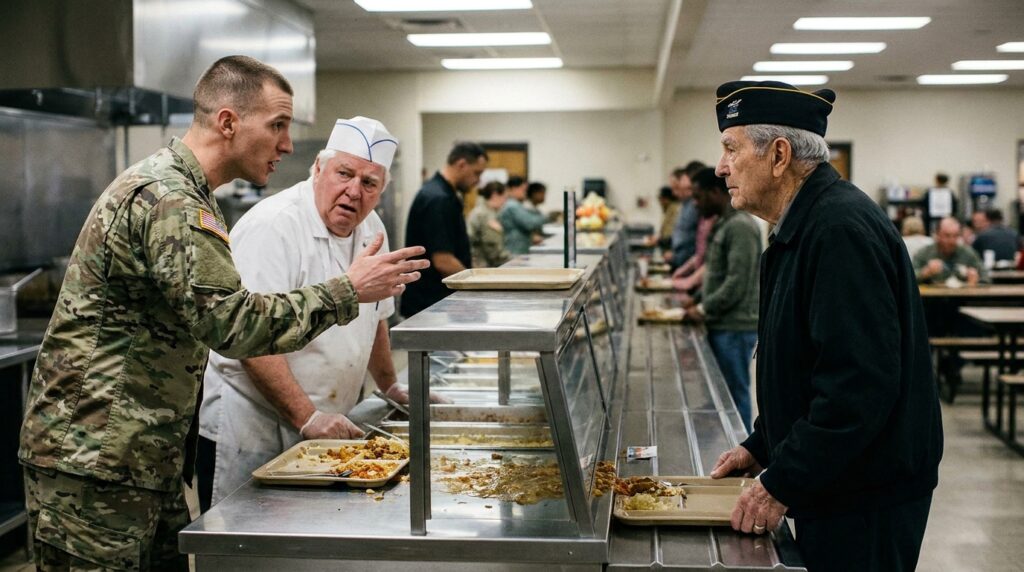
The Weight of Old Iron and Fading Ribbons across a Broken Country Coffee Line
CHAPTER 1: THE TACTICAL SURFACE
“Move aside and stop causing problems,” Miller said, his voice dropping an octave into the dry, flat rasp he usually saved for insubordinate privates during policing details.
The stainless-steel steam table between them radiated a wet, institutional heat that smelled of overcooked cabbage and cheap industrial soap. The stocky cafeteria worker in the white cook shirt didn’t move fast enough. He was seventy-one, maybe seventy-two, his knuckles swollen with arthritis as they locked around the edges of a plastic serving tray. A smear of instant mashed potatoes had already dried on his white apron, a dull crust over the fabric.
“Son,” the old man started, his voice thin, whistling slightly through a gap in his rear teeth. “The line holds here. We’re waiting on the next pan from the kitchen.”
Miller didn’t have time for the kitchen. His camouflage sleeves were rolled tight above his forearms, the green-and-tan digital pattern crisp, holding the stiff starch of a base laundry unit. Beneath the fabric, his pulse hammered against his wrists. His phone was heavy in his pocket, a three-day-old notification from his bank sitting on the locked screen like a small, cold weight. He hadn’t slept more than four hours a night since his unit returned to the state, and the slow, heavy movement of the civilian world felt like a deliberate insult, a soft slurry of people who didn’t understand the economy of a second.
He stepped forward, his boot heel coming down hard on the linoleum floor. With his left hand, he didn’t just push; he executed a precise, low-impact clearing sweep, his forearm catching the edge of the old man’s tray.
The plastic buckled. The tray tipped forward, sliding across the grease-slicked steel lip of the counter. A small bowl of canned peaches hit the edge first, shattering against the metal rim before dropping to the floor in a sticky, pale heap. The cook’s hat tilted, his stocky shoulders bunching as he stumbled back against the bread racks, his breath catching in a short, wet gasp that sounded like a tire losing air.
“I said move,” Miller barked, his fingers widening as he prepared to clear the next foot of counter space. “Some of us have places to be. Some of us actually work for a living.”
“You picked the wrong man to disrespect, son.”
The voice didn’t come from the cook. It came from Miller’s right, low and gravelly, carrying the flat cadence of the upper Midwest.
Before Miller could pivot his hips into a defensive stance, a hand closed around his left wrist. It wasn’t the soft, trembling grip of an old man; the fingers were thick, yellowed by tobacco at the nails, and they locked down onto the bone with the weight of a vice. Miller felt his balance shift instantly. His own momentum was used against him—a classic, economy-of-force leverage point taught in basic combatives but executed here with a greasy, casual fluidness that smelled of stale coffee and wool.
The floor came up fast. The linoleum was cold against his cheek, the smell of institutional pine cleaner filling his nose as his right shoulder hit the boards with a dull, hollow thud. His camouflage cap rolled into the spilled peaches.
Above him, the man in the dark jacket and the faded veteran cap stood perfectly upright. His gray hair stuck out in stiff wisps from beneath the bill of his cap, which bore the gold-embroidered lettering of a long-deactivated infantry division. The veteran didn’t look angry; his face was a map of dry wrinkles and pale liver spots, his mouth set in a thin, neutral line as he held Miller’s wrist pinned to the floor with a single, unyielding elbow lock.
“The uniform doesn’t buy you the line, specialist,” the old man said softly, his breath smelling faintly of peppermint.
Miller lay still, the heat rising into his ears as the distant chatter of the cafeteria died into a sharp, collective silence. Through the gap between the counter legs, he could see the cook’s orthopedic shoes, still dusted with white flour, trembling slightly near the broken bowl.
“I understand, sir,” Miller whispered, his teeth grinding against the salt on his own skin.
The grip on his wrist vanished. The old man stepped back into the line, his dark jacket rustling as he picked up his own clean tray, leaving Miller alone on the floor beside the grease.

CHAPTER 2: THE RECOGNITION TANK
The grease from the floor didn’t want to leave the skin. Miller dug his thumbs into the hollows beneath his jaw, forcing the institutional cold water from the basin up over his temples until his ears rang with the chill. The mirror above the porcelain sink was clouded with old silvering, mapping gray spiderwebs across his reflection. In the dim, flickering light of the cafeteria restroom, his camouflage uniform looked less like an armor and more like a rented suit that didn’t quite fit the breadth of his shoulders. His heart was still hammering a erratic, frantic rhythm against his ribs, a leftover tremor from the effortless leverage that had put him on his back.
He wrung out a paper towel, the rough, unbleached fiber tearing under the pressure of his fingers. The smell of cheap bleach and damp porcelain filled his throat, thick and suffocating. It was the same smell as the transit bays in Kuwait, the same gray neutrality of places designed to process men who were temporarily between crises. He had been back for three months, yet every room in this town felt like a holding cell where the air was too thin to breathe.
His hand shook slightly as he reached for his cap on the edge of the basin. As he lifted the damp fabric, his boot tapped against something solid beneath the curve of the porcelain pedestal.
It was a wallet, thick and dark with the grease of long handling, its edges frayed down to the gray structural threads. A strip of old olive-drab parachute cord was looped through the eyelet, severed cleanly at the end as if it had snapped away from a belt during a sudden movement. On the worn leather face, a hand-drawn infantry insignia—the crossed rifles of the 11th Regiment—was scratched into the hide, the lines faded into shallow, gray scars.
Miller picked it up, the leather cold and slightly damp against his palm. His thumb traced the scratched rifles. He knew that insignia; it was the old style, the one his own battalion commander kept framed behind glass in the headquarters building three hundred miles away.
He didn’t open it immediately. He stood by the small window where the afternoon sun cut through the frosted pane, casting a pale, desaturated yellow block across his knuckles. The silence from the cafeteria outside was heavy, broken only by the rhythmic clink of silverware being sorted into plastic bins. He felt like a thief, but the weight of the vice-like grip on his wrist was still a fresh ache in his bones. He needed to know what kind of old man kept that kind of iron in his fingers.
When he pulled the leather billfold open, there were no credit cards, no driver’s license, no bright plastic markers of modern life. There was only a folded square of standard-issue military paper, the blue ink of the official stamp faded to a ghostly, water-damaged purple.
Miller unfolded it with the caution of a man handling unexploded ordnance. His eyes skipped the standard bureaucratic headers, landing directly on the bold line near the center: General Court-Martial Order No. 412.
The name was there—Thomas J. Vance. Sergeant First Class. But it was the language below that made the air freeze in Miller’s chest. Dishonorable discharge. Forfeiture of all pay and allowances. Failure to engage. The words were flat, clinical, and total. According to the document, the old man who had just stood over him with the absolute authority of a pristine lineage was legally a ghost, stripped of his honors forty years ago for leaving his post during a midnight sweep in the central highlands.
“You shouldn’t be looking at that, specialist.”
The voice came from the doorway, dry as old pine.
Miller didn’t jump. His training took over, his shoulders locking into a rigid presentation as he turned, his thumb automatically folding the paper back into the leather billfold. The elderly veteran stood in the frame of the door, his dark jacket unzipped now, revealing a faded flannel shirt that looked too large for his frame. Without the cap, his white hair was thin, plastered down by sweat in parallel lines against his skull. He looked smaller now, the formidable shadow he had cast in the serving line dissolving under the harsh, buzzing fluorescent tubes of the restroom.
“It fell under the sink,” Miller said, his voice tightening as he held the wallet out. He didn’t offer an apology this time; the document in his hand had shifted the ground beneath them. “Sir.”
Vance stepped into the room, his boots making no sound on the wet linoleum. He didn’t reach for the wallet immediately. Instead, he leaned his weight against the second sink, his eyes resting on the faded blue ink showing through the thin paper.
“A man who stays in the service as long as you have should know how to mind his sector,” Vance said softly. There was no anger in his face, only a vast, desaturated exhaustion that seemed to come from the marrow of his bones. “That paper doesn’t belong to the unit anymore. It belongs to the state.”
“This says you walked,” Miller said, the words slipping out before his discipline could catch them. He felt a strange, defensive heat rising in his throat—a rejection of the idea that the only man who had shown real authority in this town was a fraud. “My colonel… he wears the same patch. He talks about the 11th like they were gods.”
Vance let out a short, dry sound that might have been a laugh if his mouth hadn’t remained so flat. He reached out, his thick, tobacco-stained fingers closing over the leather, pulling it gently from Miller’s grip.
“Your colonel was a lieutenant when that paper was signed,” Vance said, his voice dropping into a whisper that seemed to absorb the ambient hum of the lights. He tucked the wallet into his internal jacket pocket, his hand lingering over his heart for a second before dropping away. “And some men are better at keeping their uniforms clean than others.”
Before Miller could process the statement, the restroom door creaked open again. The stocky cafeteria worker stood there, holding a mop bucket that smelled heavily of ammonia. He looked between the two men, his eyes lingering on Miller’s uniform with a look that wasn’t fear, but a deep, unreadable pity.
“Tom,” the cook said quietly, his hand resting on the wooden handle of the mop. “The manager’s calling the base. They’re asking about the boy.”
Vance didn’t look back at the cook. He kept his eyes locked on Miller, his gaze heavy with a secret that felt older than the uniform itself. “Tell them he was just leaving,” Vance said. “He’s got a long way to walk.”
CHAPTER 3: THE GUARDED VULNERABILITY
The gravel path along the edge of the municipal park didn’t crunch so much as it ground under Miller’s boots, a dry, rhythmic scraping that felt loud enough to wake the dead. He had followed the old man at a parallel interval of fifty paces, keeping his eyes locked onto the dark wool jacket as it drifted through the desaturated gray-green map of the afternoon. The town was small enough that the base felt like a permanent low-lying cloud on the northern horizon, its perimeter lights just beginning to blink awake against the twilight.
Vance didn’t look back. He walked with an uneven, swinging stride, his right heel dragging slightly across the dirt, leaving a faint, continuous track in the damp silt. When he reached the green iron bench near the overgrown duck pond, he didn’t sit immediately. He turned his face toward the water, his profile sharp and sunken against the gray wash of the sky, before lowering himself with a stiff, brittle deliberation that made the metal frame groan.
Miller stopped ten feet away. His hands were tucked deep into his pockets, his fingers curled around the rough fabric of his trousers. The anger that had sustained him in the cafeteria had cooled into something far more dangerous—a cold, dense curiosity that felt like an unexploded shell in his gut.
“The military police didn’t show,” Miller said, his voice flat, cutting through the damp stillness of the pond.
Vance pulled a vintage brass Zippo from his jacket pocket. The hinge had a distinct hairline fracture running down the spine, a silver line of stress through the gold metal. He flicked the wheel with a thick, calloused thumb, but the flint only spit a dead shower of sparks into the dark. He didn’t try a second time. He just held the cold lighter in his palm, his fingers tracing the split bone of the brass casing.
“They don’t come into this county unless a vehicle goes missing from the motor pool,” Vance said without looking up. His voice was a slow, heavy drone that seemed to vibrate in the iron of the bench. “Or if someone complains about a soldier breaking up a municipal line. The cook didn’t complain.”
Miller took two steps forward, his shadow falling across the old man’s boots. “He didn’t complain because he knows what’s in your pocket. He knows you’re carrying a lie.”
Vance’s hand stopped moving over the brass. The silence between them stretched, thick with the smell of wet earth, rotting reeds, and the sharp, metallic tang of zinc from the old culvert nearby. A single mallard cut a clean, silver V through the black water of the pond, the movement perfectly silent.
“You think you understand the architecture of a fault line because you’ve seen the rubble, son,” Vance said softly. He turned the Zippo over, pointing the fractured spine toward Miller’s chest. “You looked at that paper in the washroom and you thought you found an anchor. You thought, here is a coward, so I don’t have to feel like a dog for hitting a cook.”
“I don’t think you’re a coward,” Miller said, the words slipping out with a raw, unvarnished heat that surprised him. He sat down on the far end of the bench, the iron cold against his thighs, forcing him to feel the rigid geometry of the space between them. “Cowards don’t drop an active-duty infantryman with a textbook sweep. And they don’t stay in the same town where their shame is printed on official stationery.”
Vance let out a dry, whistling breath. He placed the lighter down on the green slat between them. In the dimming light, the fracture in the brass looked deeper, an open mouth. “The battalion commander you have right now… Colonel Vance. He doesn’t like to talk about the old valleys, does he?”
Miller frowned, his eyes dropping to the Zippo. “The colonel’s name is Vance. I thought… I thought it was just a coincidence. This is a small state.”
“It’s not a coincidence,” the old man whispered. He reached up, his thumb hooking into the collar of his shirt, pulling it back just enough to reveal a pale, puckered knot of scar tissue high on his shoulder blade, the texture like melted candle wax against his gray skin. “A midnight sweep in the central highlands doesn’t leave many survivors if the lieutenant forgets to check his rear guard. If the lieutenant is twenty-two years old, terrified, and the son of a three-star general who can’t afford a blemish on the family ledger.”
The realization hit Miller like a physical blow, a sudden shifting of the weight in his chest. His mind rushed back to the pristine headquarters building, the framed medals, the severe, unyielding posture of his commanding officer who regularly lectured the men on the absolute purity of the chain of command.
“You took the fall,” Miller said, his voice dropping into the desaturated dark. “For your own son?”
Vance didn’t answer with words. He merely closed his fingers over the fractured Zippo, his grip tightening until his knuckles turned the color of old salt. He stood up, his joints popping like dry twigs in the quiet of the park, and looked down at Miller with a expression that was entirely devoid of hope or resentment.
“The uniform doesn’t just hold the man, specialist,” Vance said, his voice cracking slightly as he turned back toward the gravel path. “Sometimes it holds the dust of the people he had to bury to keep it clean. Go back to your barracks.”
Miller stayed on the iron bench as the dark wool jacket dissolved into the shadows of the willow trees. When he looked down at the green slat where the lighter had been, he noticed a tiny, white scrap of paper tucked into the iron weave—a page torn from a ledger, containing a list of seven names written in a neat, vintage cursive, each one crossed out with a single, heavy stroke of blue ink. The last name on the list, uncrossed, was his own battalion commander’s.
CHAPTER 4: THE GENERATIONAL BRIDGE
The cafeteria smelled different when the steam tables were dead. Without the wet, heavy fog of boiling water and overcooked starch, the space expanded into a hollow cavern of desaturated tile and cold stainless steel. The overhead fluorescent tubes had been switched off, leaving only the amber security lights by the emergency exits to cast long, skeletal shadows across the stacked chairs.
Miller pushed the heavy glass door open, the rubber seal giving a soft, breathy sigh against the frame. He had walked three miles from the park, the small scrap of ledger paper tucked into his palm like a splinter he couldn’t dig out. His camouflage coat felt stiff, holding the chill of the evening air within its nylon weave.
Near the back counter, a single yellow bulb illuminated the wash area. The stocky cook stood beside the massive galvanized sink, his white chef hat gone, revealing a bald scalp mapped with thin, purple veins. He was using a long wire brush to scrape the blackened residue from the bottom of an industrial baking pan. The sound was a rhythmic, harsh rasp—shrrk, shrrk, shrrk—that seemed to anchor the entire room to the reality of physical labor.
Miller stopped at the edge of the line, his fingers resting on the cold steel tray guide where he had initiated the chaos hours earlier. The shattered bowl of peaches was gone, the floor bleached so thoroughly that a pale, clean circle remained amidst the yellowed wax.
The cook didn’t stop brushing. “We closed at seven, son,” he said, his voice flat, not looking up from the zinc sink. “The manager went home. It’s just me.”
“I came back to say I’m sorry,” Miller said. The words felt heavy, unpracticed, like a foreign language he was trying to speak through a broken jaw. He unbuttoned his coat, exposing the blank green undershirt beneath. “For the tray. For the rest of it.”
The wire brush stopped. The old man leaned his weight against the rim of the sink, his thick forearms wet with gray, soapy foam. He turned his head slowly, his eyes tracking Miller from his polished boots up to the dark hair that was still damp from the restroom basin.
“You didn’t come back for the tray,” the cook said softly, wiping his knuckles on a rough dish towel that had worn down to the structural threads. “You met Tom in the park.”
Miller reached into his pocket and placed the small scrap of ledger paper on the counter between them. The amber light caught the cursive ink, making the crossed-out names look like old cuts on a tree. “He left this on the bench. My colonel… the man who signs my passes, the man who tells us what honor looks like… his name is at the bottom.”
The cook stepped out from behind the sink, his orthopedic shoes clicking softly on the clean linoleum. He didn’t look at the paper; he looked at Miller’s face, tracing the sharp lines of tension that still twitched near the young soldier’s eyes. “Tom was his platoon sergeant. Forty years ago. The colonel was just a boy then, three weeks out of the Academy, trying to read a map in a dark ditch while the mortars were coming in from the ridge.”
“Vance told me he walked,” Miller whispered, his voice catching on the iron tang of the air. “The papers in the washroom said cowardice.”
“The papers say what the general’s office needed them to say to keep that boy from a prison cell,” the cook said, his voice dropping into a low, gravelly register that sounded exactly like the veteran’s. He reached out, his swollen, arthritic thumb touching the edge of the steel counter. “Tom had a family back here. A wife who was sick, a house with a mortgage that was already sliding. The general made a call. One man goes to the stockade and loses his name; the other gets a star on his shoulder and a career that can support an old sergeant’s family from the shadows for forty years. That’s why Tom works the line here. That’s why I work it with him. The money that pays for this food doesn’t come from the county, specialist.”
Miller felt the room tilt slightly, the rigid certainty of his military world fracturing along lines he couldn’t see. The institutional order he had clung to so desperately—the hierarchy that he thought gave him the right to push past old men—was built on a foundation of quiet, unrecorded trades made in the dark.
“Why didn’t he tell anyone?” Miller asked, his hands tightening into fists. “Why carry the stain?”
“Because a contract is a contract, son,” the cook said, his face softening as he looked at the younger man’s uniform. “And sometimes, protecting the uniform means you have to let people think you dirtied it. Tom didn’t drop you today to show off. He dropped you because you were starting to look like the boy he saved forty years ago—someone who thought the rank made him a god.”
The old man reached down, took the ledger scrap from the counter, and dropped it into the wet foam of the sink. The blue ink began to bleed instantly, turning the gray water into a pale, swirling cloud before vanishing down the drain.
“Go back to your station, specialist,” the cook said, turning back to his baking pans. “Your colonel is waiting for his report. And Tom’s got a long shift tomorrow.”
Miller stood in the silence for a moment longer, the cold iron of the cafeteria no longer feeling like an insult, but a weight he was finally learning how to carry. He turned, his boots silent on the clean floor, and walked out into the present-day night.
CHAPTER 5: THE LEDGER FAULT
The morning assembly at the motor pool smelled of unwashed canvas and cold diesel exhaust, a thick, gray film that seemed to coat the tongue before a man could even speak. Miller stood at the tail end of third platoon’s line, his fingers locked behind his back, his boots gripping the cracked asphalt where the oil leaks had dried into slick, black scabs. The sun hadn’t cleared the tree line yet, leaving the base in a desaturated blue shadow that made the parked five-ton trucks look like sleeping iron beasts.
“Specialist Miller.”
The voice didn’t come from his squad leader. It came from the company clerk, a pale staff sergeant named Harris who carried a clipboard like a shield against his chest. He didn’t look at Miller; his eyes were fixed on the white processing slip attached to the aluminum tray.
“Report to the battalion commander’s office. Full utility uniform. Clear your sector now.”
The platoon didn’t turn their heads—the discipline was too old for that—but Miller felt the subtle shifting of the shoulders around him, the quiet withdrawal of men who knew when a name had been marked for deletion. He didn’t answer. He simply stepped out of the formation, his boot heels hitting the gravel with the same dull, rhythmic scraping that had followed him through the park the night before.
The battalion headquarters building was a long, low block of cinder sheets and green paint that had blistered under twenty summers of sun. Inside, the floor was covered in a dull brown linoleum that smelled heavily of commercial wax and stale tobacco. As Miller reached the colonel’s door, the silence from the inner office was heavy, broken only by the dry, electric hum of a desktop fan turning its blades against the stale air.
Colonel Vance sat behind a metal desk that was perfectly clear except for a green plastic blotter and a single, unzipped leather folder. He looked exactly like the portrait in the civilian cafeteria—his shoulders were wide, his short gray hair cut to the skin at the temples, his uniform carrying the sharp, crisp creases of a man who spent his life inside an institution. But as Miller stepped onto the small rubber mat before the desk and brought his hand to his brow, he noticed the colonel’s fingers were trembling slightly where they rested on the green plastic.
“Sir,” Miller said, his voice flat, his eyes fixed on the white wall six inches above the colonel’s head.
The colonel didn’t look up immediately. He reached into the leather folder and pulled out a vintage set of brass lieutenant bars. They were old, the yellow metal scratched and pitted by time, but on the back of the small pins, a clumsy lump of silver solder showed where someone had repaired the fastenings by hand decades ago.
“The manager of the community center called the provost marshal last night, Miller,” the colonel said. His voice was a dry, controlled rasp that sounded less like authority and more like a machine running out of oil. “He said an active-duty specialist was causing a public disturbance in the serving line. Shoving a civil servant. Spilling food.”
“Yes, sir,” Miller said, his jaw tightening as the memory of the cold floor and the peppermint breath rushed back into his throat.
The colonel placed the brass bars down on the desk with a tiny, metallic clink that sounded incredibly loud in the small room. “The provost marshal wanted to issue an Article 15. A reduction in rank. Forfeiture of half your pay.” He paused, his thumb tracing the soldered silver on the pins. “But Sergeant First Class Vance called my personal quarters at midnight. He said you were just helping an old man with a heavy tray.”
Miller’s eyes dropped from the wall, locking onto the colonel’s face. The skin beneath the older man’s eyes was yellowed with exhaustion, the fine lines around his mouth twitching with a hidden pressure that had nothing to do with a civilian altercation.
“He told me you found his wallet, Miller,” the colonel whispered, his voice dropping so low that the desktop fan almost drowned it out. “He told me you returned the papers.”
The silence that followed was different from the silence of the cafeteria. It was the silence of two men standing on opposite sides of a fault line, both of them holding the same piece of rusted truth. Miller looked at the old lieutenant bars on the desk and realized they were the same ones listed under the names on the wet ledger scrap—the ones that had been paid for by forty years of an old man’s silence.
“I returned the property, sir,” Miller said quietly, his gaze returning to the blank wall. “Everything was intact.”
The colonel closed his hand over the brass bars, his knuckles turning white against the green blotter. “There’s an administrative detail at the logistics warehouse this afternoon,” he said, his voice tightening back into the formal cadence of command. “A file verification. You’re assigned to it until further notice. You will report directly to me with the results. Dismissed.”
As Miller saluted and turned toward the door, he noticed a gray cardboard filing box sitting by the colonel’s boots, its lid secured with three layers of faded green rigging tape. Scribbled across the side in blue ink was a single date from forty years ago, the numbers scratched deep into the cardboard like an old scar.
CHAPTER 6: THE DEPOT MANIFEST
The glass doors of the battalion headquarters didn’t slam; they rattled in their frames, a hollow, tinny sound that vibrated down the brick stairs as Miller stepped back into the blue morning shadow. He didn’t look at the motor pool where his squad was still grease-deep in the undercarriages of the five-tons. The cardboard box by the colonel’s boots remained an imprint on his retinas, its green rigging tape like a set of three stitches keeping a wound closed.
He found the logistics warehouse on the southern perimeter, tucked behind the rusted chain-link fence of the salvage yard where the discarded skeletons of old field kitchens lay sinking into the weeds. The building was a massive corrugated iron hangar that smelled intensely of industrial rust preventative, damp wood, and mildewed manifests. A single row of low-wattage bulbs hung from the high rafters, casting a yellow, desaturated glare across miles of stacked wooden pallets and military-grade storage crates.
Miller’s utility uniform felt stiff as he walked the narrow corridors of the depot. His boots kicked up small, gray plumes of concrete dust that settled over the rusted bands of the older crates. He was alone here; the base had largely forgotten this sector, leaving it to serve as a graveyard for the hardware of forgotten campaigns.
He found the file storage area tucked behind a wall of unserviceable truck axles. It was a wire-mesh cage locked with a heavy brass padlock that had turned completely green with oxidation. Beside the gate sat three gray cardboard boxes identical to the one in Colonel Vance’s office, their edges soft and gray from decades of moisture.
Miller drew his pocketknife, the blade snapping open with a dry, clean click that bounced off the corrugated iron walls. He slipped the steel beneath the layers of brittle green rigging tape on the first box, slicing through the fabric fibers until the cardboard lid popped loose with a short puff of dead, stagnant air.
Inside, the folders weren’t green; they were the faded, yellowed manila of the late twentieth century, their tabs marked with typed numbers that had bled into the paper pulp. He pulled the first stack out, the pages fragile and thin, crackling under his fingers like dry leaves.
It wasn’t a tactical log. It was a series of logistics manifests from the 11th Infantry Battalion’s supply depot, dating back forty years.
Miller leaned against a rusted parts crate, his thumb tracking down the long columns of numbers. He didn’t look for names; he looked for the anomalies. His time in the supply room had taught him how to read the language of discrepancies—the small, ink-penned corrections that officers made when the physical count didn’t match the digital world.
Ten paragraphs down on the third sheet, the pattern broke. A shipment of replacement parts for the battalion’s armored personnel carriers had been marked as Destroyed by Hostile Fire near an outpost called Landing Zone Falcon. But beneath the official stamp, a different ink—a dark, faded blue that matched the signature on Thomas Vance’s court-martial paper—had crossed out the entry. In the margin, a handwritten note read: Transferred to Private Account, Sector 4.
Miller flipped to the next page, his breath catching in his throat. Every sheet followed the same architecture. Millions of dollars in material, vehicles, and tactical gear had vanished from the battalion’s books during the exact months of the midnight sweep in the highlands. It hadn’t been destroyed by the enemy; it had been written off, cleared from the books by a twenty-two-year-old lieutenant whose father was a three-star general with the power to approve the losses without an inquiry.
The physical decoy secret was right there in the ledger—a massive, decades-old logistics fraud that had enriched the Vance family line before the colonel had even earned his first ribbon. It explained the money. It explained why the old cook had said the county didn’t pay for the cafeteria’s food. The current colonel wasn’t just hiding his father’s tactical cowardice; he was managing the legacy of a corporate theft masked by the smoke of a combat zone.
A footstep scraped against the concrete behind him.
Miller didn’t turn around fast. He kept his eyes locked on the faded ink of the manifest, his fingers smoothing down the fragile edge of the paper as the shadow fell across his shoulder.
“You have an efficient eye, Miller,” Colonel Vance said.
The colonel was standing at the entrance of the wire cage, his utility cap held in his hand, his forehead slick with a cold sweat that caught the yellow light of the rafters. He wasn’t wearing his tactical vest or his ribbons; in the raw, desaturated gloom of the warehouse, he looked like a man who had been stripped down to his bare skin. Behind him, the hangar doors were shut, the heavy iron bolt thrown from the inside.
“This isn’t about a lieutenant losing his nerve, sir,” Miller said, his voice low, matching the heavy, dead atmosphere of the depot. He turned the folder around, the handwritten blue ink facing the officer. “The court-martial was a cover for the depot. Your father didn’t just run from the ridge. He sold the ridge before the mortars even started.”
The colonel looked at the yellowed paper, his mouth setting into that familiar, thin line of institutional defense. But his eyes weren’t on the columns of numbers; they were fixed on the small set of old lieutenant bars that he had tucked into his own breast pocket, the silver solder showing through the thin fabric like a small, malformed bone.
“My father died three years ago, specialist,” the colonel said, his voice dropping into a hollow whisper that didn’t carry past the wire mesh. “And the accounts he opened forty years ago are still paying the medical bills for every survivor of that battalion who currently lives within fifty miles of this base. Including Thomas Vance. Including the man who cleans the floors in that cafeteria.”
Miller stood still, the yellow folder heavy in his hands. The decoy secret had been cracked open, but the ultimate reality remained locked behind the colonel’s gray eyes—a systemic circle of dependency where the shame of the past was the only thing keeping the present from collapsing into poverty.
“The provost marshal is waiting outside the main gate, Miller,” the colonel said, reaching into his pocket for his car keys, his fingers slipping against the cold iron of the ring. “They’re not here for an Article 15. They’re here because a box of classified logistics manifests was reported missing from the command suite this morning. You have five seconds to decide which name you’re going to cross out next.”
CHAPTER 7: THE KINTSUGI COVENANT
The rattle of the iron gate sounded like a dry bone snapping in the cold expanse of the hangar. Outside, the low, gray hum of a military police cruiser’s diesel engine vibrated against the corrugated walls, a steady, persistent pulse that seemed to measure out the remaining seconds left in the room.
Colonel Vance didn’t reach for the yellow folder in Miller’s hands. He simply stood by the rusted rack of truck axles, his fingers lightly brushing against a grease-smeared stencil marked US ARMY salvage. His shoulder lines were slightly dropped, the rigid posture of command entirely gone, leaving only an aging man who looked as though he had been carrying a collapsing wall on his back for half a century.
“The numbers aren’t lies, Miller,” the colonel said, his voice dropping into an unhurried whisper that seemed to drift like dust through the yellow light. “They’re just the price of a quiet town. My father paid it with his honor, and I’ve spent twenty-six years signing the vouchers to ensure the checks never stopped clearing for the men who left their limbs in that valley.”
Miller looked down at the fragile, yellowed pages. In the dull amber glow of the rafters, the handwritten entries—the crossed-out gear, the reassigned funds—looked like the messy, unglamorous stitching of an old wound. This wasn’t a grand conspiracy born of greed; it was a desperate, permanent patch designed to mend a broken circle of veterans whom the system had otherwise prepared to discard. The young soldier felt his own thumbs pressing against the fragile edges of the manila folder, the texture rough and gray against his skin.
“They’re going to search this depot, sir,” Miller said, his eyes tracking the long, parallel lines of concrete dust toward the main entrance. “If the provost marshal sees these manifests, the ledger won’t survive the afternoon.”
The colonel let out a short, dry breath that sounded like old paper turning. “The provost marshal answers to the brigade commander, and the brigade commander was a captain under my father. The records will stay clean if the man who found them understands the nature of the unit.” He stepped closer, his boots making no sound on the oil-stained concrete. “I didn’t send you here to punish you, specialist. I sent you here because Thomas Vance told me you were the first person in three years who looked at that line and saw something worth protecting.”
Miller looked from the colonel’s face to the tiny set of old lieutenant bars lying on the rusted crate. The silver solder on the back pins was clumsy, an ugly, grey lump that held the yellow brass together after it had snapped under pressure. It was exactly like the old veteran’s vice-like grip on his wrist, or the cook’s quiet, methodical scraping of the grease-stained pans. It was the unglamorous, hidden work that kept a fractured world from splintering completely.
He thought of his phone, still sitting cold and dark in his pocket with its three-day-old notification from the bank. He thought of his own unexamined rage, the volatile entitlement that had made him push past a seventy-year-old worker just because the world wasn’t moving at the speed of a tactical deployment. The rage was gone now, replaced by a quiet, heavy understanding of the burden these older men had been carrying while the rest of the country slept.
Slowly, without breaking eye contact with the officer, Miller closed the yellow folder. He didn’t drop it into the gray cardboard box. Instead, he lifted the lid of an unserviceable grease bucket nearby, its interior coated with thick, black lithium lubricant that smelled intensely of petroleum and old iron, and slid the yellowed manifests deep beneath the dark sludge until the paper was completely buried.
“There’s nothing in this sector but salvage, sir,” Miller said, his voice flat, adopting the neutral, unyielding cadence of an official report. He wiped his oil-stained fingers on a piece of clean burlap from a nearby pallet, the rough fibers scraping against his skin like a dry wire brush. “The inventory is verified. The ledger balances.”
The colonel looked at the grease bucket for a long moment, then slowly reached down and picked up his utility cap from the rusted crate. His hand was no longer shaking. He tucked the old lieutenant bars back into his breast pocket, smoothing down the camouflage fabric until the outline vanished completely.
“Report back to your platoon for the afternoon detail, specialist,” the colonel said, turning toward the heavy bolt of the hangar doors. “And tell your squad leader you’re assigned to the community relations detail at the municipal center this weekend. They need someone who knows how to handle the heavy trays.”
The iron bolt gave a long, scraping shriek as the colonel threw it back, allowing the harsh, unvarnished daylight of the base to rush across the concrete floor. Miller stood in the fading yellow light of the wire cage, his shadow stretching out long and straight behind him as the external hum of the engines died away into the routine noise of the morning.







