
The Weight of Dust and Iron: A Soldier’s Last Stand for a Dying American Heartland

CHAPTER 1: THE CRACKED PAVEMENT

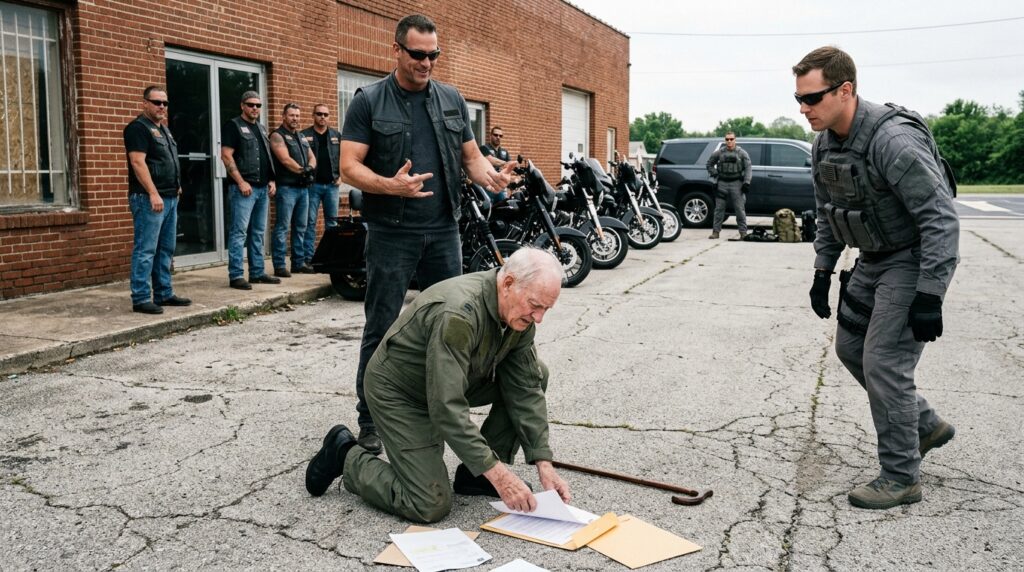
“Pick them up,” Miller spit, his voice scraping like gravel under a boot. He didn’t yell. In a town this quiet, a low voice carried all the weight it needed.

The tan envelope had split clean down its frayed seam. White sheets of thirty-pound bond paper—stamped with faded purple institutional markers from 1974—scattered across the heat-buckled asphalt. The wind from the passing logging trucks didn’t catch them; they simply lay there, heavy with decades of damp basement storage, settling into the oil-stained crevices of Elm Street.

The veteran did not look up. His thumb, calloused and mapped with thin white scars, pressed hard against the rusted brass zipper slide of his olive-green flight suit. The metal was hot from the midday sun. He lowered himself with a slow, deliberate crunch of his left knee, the fabric of the suit tightening across his narrow shoulders. His joints didn’t pop; they simply resisted, a silent friction that he managed through decades of practiced discipline.

“I said crawl for them, old man. Clean up your mess.”

Miller’s heavy engineer boots stayed exactly two inches from the edge of the nearest document. The leather was thick, coated in a fine layer of gray limestone dust from the southern county roads. Behind him, five men stood in a loose semicircle against the red brick facade of the storefront. None of them moved. They didn’t pass a cigarette; they didn’t shift their weight. They were iron fixtures against the masonry, their shadows stretching long and sharp across the cracked curb.

The veteran reached out. His fingers found the split wooden grain of his cane first. It had rolled into a shallow pothole where the asphalt had crumbled back into raw clay. He didn’t pull it toward himself yet. He used it as an anchor, a lever to stabilize the weight of his torso as his other hand gathered the scattered sheets. His lined face remained turned toward the gravel, his eyes tracking the alphanumeric sequences on the top page: Project 73-Delta, Soil Composition and Sub-Surface Substrate Analysis.

“No one owes you respect out here,” Miller muttered, leaning down just enough so his breath smelled of stale black coffee and cold grease. “The uniform doesn’t work down here anymore. The state forgot the ledger you’re holding.”

The old man remained silent. He knew the transit times. He knew the distance from the regional airfield was exactly fourteen miles over secondary roads, or six minutes by air if they cleared the ridge line behind the old foundry. His chest rose and fell in a flat, unhurried rhythm. He had lived through ninety-six hours of continuous artillery saturation in the valley; a mid-forties regional enforcer with a local corporate check in his pocket didn’t alter the clock.

Then the air changed.

It wasn’t a sound at first. It was a drop in barometric pressure that rattled the loose corrugated tin on the storefront’s awning. A low, rhythmic thrumming vibrated through the rubber soles of Miller’s boots before it hit the ear. The five men against the wall shifted simultaneously, their heads turning toward the southern horizon where the sun was cutting through the smog.

A dull gray silhouette cleared the water tower. The twin rotors of the CH-47 didn’t tilt for a standard approach; they flared hard, the nose pitching upward as the pilot used the heavy air above the asphalt to scrub eighty knots of forward velocity in three seconds.

The world went white with dust. The loose gravel on Elm Street turned into lethal micro-shrapnel, pinging against the brickwork and the steel frames of the parked motorcycles. The line of bikers broke, arms rising to shield eyes from the sudden, deafening downwash that smelled of burnt kerosene and hydraulic fluid.

The machine settled into the middle of the two-lane road, its landing gear compressing with a heavy hiss of compressed air. Before the rotors could begin their flat pitch spin-down, the side hatch slid back.

A man in a desaturated gray utility uniform dropped into the grit. He didn’t look at Miller. He didn’t draw the sidearm strapped to his chest rig. He walked with a flat, rapid stride through the swirling paper and dust, his combat boots cutting through the dynamic shadow of the blades.

He stopped directly over the old man.

The officer was young—late thirties—with the hard, clean jawline of someone who still believed the seals on his shoulders meant something. He knelt, his knee driving directly into the dirt beside the old man’s flight suit. With a smooth, functional motion, he gripped the fallen wooden cane, lifted it from the asphalt, and pressed the worn handle into the veteran’s left palm.

“Sir,” the officer said, his voice cutting clearly through the dying whine of the turbines. “The transport is turning over. We need to move before the local intercept registers on the state network.”

The veteran closed his fingers around the wood. He used the officer’s shoulder as a brace, pulling himself upright until his spine clicked into a rigid vertical line. He didn’t look back at Miller, who was wiping a line of red clay dust from his forehead, his jaw clenched as two more gray-uniformed figures stepped out of the chopper’s shadow with their carbines held at low-ready.

The old man slid the torn tan envelope under his arm, his thumb resting once more on the rusted zipper slide. As they moved toward the open cargo ramp, a single sheet of paper remained stuck to the greasy tire of a motorcycle behind them—and on it, the signature approving the original land burial was written in his own family’s ink.


CHAPTER 2: THE BULKHEAD DISCREPANCY

The vibration didn’t just rattle the teeth; it worked its way into the bone marrow, a relentless, mechanical grinding that smelled of burnt hydraulic fluid and old iron. Inside the belly of the CH-47, the air was a pressurized soup of kerosene fumes and high-altitude chill. The veteran sat straight on the red webbing of the troop seat, his spine locked against the aluminum frame. His old olive-green flight suit felt thin against the draft cutting through the seals of the upper cargo door.

He kept his hands flat on the top of his wooden cane. The wood was cold, holding the dampness of the Elm Street asphalt. Across from him, three members of the tactical team sat in matching desaturated gray uniforms, their helmets locked into the overhead communication lines. They looked like statues molded from industrial polymer, their faces hidden behind dark ballistic visors that reflected nothing but the dim red tactical lighting of the cabin.

The young officer who had handed him his cane—the one whose name tag read Vance—leaned forward, his boots vibrating against the tread-plate floor. He didn’t plug his headset into the veteran’s console. He spoke directly into the old man’s ear, his voice competing with the rhythmic thrum-thrum-thrum of the massive rotor blades overhead.

“We’re six minutes out from the primary staging area, sir,” Vance said. His breath was clean, free of the tobacco and grease that defined the men outside the storefront. “We’ll secure the documents in a classified regional vault before the corporate legal injunction hits the state wire. You’re out of the gray zone now.”

The veteran didn’t nod. His thumb drifted downward, finding the rusted brass zipper slide at his chest, running over the rough, pitted metal teeth. He turned his head slightly, his eyes tracking past Vance’s shoulder to the structural ribbing of the fuselage.

In every standard military transport he had flown during his active years, the manufacturer’s data plate was riveted directly into the bulkhead adjacent to the main starboard doorway—a rectangular plate of stamped steel listing the contract number, the depot delivery date, and the federal property code.

The plate on this bird was gone.

There were only four clean, silver circles where the rivets had been drilled out, the exposed aluminum beneath the gray paint showing no signs of corrosion or dust. It was a fresh extraction. The metal around the wound was scratched, scored by a hurried cold-chisel.

The veteran’s gaze shifted down to Vance’s chest rig. The nylon was military-spec, heavy weave, colored in the exact desaturated slate-gray of an urban intervention unit. But the weave was too tight, the stitching along the load-bearing seams executed with a triple-box pattern that he hadn’t seen in a government procurement catalog since the late nineties. It was private contracting work. It was the kind of heavy-duty, expensive reinforcing used by logistics firms operating out of offshore corporate enclaves.

“Where is the primary staging area, son?” the old man asked. His voice was a thin, dry rasp, but it held the flat cadence of an officer who expected a grid coordinate, not a generalization.

Vance didn’t blink behind the visor. “The old National Guard compound near the limestone quarry, sir. It’s been retrofitted for secure transport logistics.”

The veteran turned his attention back to the tan envelope in his lap. The torn edge exposed the corner of the 1974 documentation—the soil substrate maps that showed exactly where the old defense foundry had let the trichloroethylene leak into the deep clay strata. His fingers touched the paper. It was dry, brittle.

He thought about the town below them, hidden beneath the gray morning fog, where the wells were turning sour and the children in the eastern district were developing the same dry, hacking cough that had taken his own boy ten years ago.

His boy, Tommy, had been a heavy equipment operator for the county after his own discharge. He remembered the kid coming home with red mud on his work boots, smelling of industrial solvent, his face pale and his hands shaking so badly he couldn’t hold his coffee mug. Just clearing some old state storage pits, Dad, Tommy had told him, his eyes fixed on the kitchen floor. Just doing what the contract specifies.

The veteran’s hand tightened around the handle of his cane. The wood groaned slightly under the pressure. He reached into the side pocket of his flight suit, his fingers searching past a pair of old earplugs until they brushed against a heavy, rectangular object—a mechanical grease pencil he had carried since his logistics days.

He didn’t pull it out. He kept his hand hidden, his mind calculating the turn-radius of the aircraft as the pilot pitched the nose downward, entering a steep, tactical descent that made the hydraulic fluid in the overhead lines hiss with sudden, high-pressure stress.

Outside the small plexiglass porthole, the gray vertical cliffs of the limestone quarry began to rise through the mist like broken teeth. The engine noise changed, the turbines screaming as the reverse-thrust buckets deployed to scrub speed before the wheels hit the gravel.

“We’re down,” Vance announced, unbuckling his harness with a sharp, metallic click. He reached for the veteran’s arm, his grip firm, precise, and entirely devoid of heat. “Keep your head low, sir. The perimeter isn’t completely sanitized yet.”

The veteran let himself be guided toward the lowering cargo ramp, his boots touching the wet, white limestone gravel of the quarry floor. The air down here tasted of crushed stone and sulfur.

In the distance, past the spinning rotor blades, three blacked-out utility trucks were parked in a tight defensive box outside the rusted iron gates of the maintenance yard.

And on the side of the lead truck, partially covered by a magnetic gray panel that didn’t quite match the paint, was a stamped serial number that matched the chemical transport manifests inside his envelope—the same manifests his son had signed before the ground went bad.

CHAPTER 3: THE HIGHWAY AMBUSH

“Get him behind the line of the rear axle! Now!”

Vance didn’t look at the veteran when he shoved him. The officer’s palm was flat against the chest of the old olive-green flight suit, forcing the old man back into the deep shadow between the twin rear wheels of the parked utility truck. The rubber was hot, smelling of high-speed pavement wear and road grease.

The white limestone dust had barely settled from the helicopter’s departure before the chain-link gates at the upper lip of the quarry tore inward. A modified utility truck, its front bumper reinforced with a welded section of rusty I-beam, slammed through the iron posts. Behind it, three motorcycles cut through the gap, their rear tires throwing long, jagged plumes of white grit across the desaturated stone floor.

Miller’s crew hadn’t traveled by the state highway. They had used the old logging cuts behind the foundry, the paths only locals mapped.

A sharp, metallic pop echoed down the limestone walls—the distinct, flat crack of an unsuppressed rifle. The round didn’t strike wood; it hit the heavy steel quarter-panel of Vance’s lead truck with a violent ping, leaving a gray lead smudge across the dark finish.

“Establish the base-line sector!” Vance barked into his throat mic, his hand finally dropping to the gray composite handle of the carbine slung across his chest rig. He didn’t fire. He pivoted behind the engine block of the transport truck, his eyes tracking the dust trails. “We have non-state actors encroaching on a classified extraction point. Implement non-attributable deterrents.”

The veteran sat back against the massive rubber tire, his cane drawn close into his knees. His breath was shallow, his teeth clicking together against the bitter, chalky taste of the limestone air.

From his pocket, the unpatched tactical radio he had slipped from the cabin seat began to hum. It didn’t carry the encrypted, digital clicks of Vance’s squad. It was bleeding local citizen-band chatter, the frequency wide open and unmodulated.

“…told you the old man wouldn’t yield the logbooks,” a voice scraped through the small speaker, buried under static. It wasn’t Miller’s voice. It was thinner, older—the distinctive nasal drawl of the county records clerk who had worked out of the courthouse basement since 1980. “If those manifests hit the federal database, the whole eastern aquifer is dead property. The development corporation pulls the funding by midnight. Clear the lane.”

The veteran reached down, his fingers finding the corner of the tan envelope. The white sheets inside were bent now, stained with grease from his own palms. He pulled the top document out just enough to catch the dim light bouncing off the quarry wall.

Item 14: Sub-surface sealing verification. Below the technical column, a bold, sweeping signature in fading black ink read: T. Miller, County Logistics Sub-Contractor.

Tommy. His boy hadn’t just cleared the pits; he had signed the inspection sheets that swore the concrete caps were five feet thick. He had signed the sheets knowing the mix was lean, that the corporate entity had shorted the aggregate to save forty thousand dollars on the back-end ledger.

The veteran’s face hardened, the deep lines around his mouth tightening into gray crevices. He didn’t feel the sting of the gravel hitting his cheek as another round ricocheted off the limestone behind him. He felt the cold, heavy weight of an old debt that had finally come due at his doorstep.

Vance’s men were moving with mechanical precision, their slate-gray uniforms blending perfectly into the limestone background. They weren’t retreating; they were executing a textbook boxing maneuver, two men moving wide toward the rusted conveyor belts of the old stone crusher while Vance held the center line.

They didn’t call out targets. The only sound from their side was the dull, muffled thwip-thwip of their suppressed weapons.

One of the approaching motorcycles buckled, its front fork catching a low iron pipe hidden in the weeds. The rider went down in a long, sliding tangle of denim and rusted chrome, his body rolling into the shallow ditch where the runoff water collected in stagnant, red pools.

“Vance!” the veteran called out, his voice thin but steady against the noise of the skirmish.

The officer didn’t turn his head. “Stay down, sir. We’re containing the perimeter.”

“The truck with the I-beam,” the old man said, pointing his wooden cane toward the gate. “They aren’t trying to clear the vehicles. Look at the angle of the approach. They’re cutting off the secondary exit toward the county bridge. They don’t want the paperwork out of this basin any more than you do.”

Vance paused, his visor tilting toward the gate for a fraction of a second. The calculation was visible in the stiffening of his shoulders. He didn’t thank the old man; he simply shifted his weight, his carbine rising to lock onto the driver’s side glass of the reinforced truck.

Behind the tire, the veteran reached down and picked up a rusted iron bolt that had fallen from the old conveyor frame years ago. He used the sharp edge of the threads to scrape a clean mark into the limestone floor between his boots—a simple arrow pointing toward the old maintenance shed sixty yards away, where the old narrow-gauge rail lines ran deep into the cliffside.

He knew this quarry. He had hauled the original structural iron for the crusher back in ’68, before Vance or Miller had their first teeth. He knew that behind the rusted storage tanks lay a dry drainage tunnel that cut straight through the ridge line to the state highway.

The radio in his pocket crackled again, the voice from the courthouse basement splitting the static one last time. “Miller, the corporate office just updated the manifest verification. The veteran isn’t the only one with a copy. The gray suits with him have the original master logs in their vehicle console. Wipe the whole square. No survivors on either ledger.”

The veteran looked up at Vance’s back. The young officer was changing magazines, his fingers moving with flawless, automatic rhythm. He didn’t look like a rescuer anymore. He looked like an accountant with a rifle, sent to balance a ledger by removing every line item that carried a name.

CHAPTER 4: THE SHED AND THE COLD LEDGER

The narrow-gauge rail tracks were rusted down to pitted, orange spikes that caught the rubber tip of the veteran’s wooden cane. He moved by touch, his left hand tracing the cold, flaking corrugated iron of the maintenance shed’s outer wall. Behind him, the dull, suppressed thwip-thwip of Vance’s carbines began to merge with the louder, chaotic detonations of Miller’s crew returning fire with unsuppressed hunting rifles. The quarry basin was an acoustic trap, multiplying every gunshot into a rolling wave of iron echoes.

He slipped through a gap in the rotting timber door frame, the scent of ancient machine grease, damp sulfur, and disintegrating burlap sacks wrapping around him like a heavy blanket. His lungs burned, the limestone dust coating his throat in a dry, chalky skin.

He didn’t stop until his back hit the cold structural steel of an inactive diesel winch. His chest heaved against the zipper of his olive-green flight suit. He reached into his pocket and pulled out the small civilian-band radio, dialing the volume wheel down until the voices were nothing but a thin hiss against his thumb.

On the floor beside his boot sat a heavy, water-resistant equipment trunk left behind by Vance’s vanguard team. It wasn’t standard military olive drab. It was a dark, industrial polymer, and molded directly into the lid was a circular emblem—a stylized bird of prey grasping a horizontal bar.

It was the exact logo stamped on the upper-left corner of the 1974 chemical manifests inside his torn tan envelope. The legacy defense corporation hadn’t just hired Miller’s local crew to hide the past; they had dispatched Vance’s entire tactical team from the regional airfield to sanitize the present.

“Looking at things that don’t belong to the public register, old man?”

The silhouette in the doorway was wide, blotting out the gray light from the quarry floor. Miller stood there, his leather vest dark with sweat, his breath coming in short, ragged gasps. He wasn’t holding his rifle; it was slung over his shoulder, his right hand instead gripping a heavy iron pry-bar he’d pulled from the bed of his truck. His engineer boots left deep, white impressions in the limestone dust on the concrete floor.

The veteran didn’t raise his cane. He didn’t shift his position against the winch. “Your father was a regional foreman, Miller. He knew what went into those trenches.”

“My father died with fluid in his lungs when I was twelve,” Miller spit, taking a slow step forward, his iron bar scraping against a discarded rail plate. “The development corporation is the only reason the bank hasn’t padlocked every storefront from here to the county line. They promised three hundred manufacturing jobs if the federal environmental clearance goes through by midnight. Your little bundle of thirty-year-old scrap paper kills the town before the winter hits.”

“The paper doesn’t kill it,” the veteran said, his voice flat, dropping into the cold cadence of a logistics manager who had spent his youth counting the weight of artillery boxes. “The ground is already dead. Look at the water logs from the eastern district. Look at your own men. How many of them have sisters with children who can’t walk across a room without coughing up black phlegm?”

Miller stopped, his knuckles turning white around the rusted iron bar. His jaw muscle twitched under his beard, a violent, involuntary spasm. He knew the names. He knew every family on the eastern ridge line because he collected their local dues every Friday night.

“It doesn’t matter,” Miller muttered, his voice dropping into a rough, desperate register. “The ink is dry. The deals are locked.”

“The ink isn’t just dry,” the old man said softly, reaching into his tan envelope and pulling out the top page, holding it out between them like a shield made of dust. “Look at the signature under your father’s company name. Look at the handwriting on the logistics verification.”

Miller snatched the paper, his rough thumb smudging the faded purple stamp. His eyes scanned the line, tracking the sharp, geometric letters of the signature. His breath hitched.

It wasn’t his father’s name. It was Thomas Miller.

The veteran closed his eyes for a single second, his hand tightening around the worn handle of his cane until the old grain dug into his palm. “My boy Tommy signed the final burial manifest as the local corporate contact. He thought he was just moving state surplus. They used him to cover the corporate ledger, Miller. They used his name so if the well ever broke open, the liability stayed right here on Elm Street, buried with him.”

A shadow fell across both of them before Miller could speak.

Vance stood in the breach of the timber door, his gray utility uniform spotless except for a thin coating of white limestone dust along his boots. His carbine was raised, the barrel pointed directly at the center of Miller’s chest. The dark visor hid his eyes, but the steady, unhurried rhythm of his stance remained entirely transactional.

“The documentation is corporate property under the 1992 National Security Asset Amendment, sir,” Vance said, his voice completely level, devoid of any local accent. He didn’t look at the paper in Miller’s hand; he looked at the veteran’s envelope. “The regional enforcer is correct about one thing: the ledger will be balanced by midnight. But there won’t be any manufacturing jobs. The development contract was an eminent domain placeholder to clear the civilian zoning for a defense waste repository.”

The veteran looked from Vance’s weapon back to Miller’s white face. The decoy secret had broken wide open on the floor of the maintenance shed, leaving nothing but the raw, unvarnished friction of a trap that had closed around them both forty years ago.

Vance shifted his weight, his finger tightening slightly against the gray composite trigger guard. “Hand over the envelope, sir. The helicopter has completed its refueling sequence, and our orders require a clean perimeter before extraction.”

CHAPTER 5: THE FINAL COUNTERLEVER

The click of Vance’s trigger safety resetting was a tiny, pristine sound that shouldn’t have cleared the noise of the wind outside. But to the veteran, it sounded like an axe splitting green oak.

Miller didn’t move his boots. The iron pry-bar in his fist was useless against three hundred yards per second of jacketed lead, but his weight remained forward, his shoulder blades wedged hard against the rotten pine frame of the timber door. The page containing his father’s company name and Tommy’s signature remained pressed flat between his fingers, wrinkling under the sudden moisture of his sweat.

“The asset is non-transferable, sir,” Vance repeated. The red tactical light from the doorway glinted off the smooth curvature of his composite chest plate. “Step away from the civilian.”

The old man didn’t step back. He let his wooden cane slide exactly three inches sideways along the limestone dust, the rubber tip grinding into a grooved track between two rusted narrow-gauge rails. His thumb stayed locked over the brass zipper slide at his throat, his posture dropping into the exact, heavy stillness he had used when the supply lines broke down during the winter of ’74.

“You didn’t verify the infrastructure before you dropped your bird into this basin, Vance,” the veteran said. His voice was too quiet for the microphone on Vance’s collar, but it rattled through the flaking iron walls of the winch shed. “You took the coordinates from the legacy corporation’s land survey. You assumed the old crusher yard was dead iron.”

Vance’s carbine didn’t tilt, but his visor shifted a millimeter downward, tracking the angle of the old man’s cane. “The structural status of the perimeter is irrelevant to extraction parameters.”

“It is if you’re standing on the counterweight,” the veteran muttered.

With a sudden, violent drop of his hip, the old man didn’t swing the cane; he jammed the tip straight down into a recessed iron loop hidden beneath the dust—the original emergency release lever for the 1950s limestone processing hopper. The iron was orange with thirty years of oxidization, but the core was forged industrial steel, grease-packed before the foundry went dark.

The floor didn’t break; it slid.

A three-ton section of the corrugated wall, linked by rusted bicycle chains to the overhead trolley track, dropped six inches with a staggering, metallic clang. The balance of the entire shed shifted. A cascade of loose, white limestone gravel—thousands of tons stored in the upper silos above the conveyor belt—tore through the rotted wooden ceiling joists, creating an instantaneous, choking wall of white slate between the old man and the officer’s barrel.

The suppressed carbine fired twice. The rounds hit the falling stone with a wet, flat thud, their kinetic energy spent against forty pounds of solid calcium carbonate.

“Miller! The rail tunnel!” the veteran roared through the white blinding cloud.

He didn’t wait for the enforcer. The old man’s boots moved by muscle memory, his cane striking the iron ties every twenty inches as he stumbled backward into the deep, black throat of the drainage adit behind the diesel winch. The air here was colder, smelling of ancient ground water, rotted timber supports, and the iron scale that flakes off unpainted machinery left in the dark.

A heavy hand gripped the fabric of his flight suit at the shoulder, lifting his frail frame over a collapsed timber beam. Miller was breathing like a broken-winded draft horse, his leather vest coated in a thick, ghostly layer of white powder that made him look like a phantom from the old foundry line. He still had the crumpled manifest clutched in his left fist.

“The exit cuts behind the highway,” Miller wheezed, his boots striking the wet clay of the tunnel floor with a rhythmic, heavy slosh. “Vance’s trucks are holding the main road. We’ll never clear the shoulder.”

“They’re holding the road based on the corporate maps,” the veteran said, his voice dropping into an erratic but precise cadence as they reached the rusted iron grate at the tunnel’s terminus. “They don’t know the county emergency system is still wired into the old civil defense band.”

He pulled the small radio from his flight suit pocket. He didn’t turn the dial to the courthouse clerk’s channel. He slammed his palm against the side of the casing, breaking the plastic housing until a small, red toggle switch—the old analog override for the regional emergency broadcast system—was exposed beneath the battery lead.

He flipped it.

Outside the grate, three hundred yards down the wooded slope, the old emergency siren on top of the town hall began to wail—a low, mechanical groan that rose into a high, screaming pitch that vibrated across the entire valley. It wasn’t a digital signal; it was a physical rotor spinning inside an iron housing, drawing eighty amperes of current directly from the county line.

Within three seconds, the open civilian-band frequency on his radio erupted into a chaotic swarm of local voices—the state police dispatchers, the fire district captains, the loggers parked along the ridge lines, all responding to the pre-digital alarm that meant the local reservoir had suffered a structural breach.

“The state cars will be on Elm Street in four minutes,” the veteran said, using the edge of his cane to pry open the rusted latch of the exit grate. The cold morning sun hit his face, sharp and desaturated against the green pine needles of the ridge. “Vance’s extraction unit can’t sanitize a grid when forty local vehicles are blocking the intersection. The corporation can buy a quiet storefront, but they can’t buy a public panic.”

Miller looked down at the paper in his hand, his thumb tracing the faded ink of Tommy’s signature. The anger in his eyes had been scrubbed clean by the limestone dust, replaced by the hard, pragmatic realization of a man who had finally seen the blueprint of his own exploitation.

“What do we do with the ledger?” Miller asked.

The veteran adjusted the strap of his tan envelope, his fingers resting one last time on the rusted brass zipper slide. “We don’t take it to the courthouse, son. We walk down to the regional independent printing press at the junction. We put the signature on the front page before the gray suits can turn the sirens off.”

He turned his back on the smoking basin of the quarry, his wooden cane clicking firmly against the hard, unyielding stone of the mountain path as they descended toward the public square below.

Similar Posts

Leave a Reply

Your email address will not be published. Required fields are marked *






