The Silent Receipt: A Cold Calculus of Public Retribution and Unyielding Truth

CHAPTER 1: THE TRAP AT AISLE SEVEN

The metal of the register divider pressed cold against my ribs through the denim of my jacket. I didn’t flinch. I didn’t step back. In my line of work, you learn early that when an adversary attempts to corner you in a public space, any sudden movement is recorded as guilt.

“Stop scanning!”

The voice was pitched to carry across all twelve checkout lanes of Oakridge Supermarket. It was a projection honed in neighborhood association boardrooms—shrill, practiced, and unyielding.

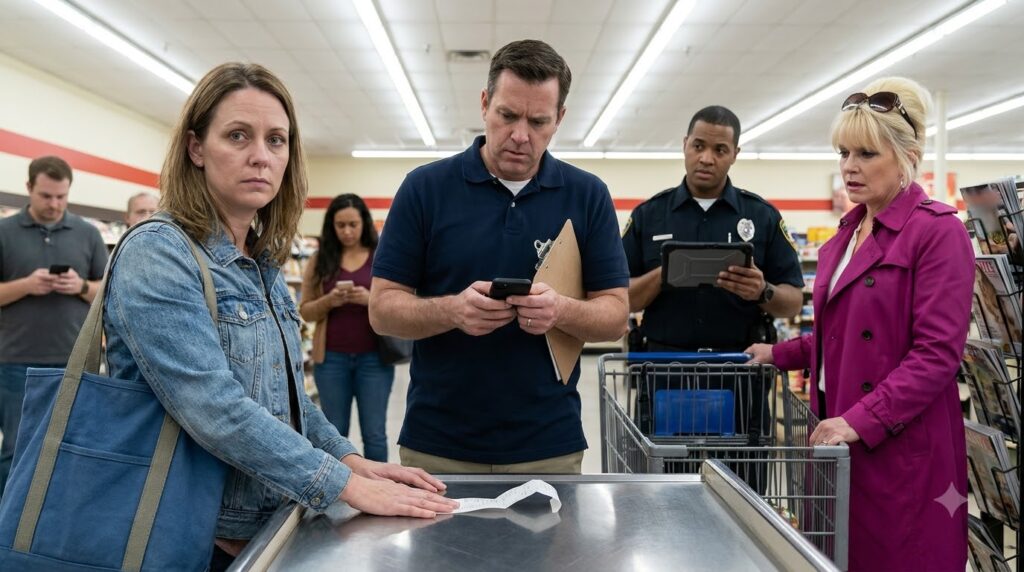
I turned my head slowly. Inches from my nose, the dual lenses of a high-end smartphone were leveled at my face like a double-barreled weapon. Behind the glass screen stood Evelyn Vance. Her oversized designer sunglasses were pushed up into her stiffly styled hair, and her bright magenta trench coat stood out against the drab gray linoleum like a flare on an asphalt road.

“This woman bypassed three families waiting at the express line,” Evelyn announced to the entire store, her free hand pointing a manicured finger directly at my blue canvas tote bag. “She used the unattended kiosk to slip unpaid premium items directly into her personal bag without presenting them to a clerk. Call management immediately!”

Around us, the background hum of the Saturday morning rush died instantly. The cashier’s scanner froze mid-air, its red laser line hovering harmlessly over the glass bottle of cold-pressed oil on the belt. In the adjacent lanes, heads turned. Suburban shoppers in fleece jackets and sneakers backed away slightly, their eyes darting between Evelyn’s aggressive posture and my faded denim coat.

I maintained a quiet, unblinking stance. Every muscle in my posture was deliberate. I calculated the geometry of the aisle: the heavy chrome cart was wedged at a forty-five-degree angle against the display rack of magazines, blocking my forward exit. The conveyor belt was behind me. She had engineered a physical bottleneck.

“Move your cart out of my path,” I said. My voice was low, devoid of inflection, engineered to contrast sharply with her theatrical volume.

“I will do no such thing!” Evelyn stepped closer, the heels of her boots clicking sharply against the floor. She tapped her phone screen against my cart handle with a metallic clack. “You think because you wear a quiet face you can bypass the rules honest people abide by? You concealed organic goods. I saw you.”

I felt the smooth, cold edges of the thermal paper folded inside my right coat pocket. My fingers didn’t move toward it yet. Timing is everything in a public ambuscade. If you show your card too early, the aggressor shifts the goalposts. You have to let them commit entirely to the lie until the weight of their own momentum breaks them.

“You have five seconds to clear the lane,” I repeated, keeping my gaze locked on the center of her sunglasses.

“Or what?” Evelyn sneered, her voice dropping into a harsh whisper meant only for the two of us, even as her phone camera continued to record. “You’re caught, dear. And by the time Marcus gets over here, everyone in this town is going to know exactly what kind of person you are.”

Behind her, near the customer service desk, a man in a crisp navy polo shirt stepped out from behind a podium, a clipboard tucked under his arm. Marcus Brooks had heard the commotion. Alongside him, the heavy leather belt of Officer Miller, the store’s private security guard, creaked with every purposeful step toward Aisle Seven.

Evelyn’s smile widened—a flash of porcelain beneath the fluorescent lights. She turned her camera toward the approaching manager, ready to deliver the final strike.


CHAPTER 2: ESCALATION UNDER THE FLUORESCENTS

The squeak of Officer Miller’s rubber-soled boots against the waxed linoleum signaled the shift in territory. Marcus Brooks moved with the measured, defensive posture of a middle manager whose primary instinct was to shield the store from liability. His clipboard was held high like a breastplate, his eyes darting from Evelyn’s trembling phone arm to my motionless tote bag.

“Mrs. Vance, lower the phone,” Marcus said. His tone was clipped, stripped of the cheerful cadence he used over the public address system. “We don’t record customers on the sales floor.”

“I am securing evidence, Marcus!” Evelyn’s voice rose an octave, vibrating with simulated outrage. She didn’t drop the camera; instead, she angled the lens closer, capturing the gold-embossed crest of her neighborhood association pin pinned to her coat lapel. “This isn’t just about a bag of groceries. Look at her. She hasn’t offered a single word of defense because she knows I caught her red-handed.”

I kept my hands visible, resting lightly on the chrome edge of the checkout belt. The metal had absorbed the chill of the air conditioning, biting cold through my palms. “I requested that she remove her cart,” I said, directing my words exclusively to Marcus. “She refused and blocked the exit lane.”

“She’s stalling,” Evelyn hissed. Her thumb tapped furiously against the screen. Suddenly, a soft, high-pitched chime rang out from her device—a distinct double-beep that didn’t match the standard camera shutter or messaging app. Evelyn’s eyes flicked down for a fraction of a second, a micro-flash of calculation passing across her features before her face hardened back into a mask of righteous fury. “And I don’t need to rely on mere observation, Marcus. I have the digital ledger.”

She turned the phone screen toward Marcus, pulling back just far enough so I couldn’t read the dense rows of text.

“My app just received an automated flag from the front kiosk network,” Evelyn declared, her chin tilting upward. “Because I am a registered community liaison for the regional district, I receive alerts when suspicious scan-skips occur in this zip code. Her loyalty account was flagged less than ninety seconds ago for an incomplete, fraudulent checkout.”

Marcus paused, his hand hovering over his clipboard. A flicker of doubt crossed his face. The mention of an official network flag carried weight in a corporate chain governed by automated loss-prevention metrics. Officer Miller shifted his weight, his hand dropping closer to the heavy utility belt at his waist.

“An app flag?” Marcus asked, his brow furrowing as he looked at the screen. “Our system doesn’t push customer scan data to third-party devices.”

“It pushes alerts to the district committee,” Evelyn lied smoothly, her voice steady and practiced. She stepped forward, using the chrome cart as a plow to push an inch deeper into my personal space. “She scanned the bread, skipped the oil, and closed the session without settling the balance. Ask her to show you her app transaction history right now. If she has nothing to hide, let Officer Miller audit the bag.”

The shoppers hanging over the lane dividers murmured. The word flagged drifted through the crowd like smoke. I could feel the collective judgment of the aisle shifting—not because Evelyn had presented physical proof, but because she had introduced a technical vocabulary that sounded official enough to create suspicion.

I didn’t reach for my phone. I didn’t open the canvas tote. To yield to an unauthorized search based on a manufactured digital claim would be to concede the battlefield she had chosen.

“Officer Miller,” I said, my voice remaining flat, devoid of the panic Evelyn was baiting. “Does store policy permit a private citizen to block a customer’s physical movement based on a personal mobile app notification?”

Miller looked at Marcus, then back at Evelyn’s phone. “Mrs. Vance, step back from the cart.”

“I will not!” Evelyn’s face flushed a deep, mottled purple beneath her styled hair. “You’re letting a thief dictate the terms of an investigation! Look at the app, Marcus! Read the line item!”

She jammed the screen closer to Marcus’s face. From my position, I caught the reflected glare of the glass: a dense list of black text over a white background, topped by a blue corporate banner. But beneath the top header, a tiny red icon blinked—a system warning that didn’t signal an incomplete sale, but an active, overlapping session error.

“Marcus,” I said softly, my voice cutting through the rising murmur of the crowd. “Look at the top line of her screen. Ask her whose loyalty account opened that session.”

CHAPTER 3: THE MANAGERS PROTOCOL

Marcus Brooks squinted at the glowing rectangle of Evelyn’s phone, his glasses reflecting the harsh fluorescent tubes overhead. The noise of Aisle Seven seemed to contract, shrinking down to the narrow channel of linoleum between my denim jacket and the chrome nose of Evelyn’s shopping cart.

“Let me see the device, Mrs. Vance,” Marcus said. His voice had lost its appeasing edge, replaced by the flat tone of an administrator enforcing store liability protocols.

“I am holding it so you can review the flag,” Evelyn countered, though her fingers twitched against the casing. She pulled the phone back three inches, angling the screen upward just enough to hide the bottom navigation bar. “Look at the red entry. It explicitly indicates a discrepancy at Terminal Four. Account ending in zero-eight-eight-two.”

I felt the subtle shift in the air before anyone else spoke. Zero-eight-eight-two. That was the midpoint hook—the decoy she had engineered to trap a less meticulous target.

“That’s my Oakridge Rewards member ID,” I said quietly, my voice slicing through the low hum of the register lane. “Which raises a very specific question, Marcus.”

Evelyn snapped her gaze toward me, her nostrils flaring beneath the indoor designer sunglasses. “It proves you tried to scan under your account and abandoned the session when you thought the camera wasn’t looking!”

“No,” I replied, keeping my eyes fixed on Marcus’s face. “It proves my loyalty account was active on Terminal Four. But I didn’t open my phone app during checkout. I used the physical barcode on the back of my keychain tag—the one currently hanging from my ignition key in the parking lot.”

Marcus looked from me to the phone screen, then reached out his hand, palm up. “Hand me the phone, Mrs. Vance. Now. Under store policy, if a customer’s private account data is being displayed on a personal device inside a register lane during an active dispute, management is required to verify the source log.”

Evelyn’s composure cracked for a micro-second. Her jaw tightened, the artificial porcelain sheen of her teeth flashing in the harsh light. “This is absurd. I am a designated community liaison. I don’t surrender my personal equipment to store staff.”

“Then Officer Miller will escort you to the security office to resolve the privacy violation,” Marcus said without hesitation. He tapped his clipboard against his thigh. “Officer, take custody of the lane log.”

Miller stepped forward, his heavy boots making a firm, decisive thud against the tile. His hand hovered inches from the chrome cart handle, effectively trapping Evelyn in the very bottleneck she had constructed for me.

The crowd behind us rustled, dozens of eyes watching the shift in power. Evelyn’s face turned from flushed red to a pale, mottled white. She realized she had overplayed her hand in front of an audience that was no longer nodding along with her performative outrage.

“Fine,” Evelyn spat, her voice dropping into a razor-thin venom. “Read it yourself, Marcus. But when corporate reviews this incident, your lack of support for community standards will be prominently featured in my report.”

She thrust the phone into Marcus’s open palm.

Marcus held the device under the direct glare of the scanner light. His thumb scrolled down the dense lines of text, tracing the transaction ledger that Evelyn had presented as her definitive evidence. The ledger indeed showed an active, flagged session on Terminal Four, timestamped at 8:41 AM, linked to account ID 0882. It listed three items scanned: two loaves of artisanal sourdough and one bottle of cold-pressed organic olive oil. The total sat at $24.85, marked as UNPAID – SESSION SUSPENDED.

“You see?” Evelyn pressed, her voice regaining a desperate strength as she pointed at the red text. “The transaction was never completed! She walked away from the terminal with the oil in her tote bag, leaving the balance unpaid!”

A ripple of judgment passed through the nearest bystanders. A man in a athletic fleece shook his head; a woman holding a box of cereal pulled her child back an inch. To anyone looking at the screen without context, the digital record appeared damning. The decoy secret had landed exactly as Evelyn intended—a physical, electronic flag that seemingly verified her public accusation.

Marcus stared at the line item, his brow furrowing deeper. For five agonising seconds, the narrative belonged entirely to Evelyn Vance. She straightened her magenta trench coat, resting her hand back on her cart handle as if she had already won the day.

“The itemized list matches what’s in her tote,” Marcus muttered, his finger tapping the glass screen. He looked at me, a heavy, cautious weight in his eyes. “Clara… according to the system log, Terminal Four was left open with an unpaid balance under your account number.”

I didn’t panic. I didn’t reach for my bag or raise my voice to match her shrill victory. Instead, I reached deep into my denim coat pocket, my fingers closing around the cold, crisp rectangle of thermal paper I had retrieved from the auxiliary printer station two minutes before Evelyn ever crossed my path.

“Look at the timestamp on that screen, Marcus,” I said, my voice steady, measured, and absolute. “It says eight-forty-one AM. Now look at what I hold in my hand.”

I drew the thermal paper out into the light, smoothing its edges against the cold chrome rail of the register belt.

CHAPTER 4: THE TIMESTAMP AUDIT

The thermal slip lay flat against the cold metal divider, its crisp black text stark under the harsh glare of Aisle Seven.

“Read line one, Marcus,” I said. My voice did not rise; it carried the cold, unyielding weight of an iron beam falling into place. “Read the terminal number and the timestamp.”

Marcus lowered Evelyn’s phone by two inches. His eyes scanned the paper, then flicked back to the digital glass. “Oakridge Terminal Four. Timestamp: eight-thirty-nine AM. Paid in full via digital wallet. Transaction approval code: seven-seven-four-delta.”

A quiet hush rippled through the immediate line. The woman in the fleece jacket leaned forward over her cart divider to stare at the black ink.

“Eight-thirty-nine,” Marcus repeated slowly, his thumb tracing the thermal edge. He looked up at Evelyn, whose rigid posture had frozen into a fragile, brittle line. “Mrs. Vance… the open session flagged on your phone app is timestamped eight-forty-one AM. Two full minutes after Clara’s receipt was issued and closed.”

“That’s impossible!” Evelyn’s voice cracked, losing its rehearsed cadence. She lunged forward half an inch, her magenta coat sleeve brushing the chrome boundary of my cart. “She reopened the terminal! She used a duplicate barcode to trick the system!”

“A closed transaction cannot be reopened from the terminal screen without an manager key override,” Marcus said, his administrative calm sharpening into cold authority. He turned to Officer Miller. “Miller. Pull up the overhead feed for Terminal Four from eight-thirty-five to eight-forty-two on your tablet. Now.”

Miller unclipped the ruggedized handheld monitor from his tactical belt. The rubberized casing clicked against his brass belt buckle. With two swipes of his thumb, he accessed the store’s high-definition dome cameras overlooking the front scan kiosks.

Evelyn’s phone camera was still recording, but her arm had dropped six inches, the lens now pointing uselessly at the linoleum floor. Her breath came in short, shallow hitches. I watched her jaw twinge—a tiny, involuntary muscle spasm beneath her left ear.

“Playback starting at eight-thirty-six,” Miller announced, holding the tablet so both Marcus and I could view the high-contrast color video.

On the screen, my own figure appeared in real-time clarity: faded denim jacket, blue canvas tote slung over my shoulder. The video showed me approaching Terminal Four at 8:37 AM. I scanned two sourdough loaves, then the cold-pressed organic olive oil. At 8:39 AM, I tapped my phone against the contact reader, waited for the green approval light, placed the oil into my canvas tote, and walked away toward the auxiliary printer station.

“There,” Marcus said, pointing at the screen. “Clean transaction. Fully settled.”

“Keep watching,” I said softly. “Watch what happens at eight-forty AM.”

Miller zoomed in on Terminal Four. The screen on the tablet expanded, showing the empty kiosk left behind as I walked toward Aisle Seven. Ten seconds after I stepped away, a figure stepped into the camera frame from the adjacent bakery aisle.

It was Evelyn Vance.

The crowd gathered around Aisle Seven edged closer, phones rising across three registers as people realized what was unfolding on the guard’s tablet.

On the recorded video, Evelyn did not select items from a cart. She walked straight to Terminal Four, reached into her pocket, and pulled out her own smartphone. Instead of starting a new session, she tapped her phone screen against the scanner glass, attempting to pull up a custom district liaison interface. When the screen prompted for a user ID, she manually typed in my loyalty card number—a string of digits she had memorized or copied from a neighborhood directory list—and scanned a spare bottle of oil she had carried from Aisle Three.

When the system threw a red error screen—noting that account 0882 had already completed a transaction and required a log-out before a new session could begin—Evelyn didn’t cancel the prompt. She deliberately left the error screen active, snapped a photo of the red warning flag on her phone, and turned on her heel to pursue me toward Aisle Seven.

The decoy secret she had tried to weaponize—the “flagged transaction log”—was not an alert sent to her by corporate loss prevention. It was an error code she had personally generated two minutes prior by tampering with an open terminal interface.

The silence that followed in Aisle Seven was total. The hum of the fluorescent lights sounded deafening.

Marcus looked up from the tablet, his face stripped of all administrative softness. His gaze locked onto Evelyn with a cold, terrifying clarity. “You manually entered her member number at an unattended terminal, Mrs. Vance. You created the system error yourself.”

Evelyn’s lips trembled. The magenta coat suddenly looked absurdly bright against her pale, drained face. “I… I was conducting a security audit! As a representative of the neighborhood board, I have a duty to ensure local retail protocols are being enforced!”

“You didn’t conduct an audit,” Officer Miller said, his voice dropping into a register that made two nearby shoppers step back. He tapped his body camera, ensuring the green recording light was solid. “You fabricated a false shoplifting claim, used a fraudulent system entry to back it up, and physically blocked a customer from exiting the premises.”

Evelyn took a step backward, her boot heel catching on the rear wheel of her cart. The metal frame rattled loudly against the magazine rack. She looked around at the ring of onlookers. The phones that had been recording me minutes ago were now pointed squarely at her. The murmurs were no longer hesitant; they were sharp, disgusted, and unanimous.

“Marcus,” Evelyn stammered, her hands fluttering near her collar. “We can discuss this in the private office. There’s no need for a scene.”

“The scene was yours, Mrs. Vance,” I said, stepping forward until the distance between us was less than two feet. “And now you’re going to clear my path.”

Evelyn swallowed hard, but even as her false authority collapsed, her eyes flashed with a final, desperate venom. “You think you’ve won something here? I sit on the district commercial review committee, Marcus! If you press this, I will have your store’s regional permit audited before the week is out!”

Marcus didn’t blink. He reached for his radio, unclipped it from his shoulder, and spoke directly into the channel. “Front desk, this is Manager Brooks. Prepare a formal Notice of Trespass and permanent property ban for Evelyn Vance. Effective immediately.”

CHAPTER 5: THE COLLAPSE OF DECORUM

The crackle of the store radio speaker cut through the silence of Aisle Seven like a physical blade.

“Notice of Trespass,” Marcus repeated into the lapel microphone, his voice echoing off the high steel trusses of the ceiling. “Aisle Seven. Officer Miller, please clear the register lane.”

Time dilated into a strange, crystalline slowness. In the harsh overhead lighting, every detail of Evelyn Vance’s undoing became absurdly magnified. I watched the color drain from her face—not in a smooth fade, but in splotches, leaving her cheekbones stark and white beneath the layer of bronzer. The magenta coat, structured and sharp moments ago, seemed to sag against her narrow shoulders, its bright dye suddenly looking garish against the dull gray linoleum of the store floor.

“Marcus,” she breathed. Her phone was completely forgotten, hanging upside down in her right hand like a useless piece of scrap plastic. “You can’t issue a trespass notice against a regional board member. I have lived in this community for twenty-two years.”

“And as of eight-forty-four AM, you are banned from all Oakridge properties,” Marcus replied. His tone was devoid of anger, devoid of theatrical triumph—it was the cold, unyielding weight of an automated system closing a gate. He pulled a bright orange carbon-copy form from the back of his clipboard, writing her full name in thick black ink across the top header. “Officer Miller will escort you to your vehicle. If you enter these premises again without administrative clearance, local police will be dispatched for criminal trespass.”

Officer Miller stepped forward, his leather gear creaking with a heavy, deliberate rhythm. He didn’t lay a hand on her; he simply placed his wide frame between Evelyn and the register belt, his posture an immovable wall of dark navy wool.

“This way, Mrs. Vance,” Miller said calmly. “Leave the cart.”

Evelyn looked at the cart—the heavy chrome obstacle she had wedged so carefully to lock me against the magazine rack. Her fingers twitched against the rubber handle, but Miller took a single step closer, and her hands snapped back as if the metal were white-hot.

Around us, the crowd broke its silence.

It wasn’t a roar of anger. It was a ripple of quiet, cutting laughter—the distinct sound of a public space reclaiming its air. A woman in Aisle Six snapped a final photograph as Evelyn was turned toward the exit. In Aisle Eight, a man holding a carton of milk let out a low whistle. The cashier at Lane Seven, whose scanner had been frozen mid-air for ten agonizing minutes, let out a long exhale and set my bottle of cold-pressed oil back on the rubber belt with a soft, steady thump.

Evelyn tried to hold her chin high as she began the long walk toward the automatic glass doors. She pulled her designer sunglasses down over her eyes, attempting to erect a barrier against the dozens of phone camera lenses tracking her movement. But her high heels squeaked on the polished tile with every step, a rhythm entirely stripped of authority, sounding small and hollow under the wide fluorescent vaults.

I didn’t watch her reach the exit. I turned my back to the aisle, facing the register.

“I apologize for the disruption, Clara,” Marcus said, stepping beside the belt. He took the bright orange trespass slip, folded it once, and placed it beneath his clipboard strap before looking at me. “Your receipt and bag are completely clear. I’ll personally ensure the district committee receives the camera logs from Terminal Four.”

“Thank you, Marcus,” I said. My voice was smooth, quiet, and steady. “I appreciate the protocol being followed.”

I picked up my blue canvas tote bag. The canvas was heavy over my arm, the weight of the sourdough loaves and the glass oil bottle resting comfortably against my hip. I adjusted my faded denim jacket, settling the collar against the cool air of the store, and walked past the now-cleared exit lane.

As I stepped through the sliding glass doors, the humid warmth of the suburban Illinois morning hit my face. The bright sunlight scattered across the parking lot, reflecting off rows of windshields and the polished chrome of grocery carts. Fifty yards ahead, near the far edge of the asphalt, Evelyn Vance was rushing toward her silver sedan, her magenta coat fluttering wildly in the breeze as she fumbled with her key fob.

She looked small against the vast, open expanse of the parking lot. Loud, performative authority requires an enclosure—a captive audience in an aisle, a structured committee room, a microphone. Placed out in the open light, stripped of the false rules she had manufactured, she was just a person in a bright coat running away from her own reflection.

I reached into my denim coat pocket, my fingers brushing the smooth, folded strip of thermal paper. The receipt was thin, fragile, and practically weightless. But as I walked toward my car, I knew the truth it carried was heavier than any loud voice trying to rewrite the rules.

Some people wear noise like authority. But quiet proof never needs to shout.

Similar Posts

Leave a Reply

Your email address will not be published. Required fields are marked *