The Line at Maple Avenue: A Story of Cold Calculation, Public Accusation, and Uncompromising vindication
CHAPTER 1: THE LINE IN THE DIRT
“Stop blaming me, you started this and everyone saw it!”
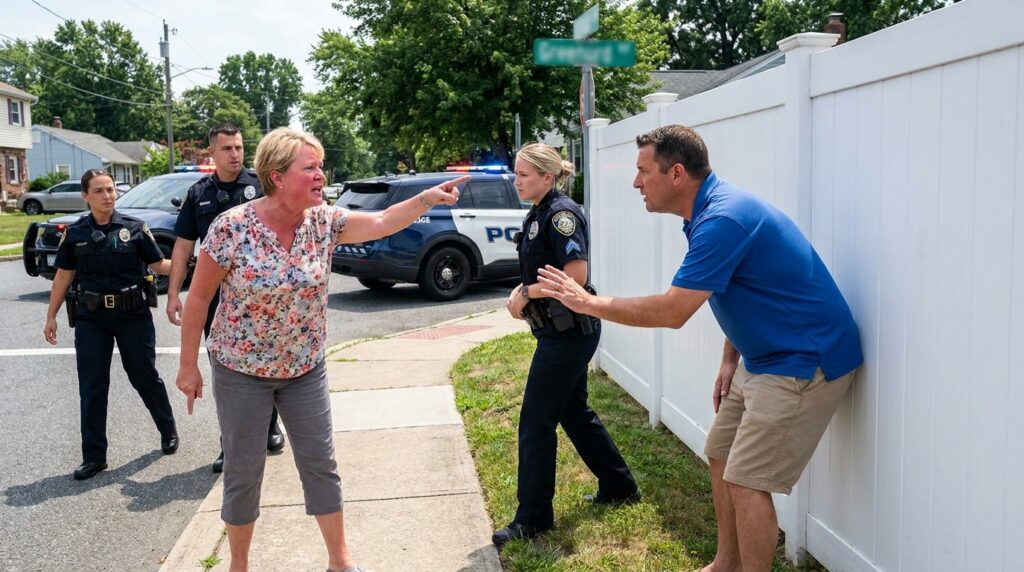
Her voice cut through the humid morning air like a rusted blade, her jabbed finger stopping three inches from my collarbone. Brenda stood on the fresh sidewalk grid at the corner of Maple Avenue, her floral blouse vibrating against the static gray of the white privacy fence behind her. Behind her, two trade workers in yellow vests stood frozen near the idling tailgate of their flatbed, post-hole diggers resting uselessly against their work boots.
I didn’t step back. The concrete beneath my sandals was warm from the 9:00 a.m. sun, holding the night’s heat in hard, immutable slabs.
“The survey markers are right there, Brenda,” I said, keeping my voice flat, stripped of pitch or tremor. I didn’t raise my hands. I didn’t point. I simply turned my eyes two inches to the right, toward the fresh pine stake driven four inches into the turf. A strip of neon-orange surveyor’s tape fluttered against the cut grass, a bright, unapologetic flag marking absolute spatial truth. “Check the line before you keep yelling.”
“I don’t need to check a stick you shoved in the dirt last night!” She stepped forward, her gray capri pants snapping as her sandals slapped the sidewalk. Her face was flushed red, the tight blonde curls around her temples damp with sweat. She had her phone clutched in her left hand, screen lit, the voice memo app recording a red digital waveform that pulsed with every breath she drew. “This corner is township easement! You’re destroying community property, you’re encroaching on my sightline, and you told your crew to shove me when I asked for the permit!”
Across the street, Mrs. Gable stepped out onto her porch, holding a mug of coffee with both hands, her eyes locked on our corner. Down the block, two men washing a sedan slowed their rags to a crawl. The neighborhood was tuning in. Brenda knew it; she fed on the audience, her shoulders squaring as she angled her chest directly into my space, trying to force me to yield three inches of ground toward the fence.
I calculated the risk in silence. In a public confrontation, the person who speaks loudest offers the first draft of reality. But the person who moves first pays the tax.
“No one touched you,” I said softly, looking past her shoulder.
At the end of Maple Avenue, a low blue strobe flickered against the windshields of parked cars. The sound of an engine rolling slowly down the residential asphalt hummed through the air. Brenda had called it in five minutes ago, reporting an active assault and property destruction. She wanted a scene. She wanted flashing lights to validate thirty years of unwritten authority over this corner.
As the dark police cruiser swung wide around the corner sign, its tires crunching over loose gravel, Brenda turned toward the street, her arms coming up in a frantic, sweeping gesture to direct the officers. She didn’t notice the subtle metal glimmer sticking out of the soil two inches behind her heel—a second, older rebar cap painted fluorescent pink, buried under three inches of pulled thatch that hadn’t been there yesterday.
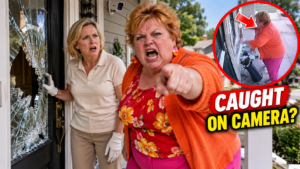
CHAPTER 2: RETRACING THE EDGE
“Sir, take two steps back toward the fence.”
Officer Sarah Vance didn’t raise her voice, but the spatial authority in her posture was absolute. Her dark utility belt creaked as she unclipped the heavy leather strap retaining her sidearm, her gloved fingers resting lightly on the plastic grip. Behind her, the secondary unit’s tires crunched to a halt against the asphalt, its roof-mounted lightbar painting the white privacy fence in erratic pulses of cerulean and crimson.
I stepped back precisely two paces, my sandals grinding against the hard edge of the concrete slab. My shoulders remained square, my hands held open at waist height, palms facing forward. “I’m compliant, Officer.”
“He was threatening me!” Brenda’s voice pitched an octave higher, shattering the brief stillness. She surged toward Vance’s left flank, her phone held out like a shield, the screen showing her active recording app. “He told his workers to push past me! Look at my property line—he’s already destroyed the turf! He’s putting up an illegal structure without township authorization!”
Vance didn’t turn her head. Her eyes remained locked on me, assessing my posture, my heart rate readable in the steady pulse at the hollow of my throat, the absence of adrenaline-fueled twitching in my fingers.
“Ma’am, stay where you are,” Vance commanded, her voice dropping into the flat, unyielding cadence of procedural control. “Officer Miller, secure the second party.”
The stocky male officer stepped around the rear of the cruiser, his broad frame cutting off Brenda’s angle of approach. Brenda stiffened, her jaw working as she realized she was being physically sequestered in the curbside control lane.
“I called you!” Brenda snapped, her chest heaving beneath the floral blouse. “I am the complainant! He is the one committing the violation!”
“We assess the scene first, ma’am,” Vance said smoothly, finally shifting her gaze to the pine stake driven into the dirt beside my sandal. The bright orange flagging tape snapped softly in the light coastal breeze. “Whose survey stake is this?”
“Mine,” I said. “Driven yesterday afternoon by SVR Engineering. Certified land surveyor, license number stamped on the cap.”
I reached slowly into my rear pocket. Vance’s hand tightened slightly on her belt, her posture sharpening.
“Reaching for a document,” I stated clearly, keeping my movement deliberate, two fingers holding the folded crisp paper by its edge so the blue official seal was visible before it cleared my shorts line. “Copy of the township permit and the stamped plot plan from the county recorder’s office.”
Vance held out her hand. I didn’t step forward to give it to her; I held it out at arm’s length, forcing her to bridge the distance. In a high-tension public call, distance is safety. The moment you cross into an officer’s personal envelope without an explicit command, you give them legal justification to put hands on you.
She took the paper, her thumb brushing the heavy bond paper. She unfolded it against her forearm, her eyes scanning the ink lines and official red stamps.
“This plan shows a nine-inch offset from the curb,” Vance observed, her eyes flicking up to the white privacy fence behind me. “Your fence line is sitting six inches inside that offset.”
“Correct,” I replied. “I surrendered three inches of my own deeded property to ensure the construction crew didn’t disrupt the municipal drainage swale.”
Brenda let out a loud, mocking laugh from behind Officer Miller. “He’s lying! Look at the binder! I have the HOA architectural guidelines right here!” She fumbled with a heavy black leather binder tucked under her arm, flipping pages with frantic, snapping motions. “The 2016 repaving project reset all corner boundaries on Maple! The township took four feet of that easement! He’s building on public land!”
Vance turned her head slightly. “You have township documentation, ma’am?”
“It’s right here! Signed by the previous board president!” Brenda shoved the open binder toward Miller, pointing frantically at a laminated sheet. “He knows his property was reduced during the road widen! He’s trying to steal back land that belongs to the street!”
I looked down at the base of the pine stake. Beneath the loose clippings of cut rye grass, a tiny glint of metallic pink caught the harsh morning light. It wasn’t the orange of my surveyor’s tape. It was a faint, pulverized dusting of fluorescent spray paint clinging to a jagged fissure in the dirt, right where a four-inch iron rebar pin should have been flush with the soil.
My chest tightened, a cold, calculating stillness settling over my ribs. The rebar pin wasn’t there. The surveyor had driven a pine marker yesterday because the original metal property pin set in 1988 was missing from its hole.
I looked up, meeting Brenda’s eyes over Miller’s shoulder. She wasn’t looking at the officer anymore. She was looking down at my feet, her lips pressed into a thin, white line, her thumb nervously scratching the brass spine of her leather binder.
“Officer Vance,” I said, my voice barely above a whisper, yet carrying clearly across the quiet pavement. “Ask her where she was at 2:00 a.m. this morning.”
CHAPTER 3: THE FABRICATED MAP
“What did you just say to me?” Brenda’s voice screeched across the pavement, raw and strident. Her fingers tightened on the brass binder rings until the knuckles turned marble-white. “How dare you! Officer, do you hear him? He’s making delusional, slanderous allegations because he knows he’s caught!”
Officer Vance didn’t flinch. She took a half-step back, her eyes shifting from my face to Brenda’s posture. The air between us felt heavy with ozone from the police vehicle’s strobes, the blue light slicing rhythmically across the white fence line.
“I didn’t make an allegation,” I said, my voice measured, carrying no heat. “I asked a question. My 4K doorbell camera covers the front apron and this entire corner. At 2:14 a.m., someone wearing a yellow raincoat walked up to that precise pine stake, knelt down with a hand-mattock, and spent four minutes digging until they lifted a twelve-inch steel pin out of the ground.”
Brenda’s chest hitched. Her eyes darted toward the curb where Officer Miller stood, then back to Vance. For a fraction of a second, the aggressive flare in her shoulders flickered, replaced by a cold, darting panic. “That’s… that’s absurd! There’s a stray dog in the neighborhood! Raccoons dig at the mulch!”
“Raccoons don’t carry yellow fiberglass toolboxes,” I said quietly.
I kept my gaze fixed on the leather binder under her arm. The sun was high enough now to catch the glossy finish of the laminated sheets inside. Along the inner edge of the page she had pointed to earlier—the one supposedly proving a 2016 township easement expansion—a thin bead of clear, tacky adhesive glistened near the plastic margin. It wasn’t an official municipal document from a city vault. It was a home-printed sheet pasted over an older, yellowed record page inside the HOA’s master archive binder.
“Officer Vance,” Brenda interrupted loudly, stepping sideways to block Vance’s view of the binder, her voice rising to drown out my tone. “Are you going to let a suspect under investigation cross-examine me on my own street? He is violating code! He is threatening my safety! I want him cited right now, or I’m calling the chief of police!”
Vance turned her torso slowly, her dark uniform fabric stretching taut across her shoulder harness. The command-ready demeanor she had maintained since stepping out of the cruiser suddenly crystallized into something far colder. “Ma’am, you will not dictate enforcement actions to me on this scene. Is that understood?”
“I am the president of the Maple Avenue Block Watch!” Brenda spat, her face flushing a dark, blotchy purple. “I have a duty to protect this neighborhood from illegal development!”
“You called 911 and reported an active, violent physical assault in progress,” Vance said, her words dropping like iron weights onto the sidewalk. “When my partner and I arrived, there was no physical violence. You were actively advancing into this gentleman’s personal space while his hands were at his sides. Now you are presenting a private HOA binder as legal authorization to halt a licensed contractor.”
“Because it is legal!” Brenda shouted, thrusting the binder toward Miller. “Look at the seal! Look at the date!”
Miller didn’t take the binder. He leaned down slightly, his eyes narrowing as he took in the laminated sheet. “Ma’am, this seal is a black-and-white photocopy. It’s not an embossed county recorder stamp.”
“It’s an official copy!” she insisted, her voice breaking into a raspy pitch. “The original is in the township vault!”
“Then the township vault is where we verify it,” Vance said smoothly. She turned back to me, her hand resting casually near her belt. “Sir, do you have that camera footage available right now on a handheld device?”
“I do,” I replied. “It’s rendered to a cloud server, timestamped, and backed up in three separate locations.”
“Liar!” Brenda screamed. She lunged forward, her sandals slapping hard against the concrete as she thrust her phone straight toward Vance’s face, screen glowing with a fuzzy, low-resolution photo. “Look at this! I took this picture at 6:00 a.m.! That’s his truck parked on the public sidewalk! That’s obstruction! He’s been breaking the law all week!”
The physical movement was too sudden. She had crossed Vance’s safety threshold in a blind rush to force the image into the officer’s eyes. Miller reacted instantly, his heavy arm extending to intercept her shoulder, blocking her path before she could make contact with Vance.
“Back up, ma’am!” Miller barked, his voice booming across the corner lot.
Across the street, three more neighbors stepped down off their porches, phones rising in unison to record the escalating scene. The entire street was watching the self-appointed authority of Maple Avenue unravel in real-time under the strobe lights.
Brenda stumbled back against Miller’s arm, her heels catching the edge of the grass. She didn’t drop the binder, but her grip slipped, the leather cover flopping open to reveal the back pocket. Slid loosely inside the plastic sleeve was a printed receipt from a local hardware store dated two days ago: 1x 12-inch Pry Bar, 1x Can Fluorescent Pink Marking Paint.
I didn’t smile. I didn’t cheer. I simply stood beside my pine survey stake, my posture rigid, watching the trap spring shut not through my anger, but through her own relentless, unhinged overreach.
“Officer Vance,” I said softly, as the silence fell over the corner like a heavy sheet. “I think you should ask her why she bought pink marking paint on Tuesday.”
CHAPTER 4: THE FALSE AUTHORITY
The thermal paper receipt fluttered down toward the grass before catching the morning breeze and slapping against Officer Vance’s polished leather boot.
Silence descended on the corner of Maple Avenue. It was a suffocating, tactile quiet—the kind that settles right before a storm breaks over dry asphalt. Across the street, two more neighbors stepped off their porches, their phone lenses glinting like dark beetles in the morning sun.
Brenda’s hands twitched toward her waist. Her lips parted, but no sound came out—just a dry, shallow wheeze. The aggressive flare in her chest collapsed into a rigid, trembling stillness.
Vance didn’t bend down immediately. She looked at the receipt against her boot, then slowly shifted her eyes back to Brenda’s face. “Don’t move, ma’am.”
Vance stooped, her duty belt creaking under the tension, and pinched the thermal slip between two gloved fingers. She held it up to the daylight. Her thumb traced the faint blue ink impression stamped on the back—a hand-drawn circular crest designed to mimic a township notary stamp, smudged with fresh blue ink.
“Hardware store on 4th Street,” Vance read aloud, her voice carrying across the sidewalk like a gavel striking wood. “One twelve-inch pry bar. One can of fluorescent pink marking paint. Purchased Tuesday at 8:14 p.m.”
“That’s… that’s for my garden!” Brenda blurted, her pitch cracking into a hysterical rasp. She took a panicked half-step back toward the fence line, her sandals scraping against the sidewalk grid. “I have a right to buy tools! I run the neighborhood beautification committee!”
“You presented a laminated survey map to my partner claiming it was an official 2016 municipal record,” Vance said smoothly, stepping into Brenda’s retreat lane to block her path toward her house. “A map that shows an easement expansion that doesn’t exist on county records.”
“It does exist!” Brenda shrieked, her finger jabbing wild air between Vance and me. “He altered his deed! He paid off the surveyor! Everyone knows he’s been planning to build a commercial driveway on residential property!”
I stepped forward one pace—not into her space, but right up to the boundary of my pine survey stake. I drew my phone from my pocket, unlocked the screen with a thumb-swipe, and turned the display toward Officer Vance.
“Layer 1 file,” I said, my voice steady, devoid of mockery or triumph. “Recorded from the corner infrared camera on Tuesday at 8:30 p.m. Exactly sixteen minutes after that receipt was printed.”
On the 4K screen, crisp monochrome footage played in real-time. A heavy figure wearing a oversized floral rain-jacket and plastic visor walked up to the corner lot. The figure knelt beside my wooden marker, pulled a long steel pry bar from a canvas tote bag, and jammed it beneath the dirt, prying upward until a twelve-inch steel rebar pin popped out of the earth with a wet, thudding snap. The figure then produced a small spray can, blasted the hole with fluorescent pink paint, and smoothed dead sod over the scar.
Officer Miller leaned over Vance’s shoulder, staring at the screen. His jaw hardened. “That’s a felony tampering charge with a recorded property marker under State Code 42.”
“That’s not me!” Brenda screamed, her face turning an impossible shade of mottled purple. Her hands flew up, her voice breaking completely as she gestured wildly toward the street. “That video is fake! He used artificial intelligence! He’s trying to frame me because I wouldn’t let him cut down the Maple tree!”
“Ma’am,” Vance’s voice cut through her tirade like a cold steel blade. “You need to stop talking right now.”
“No!” Brenda surged forward, her shoulder clipping Officer Miller’s broad chest as she tried to reach my phone. “Look at his fence! Look at the setback! He’s stealing three feet of community land and you’re letting him get away with it because he has a video?”
Miller’s hand clamped down on her forearm with practiced, firm restraint. “Ma’am, step back and keep your hands where I can see them!”
“Get your hands off me!” Brenda howled, twisting violently against Miller’s grip. She turned her torso, her elbow swinging out in a blind, frantic arc that grazed the rim of Miller’s duty cap. “I am a taxpayer! I live here! You work for me!”
The shift was instantaneous. The procedural atmosphere shattered into active physical control.
Vance didn’t hesitate. She stepped into Brenda’s blind spot, grabbed her left wrist with a swift, fluid lock, and spun her around toward the hood of the nearest patrol cruiser.
“Turn around now!” Vance commanded, her voice booming across the entire block of Maple Avenue. “Keep your hands behind your back!”
“Stop! You’re hurting me! Help! Neighbors, record this!” Brenda’s screech echoed off the white privacy fence as Miller secured her right arm, bringing her wrists together behind her back with a sharp clack-clack of stainless steel handcuffs locking into place.
Across the street, absolute silence fell over the porch observers. Phones stayed raised, catching every second of the self-appointed queen of Maple Avenue pinned against the hood of a police car, her floral blouse rumpled, her leather binder spilling its fake paper maps onto the driveway asphalt below.
I stood completely motionless beside my pine stake. The trap had sprung, but as I looked down at the paper maps fluttering across the concrete, a strange detail caught my eye—a second, older signature at the bottom of the forged easement document that didn’t belong to Brenda, but to a former township commissioner who had retired ten years ago.
The fake map wasn’t just Brenda’s frantic creation from Tuesday night. It was an old lie—one that ran far deeper into the history of this street than a simple property dispute over a fence.
CHAPTER 5: THE ANCHOR INCIDENT
Brenda’s shoulder struck the hood of the cruiser with a heavy, hollow thud. The steel panel flexed beneath her weight, radiating a dull vibration through the front grille.
“Stop blaming me, you started this and everyone saw it!” she shrieked, her head twisted sideways against the hot black enamel of the patrol car. Her short blonde curls were flattened against the metal, her floral blouse pulled taut across her shoulder blades as Officer Vance pinned her left wrist behind her spine.
“Ma’am, stop resisting!” Vance’s voice wasn’t loud, but it possessed the density of a forged iron bar. She applied a precise upward leverage on Brenda’s forearm, locking the joint until Brenda’s gasping mouth pressed flat against the paint.
“Everyone saw it!” Brenda’s voice distorted into a wet rasp against the hood. “He’s an agitator! He’s trying to ruin this street!”
Officer Miller stepped in from the right, his heavy boot pinning the loose strap of Brenda’s dropped sandal to the pavement. With practiced, mechanical speed, he pulled her right arm back, bringing her wrists together over her lower lumbar spine. The stainless steel cuffs clicked twice—sharp, mechanical ratchets closing over her pale skin.
“Hands behind your back,” Vance commanded smoothly, her knee pressed into the hollow of Brenda’s thigh to eliminate her balance. “You are under arrest for filing a false police report, obstruction, and resisting a lawful order. Keep your feet spread.”
“You can’t arrest me!” Brenda howled, her heels kicking uselessly against the concrete curb. “I live here! I pay taxes! I know Commissioner Vance! I know the chief!”
Across the sidewalk lane, I remained standing beside my pine survey stake, my arms hanging loose at my sides, my posture rigid as granite. I didn’t step closer to gloat. I didn’t open my mouth to mock her. In a tactical confrontation, victory isn’t declared with a speech; it is sealed by allowing the aggressor to exhaust their own leverage against an unyielding boundary.
Ten feet away, the crowd on Mrs. Gable’s porch went dead silent. Three smartphones remained locked on the scene, recording every angle of the neighbourhood’s self-appointed dictator pinned to a police car in broad daylight. The trade workers by the flatbed stood motionless, their post-hole diggers planted in the dirt like iron sentinels.
“Ma’am, turn around now and keep your hands where I can see them!” Vance ordered, pulling Brenda up by her shoulders and spinning her toward the open rear door of the unit.
Brenda’s knees buckled slightly, but Miller caught her upper arm, holding her upright. Her face was flushed dark crimson, her eyes bloodshot, mascara smudged into gray tracks down her cheeks. Her false authority had collapsed into raw, hysterical panic.
As Vance guided her toward the door frame, Brenda’s eyes met mine across the sidewalk. There was no hatred left in her gaze—only a cold, hollow terror as she realized that her shouting had drawn no defenders, her paper maps had provided no shield, and her false report had earned her a seat in the back of a squad car.
Vance placed a gloved hand on the top of Brenda’s head, guiding her down into the hard plastic rear seat.
“Watch your head,” Vance said flatly.
Brenda didn’t fight the threshold. She slumped onto the bench, her cuffed hands pinned behind her back, her breathing ragged against the cage partition.
Vance slammed the rear door. The heavy latch caught with a solid, echoing thunk that severed the noise from the street.
Officer Miller turned to me, wiping a thin sheen of sweat from his forehead with the back of his glove. He looked down at the sidewalk where the loose pages from Brenda’s binder were still blowing toward the gutter in the morning draft.
I knelt slowly, my sandals scraping against the concrete, and picked up the page that had slipped out of the binder’s rear pocket—the one bearing the faded blue signature of former Commissioner Hastings.
As I turned the paper over, my eyes caught a second line of text printed in microscopic font at the bottom margin, hidden beneath the fake notary stamp: Draft Revision 4 – Unofficial Site Survey. Prepared for H. Corporation, 2014.
My chest tightened with a cold, sharp realization. The fake map wasn’t an amateur document Brenda had cobbled together in her living room two days ago. It was an official land speculation draft created twelve years ago—before I even bought this lot—designed to quietly carve off four feet of residential property along the entire eastern side of Maple Avenue.
Brenda wasn’t just an entitled neighbor trying to protect a sightline. She was hiding a decade-old land theft scheme that involved the entire corner lot.
CHAPTER 6: THE PUBLIC ESCORT
The heavy door latch of the cruiser settled into its housing with a dull, airtight seal that swallowed Brenda’s muffled shouts.
Inside the rear cage, her profile was framed by the dark safety glass—short blonde curls disheveled, shoulders twitching against the restraint of the steel cuffs. She pressed her forehead once against the reinforced window, her lips moving in frantic, silent tirades, but no sound escaped into the humid morning air.
Officer Vance smoothed the front of her dark uniform shirt, her hands methodically re-securing the leather keeper loops on her duty belt. She took a slow, deliberate breath, letting the adrenaline of the physical arrest bleed off into professional composure.
“Miller,” Vance said, her voice dropping into a quiet, businesslike register. “Collect the loose documents off the sidewalk. Log them as evidence under the primary incident report.”
Miller nodded, stooping to gather the scattered pages of the leather binder that had blown against the turf. He stacked them methodically, pressing the corners neat against his thigh.
Across the asphalt, the silence hung heavy over the Maple Avenue corner. Mrs. Gable stood frozen on her porch, her coffee mug hovering halfway to her chin, her eyes wide as she watched the neighborhood’s self-appointed authority figure sitting trapped in the back of a patrol car. Down the block, the two men who had been washing their sedan stood motionless, sponge dripping soapy water onto the driveway, staring in utter disbelief.
“Fine, I’m walking, stop pulling me!”
The faint, breathless muffled snap of Brenda’s voice leaked through the slightly cracked driver-side window as Officer Vance opened the door to adjust the vehicle’s climate control. Brenda was leaning back against the vinyl seat, trying to pull her arms into a less agonizing posture behind her lumbar spine, her defiant rage dissolving into a desperate, sweating struggle for leverage.
I didn’t step toward the cruiser. I stood firmly beside my pine survey stake, the folded sheet of bond paper held flat between my fingers.
Vance walked back across the sidewalk grid, her eyes fixed on the document in my hands. The morning sun hit the blue badge pinned to her chest, casting a sharp metallic glare across the concrete.
“Sir,” Vance said, stopping three feet away, keeping her distance formal. “I need you to hand over that paper you retrieved from the binder. It’s part of the evidence chain.”
I held the document out by its top edge. “Look at the fine print at the bottom left margin, Officer. Right below the fake notary stamp.”
Vance took the sheet, holding it up into the sunlight. Her thumb brushed the smooth, laminated edge before her eyes narrowed on the microscopic type running along the border.
“‘Draft Revision 4 – Unofficial Site Survey. Prepared for H. Corporation, 2014,'” she read aloud. Her brow furrowed slightly. “Hastings Corporation. Former Commissioner Arthur Hastings.”
“Hastings owned the commercial development parcel behind this residential strip before the township rezoned it ten years ago,” I said, my voice low and sharp as a scalpel. “Brenda wasn’t just enforcing an HOA rule. She was using a ten-year-old developer’s draft to claim four feet of my deeded property line.”
Vance looked from the paper to the pine stake driven into the turf, then down at the faint, pink-stained fissure in the grass where the original steel rebar pin had been yanked out at 2:14 a.m.
“She didn’t just dig up a stake on Tuesday night,” Vance murmured, the pieces connecting in her mind. “She was trying to erase the certified boundary line before your contractors set the concrete footings.”
“Because once the fence goes up on the true legal line,” I added, “Hastings’ old access corridor to the commercial parcel is permanently blocked. The four-foot gap she tried to steal was meant to be sold off as a private right-of-way.”
A cold realization passed between us. The public entitlement, the shouting, the fake HOA binder, and the frantic 911 call weren’t just the actions of an unhinged neighbor defending her sightline—they were the desperate, final moves of an accomplice trying to execute a long-term property fraud before the concrete poured.
Behind Vance, the cruiser’s engine revved as Officer Miller shifted into drive, the blue strobes casting long, rhythmic shadows across the lawn.
“Mr. Miller,” Vance said, using my name formally for the first time as she folded the paper and slipped it into an evidence pouch. “I need you to come down to the station within two hours to provide a formal statement and transfer the unedited 4K video files from your server.”
“I’ll be there in thirty minutes,” I replied.
Vance nodded once, a brief, respectful gesture, before turning and walking toward the driver’s side of the primary unit. The neighbors on their porches didn’t move or make a sound as the two patrol cars pulled away from the curb, their tires crunching over the loose gravel at the Maple Avenue corner, taking Brenda and her decade of false authority with them.
I stood alone at the edge of the lot. The morning air felt clean, stripped of the shouting and tension. I looked down at the pine stake, the neon-orange flagging tape fluttering softly in the breeze, holding the line.
CHAPTER 7: THE UNCOMPROMISING LINE
The municipal precinct building smelled of stale drip coffee, damp floor wax, and the dry, mechanical hum of air purifiers running on high.
I sat across from Officer Vance at a heavy oak desk scarred by decades of ballpoint pen marks. Between us lay a clear plastic evidence bag containing a cold, twelve-inch cylinder of rusted iron—the original 1988 property rebar pin. The tip was caked in dried topsoil, and its flanged top bore a distinct, chipped ring of fluorescent pink spray paint.
“Officer Miller fished it out of the storm drain at the corner of Maple and 4th,” Vance said, her pen hovering over an official charging sheet. “Someone dropped it down the grate around 2:20 a.m. Tuesday. The pink overspray on the rebar matches the paint residue in the turf gap on your lot.”
I laid my thumb flat against the polished wood of the armrest. “And the binder pages?”
Vance pulled a second evidence pouch toward her. Through the clear film, the laminated draft survey sheet glinted under the harsh overhead fluorescents. “County recorder spent twenty minutes cross-referencing the Hastings Corporation draft. Hastings filed for a commercial right-of-way easement in 2014, but the township zoning board denied it unanimously. The official plot plan was never amended. Brenda kept a rejected corporate draft in her HOA binder, altered the date with a home printer, and used it to enforce a fake four-foot setback.”
“She wasn’t just enforcing a rule,” I said, my voice low and quiet, cutting straight through the hum of the office. “She was trying to keep that four-foot strip clear so Hastings could re-apply for commercial access under a grandfathered variance once my fence went up.”
“She was paid three thousand dollars by Hastings’ estate manager six months ago,” Vance stated flatly. “Discovered through her bank trail during processing. It’s no longer a neighborhood squabble, Mr. Miller. It’s grand larceny, forgery, and filing a false felony report.”
She pushed a three-page witness statement toward me, handing me a heavy black pen. “Sign at the red tags. The prosecutor is requesting a no-contact order and full restitution for your surveyor fees, the contractor standby time, and the lawn restoration.”
I took the pen. The metal barrel was cold against my fingers. I signed my name along the three red lines with clean, precise strokes, leaving no trailing ink or hesitation.
Two hours later, I walked back down the sidewalk of Maple Avenue. The midday sun hung directly overhead, casting short, razor-sharp shadows across the concrete.
The street was utterly still. No lawnmowers roared. No hose nozzles sputtered. But as I walked past Mrs. Gable’s porch, she met my eyes and gave a single, firm nod of respect—the silent acknowledgement of a neighborhood freed from a decade of petty tyranny.
At the corner of my lot, the flatbed truck was already back in position. The two trade workers in yellow vests were unloading six-by-six pressure-treated posts, their auger machine idling with a steady, thumping rhythm.
“We good to pour, boss?” the foreman asked, wiping his brow with the back of his leather work glove.
I stepped up to the edge of the property line. In the precise corner where the pink-stained gap had been dug two nights ago, a heavy new steel pin sat driven deep into the gravel, capped with a brilliant orange seal stamped with the licensed surveyor’s registration number. Beside it, the pine stake stood tall, its orange flagging tape snapping in the warm afternoon wind.
“Pour it,” I said.
The auger bit bit into the earth, churning up rich black soil, carving deep, permanent holes straight down the legal boundary line. I stood there watching the wet concrete slide around the base of the posts, setting the foundation in hard, immovable stone that no false map, no shouted accusation, and no midnight tool could ever move again.