The Weight of Clear Water and the Cold Edge of the Curb

CHAPTER 1: THE MEASURE OF THE CURB

“Shut that valve off, Miller, or I let the city handle you.”

Arthur did not drop the sponge. The foam on his knuckles was cold, mixed with the gray oil sheen of a four-mile weekly trip to the hardware store and back. He kept his right hand inside the bucket, feeling the thick, ribbed plastic against his forearm—a four-gallon industrial tub he’d hauled out of the municipal garage the summer he turned fifty-five.

Brenda Vance stood six feet back, her boots planted right on the seam where his concrete apron met the public asphalt. She wore that stiff green utility jacket, the one with the brass snaps that clicked whenever she shifted her weight. In her left hand, she held a black leather binder, its edges swollen from rain.

“The drainage ordinance covers soap runoff into the storm grates,” she said. Her voice didn’t rise; it had that flat, dry rattle of a clerk reading serial numbers off an invoice. “Section 14-B. Residential maintenance requiring chemical surfactants must utilize a closed-loop catchment. You’re washing grease into the bay.”

Arthur squeezed the sponge beneath the surface. Bubbles broke against his skin with a soft, wet hiss. “It’s castile soap, Brenda. Vegetable base.”

“It’s effluent,” she corrected instantly. She didn’t look at his face. Her eyes stayed locked on the suds pooling around the sedan’s rear tire—a thin, white film creeping toward the iron grate thirty feet down the gutter. “You’ve been at this since seven-thirty. That’s twenty minutes of continuous flow. I have the log.”

Behind him, the screen door clicked. Eleanor’s light sneakers squeaked on the damp porch steps, a uneven two-step cadence he knew better than his own heartbeat. She carried the red flannel drying towel, the fabric folded neat over her forearm like a napkin in a diner. She didn’t step down onto the driveway. She stopped on the bottom riser, her hand gripping the iron rail where the paint had flaked away down to the dull gray primer.

“Arthur,” Eleanor said softly. “The water’s running.”

“I know, El.” He didn’t turn around. He focused on the quarter panel of the sedan—ten years old, dark gray, the clear coat holding up because he clay-barred it every October before the frost hit. A single long streak of road salt from the previous night’s thaw ran from the door handle down to the rocker panel. It was the only dirty spot on the car.

Brenda took one step forward. Her left boot crossed the expansion joint. The rubber sole landed on his concrete with a hard, wet slap. “I’m giving you sixty seconds to turn the spigot at the house wall. After that, I’m calling dispatch. I already have the sergeant on speed-dial from the noise incident last Tuesday.”

Arthur looked at her boot. The leather was scuffed at the toe, showing white raw hide beneath the black polish. He thought about the brass meter key sitting in the top drawer of his workbench inside—the six-pound tool he’d used for forty years to shut down city mains when four-inch iron pipes burst under main street. He thought about the weight of water under sixty pounds of pressure per square inch, how it didn’t care about binders or green jackets or the petty borders people drew on fifty-foot lots.

“The spigot stays open until the salt’s off the frame,” Arthur said. His voice was low, heavy with the grit of fifty years of morning shifts.

Brenda pulled her phone from the jacket pocket with a snap of Velcro. Her thumb swept the glass before he could draw his next breath. “Officer,” she said into the receiver, her eyes pinned on Arthur’s chest. “I have a non-emergency violation in progress at 412 Maple. The resident is hostile.”


CHAPTER 2: THE FOOT PRINTED ON THE APRON

“Officer,” Brenda repeated, her thumb pressing so hard against the glass screen that the tip turned the color of lard. “The resident at 412 Maple is actively discharging unpermitted graywater into the storm channel and refusing access to the public easement.”

Arthur did not turn off the brass spigot. He let his hand drop back to the lip of the plastic tub, his fingers finding the familiar notch where forty years of city salt had pitted the green handle. The water inside the bucket was still lukewarm, holding a faint skin of oil from the sedan’s lower door panel. Across the driveway, thirty feet away, the storm grate sat silent in the gutter, its iron bars clogged with last October’s rot and wet maple seed pods.

“He’s standing in the driveway right now,” Brenda said into the receiver. She didn’t hold the phone to her ear; she held it six inches from her jaw, speaker active, the low, electronic crackle of the municipal non-emergency band buzzing like a fly trapped in a screen door. “He has an open bucket and a three-quarter-inch residential line running unchecked across the sidewalk. It’s a trip hazard for pedestrian traffic.”

Eleanor moved off the bottom step. The rubber soles of her light sneakers didn’t make a sound on the wet concrete, but Arthur felt the shift in the air behind him—the subtle, protective lean of a woman who had spent four decades watching him come home with grease under his fingernails and mud caked into the heels of his work boots. She didn’t touch Arthur’s shoulder. She stopped two feet to his left, her hands tightening around the red flannel towel until the terry cloth bunched into dense, hard knots.

“Brenda,” Eleanor said. Her voice was thin, carrying the dry, papery friction of her morning asthma, but it didn’t shake. “The car’s been parked here since five yesterday afternoon. Nobody’s walking through this drive except us.”

“The easement extends three feet inward from the curb line, Eleanor,” Brenda said, without shifting her gaze from Arthur’s chest. Her green utility jacket was zipped all the way to the chin, the stiff collar pressing against her throat like a neck brace. She held the black leather binder tucked under her left arm, but as she moved her shoulder, the swollen binding flexed, revealing a single, yellowed index card taped to the inside cover. It wasn’t a standard city violation slip. It was a hand-ruled grid filled with narrow, cramped handwriting, topped by an old municipal case number stamped in faded purple ink: 2014-CR-089.

Arthur noticed the card. He noticed the way the laminate around the edges was cloudy, worn down by fingers that had traced those numbers a thousand times. He’d seen that kind of ink before—the old spirit-duplicator fluid the city clerk’s office used back in the nineties before everything went digital.

“Dispatch says two minutes,” Brenda said, snapping the phone screen dark with a click that sounded like a dry bone breaking. “Sergeant’s unit was already on patrol near the elementary school. They’re bringing the civil compliance log.”

“Let them bring it,” Arthur said. He picked up the yellow sponge, soaked through and heavy as a brick, and slapped it against the sedan’s rear window. Soap suds burst across the cold glass, running down the rubber gasket in thick, white ribbons. “I’ve got forty-two years on the city payroll, Brenda. I know every valve, every main, and every ordinance between here and the river pumping station. There isn’t a code on the books that forbids three gallons of castile soap on a Saturday morning.”

“Section 14-B,” she said, her voice dropping an octave, tightening until it matched the hard, flat grey of the street. “You don’t own the runoff, Miller. You never did.”

She stepped closer, her scuffed boot sliding three inches past the expansion joint, her toe coming down squarely on Arthur’s property line. The water from the bucket was already creeping around her sole, soaking into the dry weave of her canvas laces, but she didn’t flinch. She stood there like an iron post driven into the mud, waiting for the sound of tires on wet asphalt.

From two blocks down, over the low rumble of the neighborhood heating units, came the faint, rhythmic whine of a municipal V8 engine slowing down for the speed bumps on Maple Street.

CHAPTER 3: THE FRONTAL LINE

Eleanor’s left shoe came down on the slick concrete apron with a soft, wet crunch of grit. She did not raise her voice, nor did she unclamp her fingers from the bunched terry cloth of the drying towel. Instead, she moved with the deliberate, slow weight of someone who knew exactly how much force a frail frame could exert if placed directly in a narrow passage.

She took her position two inches ahead of Arthur’s knee, her shoulder nearly touching the cold, rain-beaded driver’s side door of the gray sedan. Her red sweater, faded at the elbows from twenty years of laundry lines, stood out like a warning flag against the drab concrete and the overcast gloom of the street.

“You’re standing on private concrete, Brenda,” Eleanor said. Her voice was barely louder than the steady trickle of water spilling over the edge of the plastic tub, but it cut through the damp air with sharp, unyielding clarity. “Step back onto the public walk.”

Brenda did not retreat. Her heavy green jacket creaked as she shifted her weight onto her heels, her scuffed boots remaining firmly planted across the expansion joint. “The public easement allows reasonable access for civil inspection, Eleanor. I am documenting a active hazard.”

“You are standing on the apron Arthur poured with his own hands in seventy-six,” Eleanor replied. She shifted her stance half an inch, effectively shielding Arthur’s right hand where it rested near the spigot valve. “You’re not inspecting anything. You’re trying to provoke a man who spent forty years keeping the water running under your floorboards while you were still complaining about leaf piles.”

Arthur felt the tension radiating off his wife’s back—the thin, rigid line of her spine beneath the wool weave. He lowered his sponge into the bucket, the water swirling with gray foam. “El, let it be. The car’s nearly wiped down.”

“It isn’t about the car, Arthur,” she said without turning her head. Her eyes remained locked on Brenda’s face, catching the tight, twitching muscle along the corner of the younger woman’s jaw. “It hasn’t been about the car since April.”

Brenda’s left arm tightened around the black leather binder. As she adjusted her grip, the plastic sleeve holding the yellowed index card shifted, exposing a second piece of paper underneath: a yellowing carbon-copy receipt bearing a faded municipal header from May 1998. On it, in dark blue fountain-pen ink, was a handwritten notation: Permit #98-C-104 – Commercial Storage Inquiry – Denied.

Arthur caught the glimpse of the permit number. He remembered 1998. That was the year the city tried to annex the old gravel yard behind the townhouse row for an equipment staging depot—a plan Arthur himself had testified against at the district council meeting because the heavy trucks would have pulverized the shallow clay water mains serving their block.

“You keep those logs like they’re holy scripture,” Eleanor continued, her hand loosening slightly on the towel, allowing a corner of the red flannel to drop and brush against Brenda’s boot tip. “But there isn’t a judge in this county who wouldn’t see this for what it is. It’s harassment, Brenda. Plain and petty.”

Brenda’s face turned the color of cold tallow. “It is code compliance. If one house breaks the perimeter rules, the entire block degrades. Property values drop. Access lanes get choked.”

“Access lanes?” Eleanor let out a short, dry laugh that had no humor in it. “The only thing choking this lane is you standing in the middle of a man’s driveway on a Saturday morning.”

Down at the corner of Maple and 4th, the low rumble of the municipal V8 deepened. The cruiser was idling at the stop sign, its white roof bar catching the dull gray glare of the clouds before turning slowly into the narrow townhouse corridor.

Brenda raised her chin, her eyes flashing with a sudden, triumphant coldness. “Tell that to the officer, Eleanor. Because he’s turning onto the block right now.”

Arthur stood up straight, his lower back popping with a dry, metallic click. He didn’t drop the sponge. He looked past Brenda’s green shoulder toward the approaching car, watching the gold leaf emblem on the driver’s door catch the wet reflection of the streetlights.

CHAPTER 4: THE PAPER TRAIL ON THE ASPHALT

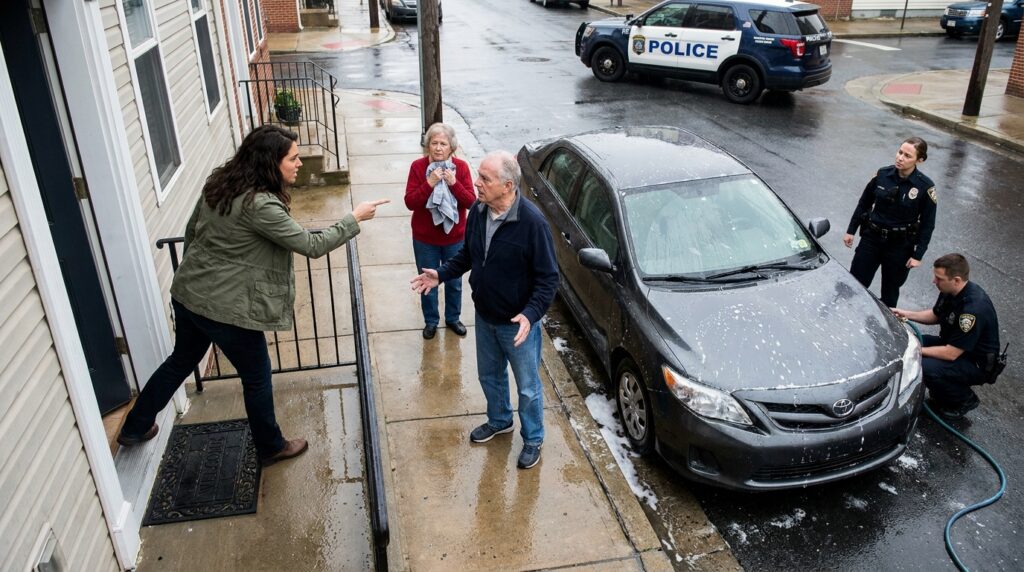
The marked municipal SUV did not bounce as its front passenger tire bumped the curb. It rolled to a heavy, dripping stop six feet behind Arthur’s dark gray sedan, its low-beam headlights cutting two yellow cones through the fine morning mist. Through the rain-beaded windshield, Officer Teresa Diaz sat with both hands resting on the wheel, her eyes sweeping the driveway before she even unlatched her belt.

Brenda did not wait for the cruiser’s door to swing open. She took two sharp, deliberate steps toward the street, her green utility jacket rustling like stiff paper. She raised the black leather binder high against her ribs, holding it out as if presenting evidence to a court that had already convened on the wet asphalt.

“Officer,” Brenda called out, her voice hard and ringing against the brick row houses across the lane. “I’m the reporting party. I called in the drainage violation and the obstruction of the pedestrian easement.”

Officer Diaz pushed the heavy door wide. The metal hinge gave a dry, ungreased groan as she swung her boots onto the street. She didn’t rush. Her navy uniform was crisp, the silver badge pinned over her left breast pocket glinting under the dull gray clouds. She stood up, resting one hand lightly on the heavy duty belt at her hip, her gaze shifting from Brenda’s stiff jaw down to the wet bucket pinned beside Arthur’s rear tire.

Behind her, the passenger door opened. Officer Marcus Vance stepped out, his tall, athletic frame moving with easy, unhurried balance. He glanced at the hose lying coiled like a black snake near the spigot, then looked past Brenda to Arthur and Eleanor.

“Ms. Vance,” Officer Diaz said, her tone cool and measured. She didn’t approach Brenda’s outstretched binder. Instead, she walked to the center of the driveway apron, her boots making a soft slap-slap against the wet concrete. “You reported an active physical altercation and an unpermitted commercial discharge.”

“Look at the gutter,” Brenda demanded, gesturing wildly toward the thin line of foam trickling toward the storm grate. “He’s using unmetered residential water to wash a commercial vehicle fleet! He’s running a car-wash operation right out of his garage!”

Arthur took a half-step forward, his old work boots creaking. “It’s one sedan, Officer. My personal car. I’m wiping off the road salt before we drive across town for my granddaughter’s party.”

“It’s not just today!” Brenda snapped, her arm shaking slightly under the weight of the thick binder. She slapped her palm against the front cover, causing a plastic sleeve to bulge outward. The flap popped open, exposing the thick stack of lined white paper inside.

Arthur’s eyes caught the top sheet. It was a dense, single-spaced ledger written in tight, mechanical handwriting. Timestamp after timestamp was inked down the margin in blue ballpoint: 04/12 – 07:14 AM: Unlawful curb park, 04/19 – 08:02 AM: Unmetered water usage, 04/26 – 07:45 AM: Hose left pressurized on sidewalk, 05/03 – 08:10 AM: Bucket left unattended.

There were forty-seven entries. Forty-seven individual logs detailing every single Saturday morning Arthur had walked out onto his own driveway with a sponge and a bucket for the past year.

The scope of it hit Arthur in the chest like a cold blast from a broken water main. This wasn’t a sudden burst of temper over soap suds. This was a systematic, obsessive ledger of his life, compiled week after week while he thought he was just keeping his old sedan clean.

“Forty-seven times,” Brenda barked, her voice cracking slightly as she thrust the ledger closer to Diaz’s chest. “I’ve documented forty-seven separate code infractions on this property alone! I’ve filed three formal written petitions with code enforcement, and nobody has issued a single citation! You have to cite him today! It’s on video! I have time-stamped photos!”

Officer Diaz didn’t take the binder. She didn’t even look at the handwritten ledger. She stared directly into Brenda’s eyes, her face completely unreadable.

“Ms. Vance,” Diaz said, her voice dropping into a register so quiet that even the dripping gutters seemed to hush. “Do you know how many times our dispatch has answered a call from your number this month?”

Brenda’s jaw worked silently for a second, her fingers tightening on the leather cover until the brass ring binders inside gave a metallic clack. “I am a tax-paying resident enforcing neighborhood standards—”

“Fourteen times, Ms. Vance,” Diaz interrupted smoothly. “Fourteen calls in twenty-two days. For garbage cans left out two hours past noon. For hedge trimmings on the public walk. And now, for a man washing his own quarter panel on a Saturday morning.”

Eleanor shifted beside Arthur, her hand reaching out to catch the sleeve of his navy jacket. The red towel hung limply between them, its cotton fibers damp with the mist hanging in the air.

“We know the address, Ms. Vance,” Officer Vance added from the rear of the cruiser, his voice quiet as he leaned against the hood, watching the green utility jacket tremble. “We know the log.”

Brenda stood frozen on the expansion joint, her boot still planted across the property line, as the full weight of the officers’ presence settled over the wet street.

CHAPTER 5: THE THRESHOLD OF THE LAW

Officer Diaz took one more step forward. The heavy leather of her utility belt creaked against the brass restraint clips at her hip, a dull, metallic friction that seemed to anchor her to the damp asphalt. Her shadow fell long and flat across the wet apron, covering the scuffed toe of Brenda’s utility boot.

“Fourteen calls,” Officer Diaz repeated, her voice unhurried, holding the flat, grinding cadence of someone who had spent twelve-hour shifts listening to civil complaints over dispatch crackle. “And every time my unit drives down Maple Street, we find a woman standing on the easement with a binder.”

Brenda did not drop her arms, but her shoulder muscles tightened until the seams of her green utility jacket strained. “I am documenting violations. That is my right as a property owner. Section 14-B—”

“Section 14-B,” Officer Diaz interrupted, stepping sideways to place her body directly between Brenda and the driveway apron, “applies to commercial fleet maintenance discharging petroleum derivatives into storm drains. I see a ten-year-old sedan, a plastic tub, and a bucket of water.”

“It’s runoff!” Brenda’s voice pitched upward, harsh and thin against the wet brick walls of the townhouses. “It crosses the curb! It enters the public channel!”

Arthur stood three feet back, his right hand still resting on the cold, pitted plastic rim of his four-gallon tub. The water inside had settled, reflecting the overcast gray sky like a dull piece of lead. Beside him, Eleanor didn’t move an inch. Her small frame remained anchored beside the sedan’s rear door, her fingers dug deep into the folds of the red flannel towel.

Arthur looked down at the binder still gripped in Brenda’s left hand. The plastic sleeve holding her handwritten entries had billowed open, and beneath the forty-seven logged citations, his eyes caught the faded purple ink on the index card tucked into the binder’s lining: 2014-CR-089.

He remembered that case number now. It wasn’t a code violation or a commercial permit dispute. In the summer of 2014, the city had run a fatality investigation on the blind S-curve two blocks past the development—a hit-and-run where a speeding pickup had clipped a boy on a bicycle before taking off toward the highway. The city council had spent six months debating speed humps, streetlights, and sightline obstructions along the curb. Nothing had ever been built.

“Arthur,” Eleanor whispered, her voice barely carrying over the hum of the idling police SUV. “Look at her hands.”

Brenda’s knuckles were white, locked around the binder’s spine so hard the vinyl was creasing into sharp, gray ridges. Her eyes weren’t fixed on Officer Diaz’s badge or Arthur’s wash bucket anymore; they were pinned on the narrow strip of asphalt between the sedan’s front tire and the curb—a strip of road that was completely clear, completely visible, and completely free of parked obstructions.

“I need your identification, Ms. Vance,” Officer Diaz said calmly, pulling a small leather notebook from her shirt pocket.

“My identification?” Brenda’s chest heaved once, a shallow, ragged breath. “I called you. I am the complainant!”

“And you are currently standing past the public easement, obstructing the sidewalk, and making a false report regarding a commercial operation,” Officer Diaz said, her pencil hovering over the paper. “I can either review your ID here, or we can discuss the misuse of the non-emergency line at the station.”

Officer Vance stepped up from the rear of the cruiser, his tall frame blocking the street view behind Brenda. He didn’t draw a tool or raise his voice; he simply stood there, an immovable wall of navy blue polyester and polished leather, shifting the balance of the entire block.

Brenda looked from Diaz to Vance, then back to Arthur. For the first time since she had marched onto the concrete apron, her forward momentum stalled. She didn’t reach into her jacket for her wallet. She took one slow, reluctant step backward, her scuffed boot sliding off the concrete apron and dropping into the wet asphalt gutter with a soft splash.

Arthur gripped the yellow sponge in his hand, feeling the cold water squeeze through his fingers, knowing that while the immediate threat of a citation had evaporated, the deep, jagged crack running through their neighborhood had just opened wider.

CHAPTER 6: THE DISPATCH AT THE GUTTER

Officer Vance didn’t take out his ticket book. His boots made a wet, heavy crunch against the gravel grit as he walked past Brenda, ignoring the black leather binder she still held pinned to her ribs like a shield. He stepped over the property apron’s expansion joint, his eyes sweeping the dark gray sedan’s rear quarter panel where the soapy film had begun to dry into pale, cloudy streaks under the morning mist.

“You’re using castile, right?” Officer Vance asked. His voice was low, devoid of the official sharp edge Officer Diaz maintained. He crouched by the sedan’s rear wheel, his knees popping with a quick, metallic snap that sounded like a ratchet wrench turning in a cold garage.

Arthur blinked, his fingers still wrapped around the yellow sponge. “Vegetable base. Zero phosphate. Same stuff I used at the municipal pumping station for thirty years.”

“Pumping station on 8th?” Vance picked up the brass nozzle attached to Arthur’s green garden hose. The fitting was pitted and dark with patina, the threading worn smooth by four decades of Saturday mornings. “My uncle worked maintenance there back in the nineties. Said the pressure valves on the main lines used to chatter like teeth every time the river swelled.”

“That was the old cast-iron intake,” Arthur said, the tightness in his chest easing half a fraction as the officer tested the brass valve with his thumb. A thin thread of clear water trickled onto the wet concrete. “We replaced the seat gaskets in ninety-six. Never leaked a pint after that.”

Behind them, Brenda took another half-step forward from the gutter, her scuffed utility boot splashing into a puddle of runoff. “Officer, you are fraternizing with an active offender! The drainage compliance ordinance—”

“Ms. Vance,” Officer Diaz interrupted without looking back from her small leather notebook. She stayed planted directly in front of the sidewalk path, her boots forming an immovable angle between Brenda and the house. “I am logging your dispatch call right now. Non-emergency line, eight-fourteen AM. Claim: commercial vehicle operation, environmental hazard, physical intimidation.” She clicked her ballpoint pen shut. “None of which exists on this driveway.”

“It’s the visibility!” Brenda’s voice cracked, dropping its stiff, bureaucratic cadence and exposing a raw, ragged edge underneath. Her thumb dug into the binder’s edge so hard the clear plastic sleeve crumpled against the paper logs. “If people park along the apron, if they set up buckets and hoses, drivers coming around the bend can’t see the curb line! The sightline is blocked! You can’t see what’s crossing the street until it’s under the wheels!”

Arthur froze. The sponge in his hand felt suddenly heavy, cold water dripping down his wrist and soaking into the fraying cuff of his navy jacket. He looked past Brenda’s green jacket toward the quiet asphalt bend two hundred feet down Maple Street. It wasn’t about the soap. It wasn’t about the three-quarter-inch hose or the municipal code.

He stared at the faded purple stamp visible through the binder’s plastic cover—2014-CR-089. Twelve years ago. A rainy Tuesday morning on an unmonitored curve. A boy on a bicycle, a hit-and-run driver who never tapped the brakes, and an intersection that the city council had deemed “low priority” for traffic calming measures.

“Brenda,” Arthur said quietly, his voice dropping into the low, gravelly register he used when explaining a broken main to a panicked homeowner. “The sedan isn’t blocking the sightline. It’s six feet back from the curb.”

“It’s on the lane!” she snapped, her eyes wide, pinned on the damp asphalt where the water was creeping toward the iron grate. “Everything on this street moves too fast! Nobody looks! Nobody stops!”

Officer Vance didn’t comment on the curve or the binder. He stood up from his crouch, holding the brass hose nozzle in his right hand. He looked down at the wash bucket, then turned his gaze to Arthur with a slight, knowing nod.

“Mind if I give this side a rinse, Mr. Miller?” Vance asked, his thumb resting over the brass trigger. “Looks like the soap’s starting to set on your paint.”

Arthur stood motionless, the yellow sponge limp in his palm, as the full, suffocating weight of Brenda’s twelve-year obsession hung over the wet street like smoke.

CHAPTER 7: THE CLEAR STREAM ON CLEAN GLASS

Officer Vance squeezed the brass lever. The hose hissed, a sharp spray of high-pressure water fanning out across the dark gray sedan’s rear quarter panel. The gray soap film shattered instantly, swirling into white riverlets that pooled around his boots before running down the asphalt slope toward the street gutter.

Arthur didn’t move to take the hose back. He stood on his apron, his knuckles wet and raw from the morning air, watching the young officer kneel on the damp concrete. Vance’s navy uniform pant leg brushed against the wet tire tread, but he didn’t care. He adjusted the spray with a turn of his wrist, sweeping the nozzle systematically from the roofline down to the rocker panel, rinsing away the salt and grit.

Brenda took a ragged step out of the gutter, her scuffed utility boot landing hard on the concrete apron. Her hands shook against the black binder, the plastic sleeves rustling like dry corn husks.

“Officer!” Her voice cracked, a high, strained screech that made a porch screen door click open two houses down. “You are assisting him! You are participating in a civil code violation! I am filming this! I am filing a formal grievance with the police commission!”

Officer Diaz stepped directly into Brenda’s path, her tall frame blocking the phone camera Brenda tried to raise with her trembling right hand. Diaz didn’t reach for her baton or her cuffs. She simply stood six inches from Brenda’s chest, her silver badge catching the dull gray glare of the morning clouds, her face set like carved granite.

“Ma’am,” Officer Diaz said, her voice dropping into a register that carried straight across the street to the watching neighbors on their second-story porches. “They’re doing nothing wrong—we’re helping them finish.”

The words hung in the cold air, heavy and unyielding. Down the block, a door latch clicked shut. Across the street, old Mr. Henderson leaned over his porch rail, nodding slowly as he watched the scene play out on Arthur’s apron.

Brenda’s arm froze in midair. The phone screen stayed black. The forty-seven pages of single-spaced logs, the yellowed permit copies, the hand-ruled grids—the entire fortress of paper authority she had spent twelve years building out of grief and control—collapsed in a single second. The police weren’t her enforcement arm. They weren’t going to cite Arthur. They weren’t going to turn the neighborhood into a fortress of citations to keep the ghost of a rainy Tuesday morning at bay.

“We have reviewed the curb clearance,” Diaz continued, her pencil tapping twice against her small leather notebook. “The vehicle is parked legally. The water runoff contains no toxic contaminants. There is no obstruction of the public easement.” She paused, her eyes locking onto Brenda’s pale, twitching face. “If you dial dispatch again today regarding this property, Ms. Vance, I will personally file charges for misuse of emergency services and public nuisance.”

Officer Vance released the brass lever. The water stopped with a soft thunk inside the hose. The dark gray sedan stood gleaming under the overcast sky, its paint smooth, clear, and completely free of salt.

Arthur stepped forward, his hand extending instinctively toward the hose. Eleanor stood right beside him, her red flannel towel still held firm, her shoulders squared against the cool breeze blowing off the river.

Officer Diaz turned slightly, gesturing toward the narrow walkway leading to Brenda’s front door. “Ma’am,” she said, her voice quiet but carrying the absolute weight of municipal authority. “Please step aside and let them through.”

Brenda looked at Arthur. Her mouth opened, but no words came out—only a thin, dry rasp of air. She pulled her binder tight against her stomach, turned her heels, and stumbled backward up her concrete steps, her green jacket disappearing into the shadow of her dark entryway as the door slammed shut behind her.

CHAPTER 8: THE PEACE AT THE BORDER

The slam of the entryway door echoed down the brick alleyway between the townhouses, sharp as a dry branch snapping underfoot. Then the street fell completely silent, save for the steady, rhythmic drip of rain gathering on the sedan’s side mirror.

Officer Vance handed the brass hose nozzle back to Arthur. The metal was still cold, wet with condensation, but the brass threads turned smoothly in Arthur’s thick, calloused palm. Vance wiped his wet hands against the thighs of his navy trousers, his eyes sweeping the clear, bead-covered hood of the gray sedan one last time.

“She won’t be calling dispatch again today, Mr. Miller,” Vance said quietly. “Or next Saturday.”

Officer Diaz walked back toward the cruiser, her heavy boots making a slow, steady thrum against the wet asphalt. She paused at the driver’s door, looking back over her shoulder at Arthur and Eleanor. Her gaze lingered for a second on the red flannel towel Eleanor still held tightly against her sweater, then shifted to the four-gallon plastic bucket sitting beside the sedan’s rear wheel.

“Have a good party for your granddaughter, Mr. Miller,” Diaz said. She didn’t offer a salute or a formality; she simply gave a single, firm nod of her head before sliding behind the wheel of the cruiser.

The police SUV pulled away from the curb with a low, throaty rumble, its tires leaving two dark, wet tracks along the rain-slicked asphalt of Maple Street. Down the block, old Mr. Henderson stepped back from his porch rail, pulling his coat tight around his shoulders as he gave Arthur a long, silent raise of his coffee mug before stepping back inside.

Arthur turned off the brass spigot at the house wall. The iron handle gave a familiar, satisfying clack as the valve seated deep inside the copper pipe, cutting off the water flow completely. He unhooked the brass nozzle and drained the remaining water from the green hose, coiling the rubber tightly around the iron wall hook he’d screwed into the foundation forty years ago.

Eleanor stepped off the concrete apron onto the wet driveway. She didn’t say a word about Brenda, or the binder, or the forty-seven logged entries resting behind the closed door next door. She simply unfolded the red flannel towel, laid it flat against the sedan’s wet roof, and began to wipe down the glass in long, steady, rhythmic strokes.

Arthur picked up the yellow sponge, dropped it into the plastic tub, and carried the bucket to the lawn edge, pouring the gray, soapy water out onto the grass roots where the castile soap would sink harmlessly into the earth. As the water drained away into the soil, he looked down the quiet street toward the blind S-curve two blocks away.

The road was clear. The asphalt was wet and gray, reflecting the overcast morning sky like a mirror. No sirens sounded, no binders rattled, and no scuffed boots blocked the path.

Arthur walked over to the driver’s side door, took the dry corner of the flannel towel from Eleanor’s hand, and together they finished wiping down the clean glass before getting into the car.

Similar Posts

Leave a Reply

Your email address will not be published. Required fields are marked *