They Returned Lucky Twice as “Too Clingy” Then a Widow Asked for Him by Name
CHAPTER 1: The Shadow in the Hall
The silence in Marianne’s house had a weight to it, like a dusty quilt that had been folded for too long. It sat in the corners of the kitchen and settled over the empty chair where Arthur used to read the morning news. For three years, the only thing that broke that stillness was the rhythmic, metallic squeak-thump of her walker against the linoleum.
Then came the ginger-and-white shadow.
On his first afternoon, Lucky didn’t hide under the bed or tuck himself behind the sofa like the shelter volunteers said a “normal” cat might do. Instead, he sat precisely four feet away from Marianne’s walker, his amber eyes locked onto her ankles. When she took a step, he took a step. When the metal frame of her walker let out its signature squeak, Lucky’s tail gave a sympathetic, grounding twitch.
Marianne noticed it first in the kitchen. She was reaching for the chamomile tea, her fingers stiff with the morning’s dampness. As she turned, a small, warm weight brushed against her shin. It wasn’t the frantic, tripping-hazard leap of a kitten, but a steady, deliberate lean. Lucky wasn’t trying to get somewhere; he was simply making sure she was still there.
“Well, aren’t you a persistent little thing?” she whispered. Her own voice sounded loud in the kitchen, a stark contrast to the months of speaking only to the evening news or the grocery clerk.
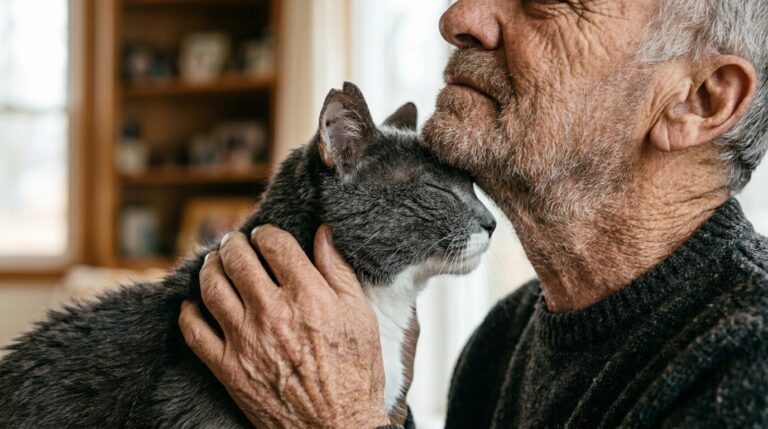
Lucky didn’t meow. He didn’t demand a treat or claw at the cabinets for attention. He simply sat on her feet, the heat of his body soaking through her thin floral slippers. To the families who had returned him, this was a defect—a shadow that refused to leave. But to Marianne, it felt like a tether.
From Lucky’s perspective, the world was a fragile place where people tended to vanish when doors clicked shut. He watched the silver-haired woman with a focus that bordered on prayer. The scent of her—lavender and old paper—was the only solid thing in a world that had rejected him twice for the crime of wanting to stay close.
He didn’t understand the concept of a “bathroom” or a “bedroom.” He only understood the Gap. The Gap was the space between him and his person, and it was a space that needed to be closed at all costs. To him, every step she took was a promise he had to keep.
By the third day, the pattern was set. If Marianne went to the mailbox, Lucky was a silent sentinel by the front window, his nose pressed to the glass until the door creaked open again. If she sat in her recliner to watch the ballgame, he was on the footrest, his chin resting on the hem of her trousers. He wasn’t just a pet; he was a silent partner in the business of getting through the day.
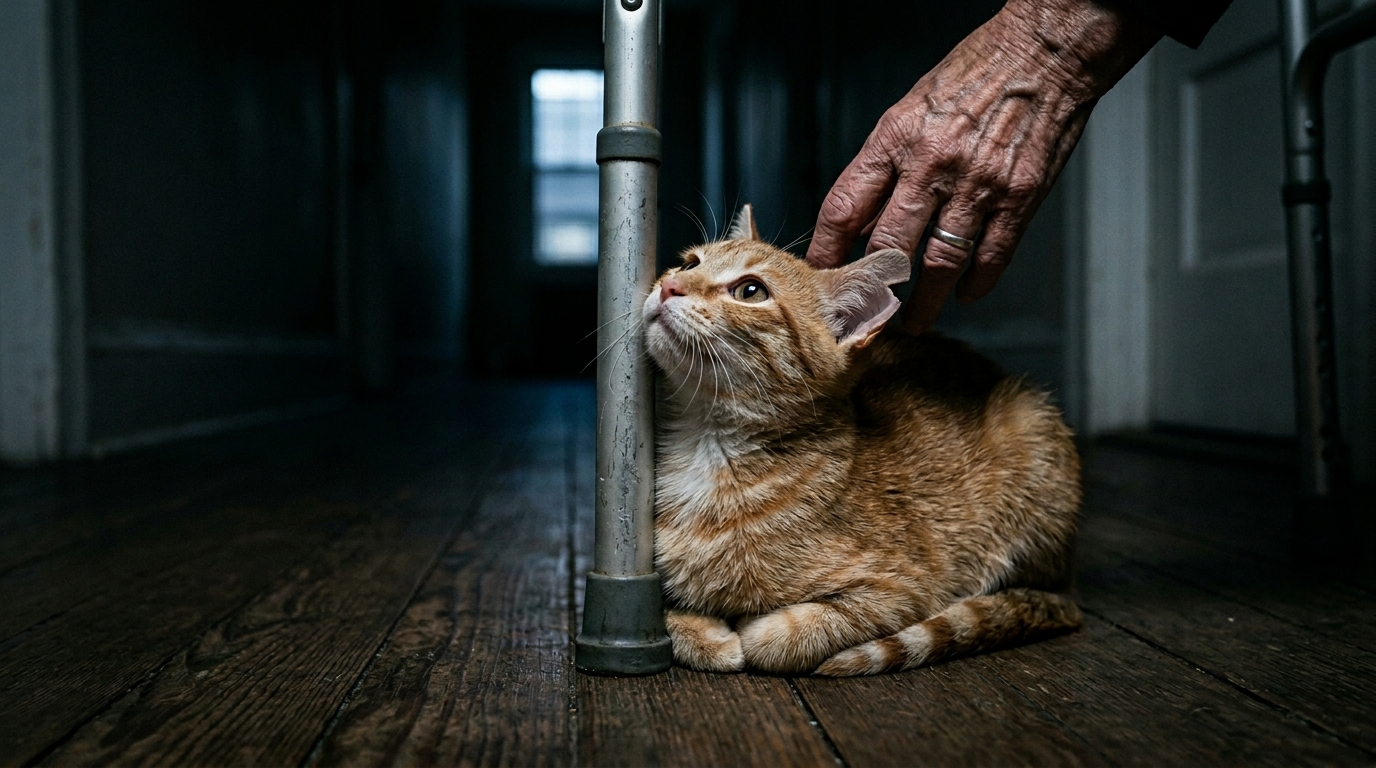
One evening, Marianne forgot to bring her water glass to the bedside table. She stood up from her bed, her joints groaning in the dark of the midnight hour. She didn’t turn on the light, thinking she knew the path by heart. But as she gripped the handles of her walker, she felt a familiar vibration.
It wasn’t coming from the floor, but from the metal legs of her walker.
Lucky had followed her into the dark. He was pressing his side against the cold aluminum, purring so deeply that the metal itself seemed to hum. It was a rhythmic, grounding sound that cut through the loneliness that usually settled in after the sun went down.
Marianne stopped in the middle of the hall. She looked down at the pale patch of white and orange fur at her feet. For the first time in three years, the house didn’t feel like a museum of things she used to have. It felt like a home where something was happening right now.
“You’re not clingy, are you?” she murmured, reaching down to find the soft notch in his ear. “You’re just making sure I don’t drift away.”
Lucky looked up, his eyes catching the sliver of moonlight from the hallway window. He didn’t look away, and he didn’t blink. He just leaned harder into the metal walker, his purr intensifying until it filled the small space.
Marianne realized then that she wasn’t just a woman with a cat. She was a woman with a shadow that had a heartbeat. And for the first time since the funeral, the silence didn’t feel like a weight. It felt like a shared secret.
As she finally climbed back into bed, she felt the slight dip at the corner of the mattress. Lucky hadn’t waited for an invitation; he had simply claimed his spot near her feet, a warm, breathing anchor in the dark. She fell asleep listening to the soft, rhythmic puff of his breath, a sound that told her the morning would come, and she wouldn’t have to face it alone.
But the next morning, the quiet of the neighborhood was broken by a different kind of noise—the sound of voices on the other side of the screen, and the realization that not everyone saw their bond as a blessing.
Next up in Chapter 2: Marianne discovers that the rest of the world has a very different opinion on Lucky’s devotion, and the “too old” whispers begin to reach her front porch.
CHAPTER 2: The Cold Breath of the World
“You really should see this, Marianne,” Gladys said, her voice pitched in that high, thin register people use when they’re about to deliver bad news they actually enjoy sharing.
She thrust the phone toward Marianne’s face. On the screen was a photo—blurry but unmistakable. It was Lucky, curled on the footrest of the recliner, his head resting on Marianne’s ankles. The caption from the shelter was sweet enough: Lucky found his person. But it was the scroll of text beneath the image that made the room feel suddenly smaller.
Marianne squinted through her bifocals. Her heart, usually steady and slow like an old clock, gave a sharp, indignant thump.
“Why would they give a cat with separation anxiety to someone that old?” one comment read. “It’s irresponsible. What happens when she falls or ends up in a home? That cat will be traumatized all over again.” Another person had written: “That cat doesn’t need a lap; he needs a vet and Prozac. Giving him to a senior is just setting him up for another return.”
Marianne felt a flush of heat crawl up her neck. It wasn’t just the word old that stung, though it felt like a slap in a house that usually treated her with quiet respect. It was the clinical way they talked about Lucky. They spoke as if he were a defective toaster, a “problem” to be managed by experts, rather than a living soul who had finally stopped shaking.
“The whole neighborhood is talking, dear,” Gladys added, her eyes darting to Lucky. “People are worried. You know how ‘clingy’ cats can be. They’re saying it’s a lot for a woman your age to handle. Especially a… well, a special needs case like this one.”
Lucky didn’t know about the internet. He didn’t know about “viral posts” or the opinions of strangers in distant cities. But he knew the scent of Marianne’s sweat had changed from the sweet, faded smell of tea to the sharp, acidic tang of distress.
He felt the tension in her hand as it gripped the handle of her walker—a white-knuckled vibration that traveled down the aluminum and into the floor. He didn’t retreat. Instead, he moved. He paced a tight, protective figure-eight around Marianne’s ankles, his fur brushing against the hem of her housecoat. To a stranger, it looked like a symptom. To Lucky, it was a calibration. He was trying to absorb the static she was giving off, pressing his ribcage against her shin to offer the steady rhythm of his own lungs.
Marianne looked down at him. She looked at the nick in his ear and the way he refused to look at Gladys, keeping his focus entirely on his person.
“Is that right?” Marianne said, her voice trembling just enough to make her angry. She straightened her shoulders, moving with a deliberate slowness that signaled the end of the conversation. “They’re worried about what happens when I fall? Or when I’m ‘gone’?”
“Well,” Gladys hedged, looking a bit taken-back by the steel in Marianne’s tone. “They’re just thinking of the animal, Marianne. It’s a lot of responsibility. A cat that follows you into the bathroom… it’s not normal. It’s a burden.”
“He isn’t a burden, Gladys,” Marianne said, her hand finally dropping from the walker to find the top of Lucky’s head. “He’s an escort.”
When Gladys finally left, the house felt colder. Marianne sat in her recliner, but she didn’t turn on the ballgame. She stared at the empty space where Arthur’s chair used to be. The comments on the screen played on a loop in her mind. Traumatized all over again. Setting him up for failure. Too old.
Was she being selfish? The question gnawed at her. She was seventy-eight. Her knees ached when it rained, and her world had shrunk to the size of this zip code. Lucky deserved a long life. He deserved a family with children who would run with him for twenty years. If she kept him, and her time ran out, would he end up back in that cold metal cage, wondering why the lavender-scented woman had vanished like all the others?
Lucky jumped onto the footrest. He didn’t wait for her to settle. He pressed his forehead against her knee, a firm, insistent pressure. He wasn’t asking for food. He wasn’t asking for play. He was asking for her to come back from wherever her mind had gone.
Marianne looked into his amber eyes. She saw the reflection of her own tired face, but she also saw something else—a stubborn, unyielding recognition. He didn’t want a “long-term plan” or a “statistical guarantee.” He wanted the person who was in the room now.
But as she stroked his back, her gaze drifted to the rug in the hallway—the one with the corner that always curled up just a little too much. The “world” said she was a danger to him. And for the first time, as she looked at that rug, she felt a flicker of the very thing they were all talking about: fear.
CHAPTER 3: When the World Tips Over
The morning started with a stubborn sort of pride. Marianne had spent half the night rehearsing arguments against the people on the computer screen. To prove them wrong, she decided she would be more than just “fine”—she would be efficient. She would tackle the laundry, the dusting, and the kitchen floor, all before the mail arrived.
She moved through the house like a captain on a deck, her walker clicking with a sharp, determined rhythm. Lucky was there, of course. He didn’t seem to care about her newfound mission; he only cared that she was vertical. He paced alongside her, occasionally pausing to lean his weight against the wheels of the walker, a silent anchor in her sea of chores.
“I’m not going anywhere, Lucky,” she told him, though the words were really for herself. “See? I’m as steady as a rock.”
She avoided the hallway rug for two hours. It was a small, braided thing Arthur had bought at a craft fair years ago, its edges now slightly curled and treacherous. She had planned to fix it, to tape it down or throw it out, but it was a piece of the life she used to have.
By noon, the clouds had moved in, turning the golden October light into a flat, gray afternoon. Marianne headed toward the kitchen for a glass of water, her focus momentarily shifting to the ticking clock on the wall. She was tired, her knees singing with that familiar, dull ache.
It happened in a heartbeat.
The front right leg of the walker caught the lip of the rug. For a second, time stretched like taffy. Marianne felt the handles slip from her grip. She reached for the wall, her fingers grazing a framed photo of the Grand Canyon, but gravity was faster than seventy-eight-year-old reflexes.
The world didn’t crash; it simply tipped. She went down on her side, her hip meeting the floor with a hollow thud that seemed to vibrate through the very foundation of the house. The walker skittered away, landing with a loud, metallic clang against the baseboards.
Then, there was the silence. The heavy, suffocating silence of a house where no one else is breathing.
Lucky didn’t see a fall; he saw the end of the world. The tall, steady source of his safety—the one who smelled of lavender and brought the morning light—had suddenly collapsed into a heap of limbs and fabric. The sound of the metal walker hitting the wall sent a jolt of primal fear through his spine, his fur standing on end as he skidded across the linoleum.
He didn’t hide. He didn’t run to the basement. The bond that people called “clingy” was now a frantic, electric wire connecting him to the figure on the floor. He circled her, his paws dancing around her head. He let out a sound he had never made before—a sharp, ragged yowl that wasn’t a request for food, but a demand for a response. He leaned his face into hers, his wet nose pressing against her cheek, searching for the heat of her breath.
“Oh… oh, Lucky,” Marianne whispered. The pain in her hip was a white-hot bloom, making her breath come in short, shallow gasps. She tried to roll over, to find purchase on the floor, but her body felt like it belonged to someone else. It was heavy, uncooperative, and frighteningly still.
She looked toward the front door. It was locked. The curtains were drawn against the gray afternoon. The neighbors were inside their own warm houses, watching their own televisions. She was on the floor, hidden by the sofa, and the phone was miles away on the kitchen counter.
“Help,” she tried to call out, but it came out as a ragged sob.
Lucky felt the vibration of her fear. It was a cold, sharp thing. He realized the lavender woman couldn’t get up. He looked at the heavy wooden door, then back at Marianne. The panic that usually made him cry at closed doors now had a direction.
He didn’t sit and wait. He began to run.
He threw himself at the front door, scratching at the wood until his claws clicked like rain. Between the scratches, he let out a relentless, piercing yowl—a sound that carried through the thin glass of the sidelight and out into the quiet street. It was the sound of a creature who refused to be ignored.
Across the street, Sarah, a younger neighbor who usually walked her Golden Retriever around this time, stopped in her tracks. She looked toward Marianne’s house. She knew Marianne lived alone. She knew the cat was “the clingy one” from the shelter’s post. But this sound wasn’t the cry of a lonely cat. It was a siren.
Lucky didn’t stop. His chest was heaving, his throat raw. Every time he heard a footstep on the porch or a rustle in the leaves, he doubled his effort. He was a tiny, orange-and-white alarm system with no off switch. He paced from the door to Marianne and back again, his tail a frantic whip, until he heard the magic sound: the jingle of keys and a human voice.
“Marianne? Marianne, are you in there?”
Lucky didn’t back away when the door swung open. He stood his ground, pointing the way with his entire body, his eyes wide and unblinking.
As Sarah rushed to Marianne’s side, calling 911 on her cell phone, the room filled with the chaos of rescue. But amidst the noise, Marianne felt a small, warm pressure against her good side. Lucky had squeezed himself into the narrow space between her and the floor. He wasn’t crying anymore. He was purring—a deep, desperate rumble that felt like a heartbeat against her ribs.
“He didn’t leave me,” Marianne whispered as the sirens began to wail in the distance. “The ‘problem’… he stayed.”
She looked at the curling rug, now bunched and messy on the floor. The world had tipped over, just like the experts said it would. But as she gripped the fur on Lucky’s neck, she knew the experts had missed the most important part of the story.
CHAPTER 4: The Language of the Lost
The living room felt different now. It was no longer just a place of quiet memories; it felt like a battlefield where a small victory had been won. Marianne sat in her recliner, a heating pad draped over her hip, watching the late afternoon sun stretch across the carpet.
Lucky was not on the footrest today. He was tucked into the crook of her arm, his weight a steady, warm pressure against her ribs. He seemed to be vibrating with a purr so intense it felt like he was trying to stitch her back together from the outside in. Every time she shifted or let out a soft sigh of discomfort, his ears would swivel, and he would let out a tiny, questioning mrrp.
Sarah sat on the sofa opposite them, holding a mug of tea she’d insisted on making. She looked at Lucky, then at Marianne, her expression a mix of awe and lingering adrenaline.
“I keep thinking about it, Marianne,” Sarah said, her voice dropping to a whisper. “What would have happened if I hadn’t been walking Buster right then? If I’d decided to take the long way around the block?”
“I don’t like to think about it,” Marianne admitted, her hand trembling as she stroked Lucky’s ears. “I just thought he was scared. I thought he was just being… what the people on that website said. Clingy.”
Sarah shook her head slowly, setting her mug down on the coaster. “No. That wasn’t fear, Marianne. That was a mission. You didn’t see him from the outside. You didn’t hear what I heard.”
Lucky sensed the shift in Sarah’s voice—the sharp, staccato rhythm of a human telling an important story. He didn’t trust the stranger entirely, but he recognized the scent of the woman who had brought the “help” when his person was on the floor. He narrowed his eyes, leaning his chin more firmly against Marianne’s collarbone. To him, the house was finally safe again, but the perimeter had to be maintained. He wasn’t watching the door for himself; he was watching it for the heartbeat beneath his paws.
“I was halfway across the street,” Sarah continued, her eyes wide. “And I heard this sound. It wasn’t a normal cat meow. It was… it was a siren. It was rhythmic, loud, and it didn’t stop for breath. It sounded like he was trying to break through the glass with his voice.”
She leaned forward, her hands animated. “I looked up and saw him through the sidelight by your door. He wasn’t just crying. He was throwing his body against the wood, then running back into the hallway, then coming back to the door. He was pacing a path. He was literally showing me where you were before I even got inside.”
Marianne felt a lump form in her throat. She pictured the “problem” cat—the one rejected for being too needy—turning his greatest insecurity into a lifeline. “He didn’t hide?”
“Hide?” Sarah laughed, though there were tears in the corners of her eyes. “Marianne, he nearly tripped the EMTs because he wouldn’t get out of the way until they were kneeling right next to you. He was like a tiny, orange-and-white bodyguard. One of the medics told me he’d never seen anything like it. He said, ‘That cat isn’t anxious; he’s invested.'”
The word invested hung in the air, heavier and more beautiful than the word independent could ever be.
“The things they said online,” Marianne whispered, thinking of Gladys and the cruel comments. “They said his behavior was a defect. They said he was broken because he couldn’t stand to be alone.”
“Maybe he knew you shouldn’t be alone either,” Sarah said softly. “Maybe he wasn’t crying because he was weak. Maybe he was crying because he knew exactly what was at stake.”
Later that evening, after Sarah had gone and the house settled into its usual twilight, Marianne looked at the hallway rug. Sarah had moved it to the garage, leaving the floor bare and safe. The “danger” was gone, but the vulnerability remained.
Marianne looked down at Lucky, who was now groomed and sleek, his amber eyes reflecting the soft glow of the lamp. She realized that the “experts” were right about one thing: Lucky couldn’t handle being alone. But they were wrong about why. It wasn’t a flaw in his character; it was a choice of his heart.
She reached out and picked up her phone. She didn’t look at the comments. Instead, she began to type a message to the shelter, her fingers sure and steady. She had a reveal of her own to share, but as she began to write, a new thought struck her.
A shadow moved across the window—Gladys, walking her own dog, pausing to peer at the house. The world was still watching, still waiting for Marianne to fail. And as Lucky lifted his head, a low, protective growl vibrating in his throat, Marianne realized that the final battle wasn’t about the fall. It was about who got to decide what a “good life” looked like.
CHAPTER 5: Exactly Enough
The first frost of November had traced delicate, fern-like patterns on the kitchen windows, silvering the edges of the world outside. Inside, the house was warm, smelling of cinnamon toast and the faint, clean scent of cedarwood. Marianne sat at the oak table, her hip only giving her a dull, occasional reminder of the fall.
She had cleared away the breakfast dishes, but she hadn’t moved to start her chores. Instead, she had a single sheet of heavy cream stationery in front of her and a pen that Arthur had given her for their fortieth anniversary. She wasn’t looking at the screen of a phone or a computer; she was looking at the ginger-and-white cat sitting on the chair directly opposite her.
Lucky sat tall, his paws tucked neatly under his chest. He wasn’t leaning on her ankles or crying at the door. He was simply watching the movement of the pen, his amber eyes following the silver clip as she clicked it open. There was a profound stillness in him—the kind of quiet that only comes when a creature finally realizes the ground beneath him isn’t going to vanish.
Marianne began to write. Her handwriting was careful, the loops of the letters steady despite the chill in the air. She didn’t write to the “internet” or the “experts.” She wrote to the young woman at the shelter desk who had looked at Lucky with such pity on that first Tuesday.
“Dear Friends,” she began. “I am writing to tell you that Lucky is doing more than just ‘fitting in.’ He is teaching me how to live in a house that I thought was empty.”
Lucky shifted, his ears twitching at the scratch of the nib on paper. He didn’t understand the words, but he understood the environment of the room. The air was thick with the scent of “settled.” His person wasn’t preparing to leave; she wasn’t radiating the sharp, cold static of grief or the frantic heat of a fall. She was focused, her heartbeat a slow, rhythmic drum that he could feel even from two feet away. He blinked at her slowly, a long, deliberate closing of his eyes—the feline equivalent of a deep, satisfied sigh.
He didn’t need to be touching her every second now. The “shadow” had found its place in the light. He knew that if she stood up, he would go with her, and if she sat down, he would be there. The panic of the “Gap” had been replaced by the certainty of the “Us.”
Marianne paused, looking out at the street. She saw Gladys walking by, bundled in a heavy coat, looking suspiciously at the lack of a “For Sale” sign in the yard. Marianne smiled to herself, a small, private victory.
“People keep using the word ‘independent’ like it’s a prize we’re all supposed to win,” Marianne wrote, her pen moving faster now. “They act like needing someone is a weakness. But I have spent three years being independent, and all it gave me was a very quiet house and a heart that felt like it was shrinking.”
She looked at Lucky, who had now stood up and walked across the table to sit beside her hand. He didn’t knock the pen away. He simply lowered his head, inviting the touch he knew was coming. Marianne’s fingers found the soft, warm spot behind his ears.
“Lucky is not a ‘lap cat,'” she continued, the ink dark and bold on the page. “He is a ‘life cat.’ He follows me because he can. Because he wants to. Because he knows where I am, and that makes him calm. And I like it. I like being known.”
She finished the letter with the sentence she had been carrying since the day Sarah told her about the “siren” in the hallway. “If someone calls him ‘too much’ again, tell them I waited a long time for ‘too much.’ To one home, he was a problem. To me, he is exactly enough.”
Marianne folded the paper and tucked it into the envelope. She felt a lightness in her chest that had nothing to do with her recovery and everything to do with her choice. She wasn’t a “burden” and he wasn’t a “defect.” They were two beings who had refused to pretend they didn’t need each other.
She stood up, reaching for her walker. Lucky was off the table before her feet even hit the floor. He didn’t trip her. He didn’t cry. He simply took his position—two inches behind her right heel—and waited.
Together, they walked toward the front door to put the letter in the box. The hallway rug was gone, the floor was clear, and the house was no longer quiet. It was full of the sound of a walker, the patter of paws, and the breathing of a pair that finally, truly belonged.
Epilogue: 6 Months Later
The Oak Creek spring had arrived with a riot of daffodils and the smell of wet earth. Marianne’s garden was thriving, the weeds kept at bay by a woman who moved a little slower than she used to, but with a lot more purpose.
She was sitting on her back porch in a new, sturdy wicker chair. Beside her, on a small rug she had specifically bought for the outdoors, Lucky was watching a robin with intense, professional interest. He didn’t chase it. He just kept one eye on the bird and one ear turned toward the sound of Marianne’s knitting needles.
There were no more “viral” posts. The neighbors had grown used to the sight of the ginger-and-white shadow following the walker down the sidewalk. Even Gladys had stopped making comments, mostly because she had seen Lucky sit on the porch during a thunderstorm, refusing to go inside until Marianne had safely gathered the laundry from the line.
Marianne looked down at the cat who had saved her, and who she, in turn, had saved. Her house wasn’t “empty quiet” anymore. It was “peaceful quiet.” She reached down and felt the familiar, grounding vibration of a purr against her knuckles.
In a world that worships being alone, they had found the courage to be together. And in the end, that was the only expert opinion that mattered.