When the Lights Went Out, an Old Cat Showed Us What Matters
CHAPTER 1: The Cabin’s First Breath
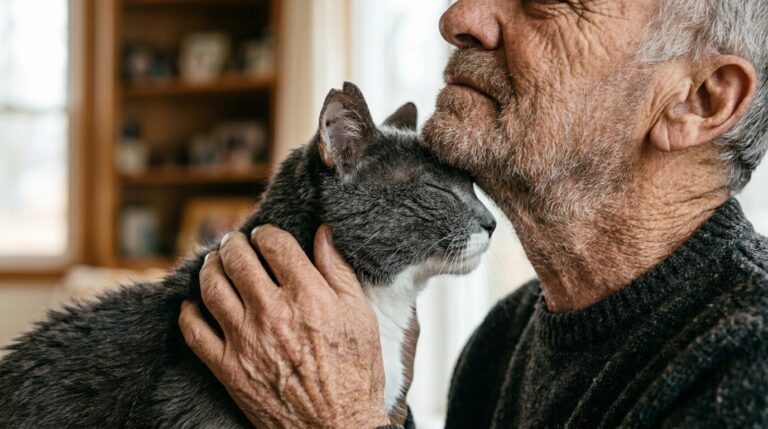
The mountain air didn’t care about Derek’s optimization or Claire’s polished schedules. It just was—sharp, cold, and smelling of ancient pine. I sat on the edge of the sagging porch, watching the shadows stretch across the snow, feeling the silence settle into my marrow like a long-lost friend.
For thirty years, I’d been the one pulling people out of the dark, but sitting here, I realized I’d never felt more rescued.
I looked down at the old wool blanket bundled beside my boots. Bino didn’t move much, but I could see the rhythmic rise and fall of his sides, a slow, hitching breath that told me the ribs were still knitting. He looked smaller out here, stripped of the bravado he’d used to launch himself at a man twice his size. He looked like what he was: an old soldier who’d finally been allowed to come home from a war that didn’t deserve him.
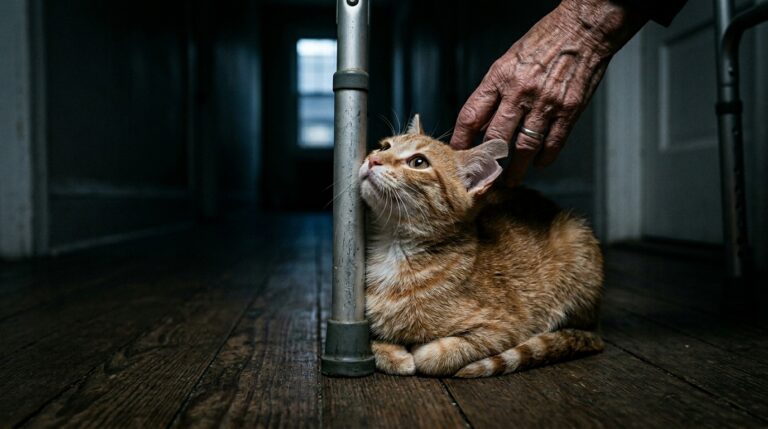
The cabin creaked as the temperature dropped, a groan of timber that sounded like a heavy sigh. I reached down, my fingers ghosting over the top of Bino’s head, steering clear of the shaved patches and the stiff, medical smell of the antiseptic. His good ear twitched, and he let out a low, vibrating hum—not a purr of contentment, but a signal. I’m still here, George. Don’t go getting soft.
In the “guest suite” back in Denver, every surface was meant to be seen and not touched. Here, the floorboards were scarred by decades of boots and woodstoves. It was a place where a stain wasn’t a catastrophe; it was a memory. But as the sun dipped behind the jagged peaks, the quiet started to feel heavy. It’s funny how you can crave the silence until you’re drowning in it. I found myself checking my phone, hoping for a sign that my grandson was sleeping, or that my daughter had finally looked at her hallway and realized the emptiness wasn’t just because the rug was at the cleaners.
I went back inside to stoke the fire, the light of the lantern casting long, dancing shadows against the log walls. Bino followed me, a slow, limping shadow of his own. He didn’t head for the kitchen or the rug; he went straight for the old cat carrier I’d tossed in the corner, the one that still smelled like the emergency vet and the fear of that Tuesday night.
He didn’t go in. He just sat in front of it and tapped the plastic door with a white-tipped paw.
I knelt beside him, the wood chips biting into my knees. “It’s over, Bino. We aren’t going back.”
But Bino kept tapping. When I reached out to move the carrier, I felt something shift inside. I unzipped the side pocket—the one I’d stuffed in a hurry while Derek was talking about “professional cleaning.”
I pulled out a crumpled piece of drawing paper. It was a crayon sketch, jagged and bright. It showed a giant gray cat with teeth like a saw and a cape the color of a mountain sunset. Standing behind the cat was a small boy with a headset. At the bottom, in the shaky, determined print of an eight-year-old, were three words: BINO IS BRAVE.
Tommy must have slipped it in while I was loading the SUV, a secret message sent into exile.
I looked at Bino, and for the first time since the lights went out in Denver, I saw his eyes truly catch the light. They weren’t just judgmental; they were waiting. He wasn’t just my cat anymore; he was the keeper of a boy’s courage, and we were five thousand feet above the only person who understood why that mattered.
Next up in Chapter 2: A surprise package arrives at the cabin, but it isn’t the apology George hoped for. Instead, it’s a heartbreaking request from Tommy that forces George to face the gap between his mountain truth and his daughter’s suburban silence.
CHAPTER 2: The Letter in the Snow
The high country has a way of making you feel the passage of time in your joints. Three days after we arrived at the cabin, a fresh skiff of snow had turned the world white and silent. Bino spent most of the morning by the woodstove, his whiskers twitching as he chased dream-mice, while I worked on the porch, clearing a path to the woodpile.
The “smart” house in Denver felt like a lifetime ago, but the tension lived in my pocket. Every time my phone buzzed, I felt a jolt of caffeine-like nerves. It was usually Claire, checking in with that forced lightness that hides a heavy heart. Derek remained a ghost in our conversations—a name we both avoided like a patch of black ice.
Around noon, I heard the low gear of a heavy truck grinding up the switchbacks. It was Miller, the local mail carrier who’s been running these mountains since before Bino was a kitten. He didn’t stop to chat, just leaned out the window and shoved a flat, cardboard Priority Mail envelope into the box at the end of the drive.
I trekked down to get it, the wind biting at my ears. There was no return address, just my name scrawled in a shaky, oversized hand that I recognized instantly. It wasn’t Derek’s precise, printed labels or Claire’s elegant script. It was Tommy.
Back inside, the cabin smelled of cedar and the remains of breakfast. I sat at the small pine table, my hands still stinging from the cold. Bino sensed the change in the room’s energy. He didn’t come to me for food; instead, he limped over and sat at my feet, his head tilted, his one good ear swiveling toward the crinkle of the envelope.
Bino’s world had narrowed to the four walls of this cabin and the man who kept the fire going. He watched the way I handled the cardboard—not with the casualness of a bill, but with a certain reverence. To him, the scent of the envelope was familiar. It carried the faint, chemical tang of the “perfect” house, but underneath, it smelled of the boy who used to drop crumbs under the table. Bino’s tail gave a single, heavy thump against the floor. He wasn’t waiting for a treat; he was waiting for news from the pack.
I tore the strip. Inside wasn’t a letter, at least not a traditional one. It was a collection of things.
First, a small, plastic dinosaur—a T-Rex with a missing toe. Tommy’s favorite. Then, a photograph. It was a picture of the living room back in Denver. The white rug was back, looking pristine and untouched. But in the middle of that vast, empty white space sat Tommy, looking tiny and hunched, staring at the spot where Bino had bled. He wasn’t playing. He wasn’t wearing his headset. He just looked lost in his own home.
Finally, there was a single sheet of notebook paper.
Grandpa, the letter began. Dad says the house is fixed now. He bought a new alarm that talks. But it sounds like a robot and it makes me jump. Mom cries in the laundry room when she thinks I’m playing my games. I don’t want to play the games. The monsters in the games are easy to hit. The man in the house was real.
I felt a lump form in my throat, hard as a mountain pebble.
I miss Bino. I told Dad that Bino is a hero. Dad said heroes don’t leave messes. I told him I liked the mess because it meant Bino was there. Grandpa, can you tell Bino I’m sorry? I think he left because I didn’t say thank you loud enough.
I looked at Bino. He had rested his chin on my boot, his yellow eyes fixed on the photograph Tommy had sent. I realized then that Derek hadn’t just tried to sanitize the rug; he’d tried to sanitize the trauma. By erasing the evidence of Bino’s sacrifice, he’d told his son that the pain didn’t happen—or worse, that the pain was something to be ashamed of.
Tommy wasn’t struggling because of the intruder. He was struggling because he was the only one in that house allowed to feel the weight of what had actually been saved.
The dilemma sat heavy on the table. If I stayed here in my mountain peace, I was leaving Tommy alone in a house that treated his heart like a hygiene liability. But if I went back, I’d be handing Bino back to a man who saw him as a “risk assessment.”
I reached down and picked up the T-Rex, placing it on the floor. Bino sniffed it, his whiskers brushing the plastic. He let out a soft, mourning chirp—a sound I’d only heard him make once before, years ago. He knew. He knew the boy was calling for the sentinel.
I picked up the phone to call Claire, my hand shaking. I needed to tell her that a clean rug is a poor substitute for a father’s understanding. But before I could dial, a text popped up from an unknown number.
George. We need to talk about Tommy. He’s refusing to leave his room. Claire is a wreck. I’m starting to think the cat isn’t the only thing that’s unpredictable.
It was Derek. And for the first time, he didn’t sound like he was in control. He sounded like a man who had optimized his life into a corner and was finally realizing he couldn’t find the exit.
Next up in Chapter 3: The Shadow on the Porch | Claire arrives at the cabin alone, unannounced. A raw confrontation ensues as Bino’s health takes a sudden, terrifying dip, forcing a choice between the mountain’s solitude and the valley’s complicated love.
CHAPTER 3: The Shadow on the Porch
The wind had a bite to it that morning, the kind that gets under your skin and reminds you that the mountains don’t negotiate. I was sitting by the stove, nursing a cup of coffee and looking at the photo Tommy had sent—the one of him sitting in the middle of that vast, sterile rug. Bino was uncharacteristically still. Usually, by ten o’clock, he’s found a patch of weak mountain sun to claim, but today he remained tucked under the kitchen chair, his chin resting on the wood chips I’d tracked in.
The sound of tires on gravel broke the silence. Out here, you hear a visitor long before you see them. I stood up, my knees popping, and watched through the frosted window as a sleek, silver SUV pulled into the clearing. It looked like a space vessel landing on the moon—too clean, too quiet, and entirely out of place.
Claire stepped out. She wasn’t wearing mountain gear; she was in a long wool coat and boots that were meant for city sidewalks. She looked up at the cabin with an expression that hovered somewhere between exhaustion and resentment.
I met her on the porch. We didn’t hug. The air between us was still thick with the things we hadn’t said back in Denver.
“You look tired, Claire,” I said, leaning against the railing.
“I haven’t slept, Dad,” she snapped, her breath huffing out in a white cloud. “Tommy won’t go to school. Derek is sleeping in the guest room. And you’re up here playing hermit with a cat that nearly lost us our homeowner’s insurance.”
I felt the old heat rise in my chest, but I kept my voice low. “Bino didn’t nearly lose you anything. He kept you from losing your son. There’s a difference.”
“He’s unpredictable, Dad! That’s what Derek keeps saying. One minute he’s a pet, the next he’s a wild animal tearing into someone’s arm. How am I supposed to feel safe with that in my house?”
Bino stayed in the shadows of the kitchen, but his body was a tight coil of survival instinct. He didn’t recognize the tone of “home” in Claire’s voice; he recognized the vibration of a threat. To an animal, high-pitched tension is the sound of a predator or a storm. He could smell the stress on her—the sour scent of adrenaline and the artificial perfume of a world that didn’t make sense to him. His breathing slowed, his muscles tensing against the dull ache in his ribs. He wasn’t thinking about rugs; he was calculating the distance to the door.
“Safety isn’t the absence of a mess, Claire,” I said, stepping toward her. “Safety is having someone in the room who loves you enough to bleed for you. Derek doesn’t get that. He thinks he can buy a sensor to replace a heart.”
“That’s not fair! Derek is trying to protect us in his own way.”
“By erasing the evidence?” I pointed back toward the table where Tommy’s drawing lay. “Tommy knows Bino is a hero. You’re the only ones trying to convince him he’s a liability. You’re gaslighting an eight-year-old because a rug got ruined.”
Claire opened her mouth to argue, her face flushing red, but the sound that came from inside the cabin stopped us both.
It wasn’t a meow. It was a wet, rattling cough, followed by a low, pained groan that sounded far too human.
I turned and ran inside. Bino had dragged himself out from under the chair. He was on his side, his legs paddling weakly against the floorboards. His breathing was shallow, a terrifying whistling sound coming from his chest.
“Bino!” I dropped to my knees, my hands hovering over him, afraid to touch him and afraid not to.
“Oh my God,” Claire whispered, standing in the doorway, her anger vanishing in an instant.
I looked at his gums—they were pale, almost white. The mountain air, the stress of the move, the internal damage we thought was healing—it was all crashing down at once. He looked up at me, his pupils blown wide, and for the first time in all the years I’d known him, I saw fear in those ancient eyes. Not the fear of an intruder, but the fear of a flame that’s running out of oxygen.
“Is he… is he dying?” Claire’s voice broke.
“I don’t know,” I rasped, my heart hammering against my own ribs. “I need to get him to the vet in the valley. Now.”
I scooped him up in the wool blanket. He felt lighter than he had yesterday, a fragile collection of fur and bone. As I headed for the door, Bino’s head fell back against my arm, and his tail, usually so full of defiant thumps, lay limp and still.
Next up in Chapter 4: The Messy Truth | The race to the valley vet brings George and Claire into a forced, raw alliance. As they wait for news in the fluorescent hush of the clinic, a surprise visit from Tommy reveals a secret Derek has been keeping—one that changes everything George thought he knew about that night.
CHAPTER 4: The Messy Truth
The veterinary clinic smelled of floor wax and old fear, a scent that usually makes me want to bolt. But as I sat there with Claire, the silence between us wasn’t sharp anymore. It was heavy, like a wet coat you can’t quite shake off. We were waiting for the “all clear” to sit with Bino, who was currently hooked up to a small tube helping him breathe.
“He looks so small in there, Dad,” Claire whispered. She was staring through the glass partition at the recovery ward. Her hands, usually so busy with her phone, were twisted together in her lap. “In the house, when he jumped… he looked like a tiger. Now he just looks like an old cat who’s tired of being brave.”
“Being a hero takes it out of you,” I said. “It doesn’t matter if you’ve got two legs or four.”
A bell chimed at the front door, and a gust of valley wind swept in. I expected it to be Derek, coming to collect Claire and talk about the cost of the oxygen. Instead, it was my neighbor from the mountains, a retired teacher named Mrs. Gable. She had Tommy by the hand. He was still in his school hoodie, his face smudged with what looked like dried tears and dirt.
“Grandpa!” Tommy broke away from Mrs. Gable and threw his arms around my waist. “Is he okay? Dad said Bino was gone.”
I looked at Claire, who had gone pale. “Derek told him Bino was gone?”
“I think he meant ‘gone from the house,’ Tommy,” Claire said quickly, though her voice lacked conviction. She knelt down to her son’s level. “Bino is right there. See?”
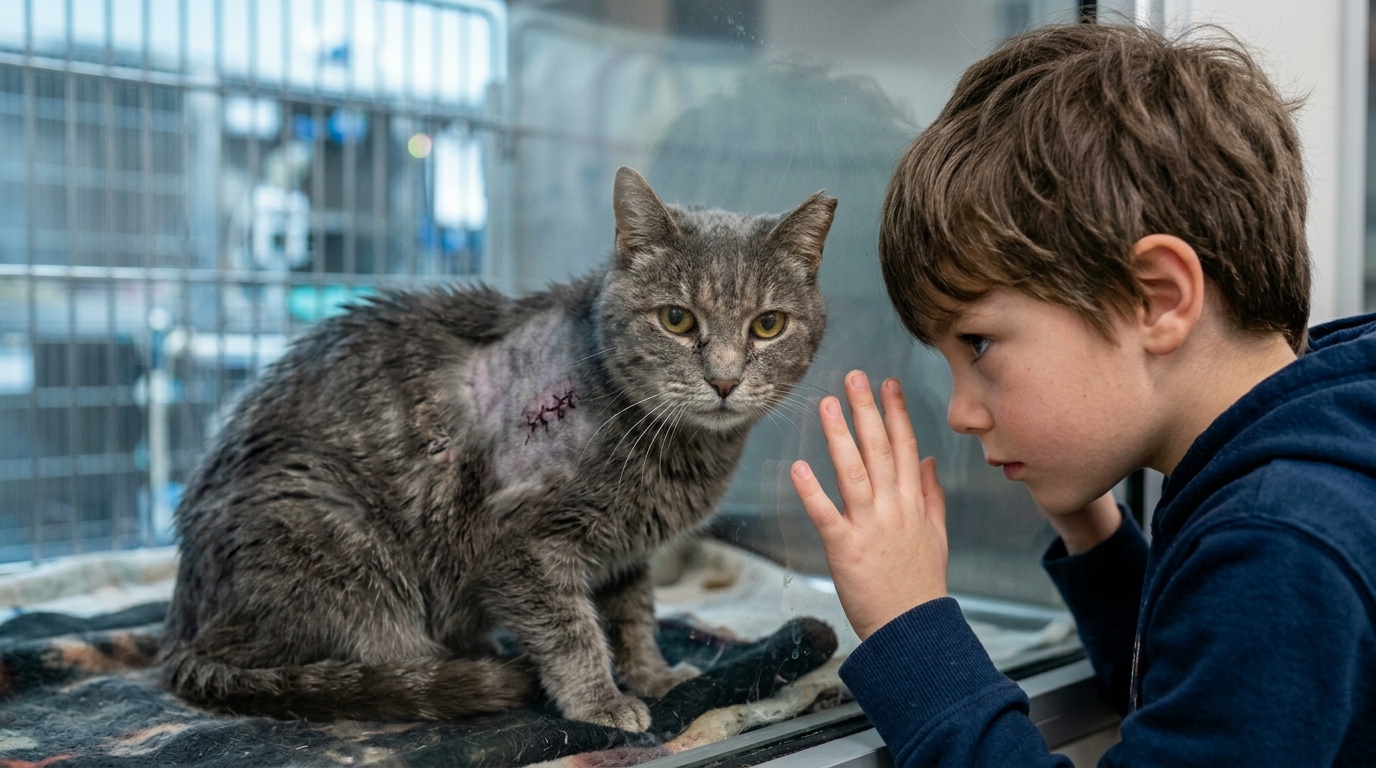
Tommy walked slowly toward the glass. He didn’t flinch. He didn’t look away from the shaved patches on Bino’s side or the jagged line of stitches near his shoulder. To an adult, those marks were a reminder of a violent night. But Tommy pressed his forehead against the cool glass, his eyes tracing every scar.
Bino’s ears flicked. He couldn’t lift his head yet, the sedatives and the oxygen keeping him anchored to the heavy vet mat. But he knew that scent—the sweet, milky smell of the boy who dropped goldfish crackers. To Bino, the boy wasn’t a “Tommy” or a “grandson”; he was the smallest member of the pack, the one who needed the most guarding. His tail didn’t thump, but his back paw twitched, a reflexive signal of recognition. He wasn’t afraid of the boy seeing him like this. In the animal world, scars are just the map of where you’ve been and what you survived.
“He has armor now,” Tommy said, his voice hushed with awe.
“Armor?” I asked, moving to stand behind him.
“Yeah. Like the knights in my books,” Tommy pointed to the stitches. “The bad man tried to break him, but Bino just grew new skin that’s stronger. He’s not dangerous, Mom. He’s a warrior.”
Claire looked at the scars, then at her son. I saw the moment her heart finally “un-sanitized.” She didn’t reach for a wet wipe. She didn’t talk about bacteria or liability. She reached out and touched the glass right where Tommy’s hand was. For the first time, she wasn’t looking at the mess. She was looking at the miracle.
“You’re right, Tommy,” she said, her voice thick. “He’s a warrior.”
Mrs. Gable cleared her throat, looking uncomfortable. “George, the boy was waiting by the mailbox when I drove past. He had a backpack full of stuff. He told me he was going to walk to the mountains if I didn’t give him a ride.”
“I had to bring this,” Tommy said, pulling something out of his pocket. It was Derek’s phone—the old one he kept in the kitchen drawer. “I found the video, Grandpa. The one Dad deleted.”
My heart did a slow, heavy roll in my chest. “What video, buddy?”
Tommy swiped the screen. It was the footage from the “smart home” security system. Derek had told us the cloud storage glitched during the power outage. He lied.
We watched the grainy, night-vision footage. We saw the intruder enter. We saw the man raise the metal tool over Derek’s head. But what we saw next was the part Derek never mentioned.
The man didn’t just hit Bino. Before Bino even launched, the intruder had turned toward the couch where Tommy was hiding. The man had reached out for the boy.
Bino hadn’t just “intervened” in a burglary. He had intercepted a kidnapping.
And then we saw Derek. In the light of the intruder’s flashlight, we saw Derek frozen. He wasn’t trying to reach Tommy. He was staring at his own hands, paralyzed by the very “unpredictability” he now claimed to hate in Bino. He had watched an old cat do the one thing he couldn’t: act when the systems failed.
The silence in the vet clinic became absolute. Claire stared at the screen, her hand over her mouth. The “messy truth” wasn’t that Bino was dangerous. It was that the cat’s bravery was a mirror that showed Derek exactly how small his own rules had made him.
Next up in Chapter 5: The Blood and the Bone | A final confrontation occurs at the clinic as the family must decide where Bino—and George—belong. A permanent boundary is set, and a new kind of family is forged in the wreckage of the old one.
CHAPTER 5: The Blood and the Bone
The vet clinic’s back exit opened to a small, gravel-strewn alleyway. It was cold, but the air was clear, stripped of the antiseptic tension that had defined the last few hours. Bino was in his carrier, tucked deep into the wool blanket. He was breathing on his own now—slow, shallow, but steady. He wasn’t the same cat he’d been a week ago. He moved like a ghost of himself, but his eyes were open, and they were fixed on the sky.
Derek was standing by his car when we walked out. He looked smaller than I remembered. Without the backdrop of his smart-home sensors and his white rugs, he just looked like a man who had realized that his maps didn’t cover the terrain he was actually walking on.
“Tommy showed me the phone,” Claire said. Her voice was quiet, but it had the weight of a mountain. She didn’t wait for him to explain. She just handed him his keys. “He didn’t hit Bino because he was scared of a cat, Derek. He hit him because Bino was doing what you couldn’t.”
Derek didn’t look at her. He looked at the gravel. “I didn’t delete it to be cruel, Claire. I deleted it because I couldn’t look at it. Every time I closed my eyes, I saw that man reaching for Tommy, and I saw myself… just standing there.”
“We all freeze sometimes, Derek,” I said, stepping forward. “That’s not the sin. The sin was trying to make the one who didn’t freeze pay for the cleaning bill.”
I set the carrier down on the trunk of my SUV. Bino shifted inside. He could smell the valley air—damp, low-altitude, heavy with the scent of exhaust and distant mown grass. But he also smelled the three humans standing in a circle around him. He felt the familiar vibration of the “pack” arguing, the rising and falling tones that usually preceded a move or a meal. He didn’t care about the footage or the rugs. He just wanted the door to open so he could feel the sun. His tail gave a weak, singular flick against the plastic wall. He was tired of the noise; he was ready for the quiet.
“I’m going back to the cabin,” I told them. “Bino needs the mountain air. And honestly, so do I.”
Tommy ran over, his face still streaked with the day’s dirt. “Are you staying there forever, Grandpa?”
“I don’t know about forever, buddy,” I said, kneeling down to look him in the eye. “But I’m staying there for now. And Bino is staying with me. He’s the king of that porch, and I think he’s earned the right to watch the birds without someone worrying about his hair on the sofa.”
I looked at Claire. “You’re always welcome. But the mountain has rules. No invoices for blood. No apologies for being real. If you can handle the drafty windows, the door is always unlocked.”
Claire nodded, a small, sad smile touching her lips. She looked at Derek, then back at me. “I think we might need a few weekend trips. To learn how to be… unpredictable.”
I shook Derek’s hand. It was a brief, stiff gesture, but it wasn’t an ending. It was a boundary. He knew now where my world ended and his began. He knew that some things—like an old cat’s loyalty or a grandfather’s dignity—couldn’t be optimized.
I loaded Bino into the passenger seat. As I pulled out of the clinic parking lot, I saw them in the rearview mirror: a family standing in a valley, trying to figure out how to be whole again.
We climbed the switchbacks in silence. The higher we got, the more the air seemed to thin and brighten. When we finally reached the cabin, the moon was up, turning the snow into a field of diamonds. I carried Bino inside and laid him on the quilt by the stove. He didn’t crawl under a chair this time. He stretched out, his “armor” of stitches visible in the firelight, and let out a long, deep purr.
It wasn’t a purr of contentment. It was the sound of a heartbeat that had decided it was safe enough to rest. I sat in the chair beside him, the T-Rex toy on the table and the mountain wind singing in the eaves.
We weren’t perfect. We were battered, shaved, and scarred. But we were home. And out here, that was the only thing that mattered.
Epilogue: 6 Months Later
The rug in Denver was eventually replaced with hardwood—something Derek said was “easier to manage,” though Claire knew it was because wood shows the scuffs of life more honestly.
Up at the cabin, the porch doesn’t sag quite as much as it used to. Every Friday evening, the silver SUV winds its way up the mountain. Tommy is the first one out, usually carrying a bag of the “expensive” treats Bino likes.
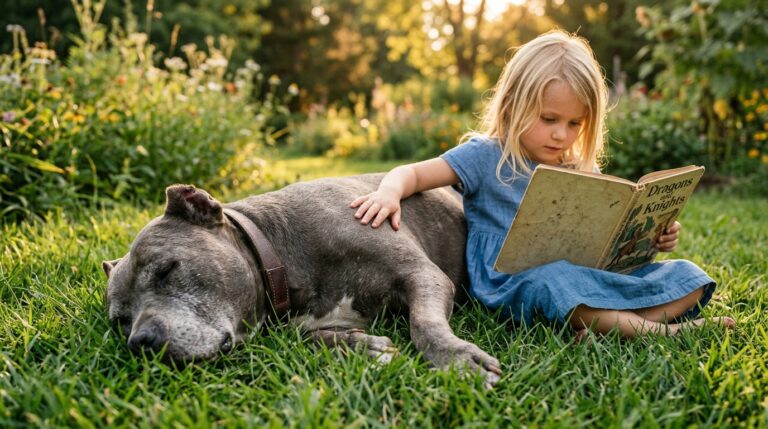
Bino doesn’t limp as much in the summer. He spends his days on the top step, his one folded ear twitching at the sound of the wind. He still doesn’t “perform” for the family. He doesn’t have to. When Tommy sits beside him to read, Bino simply leans his weight against the boy’s leg—a silent, heavy anchor.
Derek stays for the weekends now. He’s learned how to chop wood, though he still wears gloves to avoid the splinters. He doesn’t talk about “senior pet residences” anymore. Sometimes, late at night, I see him sitting on the porch, staring out at the dark woods where the sensors don’t reach. And sometimes, he reaches down and touches the scar on Bino’s nose, his hand lingering for a moment in a quiet, un-optimized act of gratitude.
We aren’t a brochure family. We’re a family with stains, creaks, and memories. And as Bino watches the sun set over the Rockies, his tail thumping slow and certain, I know that we finally understand what loyalty costs. It costs everything. And it’s worth every penny.