The Monsters Who Brought Us Home
CHAPTER 1: The Midnight Knock
The jukebox was mid-chorus on a Haggard track when the heavy oak doors of the Steel Haven swung wide, letting in a swirl of November sleet and a ghost. We were fifteen men deep at the bar, a sea of black leather and graying whiskers, but the room went stone-quiet before the door even clicked shut. It wasn’t the cold that chilled us; it was the sight of the small, trembling boy clutching a frayed nylon leash like it was a lifeline to the world of the living.
Beside the boy stood a creature that looked like he’d been through a war and lost every battle but the last one. He was a Pitbull mix, his coat the color of wet pavement, mapped with the white lines of old scars. His paws were raw, leaving dark, blooming stains on our floorboards with every heavy step. He didn’t cower; he planted himself in front of the kid, his chest broad and shaking, and let out a low, vibrating growl that hummed in the floorboards beneath my boots.
I didn’t move fast—you don’t move fast around a dog that’s decided he’s the only thing standing between a child and the dark. I slowly lowered my six-foot frame until I was eye-level with the boy’s soaked sneakers, keeping my palms open and visible. I didn’t look at the dog’s eyes; I looked at his tattered ears, listening to the way his breath came in ragged, exhausted hitches.
“You’re okay, big guy,” I said, my voice barely a whisper against the sudden silence of the room. “You done your job. You got him here. We’ll take the watch from here.”
The shift was subtle, but I felt it. The dog’s ears flicked, and the hard tension in his shoulders seemed to evaporate all at once. He let out a sigh so heavy it sounded like a sob, his legs giving way as he collapsed onto the wood. As he went down, he leaned his entire weight against the boy’s shins, and the kid followed him down, burying his small, blue-tinged face into the dog’s scarred neck.
That was when I saw it—the plastic-wrapped note pinned to the boy’s backpack, fluttering like a white flag in the drafty room. I reached out, my fingers trembling more than I’d like to admit, and unpinned the message that would pull us all into a fight we never saw coming.
Next up in Chapter 2: The sound of tires screaming in the parking lot signals that the “monsters” in leather aren’t the ones Leo needs to fear as his uncle arrives with a catchpole and a grudge.
CHAPTER 2: The Wall of Leather
The silence that followed the boy’s collapse was broken not by a whisper, but by the violent scream of tires on wet asphalt. Headlights swept across the frosted windows of the Steel Haven, casting long, distorted shadows of Harley-Davidsons against the far wall. The front doors, which had so recently admitted a broken child, were now kicked open with the kind of entitlement that only comes from owning the deed to half the town.
In stepped a man who looked like he’d stepped off a yacht and onto the wrong planet. His thousand-dollar wool coat was pristine, save for a few drops of rain he flicked off his sleeve with a look of pure disgust. Behind him stood two city animal control officers, their faces set in that uncomfortable grimace men wear when they’re following orders they don’t particularly like. One of them held a heavy, cold-looking metal catchpole with a wire loop dangling at the end.
“There he is,” the man snapped, pointing a manicured finger at the floor where Leo lay curled against Sarge. “The kid ran off with that mongrel. I’m his legal guardian, and I want that animal removed. Now. He’s a menace to public safety.”
I felt the temperature in the room drop twenty degrees, and it wasn’t the draft. Beside me, Big Mike shifted his weight, his leather vest creaking like an old ship. One by one, the brothers stood up from their stools. We didn’t draw weapons. We didn’t have to. There is a specific kind of gravity that fifteen large men in heavy boots create when they move as a single unit.
Sarge’s head snapped up. Even in his state of total exhaustion, the instinct to guard was a hard-wired circuit that wouldn’t break. He didn’t have the strength to stand, but his lip curled back just enough to show the ivory of his teeth, and a sound started deep in his chest—a low-frequency vibration that felt like a warning bell.
To Sarge, the air had changed. The smell of the room, once thick with the comforting scents of old grease, woodsmoke, and friendly humans, was now pierced by the sharp, acidic tang of human adrenaline and the cold, metallic scent of the wire loop. He felt the small human’s grip tighten on his fur, the boy’s heartbeat drumming a frantic, irregular rhythm against his ribs. The dog didn’t see a “guardian” or an “officer”; he saw a threat to the pack’s smallest member. He braced his sore, bleeding paws against the floor, ready to spend the very last of his life force if that wire moved an inch closer.
“You’re making a mistake, Mr. Sterling,” I said, stepping into the space between the catchpole and the dog. My voice was steady, the kind of calm you use right before a storm breaks. “That dog didn’t ‘run off.’ He dragged this boy five miles through a freezing rainstorm to find help. He’s the only reason the kid isn’t an icicle on the side of Highway 42.”
“I don’t care if he carried him on a golden litter,” Sterling sneered, his face reddening. “I am the boy’s uncle. I have the papers. That dog is my property, and I am surrendering it for immediate destruction. Officers, do your job.”
The lead officer took a hesitant step forward, the wire loop swaying. Little Leo let out a shriek of pure, unadulterated heartbreak, throwing his entire body over Sarge’s back. “No! You can’t! Mom said Sarge is an angel! Please don’t take my best friend!”
That was the breaking point. As one, the “Steel Haven” moved. We didn’t shout. We didn’t throw a punch. We simply formed a solid, unbroken wall of leather and bone between the law and the child. Fifteen sets of shoulders locked together, creating a human barricade that turned the clubhouse into a fortress.
Sterling stepped back, his expensive shoes clicking erratically on the floor. “You bikers are going to get yourselves arrested! I’ll have the police chief shut this den of filth down by morning!”
From the back of our line, Specs stepped forward. He didn’t look like a “monster”; he looked like a man who had spent thirty years reading the fine print. He held up his smartphone, the screen glowing bright in the dim room.
“Go ahead and call him, Julian,” Specs said, his voice dripping with a terrifyingly polite edge. “But you should know I’ve been live-streaming this to our club’s page for the last ten minutes. We have two hundred thousand followers watching a wealthy developer try to kill a grieving orphan’s only source of comfort. The public relations nightmare is already trending. Are you sure your board of directors wants to see this on the morning news?”
Sterling froze. He looked at the phone, then at the wall of grim-faced men, and finally at the boy sobbing into the dog’s neck. For a man like him, the loss of a soul was nothing, but the loss of a reputation was everything. He turned on his heel, his face pale, and stormed out into the night, the officers trailing behind him with visible relief.
But as the tail-lights faded, the weight of the moment hit us. We had won the standoff, but we had just declared war on a man with deep pockets and a legal claim to the boy. I looked down at Leo and Sarge. They were safe for tonight, but tomorrow was coming, and we were just a bunch of guys in leather vests up against a system that didn’t believe in miracles.
Next up in Chapter 3: The legal clock starts ticking as Specs digs into the mother’s past to find the “Evidence of the Heart” needed to keep the pair together, while Sarge faces a different kind of test—the vet’s office.
CHAPTER 3: Evidence of the Heart
I watched Sarge from across the room as Leo sat cross-legged on the floor, reading a dog-eared comic book aloud. Sarge wasn’t just resting; he was monitoring. Even with his chin resting on his bandaged paws, his eyes followed every movement I made. When I shifted my weight, his tail gave a singular, muffled thump against the rug. It wasn’t a wag of joy yet; it was a check-in. A confirmation that the pack was still intact.
“Jax, come look at this,” Specs called out, his voice cracking the morning quiet. He beckoned me over to the corner table he’d claimed as his temporary war room.
Specs had spent the night digging through public records and social media archives, but he’d also made a few calls to old contacts in the family court system. Spread across the table were printouts—old photos, scanned medical documents, and a copy of the mother’s handwritten letter we’d read the night before.
“Everyone thinks this is just a dispute over a pet,” Specs whispered, glancing toward Leo to make sure the boy wasn’t listening. “But Sterling isn’t fighting for the kid because he loves him. He’s fighting because Leo is the sole beneficiary of his mother’s life insurance and a small trust left by their grandfather. If Sarge is declared a ‘menace’ and the boy is placed in a facility or a ‘stable’ environment of Sterling’s choosing, Julian gets to manage the estate.”
The greed was a bitter pill, but Specs wasn’t done. He slid a folder toward me. Inside was a certified copy of Sarge’s veterinary history from a clinic three towns over.
“Look at the dates,” Specs said, pointing a steady finger. “Six months ago, Sarge was enrolled in a local program for ‘Canine Good Citizens.’ He passed with flying colors. And here—this is the gold mine. These are service animal training logs. Leo’s mother was preparing him to be a formal emotional support animal for the boy’s anxiety. Sarge isn’t a ‘dangerous animal.’ He’s a documented protector with a clean record.”
To Sarge, the rustle of the papers was just another background noise in this strange, new den. He could smell the old ink and the stale coffee, but more importantly, he could smell the change in the big human’s scent. The sharp, metallic tang of stress that had hung over Jax all morning was beginning to soften into something warmer—something like hope. Sarge let out a long, fluttering breath through his nose, his eyelids growing heavy. The “danger” scent from the man in the wool coat was gone, replaced by the steady, rhythmic heartbeat of the boy beside him. For the first time in days, the dog felt the urge to truly sleep, not just wait.
“There’s more,” Specs continued, his eyes gleaming behind his glasses. “I found a video. The mother posted it to a private group a year ago. It’s not just a video of a dog; it’s a testimony.”
He pressed play on his laptop. The screen showed a younger, healthier version of the woman who had written that desperate note. She was sitting on a porch swing, Sarge’s large head resting in her lap.
“I know what people see when they look at him,” she said into the camera, her voice shaky but clear. “But Sarge saved my son long before we went on the run. When Leo’s father passed, this dog stayed awake every night by his bed so the boy could sleep. He’s not a monster. He’s the heart of this family. If anything ever happens to me, don’t let them judge him by his breed. Judge him by the boy he kept whole.”
I felt a lump the size of a spark plug form in my throat. We finally had the “why.” We had the evidence that Sarge wasn’t just a dog, but a prescribed necessity for a grieving child. But as I looked at the legal headers on the documents, my heart sank.
“This is incredible, Specs,” I said, “but we’re still just a motorcycle club. We aren’t a ‘suitable placement’ in the eyes of the state. Sterling has the bloodline. We just have the leather.”
Specs looked at me, a slow, knowing smile spreading across his face. “That’s where you’re wrong, Jax. I did a little digging into your own records, too. You and Sarah have been licensed foster parents for twelve years. You have a clean home study, a fenced yard, and a history of taking in the ‘hard cases.’ The state doesn’t need to find a stranger. They just need to see that the boy and the dog are already home.”
The reveal hit me like a physical weight. We weren’t just protecting them for the night. We were looking at a way to keep them forever. But before I could speak, the front door chimes rang—not a kick this time, but a formal, steady knock.
Next up in Chapter 4: The battle moves from the clubhouse to the courthouse. Sarge is forced to face a temperament evaluator who holds his life in her hands, while Jax and Sarah prepare to make the most important pitch of their lives to a judge who has never liked bikers.
CHAPTER 4: The Hearing
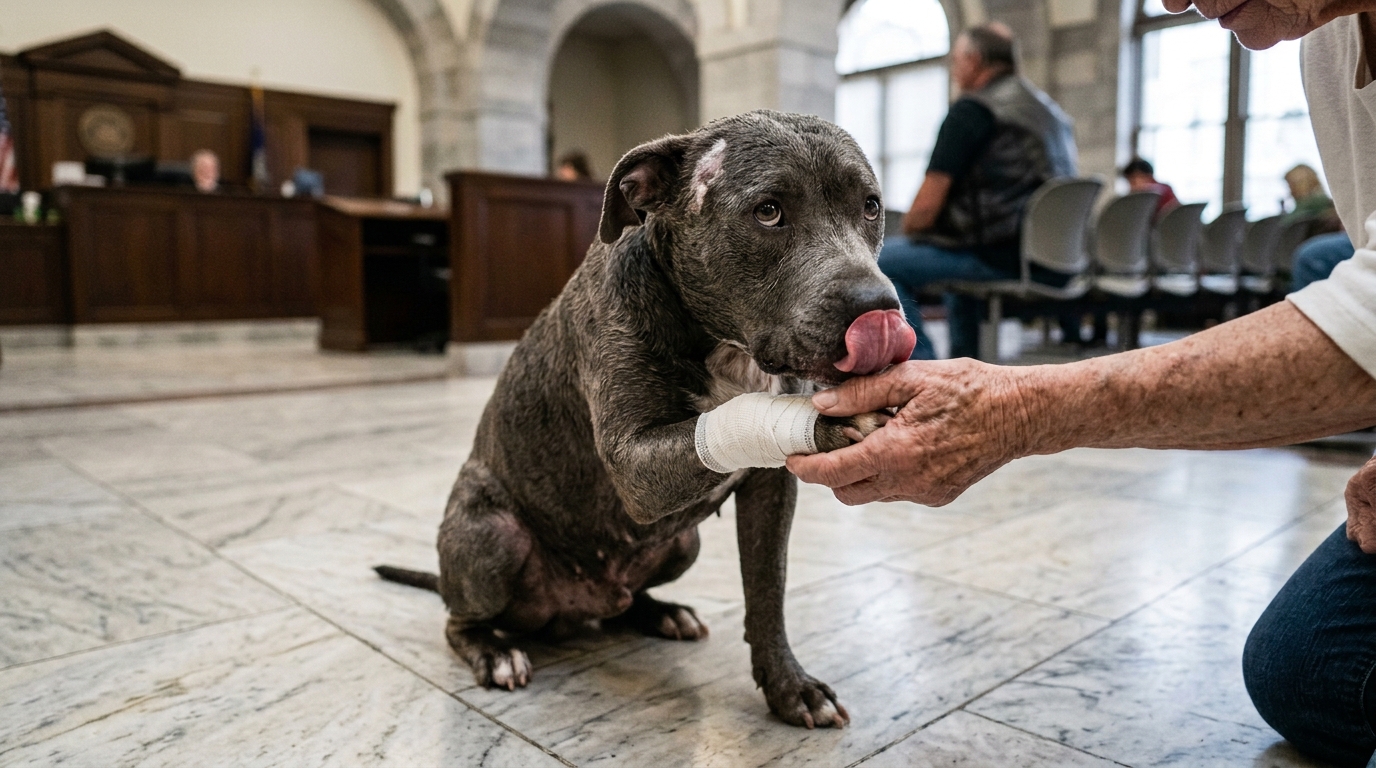
The marble hallways of the county courthouse felt cold and hollow, a far cry from the warm, oil-scented air of our clubhouse. Every click of our dress shoes echoed like a gavel strike. I walked with my hand resting on Leo’s shoulder, while Sarge walked on a short, tight lead between us. He was a different dog today—groomed, bandaged, and wearing a leather harness Specs had found that looked more “service dog” and less “junk-yard guardian.” Still, people stepped aside as we passed, their eyes lingering on the jagged scar over his ear.
Julian Sterling was already there, flanked by two lawyers who looked like they’d been carved out of ice. He didn’t look at Leo; he looked at Sarge with a smirk that told me he expected a victory. He knew that one wrong move—one growl, one bared tooth—and the “menace” label would stick forever.
Judge Miller peered over her spectacles as we took our seats. She didn’t look impressed by the row of bikers in the gallery, all of whom had tucked their long hair back and put on their cleanest shirts. “This is an unorthodox request,” she began, her voice like dry parchment. “The petitioner claims this animal is a vital therapeutic necessity. The respondent claims the animal is a danger to the child and the public. Before I rule on guardianship, I want to see this dog’s temperament myself.”
The evaluator, a stern woman named Dr. Aris, stepped into the center of the courtroom. She carried a series of “stressors”—a heavy umbrella, a recording of high-pitched sirens, and a mechanical cat that moved with an uncanny jerkiness. This was the moment. If Sarge’s rough past or his injuries triggered an aggressive response, the case was over.
Sarge felt the floor—slick and foreign beneath his sensitive paws. He could sense the thick, heavy layer of anxiety radiating off Jax and the boy. The room was full of strangers who smelled of sharp chemicals and old paper, but there was one scent that acted as a focal point: the cold, arrogant smell of the man in the wool coat. Sarge’s hackles wanted to rise. He felt the old, primal urge to circle the boy and push the strangers back. But he also felt the weight of Jax’s hand on the leash—not a pull of command, but a steadying touch that signaled trust. Sarge lowered his head, his tail giving a single, tentative sweep against the marble.
Dr. Aris approached. She suddenly popped the umbrella open just inches from Sarge’s face. The room gasped. Sarge flinched, his body tensing into a spring, but he didn’t snap. He simply stepped closer to Leo’s chair, tucking his head under the boy’s hand. Next came the mechanical toy, whirring and clattering toward him. Sarge watched it with a curious tilt of his head, then looked up at Judge Miller as if to ask why the humans were playing with such strange things.
“He’s not reacting,” Julian Sterling hissed loudly to his counsel. “The dog is clearly sedated!”
“He’s not sedated, Mr. Sterling,” Specs said, standing up. “He’s loved. There’s a difference.”
The final test was the hardest. Dr. Aris reached down to firmly grab Sarge’s injured paw—the one still wrapped in gauze from his five-mile trek. I felt my heart hammer against my ribs. Sarge let out a tiny, sharp whimper of pain, but instead of baring his teeth, he turned and licked the evaluator’s hand. It was a gesture of submission and gentleness that silenced the entire courtroom.
Judge Miller leaned forward, her expression softening for the first time. “It seems the ‘monster’ has better manners than many humans I’ve had in this court.”
Just as the tide seemed to turn, Sterling’s lead attorney stood up, holding a thick folder. “A charming display, Your Honor. But it doesn’t change the fact that the boy’s mother was a fugitive from her own family, or that these men are members of an organization with a criminal history. We have a deposition from a neighbor claiming the dog was involved in a violent altercation only two months ago.”
My blood ran cold. It was a lie, or at least a twisted version of the truth, but in a courtroom, a well-placed lie can be as lethal as a bullet. I looked at Specs, but for the first time, our lawyer looked worried. He was scrambling through his papers, looking for a rebuttal we didn’t have.
Next up in Chapter 5: The final verdict. Specs plays his last card—the mother’s secret trust conditions—as the judge decides if a boy and his dog belong in a mansion or a clubhouse sidecar.
CHAPTER 5: The Sidecar Legacy
The morning air in the valley was crisp, carrying the scent of pine and the low, rhythmic thrum of forty idling engines. It’s a sound that usually makes folks pull their curtains shut, but today, in our small town, people were out on their porches, waving. We weren’t just the Steel Haven anymore; we were the escort for something much bigger.
I checked the straps on the custom-built sidecar one last time. It was a beauty—bolted to my cruiser, lined with weather-resistant padding, and bearing a small, hand-painted logo of a paw print inside a gear. Leo, now nine years old and sporting a leather vest that had finally started to fit his shoulders, climbed in with the practiced ease of a veteran road captain.
Then came Sarge. He didn’t need a leash or a command. He trotted to the sidecar, his white-patched chest puffed out, and waited for Leo to help him into his seat. We slid the custom dog goggles—”doggles,” Leo called them—over Sarge’s ears, covering the jagged scar that had once been a mark of his rough past. Now, that scar was just a part of his story, a map of where he’d been and the boy he’d saved to get here.
Sarge leaned into the sidecar’s padding, his body vibrating with the hum of the motorcycle. To him, the world was no longer a place of freezing rain and “monsters” in wool coats. It was a world of familiar scents: the scent of Jax’s heavy leather jacket, the sweetness of the boy’s bubblegum, and the metallic tang of the open road. He didn’t feel the need to growl at the horizon anymore. The pack was large, loud, and made of chrome, and he was tucked safely in its heart. He felt the boy’s small hand rest on his shoulder, and Sarge let out a contented huff, his tail giving a steady thud-thud against the metal floor.
I kicked the kickstand up and caught Sarah’s eye in the rearview mirror. she was on her own bike, trailing just behind us. She gave a sharp nod. Behind us, fifteen massive men in leather vests—the same men who had once formed a wall of defiance—now formed a wall of celebration. We weren’t outcasts today. We were just parents, uncles, and friends taking our kid for a ride.
“You ready, Leo?” I shouted over the rumble.
“Ready, Dad!” Leo yelled back, his grin wide enough to catch bugs. “Sarge is ready, too!”
I rolled the throttle, and the line of bikes began to move. We swept through the main street, a river of leather and chrome. As we hit the open highway, the wind picked up, ruffling Sarge’s fur and carrying our worries away with the exhaust. I looked to my right and saw Sarge’s head held high, his nose twitching as he took in a thousand new smells at sixty miles an hour. He looked like a king on a moving throne.
The “unresolved question” that had haunted us for years—whether a group of misunderstood bikers could raise a broken boy—had been answered by the steady beat of a dog’s heart and the laughter of a child who was no longer afraid. Society looks at us and sees trouble; they look at Sarge and see a threat. But as we roared toward the mountains, I knew the truth. True family isn’t about bloodlines or trust funds. It’s about who stands in front of you when the storm hits, and who stays beside you when the sun finally comes out.
We might not have halos, but we have heavy cruisers. And as long as this boy and his best friend are with us, we’ll never stop riding.
Epilogue: 6 Months Later
The backyard of the foster home Sarah and I shared was now a permanent obstacle course of chew toys and soccer balls. Leo was thriving in school, but his favorite part of the day was still “The Homecoming.” Every afternoon, when the school bus hissed to a stop at the end of the gravel drive, Sarge would be there, waiting by the mailbox.
He didn’t need a watch to know the time. He’d sense the vibration of the bus three blocks away, his ears perking up as he looked toward the road. The “damage” of his earlier life had faded into a gentle wisdom; he was the club’s unofficial mascot now, the dog who taught fifteen grizzled bikers that it was okay to be soft.
On Sunday mornings, you can still find us at the Steel Haven, but the jukebox plays more than just outlaw country now. There’s a corner with a big velvet bed and a bowl that says Sarge. We haven’t seen or heard from Julian Sterling since the day his reputation crumbled. Some people are meant to be owners, and some are meant to be family. We’re just glad we knew the difference.