I Asked for the Oldest Shelter Cat And Brought Home a Quiet Goodbye

CHAPTER 1: The Last Row

I walked into the county shelter on a Tuesday, the kind of gray morning that makes a house feel too large for one person. Ever since Martha passed three years ago, the silence in my kitchen has had a way of growing teeth. I didn’t go there looking for a kitten with high-voltage energy or a dog that would pull me down the sidewalk. I went there because I wanted to look at something that understood what it felt like to be part of the furniture that people stop noticing.

“Which cat here is the oldest?” I asked the woman at the desk. Her name tag said Maya, and she looked like she’d spent the last decade carrying the weight of a thousand “no’s.” She didn’t smile, but she grabbed a heavy ring of keys and led me past the bright, loud rooms where the young ones scream for a life. We kept walking until the air felt thinner and the floor turned to cold, unforgiving concrete.

At the very end of the hall sat a kennel that looked far too cavernous for the occupant inside. He was a tuxedo, though the black was more of a faded charcoal now, like a suit that had seen too many Sundays. His face was rimmed in white, age having signed its name clearly around his cloudy, searching eyes. A small plastic sleeve on the door held a card with a single word that felt like a punch to the gut: Pie. 17 years old.

“Seventeen,” I whispered, the number hanging between us like a countdown. Maya leaned against the cold wall. “Most folks see that number and they start doing the math of how much time they’ll have to grieve,” she said quietly. “They don’t want their hearts broken on a schedule.”

But when Maya unlocked the door, Pie didn’t bolt. He stepped out with the measured, careful grace of an old professor entering a lecture hall. He didn’t meow; he just walked straight to me and leaned his forehead against my shin. It wasn’t a plea for a treat or a frantic rub for attention. It was an agreement. A recognition.

As I knelt down, ignoring the protest in my own sixty-two-year-old knees, I noticed a small, yellowed slip of paper tucked behind his shelter ID card. It was folded tight, the edges worn as if it had been handled a hundred times by someone who couldn’t let go. I didn’t open it then. I just felt the warmth of his small, light body against me and knew that even if we only had a month, or a week, or a single afternoon, he wasn’t going to spend it behind a wire door.

Next up in Chapter 2: The mystery of Pie’s midnight ritual begins, and Arthur discovers that his new roommate is still haunted by a home he can’t quite forget.

CHAPTER 2: The Tap in the Dark

The first night in the saltbox cottage was too quiet. Usually, the house hums with the phantom sounds of a life once shared—the floorboard that creaks like Martha’s mid-night walk to the kitchen, the rattle of the radiator that sounds like a cough she never quite shook. I sat in my wingback chair, the coffee grinder finally silent on the counter, watching Pie.

He didn’t hide under the sofa as the shelter pamphlet warned. He simply claimed a small patch of the faded Persian rug and tucked his paws neatly beneath his chest. He looked like a gargoyle carved from shadow and salt, his notched ear leaning toward the window every time a car passed on the coastal road. He wasn’t resting; he was auditing the silence.

I finally turned off the lamp, leaving only the pale moonlight filtering through the salt-filmed glass. “Goodnight, Professor,” I whispered. He didn’t move, but the tip of his tail gave one slow, deliberate flick against the rug. It felt like a dismissal, or perhaps, a shared understanding of the dark.

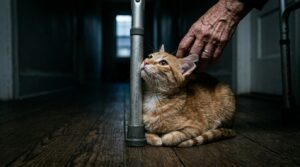
I woke at 2:17 a.m. to a sound that shouldn’t have been there. It wasn’t the wind or the settling of old timber. It was a rhythmic, hollow percussion coming from the hallway. Tap. Tap. Tap. I swung my legs out of bed, the cold floor biting at my heels. In the dim glow of the nightlight, I saw him. Pie was standing in the center of the hallway, perfectly upright, facing the blank stretch of drywall next to the linen closet. His right paw was raised, striking the baseboard with the careful, persistent seriousness of a man knocking on a door that had been locked for decades.

He wasn’t scratching the wood. He wasn’t hunting a mouse. He was communicating with a ghost.

I crouched down, keeping my distance. “Pie? What is it, old man?”

He didn’t startle. He turned his head with a slow, heavy dignity, his cloudy eyes catching the light. There was no feline playfulness in them, only a profound, disciplined patience. He looked at me, then back at the wall, and let out a tiny, broken chirp—a sound that seemed to get stuck in his throat, halfway between a greeting and a question.

In that moment, the air in the hallway felt different. For Pie, the smells of my house—the old books, the lavender soap, the lingering scent of morning coffee—were just a thin veil over a deeper hunger. He could feel the lack of a familiar vibration, the absence of a specific floorboard’s give under a specific human weight. His muscles were tight with the memory of a routine that had been his entire world for seventeen years. He wasn’t just in a new house; he was in a vacuum, waiting for the atmosphere of his real life to return.

He turned back to the wall and tapped again. Tap. Tap. A cold shiver raced down my spine. I realized he wasn’t just confused; he was faithful. He was performing a ritual for a door that wasn’t there anymore, for a person who hadn’t come to open it. It was the sound of a heart refusing to admit it had been relocated.

“Come here, Professor,” I said, my voice thick. I sat on the floor, ignoring the ache in my hip.

Pie hesitated. He looked at the wall one last time, a silent plea hanging in the air, before he walked over to me. He didn’t climb into my lap. He simply leaned his forehead against my shin, pressing hard, as if he were trying to anchor himself to the present so he wouldn’t drift back into the hallway of his memories.

I reached for my robe pocket and pulled out the yellowed slip of paper I’d taken from the shelter. I hadn’t opened it yet, but holding it now, the paper felt heavy, like it was made of lead instead of wood pulp.

The tapping had stopped, but the silence that followed was worse. It was the silence of a man and a cat both realizing that being “saved” isn’t the same thing as being “home.” I looked at Pie, whose breath was finally slowing against my leg, and I felt a terrifying surge of responsibility. I wasn’t just his provider; I was the person standing between him and the total erasure of everything he had ever loved.

I unfolded the note. The handwriting was shaky, the ink blurred in places by what I now realized were old teardrops.

If someone chooses him, please tell him he was a good cat. He didn’t get left behind because he wasn’t lovable. Life just ran out of room.

My hand trembled. Life just ran out of room. I looked at the blank wall Pie had been knocking on. Somewhere out there was the other side of that door—the person who had taught him to tap, the person who had run out of room.

I realized then that if I didn’t find the source of that note, Pie would spend the rest of his short life knocking on walls that would never open. He was a cat with a countdown, and I was the only one who could hear the ticking.

Next up in Chapter 3: Arthur’s search for the note’s author goes viral, leading to a shocking connection and the revelation of Pie’s true identity as “The Professor.”

CHAPTER 3: The Viral Echo

I spent most of Wednesday morning with my phone face down on the kitchen table. I’ve lived long enough to know that when you invite the world into your house, they don’t always take their shoes off. By noon, the post had been shared three hundred times. By evening, it was thousands.

Most of the comments were the kind that make you believe in people again—stories of other senior rescues, offers to buy “The Professor” his favorite soft food, and simple words of thanks. But as the sun dipped below the horizon, casting long, bruised shadows across the saltbox floor, the tone shifted. The “judges” had arrived. One person accused me of “virtue signaling,” while another suggested that whoever surrendered a seventeen-year-old cat deserved to be publicly shamed.

“They don’t know, do they, old man?” I whispered. Pie was perched on the back of the sofa, his eyes fixed on the screen of my laptop. To him, the buzzing of the phone was just another strange, meaningless sound in a world that had become increasingly foreign. He wasn’t looking for likes; he was looking for a scent he recognized.

Pie’s ears twitched. He felt the vibration of the house—the low hum of the refrigerator and the sharper, erratic pings of the device on the table. To a cat whose world had narrowed to the tactile and the immediate, the digital storm meant nothing. But he sensed the shift in my posture, the way my shoulders had hiked up toward my ears. He saw me as a tall, warm presence that had suddenly become as rigid as a fence post. He moved toward me, not out of curiosity, but out of a primal need to stabilize his pack. If the tall one was agitated, the territory wasn’t safe.

My finger hovered over the ‘delete’ button. I felt a hot, defensive prickle in my chest. These strangers were treating Pie’s life like a moral debate, a clean-cut story of heroes and villains. They didn’t see the shaky handwriting on the note. They didn’t see the grief that lives in the word “surrender.”

Then, a private message request flickered onto the screen. It wasn’t from a local. The profile name was simply E. Miller, and there was no photo.

“I know that cat,” the message read. “He isn’t just ‘Pie.’ My grandfather called him Professor because he used to sit on his desk and paw at his fountain pen while he wrote letters. He’s been tapping on your wall because that’s how he used to tell Grandpa it was time for his heart medication. Grandpa can’t see well, and the Professor knew the sound of the alarm.”

My breath caught. I felt as if the room had suddenly run out of oxygen. I looked at Pie, who was now sitting on the table next to the phone, his nose inches from the screen.

“My grandfather is in the Shady Oaks Care Facility,” the message continued. “We told him the cat went to a good home, but he’s stopped eating. He thinks the Professor thinks he was abandoned. We didn’t have a choice—the facility doesn’t allow pets, and none of us could take a cat that old with our kids’ allergies. Please… I saw your post. I didn’t mean for people to be mean. I just wanted to know he was okay.”

The reveal hit me like a physical blow. The “villain” wasn’t a cruel person; it was a family caught in the gears of a life that had, quite literally, run out of room. The Professor wasn’t just an old cat; he was a medical alert system, a secret-keeper, and the last tether an old man had to his dignity.

I looked at the comments again—the people calling for “accountability” and “justice.” They wanted a fight, but all I saw was a circle of broken hearts. I looked at Pie, the notched ear leaning as he watched me. He had been trying to save me at 2:17 a.m., just like he’d tried to save his first person. He was still on duty.

I didn’t reply to the comments. I didn’t engage with the debate. My hands were shaking as I typed back to E. Miller.

“Tell your grandfather the Professor is still on the job. And tell me when I can bring him for a visit.”

Next up in Chapter 4: Arthur and Pie navigate the sterile hallways of Shady Oaks for a high-stakes reunion that tests the limits of the facility’s rules and Pie’s failing strength.

CHAPTER 4: The Window at the End

The hallway of Shady Oaks felt like a place where time went to hold its breath. Everything was muted—the colors, the voices, even the light. As I carried the plastic crate, I felt like I was smuggling something vital and illicit into a desert. Pie didn’t yowl. He didn’t claw at the gate. He just sat there, his one notched ear pressed against the plastic mesh, listening to the rhythmic squeak of a nearby med-cart.

We reached the door to 212. Elias stopped, his hand hovering over the handle. “He doesn’t know you’re coming,” he whispered. “He’s… he’s been very quiet lately. The doctors call it ‘failure to thrive.’ I just call it a broken heart.”

I stepped into the room. It was small, but filled with the sharp, bright glare of a New England afternoon. An old man, thinner than a winter reed, sat in a high-backed chair by the window. He was staring out at the trees, his hands resting motionless on a plaid blanket. He looked like he was waiting for a bus that had already passed him by.

I set the carrier down on the linoleum floor. The click of the latch felt as loud as a gunshot in the still room.

Pie stepped out of the carrier. He didn’t run. He didn’t investigate the strange medical equipment or the smell of disinfectant. He stood in the center of the room, his white-rimmed eyes scanning the space until they landed on the man in the chair.

Pie’s nostrils flared, drawing in the stale air. Underneath the smell of medicine and starch, there was a chemical signature he knew in his marrow—the scent of the hands that had fed him for seventeen years, the specific pheromones of the person he had been trained to protect. His body, usually stiff with the indignity of age, suddenly found a fluid, purposeful grace. He felt the familiar vibration of the man’s shallow breathing. He didn’t need a name; he knew the shape of the soul in that chair.

The old man didn’t turn around at first. “Elias?” he croaked. “Is that you?”

“It’s someone else, Grandpa,” Elias said, his voice cracking. “And a friend.”

Pie walked across the floor, his paws making no sound on the tiles. He reached the chair and did something I hadn’t seen him do at my house. He didn’t lean. He stood on his hind legs, his front paws catching the edge of the old man’s knee, and let out a long, rattling purr that sounded like a motor being brought back to life.

The man, whose name I learned was Henry, looked down. His jaw dropped, and for a second, I thought the shock might be too much. His hands, gnarled by arthritis and time, began to shake violently as they reached out.

“Professor?” Henry whispered.

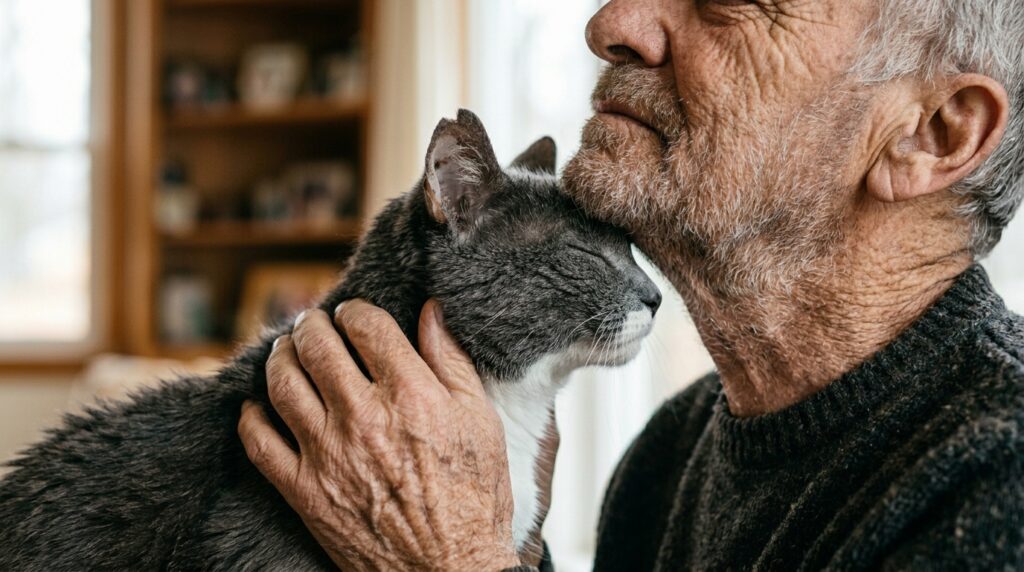
Pie didn’t wait for an invitation. With a soft, careful hop that looked like it cost him every ounce of his remaining strength, he landed on Henry’s lap. He didn’t circle. He didn’t settle. He walked right up to Henry’s chest and leaned his forehead against the man’s chin, mirroring exactly what he had done to me on that first day at the shelter.

“Oh, you good boy,” Henry sobbed, burying his face in the sun-faded tuxedo fur. “You good, good boy. I thought I left you. I thought I’d lost you in the dark.”

I stood by the door with Elias, feeling like an intruder in a sanctuary. I saw the way Henry’s hands finally stopped shaking as they stroked the Professor’s notched ear. I saw the way Pie’s eyes closed, his whole body sinking into the plaid blanket as if he had finally found the only anchor that mattered.

They sat like that for a long time. There was no need for explanations about “running out of room” or internet debates. There was just a man and a cat, two survivors of a world that moves too fast, finding a moment of stillness together.

Henry looked up at me, his eyes wet but clear. “You’re the one?” he asked.

I nodded. “I’m Arthur. He’s been keeping me company.”

Henry smiled, a fragile, beautiful thing. “He’s a teacher, you know. He teaches you how to stay when everyone else wants to leave. Thank you for staying, Arthur.”

As the nurse came in to tell us the visit was over, Pie didn’t fight when I had to pick him up. But as I placed him back in the carrier, he looked back at Henry and gave one short, sharp tap against the plastic gate.

Henry laughed through his tears. “I know, Professor. I’ll take my pills. I promise.”

Next up in Chapter 5: The final chapter. As the season turns, Arthur prepares for the inevitable goodbye, realizing that Pie didn’t just need a place to die—he needed a place to finish his story.

CHAPTER 5: The Warm Ending

The salt air turned sweet as the New England spring finally pushed through the frost. In the three weeks following our visit to Henry, a strange, beautiful stillness settled over the cottage. Pie—my Professor—didn’t tap on the walls anymore. He didn’t pace. It was as if by delivering that one last message to Henry, he had finally closed the book on his old life and was ready to simply rest in the margins of mine.

I moved his bed into the patch of sunlight that hit the living room floor at ten each morning. He was eating less now, just a few careful licks of broth, but his purr remained deep and rhythmic, a steady engine that filled the quiet corners of the house. I spent my afternoons sitting on the floor beside him, reading aloud from the old books I used to share with Martha. He liked the sound of a human voice; it seemed to be the only blanket he needed.

Pie felt the warmth of the sun on his charcoal fur, but he also felt the gradual thinning of his own strength. The world was becoming a collection of soft edges and distant sounds. He no longer felt the urgent call to guard the doors or monitor the alarms. The tall man with the scent of coffee and old paper was there, his hand a constant, grounding weight. For seventeen years, Pie had been a sentinel. Now, for the first time, he allowed himself to be the one who was watched over.

One rainy Tuesday evening, the Professor didn’t get up for dinner. He lay on the Persian rug, his notched ear twitching just once as I walked into the room. I knelt beside him, and for the first time, I didn’t feel the panic of a “countdown.” I felt the profound privilege of being the one chosen to witness the end of a long, good story.

“You’re okay, Professor,” I whispered, stroking the soft, sun-faded fur between his eyes. “You did your job. Henry knows. I know. You can let go now.”

He leaned his forehead into my palm one last time—not a request, but a gentle “thank you.” His breathing slowed, becoming as light as the mist rolling off the Atlantic. He didn’t struggle. He didn’t cry. He simply exhaled, a soft release of seventeen years of faithfulness, and stayed still.

The house was silent afterward, but it wasn’t the empty, biting silence I had moved into three years ago. It was a full silence. The Professor had left his fingerprints—his “paw-prints”—on the very atmosphere of the cottage. I sat there for a long time, the yellowed note from the shelter still tucked in my pocket, realizing that Pie hadn’t just needed a place to die. He had needed a place where his ending would matter.

I looked at the blank wall in the hallway where he used to tap. I realized then that I wasn’t just a man who had adopted an old cat. I was a man who had been taught how to live in a house with a history, and how to face the future without being afraid of the quiet. My home wasn’t empty anymore. It was a library of lives well-loved, and the Professor had just become my favorite chapter.

Epilogue: 6 Months Later

The coffee grinder makes the same familiar whirring sound every morning, but the kitchen feels different now. I still live in the saltbox cottage, and the Persian rug still bears the slight indentation where a seventeen-year-old tuxedo cat used to spend his mornings.

Henry passed away two months after our visit, peacefully, in his sleep. Elias called to tell me, and we spent an hour on the phone—not talking about the “guilt” of surrendering a pet, but sharing stories of the Professor’s antics with the fountain pens. Elias told me that in his final days, Henry seemed lighter. He wasn’t a man who had “abandoned” his best friend; he was a man who had made sure his friend was safe.

I still volunteer at the shelter now. I don’t work the front desk with Maya; instead, I go straight to the “Last Row.” I bring soft blankets and I sit with the ones whose faces are rimmed in white and whose eyes are cloudy with memories.

Sometimes, when the house is very still at 2:17 a.m., I think I hear a faint tap-tap-tap in the hallway. I don’t get up to check anymore. I just smile in the dark, pull the quilt up a little higher, and thank the Professor for teaching me that the best stories are the ones we have the courage to finish together.

Similar Posts

Leave a Reply

Your email address will not be published. Required fields are marked *