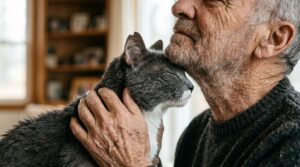
I Emptied My Life Savings To Save My Dying Golden Retriever
CHAPTER 1: The Station of Desperation
The ticket agent didn’t see a man and his dog; he saw a liability and a mess. He looked at Barnaby’s graying muzzle and the heavy, labored rise of his golden chest, and his lip curled in that way people do when they want to look away from mortality. But I couldn’t look away—I was carrying the weight of a thirty-year promise in my trembling hands.
I didn’t have time for a lecture on railway policy or the “proper channels” for transporting livestock. Every second we stood on that cold marble floor, I could feel the clock in Barnaby’s chest winding down. I reached into my coat and produced the only language a man like that understands: a thick, rubber-banded stack of hundred-dollar bills.
It was my pension. It was my house, my sweat, and three decades of grease under my fingernails, all sitting on a counter because a sterile room with a stainless steel table was not where this story was allowed to end. “Make an exception,” I whispered, and my voice sounded like a ghost’s. “He’s dying, and we’re going home.”
Barnaby leaned his heavy head against my leg, his fur soft but his skin burning with the fever of the cancer. He gave one weak, loyal thump of his tail against the floor—a sound that hit me harder than any freight train ever had. He wasn’t just a dog; he was the last tether I had to my wife, Clara. He was the one who stayed when the world got quiet.
The agent’s eyes flickered from the money to the dog, and for a second, the bureaucrat vanished, replaced by a man who maybe once loved something, too. He slid the premium boarding pass across the marble. “Platform nine,” he said quietly. “The night train leaves in five minutes. God bless you, sir.”
I scooped eighty pounds of failing life into my arms. My seventy-year-old spine screamed, a sharp, white-hot reminder that I was nearly as broken as the animal I held. I didn’t care. I marched toward the steel behemoth waiting on the tracks, the steam hissing like a warning I intended to ignore.
As I settled Barnaby onto the velvet sofa of our private cabin, wrapping him in my heavy wool coat, a sudden, familiar squeezing pain shot down my left arm. It was a cold, iron grip around my heart. I reached for my shirt pocket, my fingers frantic and numb, searching for the small orange bottle that kept the rhythm of my life steady.
My fingers touched only empty fabric. In the rush to save Barnaby from the needle, I had left my own lifeline sitting on the kitchen counter next to a half-finished cup of coffee. Outside, the train lurched, the heavy steel wheels beginning their slow, rhythmic crawl toward the mountains.
I sank onto the floor beside him, watching his cloudy eyes follow me with absolute trust. I had seventy-two hours to get him to the ocean, but as the city lights began to blur into the rainy dark, I realized my own heart was now running on nothing but the same borrowed time as his.
Next up in Chapter 2: The mountain air turns lethal as a blizzard halts the train, and Arthur must defend Barnaby’s warmth against a passenger who views him as “just an animal.”
CHAPTER 2: The Cold Between Us
The rhythmic clack-clack of the steel rails had been a lullaby, but it ended with a scream of grinding metal. The Oceanic Silver shuddered so violently that Barnaby slid off the velvet seat, landing with a heavy thud on the floor. I lunged to cushion him, my own heart giving a sharp, warning jab behind my ribs. Outside the frosted window, the world had disappeared. A white-out blizzard had swallowed the mountain pass, and the giant locomotive had finally met an immovable object: a fallen ancient pine, buried under the drifts.
Within minutes, the hum of the ventilation died. The silence that followed was heavier than the snow. The auxiliary lights flickered to a dim, sickly yellow, and the mountain cold began to seep through the steel skin of the train. It was a predatory chill, the kind that seeks out the weak and the old.
I stripped off my heavy wool coat and tucked it around Barnaby, then added my sweater, leaving myself in just a thin shirt. I laid down on the hard floorboards next to him, pulling his large, trembling body against mine. I wanted to give him every degree of warmth I had left in my seventy-year-old bones.
Barnaby didn’t try to move. He just let out a long, shuddering sigh against my neck. To Barnaby, the world had become a place of shifting shadows and dull, constant pressure. He could smell the sharp, metallic scent of the ice outside and the rising copper tang of fear coming off me. He didn’t understand the storm or the broken train; he only knew the pack was together, and that the leader—his person—was shivering. He pressed his cold nose into the hollow of my throat, a small, instinctive gesture of comfort even as his own life force flickered.
The peace of the cabin was shattered when the door was shoved open with a bang.
“I knew it!” a voice boomed. It was a man in his forties, wearing a suit that cost more than my first car. He looked down at us on the floor, his face twisting with a mix of entitlement and disgust. “The steward said this cabin has a backup heater. I’ve got a wife and kids freezing in coach, and I’m not staying out there while you waste the only warm room on a dying mutt.”
He stepped into the small space, the smell of expensive cologne and cold air trailing behind him. He reached down, his hand closing on the edge of my coat—the coat currently keeping Barnaby from freezing. “Move the dog into the hallway, old man. People take priority.”
A rage I hadn’t felt in decades surged through me, hotter than any heater. I stood up, my legs shaking, and shoved his hand away. “Do not touch him,” I growled.
“Are you crazy?” the man sneered, looking back at the small crowd of shivering passengers gathered in the hallway. “It’s a dog! It’s probably going to kick the bucket before sunrise anyway. Look at it!”
“He is my family,” I said, my voice cracking but loud enough to echo. “He stayed by my wife’s side when she couldn’t breathe. He didn’t leave when the rooms got sterile and quiet. I am not moving him for your comfort.”
The man stepped forward, his jaw set, ready to use his youth and weight to win the argument. But then, a young mother holding a toddler stepped out from the hallway. She didn’t look at the businessman. She looked at Barnaby’s cloudy eyes, then at my trembling hands. Without a word, she took a knitted shawl from her own shoulders and handed it to me.
“For your boy,” she whispered.
An older man behind her followed suit, unzipping a heavy flannel overshirt. “Take this, too. Keep him warm.”
The businessman stood frozen, suddenly the only cold thing in the room. He looked at the growing pile of donated warmth and the silent, judging faces of his fellow passengers. With a muttered curse about “lunatics,” he retreated back into the shadows of the hallway.
I closed the door and sank back down to the floor, my chest heaving. The confrontation had taken more out of me than I wanted to admit. My left arm felt heavy, like it was made of lead. I needed to get some fluids into Barnaby; his gums were pale, and the stress of the cold was dehydrating him.
I reached for the small metal bowl of water I’d kept near the seat. “Come on, buddy,” I whispered, pressing it gently against his dry nose. “Just a sip. For me.”
Barnaby didn’t move. I nudged his chin, urging him, but he simply turned his head away into the blankets. He didn’t even sniff at the water. It was the sign I had been dreading—the “refusal” that every dog owner knows in their soul. It was the moment the body decides the struggle is no longer worth the reward.
“Barnaby, please,” I begged, my voice a ragged sob.
He stayed still, his breathing shallow and rattling. Outside, the wind screamed against the steel, a reminder that we were still trapped, miles from the ocean, and my own heart was skipping beats like a failing engine.
Next up in Chapter 3: The Intercept. As Arthur collapses from the cold and lack of meds, a deafening roar breaks the mountain silence—David’s rescue helicopter arrives to force a confrontation between duty and love.
CHAPTER 3: The Intercept
The darkness in the cabin wasn’t just the storm anymore; it was the edges of my vision fraying like old rope. I had spent the last hour singing a low railway lullaby to Barnaby, my voice a dry rattle against the howling wind. He was tucked into the nest of donated blankets, his breathing so faint I had to press my palm to his ribs every few minutes just to be sure he was still with me.
Every time I moved, the iron band around my chest tightened. The missing nitroglycerin wasn’t just a mistake now; it was a death sentence. I slumped against the base of the velvet sofa, my hand still resting on Barnaby’s golden head. “I’m sorry, buddy,” I whispered. “I think I’ve run out of track.”
Barnaby’s ears flickered. To him, the world was a dull roar of cold and pain, but a new vibration began to cut through the mountain silence. It wasn’t the rhythmic clack of the train, but a thrumming in the air that shook the very marrow of his bones. He sensed the approach of something massive and loud—a predator of steel descending from the clouds. He let out a weak, warning whuff, his cloudy eyes fixed on the frosted window.
Then, the world turned white.
A blinding spotlight pierced the cabin, turning the frost on the glass into a thousand tiny diamonds. The roar of helicopter rotors drowned out the storm, and the train’s air brakes shrieked in a final, agonizing protest. The sudden jolt threw me forward, and as the train groaned to a dead halt, the iron band around my heart finally snapped shut. I couldn’t breathe. I couldn’t cry out. I simply slid onto the floor, my cheek resting against Barnaby’s soft fur as the blackness took me.
The cabin door didn’t just open; it was kicked off its hinges.
David burst into the room, his police uniform a dark silhouette against the flashing strobe of the helicopter’s searchlight. He looked like a stranger, a man of law and iron, until he saw me lying there. The flashlight in his hand wavered, the beam dancing over the donated blankets and my blue-tinged lips.
“Dad!” he screamed. It wasn’t the voice of a police captain; it was the cry of a terrified boy. He was on his knees in an instant, his heavy boots thudding on the floorboards. He grabbed my shoulders, his hands shaking as he fumbled for the orange pill bottle he’d brought from my kitchen.
Behind him, two flight medics crowded into the doorway, their trauma bags hitting the floor with a heavy thud. “We need to move him now, Captain,” the lead medic barked, already reaching for a portable oxygen mask. “His rhythm is erratic. If we don’t get him to the cardiac center in the next twenty minutes, he’s gone.”
David forced the tiny white pill under my tongue, his eyes darting to Barnaby. The dog was watching him, a slow, rattling breath escaping his lungs. Barnaby didn’t bark. He didn’t growl. He simply rested his chin on my lifeless arm, his eyes begging the son to save the father.
“We’re taking the dog,” David said, his voice dropping to a low, dangerous growl.
“Sir, protocol is clear,” the medic argued, reaching for my wrist. “We are a medical transport. We cannot carry a terminal animal in a sterile environment. It’s a violation of three different state codes. We load the patient and we go. Now.”
David stood up, towering over the medics. He held my heart medication in one hand and his silver badge in the other. He looked at the law he had spent twenty years enforcing, and then he looked at the dog that had sat with his mother when he was too afraid to show up.
“I don’t care about the codes,” David whispered, and the steel in his voice would have chilled the blizzard. “This dog is the only reason my father is still breathing. You load that stretcher, or I will fly this chopper myself and leave you on the tracks. Is that clear?”
The medic hesitated, looking at the dying retriever and the broken old man. He saw the dilemma written in the lines of David’s face—the choice between the rigid rules of a lifetime and the messy, beautiful requirement of love.
David didn’t wait for an answer. He reached down and began to lift Barnaby himself, the dog’s weight pulling at his uniform. “Help me,” David commanded, his voice breaking. “Help me save them both.”
Next up in Chapter 4: Above the Clouds. As the helicopter races toward the coast, David makes a heartbreaking confession about his mother’s final days, revealing the true reason he’s risking his career for Barnaby.
CHAPTER 4: Above the Clouds
The vibration of the helicopter was different from the rhythmic thrum of the train. It was a violent, desperate shaking that seemed to mirror the state of my own heart. I drifted in and out of a medicinal fog, the tiny white pill David had forced under my tongue finally widening the narrow, painful channels of my life. When I finally opened my eyes, the world was a cramped cabin of gray metal and flashing digital displays.
David was sitting directly across from me, his large hand resting on the edge of the tactical stretcher where Barnaby lay. The dog looked smaller under the harsh LED lights of the aircraft, a specialized oxygen mask covering his muzzle. Every few seconds, the plastic would fog with a faint, ghostly puff—the only proof that Barnaby was still in the room with us.
Barnaby’s world had narrowed to the scent of the man holding his paw and the strange, artificial air flowing into his lungs. He could hear the screaming of the engines, but beneath it, he tracked the familiar, jagged rhythm of my breathing. He didn’t have the strength to wag his tail, but his front paw twitched against David’s palm, an instinctive reach for the pack. He sensed the altitude, the thinning of the air, and the sudden, sharp drop in the pressure of the hands that held him.
“You’re awake,” David said, his voice crackling through the headset I didn’t realize I was wearing. His eyes were bloodshot, the mask of the stoic police captain finally cracked beyond repair.
“How much… further?” I croaked. Every word felt like dragging a stone through gravel.
“We’re over the foothills. Another twenty minutes,” David replied. He looked down at Barnaby, then back at me, his jaw clenching. “Dad, I need you to listen to me. I spent five years acting like this dog was a burden. Like your ‘fixation’ was a sign of you losing your mind.”
He paused, a single tear cutting a path through the soot and salt on his cheek. “But the truth is, I was the one who was lost. When Mom was in hospice, I couldn’t handle the silence. I couldn’t handle the smell of the room or the way her hands felt. I used the precinct as a shield. I worked double shifts so I wouldn’t have to watch her fade.”
I reached out, my fingers brushing the sleeve of his uniform. “David, you don’t have to—”
“I do,” he interrupted, his voice breaking. “Barnaby did my job. He was the son she needed. He stayed when I ran. And I realized tonight, standing in that dark house holding your heart pills, that if I let him die on a frozen train, I’d be running away all over again. I’m not that coward anymore.”
The lead medic leaned over, checking the monitors. “BP is stabilizing, but it’s fragile. We’re pushing the engines as hard as we can.”
“I used my retirement fund, Dad,” David whispered, leaning closer so the medics couldn’t hear, though the roar of the rotors made secrets easy to keep. “And I sold the truck to the dealer over the phone at the dispatch center. I didn’t ‘authorize’ a police flight. I hired a private medical intercept. I’ll probably lose my badge for the laws I bent to get the clearance, but I don’t care. I finally figured out that some promises are worth more than a career.”
I looked at my son—really looked at him—and saw the man Clara always knew he could be. He had drained his future to buy a few minutes of sand and salt for an old dog and a broken father.
Outside the window, the dark, jagged peaks of the mountains began to give way to a flat, silver expanse. The first hint of dawn was bleeding into the horizon, a thin line of violet and gold that promised the end of the night.
“Look, buddy,” I whispered, reaching down to touch Barnaby’s cold, soft ear. “The sky is changing.”
Next up in Chapter 5: The Golden Shore. The final descent to the Pacific beach. Arthur and David carry Barnaby to the water’s edge for one last heartbeat as the sun rises over the horizon.
CHAPTER 5: The Golden Shore
The roar of the helicopter engines changed pitch, a deep, vibrating hum that signaled our final descent. Through the reinforced glass, the world transformed from the dark shadows of the coastal range to a vast, shimmering mirror of blue and silver. The Pacific. I felt a surge of strength that had nothing to do with medicine; it was the adrenaline of a promise kept.
David gripped the handles of the stretcher as the skids touched the damp, packed sand of a secluded cove. This was the place—the same stretch of shore where we had said goodbye to Clara five years ago. The door slid open, and the scent hit us instantly: salt, decaying kelp, and the clean, cold breath of the sea. It was the smell of home.
Barnaby’s nostrils flared, his gray muzzle twitching. The heavy, artificial weight of the oxygen mask was gone, replaced by the sharp, electric tang of the ocean air. He couldn’t see the horizon through his cloudy eyes, but he could feel the rhythm of the waves in the ground beneath the stretcher. The frantic vibration of the “metal bird” was replaced by the steady, ancient pulse of the water. He leaned his head into the wind, his ears lifting just a fraction. He knew this scent. He knew this pack-place.
David and the flight medic carried the stretcher toward the water’s edge, while I stumbled behind, my boots sinking into the wet sand. “Wait,” I croaked. David stopped, looking back at me with a face softened by the morning light. “Set him down here. He needs to feel it.”
They lowered the canvas directly onto the sand just as a rogue wave sent a thin, lacy sheet of foam swirling beneath the stretcher. I dropped to my knees, the cold water soaking into my trousers, but I didn’t care. I pulled the blankets away and placed my hand over Barnaby’s heart. It was slow—a tired, fading rhythm—but it was still beating.
“You did it, buddy,” I whispered, my tears falling to join the salt spray. “You’re here. Clara is here.”
Barnaby let out a long, contented sigh. He didn’t look at the ocean; he looked at us. He turned his heavy head toward David, his wet nose brushing against my son’s palm. There was no hesitation in the gesture, no memory of the years of distance. It was a simple, primal signal of forgiveness. He had carried the grief of this family as long as his body allowed, and now, seeing us together, he finally let the burden go.
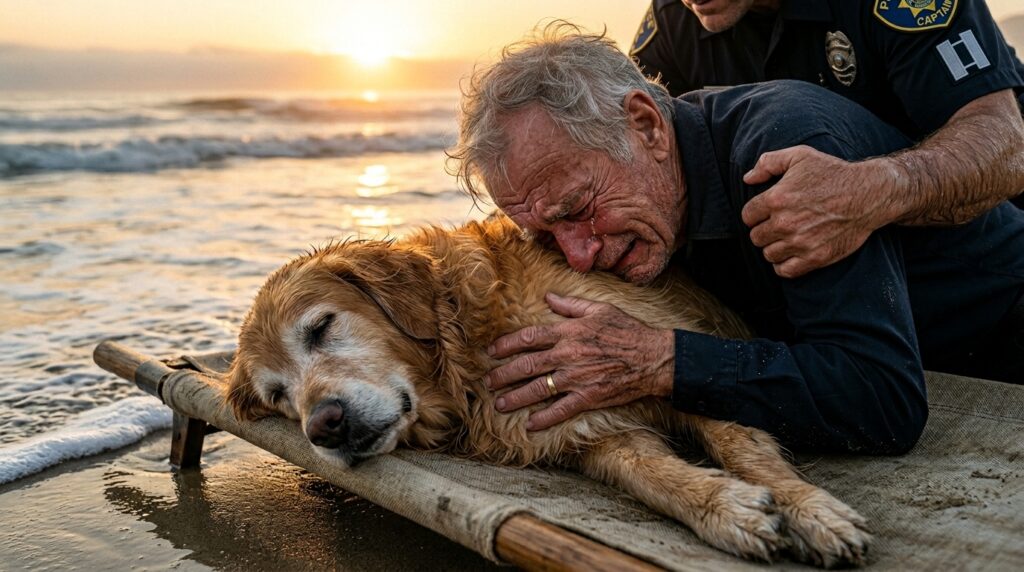
He gave one final, weak thump of his tail against the canvas. His eyes closed, and his breathing, which had been a ragged struggle for three days, became as quiet as the receding tide. He let out one last, soft exhale, and then he was still. The gold of his fur seemed to catch the first direct beam of the rising sun, glowing with a light that felt eternal.
I buried my face in his neck, sobbing for the dog who had saved me, and for the wife he had gone to find. I felt a strong, heavy arm wrap around my shoulders. David pulled me against him, his own chest heaving with silent sobs. For the first time in a decade, there was no “Captain,” no “stubborn old man,” and no badge between us. There was only a father and a son, anchored to each other by the memory of a loyal friend.
“He’s at peace, Dad,” David whispered, holding me tighter as the sun fully broke over the horizon, turning the entire Pacific into a field of liquid gold. “We kept the promise.”
Epilogue: 6 Months Later
The garden in the backyard is quieter now, but it isn’t empty. I still find myself checking the floor before I step into the kitchen, a habit forty years in the making. My heart still needs the little orange pills, but the crushing weight in my chest has lifted, replaced by a steady, quiet hum of gratitude.
David comes over every Sunday. He didn’t lose his badge, though his file is thick with “disciplinary warnings” that he wears like a suit of armor. He traded the heavy truck for a sensible station wagon, and three months ago, he stopped by with a surprise.
She’s a gangly, red-haired Golden mix from the county shelter. She has too much energy and no manners, but when she sits on the porch, she leans her head against my leg in a way that feels like a familiar echo. We don’t call her Barnaby, but sometimes, when the light hits the grass just right, I see him in the way she watches the gate.
David stays for dinner now. We talk about Clara, and we talk about the night on the train, and we don’t look away from the hard parts anymore. Barnaby didn’t just get me to the ocean; he brought me back to my son. And as I watch David throw a tennis ball across the lawn, I know that the “Last Ticket” wasn’t for a train ride at all. It was for a second chance at being a family.