
The Friction of Spent Brass and Bleached Horizons Under a Desert Sky
CHAPTER 1: THE ACCORDION BENCH
“You want to prove something, put every dollar on this table!”
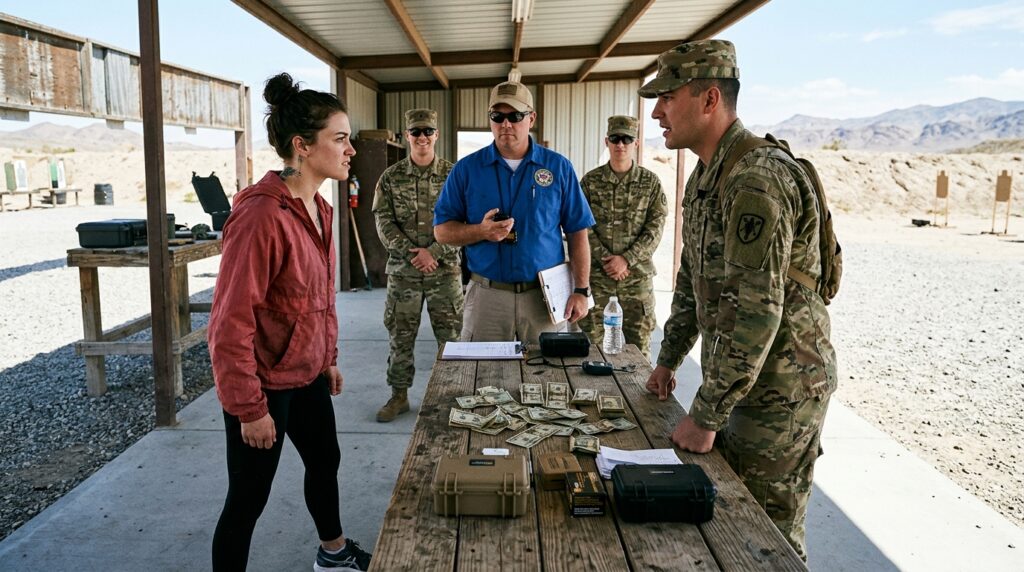
The service member’s hand hit the raw wood with the heavy, flat thud of an entrenching tool. The currency beneath his palm didn’t flutter; it was too slick with desert sweat and fine grit to catch the hot draft moving under the corrugated iron roof. He didn’t blink. His patrol cap cast a hard, geometric shadow across his eyes, turning his stare into something mechanical, born of a decade of standing exactly where he was told to stand.
The civilian woman didn’t take a step back. Instead, she leaned her weight into the edge of the bench, the nylon of her faded red windbreaker scratching against the rough-sawn pine. The movement brought her neck tattoo—a jagged line like a torn fence—inches from the glare of his collar pins. Her knuckles were already white where she gripped the lip of the table.
“Fine,” she said, her voice dropping into a register that made the two young soldiers in the back stop whispering. “Count it clean, then watch what happens next.”
Between them, the small equipment cases and the plastic boxes of factory-load ammunition seemed to shrink, squeezed by the sudden lack of air in the shelter. The smell of dry heat, sulfur, and the sour tang of old canvas hung in the shade. The sun outside was blinding, turning the gravel flats into a white mirror that ate the edges of the distant targets.
The service member let his lips curl, just enough to show the dry line of his teeth. “You got a lot of nerve coming out here with a plastic holster and a box of scraps, girl. This isn’t a county fair.”
“Do not smirk at me,” she whispered, leaning down until her breath stirred the loose bills between them. “I know exactly why I came here. And I know exactly what your name tape is worth if you leave this dirt empty-handed.”
His face went stiff. The arrogance didn’t drain; it hardened into something older, the defensive wall of a man who knew his subordinates were watching his spine. His fingers twitched against the cash, gathering the loose edges into a tight, crumpled stack toward his side of the bench.
“Then prove it right now,” he said, his voice clipped, dropping low enough that the microphone on the official’s hip barely caught the signal. “No excuses, no backing out. You pull or you pack up.”
Behind them, the shadow of the range official shifted. The blue shirt he wore was dark with sweat between the shoulder blades, and the plastic clipboard under his arm gave a small, sharp snap as his thumb released the metal clip. He didn’t look at either of them; his eyes were fixed on the small, black digital display of the shot-timer in his palm. The two witnesses in camouflage covers stood perfectly still now, their sunglasses reflecting identical, miniature versions of the woman’s red jacket.
The official took one short, deliberate step forward, the gravel grinding beneath his heavy boot. He lifted the timer chest-high, his thumb hovering over the rubber button that would trigger the high-frequency beep. The silence that followed was total, save for the ticking of a cooling truck engine somewhere behind the berm.
Her hand went into her jacket pocket, her fingers closing around a single, cold object hidden in the lining. Her palm grew slick against the metal. It wasn’t more money; it was a heavy, brass-colored key with a stamped inventory tag that didn’t belong to any civilian lock in the valley.

CHAPTER 2: THE SCORING FLOOR
The electronic shriek of the shot-timer split the shade like a razor.
In the same microsecond, the wooden bench shook as the service member drew. His service weapon came up in a gray blur, the slide cycling with a sharp, mechanical slap before the woman’s hands had even cleared the pockets of her faded red windbreaker. He didn’t look at her; his focus was pinned ninety yards downrange where the steel silhouettes waited in the white glare of the noon flats. Three distinct cracks tore through the shelter, the muzzle blasts punching concussive waves through the heavy air, followed by the immediate, musical tang-tang-tang of lead flattening against armored plate.
The woman’s movement was rougher, born of survival rather than a manual. Her fingers tore away from the stamped inventory key tucked in her lining, her palm gripping the worn polymer frame of her own weapon. She didn’t use a standard competition draw. She whipped the barrel up from her hip, her unorthodox stance leaning low to counter the gravel slipping beneath her black leggings. Her front sight post hadn’t even settled into the rear notch when she broke her first shot.
The sound of her weapon was deeper, a raw, unsuppressed thump that scattered loose pine needles off the edge of the range table. Her brass flew right, one hot casing striking the service member’s stiff camouflage sleeve before bouncing onto the cash between them.
“Left array,” the range official muttered, his voice flat, completely unbothered by the brass raining near his clipboard. He stood perfectly rigid, his sunglasses tracking the dust plumes rising behind the berms.
The service member adjusted his lead, his boot pivoting with an audible crunch on the grit. His face remained a mask of iron discipline, but a bead of sweat had cut a clean line through the dust on his jaw. He was fast—metronomic—but he was firing into an array he expected. The woman was firing as if she were cornered in an alleyway, her shots breaking a fraction of a second before his, her unorthodox cadence forcing him to compress his own sight picture to keep pace.
Four more shots from her weapon turned the middle steel silhouette sideways, the target resetting mechanism groaning under the impact of non-standard, heavy-grain ammunition. She wasn’t throwing clean target loads; she was using old, high-pressure duty rounds that smelled of sour ammonia and stale grease.
“Time,” the official called. The timer gave a short, double-chirp.
The sudden absence of gunfire felt heavier than the noise. The air inside the shelter was thick with the stench of scorched powder and gray smoke that refused to drift out into the heat. Both shooters held their weapons at the ready, barrels pointed downrange toward the shimmering dirt, their chests rising and falling in identical, heavy rhythms.
The official turned his stocky frame toward the target monitors mounted on the center post. He adjusted the dials with thick, calloused fingers, his sunglasses reflecting the green digital grid lines. The two young witnesses in the back leaned forward, their amused expressions gone, replaced by the uneasy realization that the civilian hadn’t just held her ground—she had pushed the pace.
“Clean run on the left,” the official announced, his pen scratching against the clipboard with an agonizingly slow precision. “Service member: eight-point-four seconds. Four hits, two skips on the transition. Civilian: seven-point-nine seconds. Six hits. Direct center mass.”
The service member didn’t lower his weapon immediately. His knuckles were gray against the grip panels. When he finally holstered, the click of the retention lock sounded like a snap of a bone. He turned his head slowly, his eyes dark under the brim of his camouflage patrol cap, looking at the woman as if seeing her for the first time through the haze of gunsmoke.
“You’re throwing over-pressure lead,” he said, his voice dropping into a dangerous, clipped rasp. “That’s not compliance gear.”
“The wager didn’t specify the grain,” she replied, her voice steady despite the slight tremor in her forearms. She didn’t holster. She kept her thumb riding the safety catch, her eyes tracking his hands. “It specified the hits. Count it clean.”
The service member stood motionless for a beat, his jaw muscles working fiercely. Then, with a short, rough jerk of his arm, he shoved the stacked cash across the rough pine toward her side of the bench. The bills slid through the loose sand, stopping against the small, plastic ammunition boxes.
She didn’t put the money away. She kept her left hand on the table, her fingers spreading the bills flat to count them under the official’s cold gaze. As her thumb peeled back the top twenties, her eyes caught something that made her breath catch in her throat. The ink on the edges was crisp, but across the face of three consecutive hundred-dollar bills, a faint, purple alphanumeric sequence had been stamped with a small hand-inked dye block: DF-09-RE.
Her mind immediately snapped back to the heavy, stamped key hidden in her jacket pocket—the one she had taken from her brother’s footlocker after he went missing from the state logistics depot three weeks ago. The inventory tag on that key bore the exact same three-letter prefix. These weren’t personal savings or local poker winnings. This cash had come out of a secured federal vault less than fifty miles away.
She looked up, her gaze shifting from the money to the service member’s face. His eyes were pinned on her hands, his expression suddenly rigid, his earlier arrogance replaced by a tense, calculating stillness. He knew exactly what she was looking at. He had intentionally put those specific bills on the table, testing her to see if she would recognize the mark.
Behind them, the range official didn’t move, but the shadow of his clipboard fell directly across the marked currency, cutting off the light before she could check the rest of the stack.
CHAPTER 3: THE MIDPOINT SPLIT
The fly didn’t move from the ring of dried syrup near the napkin dispenser. Outside, the highway shimmered under eighty miles of straight asphalt, the heat rising off the road in greasy, liquid waves. Inside the diner, the air conditioner rattled behind a rusty grate, smelling faintly of sour milk and old lard.
The woman sat with her back to the wood-grained paneling, her hands buried in the pockets of her red windbreaker. Across the table, the service member had pulled his camouflage blouse off, leaving him in a brown, sweat-stained undershirt that showed the hard, scarred angle of his shoulder blade. His patrol cap lay between them like a dead bird, sitting right on top of a grease-filmed plastic menu.
“You shouldn’t have followed me here,” he said. His voice was different without the range under his boots—thinner, stripped of the institutional bark that had kept the witnesses back at the line.
“You left three thousand dollars of federal property in my lap,” she said, her voice cutting through the hum of the refrigerator case. “And you knew exactly whose prefix was on those bills. My brother didn’t run off with a shipment, Miller. He didn’t have the stomach for it.”
The service member—Miller—picked up a heavy thick-rimmed coffee mug. The ceramic was chipped at the lip, showing the gray, porous clay underneath. He didn’t drink. He just ran his calloused thumb over the crack, over and over, until the skin clicked against the sharp edge.
“Your brother was a clerk who looked at the wrong column on a digital manifest,” Miller muttered, his eyes staying down. “He thought he found a leak. He didn’t understand that the leak was the only thing keeping our logistics pool from going under. The depot hasn’t seen a full parts delivery since the winter budget split. We were cannibalizing dead trucks just to keep the perimeter patrols moving.”
“So you staged the training losses,” she said. The piece of truth fell between them, heavy and dirty, like a dropped transmission part. “The broken night-vision gear, the destroyed casings, the lost ammunition boxes. You wrote them off as range accidents, cleared the inventory blocks, and sold them across the state line to balance your internal ledger.”
Miller looked up then. His eyes were bloodshot, the yellowed corners showing the true weight of the sand he’d been swallowing for three years. “We didn’t sell them for profit. Every dollar went back into fuel requisitions and black-market hydraulic fluid from the civilian yard. If the vehicles don’t turn over, the sector inspection fails. If the inspection fails, the command gets dismantled. We were saving the unit.”
The woman felt her hand tighten around the heavy key inside her pocket. The metal was hot now, warmed by her own skin. “And my brother?”
“He didn’t take the deal,” Miller whispered. He leaned forward, his elbows sticking to the varnished tabletop. “He wanted to go to the regional provost. He thought the system had an honest floor. I tried to buy him out. I put that cash in his locker to lock him into the chain, to make him look compliant if an audit hit. But he cleared out before the weekend shift.”
The woman felt a cold, dull ache settle behind her ribs. The decoy secret was complete; it was a small, miserable ring of logistics soldiers falsifying records to buy spare parts and keep their badges clean. It was an elegant, logical lie that accounted for every missing box and every marked bill.
But as she stared at Miller’s desperate, sun-bitten face, the geometry didn’t balance.
“Miller,” she said slowly, her thumb tracing the hand-filed notch on the spent shell casing she still held in her left pocket. “If you were just buying black-market fluid to pass inspection, why did the range official have the identical digital tracking logs on his clipboard? He’s civilian contractor. He doesn’t answer to your sector logistics pool.”
Miller’s thumb froze against the chipped ceramic of his mug. The color didn’t just leave his cheeks; it seemed to sink straight into his throat, leaving his skin the color of dry alkali dust.
“What did you say?” he asked, his voice losing its transactional edge entirely.
“The clipboard,” she repeated, her heart starting to strike against her ribs with a sudden, erratic rhythm. “When he stood behind us, his tracking log wasn’t an official score sheet. It had the same terminal manifest numbers that my brother copied onto the inventory tag of this key. He wasn’t timing our shots. He was verifying the lot numbers on my heavy duty rounds.”
Before Miller could answer, a shadow blotted out the white glare coming through the diner’s front window. A white, four-door pickup with government exempt plates and a reinforced steel bumper pulled slowly into the gravel lot, its tires crunching the stone with a heavy, deliberate sound. The engine didn’t shut off. The diesel idle rattled the grease-filmed glass next to their booth.
The passenger door didn’t open, but through the dark tint of the windshield, the silhouette of a tan cap and a stocky shoulder was perfectly legible against the burning white landscape behind it.
Miller stood up so fast his knees caught the underside of the table, sending the coffee mug rolling. The brown liquid spread across the Formica, soaking into the paper napkins until they turned the color of old rust.
“Get out the back,” Miller said, his teeth chattering with a sudden, instinctual terror that shattered his soldier’s frame. “He didn’t come for the cash. He never cared about the parts.”
CHAPTER 4: THE CLOSED HORIZON
The corrugated iron sheet on the side of the maintenance shed didn’t open easily. It groaned, a long screech of rusted metal teeth biting against ungreased tracks, shedding flakes of orange scale onto the dry earth. Inside, the darkness smelled of leaked gear oil, rotting rubber tires, and old canvas that hadn’t seen the sun since the local decommissioning era.
The woman went through the gap first, her shoulder catching the sharp edge of the zinc plating. The rip in her red windbreaker made a small, clean hiss. Behind her, Miller was breathing through his nose, his lungs working like an old bellows filled with sand. He didn’t have his service weapon drawn; his fingers were curled around a heavy iron tire iron he’d snatched from the diner’s kitchen entryway.
“The back manifests,” she whispered, her voice flattening against the grease-soaked concrete. Her left hand remained locked around the inventory key in her pocket. “If the range official isn’t part of your logistics pool, the logs in this shed won’t match his master sheet.”
“They don’t match anything,” Miller said. He stepped deeper into the shadow of a jacked-up five-ton transport truck, his boots sliding through a pool of dark, thick oil that looked like old blood in the dim gray light. “The whole sector is a ghost ship. We thought we were just skimming the overflow to keep the units running. But the numbers your brother found… they weren’t small discrepancies. Someone was erasing entire shipments before they ever crossed the state line.”
The woman stopped beside a rows of olive-drab steel storage lockers, their fronts crusted with gray desert mud. She pulled the key from her pocket. The notch she had filed into her own spent casing clicked against the keyhole as she jammed it into the padlock of locker forty-four. The cylinder turned with a heavy, dry snap.
Inside lay three wooden crates, their lids already pried loose. There were no spare parts, no hydraulic fluid canisters, no standard infantry gear. The crates were packed with high-grade, serial-matched optical tracking systems and modular electronics arrays—the kind of specialized hardware used to guide long-range defense systems.
“This isn’t truck oil,” she said, her voice dropping into a flat, hollow realization. “Your men weren’t balancing a ledger, Miller. You were hauling the screen.”
“They used us,” Miller whispered. The tire iron in his hand trembled, the tip knocking against the steel wheel rim of the transport truck with a tiny, musical clink. “They let us think we were being clever. They let us think we were stealing the crumbs so we wouldn’t notice they were moving the whole table.”
“Very efficient,” a voice said from the open slide-door.
The light that cut into the shed was white, blinding, and perfectly rectangular. The range official stood in the center of the frame, his stocky silhouette framed by the idling headlights of the white pickup behind him. He hadn’t changed his blue shirt, but the sunglasses were gone, tucked into his pocket. His eyes were small, pale, and completely steady, devoid of the standard heat of anger. In his right hand, he held a heavy, gray frame pistol, held low and loose at his side.
“Your brother had the same look on his face when he opened that specific locker,” the official said, his boots grinding the rust flakes into the dirt as he took two steps into the bay. “He thought he’d found a crime. He didn’t understand that at this scale, it’s just logistics. The state doesn’t care about thirty miles of wire and some old scopes. They care about the manifest being clear.”
“Where is he?” the woman asked. She didn’t draw her weapon. Her hand was still inside the locker, her fingers touching the rough, cold pine of the crate.
“He’s under the third berm on the south range,” the official said smoothly, his arm rising with a slow, deliberate economy of movement that showed he had spent decades on scoring floors. “He wouldn’t sign the compliance verification. He thought there was an independent floor to the ledger. There isn’t. There’s just the people who hold the clipboard, and the people who do the shooting.”
Time dilated, stretching into the heavy, oil-choked silence of the shed. The woman didn’t look at Miller. She didn’t look at the barrel of the gray pistol pointing at her chest. She focused entirely on the small, silver digital timer still clipped to the official’s belt—the same device that had triggered the shriek under the range shelter.
“Miller,” she said, her voice dropping into the quiet rhythm she had used before her first shot on the targets. “Left array.”
Miller didn’t hesitate. He didn’t look for an opening. He threw his entire weight against the iron jack holding up the five-ton transport truck. The metal lever cracked as his weight buckled the rusted pins.
The massive chassis dropped six inches with a concussive, iron scream, the flat tire slamming into the concrete with a force that shook the foundation of the shed. The official’s eyes flicked toward the noise for a fraction of a second—a single, mechanical reflex he couldn’t suppress.
In that microsecond, the woman’s weapon cleared her windbreaker. She didn’t use a sight picture. She didn’t wait for her stance to settle. Her first shot broke from her hip, the raw, unsuppressed thump of the heavy-grain duty round tearing through the gray smoke and oil mist.
The bullet struck the official’s clipboard first, shattering the plastic board into a cloud of white fragments before plunging into his shoulder. The gray pistol spun out of his grip, clattering against the rusted base of a parts washer. He stumbled back into the white glare of the headlights, his hand instantly clutched against his blue shirt as a dark, wet stain bloomed through his fingers.
The white truck didn’t wait. From the driver’s side, a second silhouette slammed the gear shift into reverse, the tires screaming against the gravel as the vehicle swung around, its doors throwing dust into the bay before disappearing down the dark access road toward the highway.
The official sat heavily against the rusted bumper of an old tractor, his breath coming in short, wet gasps. He didn’t look at his wound. He looked at the shattered pieces of his clipboard scattered across the dirt.
The woman walked over to him, her boots crunching on the plastic fragments. She pointed her weapon down at his head, her thumb riding the safety catch with an unbroken, icy precision. Her left hand reached down and tore the digital timer off his belt.
“The ledger’s open,” she whispered, her voice colder than the desert night settling over the flats. “Now count it clean.”
Miller approached from the shadow of the truck, his face gray with shock, looking down at the official who had held their lives on a string for three years. The silence returned to the shed, but it was no longer the silence of a trap. It was the vast, open horizon of an unmade road.
CHAPTER 5: THE OPEN LEDGER
The bleeding didn’t stop, but it slowed, thickening into a dark, gelatinous crust where the rough fabric of the blue range shirt drank the overflow. The official lay curled against the rusted iron rim of the tractor tire, his breath making a wet, clicking sound in the roof of his mouth every time the cold air touched his throat. He looked smaller without the concrete scoring counter in front of him, his authority stripped down to a torn sleeve and a handful of cracked plastic fragments scattered across the oily floorboards.
The woman didn’t lower her weapon. The barrel remained leveled three inches from the bridge of his nose, her thumb resting heavy against the serrated edge of the safety catch. Her hand didn’t shake, but the skin across her knuckles was dry, caked with a fine layer of gray alkali dust that had drifted in through the torn sheet metal.
“The white truck isn’t coming back for you,” she said. Her voice didn’t carry the heat of the shots she’d broken; it was flat, level, and entirely cold, matching the dead weight of the iron jacks surrounding them.
“They… don’t need to,” the official whispered, his lips bubbling with a thin pink froth that ran down into the gray stubble on his chin. He didn’t look at the gun. His eyes were fixed on the black plastic shell of the digital timer she held in her left hand. “The lot codes… already cleared the regional hub. By five o’clock, the entire inventory block forty-four doesn’t exist on any server between here and the border. You’re holding… nothing but scrap.”
Miller came up from the side of the collapsed five-ton transport, his fingers slick with grease where he’d torn the locking pins free. He didn’t look at the wounded man. He looked at the wooden crates stacked inside the open locker, his face tight with the hard realization of what they’d spent three years protecting.
“He’s right,” Miller said, his boots grinding a broken piece of clipboard into the sand. “The logistics network doesn’t keep hard copies. If the terminal coordinates on that timer match the master deletion code, the regional pool will show these bays have been empty since the decommissioning order. We have the iron, but we don’t have the paper to prove we didn’t steal it ourselves.”
The woman looked down at the small digital display in her palm. The glass was cracked across the center, splitting the green numbers into jagged, unreadable blocks of light. But beneath the crystal, a tiny, red light-emitting diode was still pulsing—a steady, rhythmic half-second beat that didn’t belong to a standard commercial shot-timer.
She turned the plastic housing over. Stamped directly into the reinforced backing plate was a small, brass-shielded data port, its internal pins coated in the same dark gray anti-corrosive wax her brother used on the logistics vault servers.
“He didn’t use this to time the strings,” she said slowly, her thumb catching the edge of the data port. “He used it as a local hardware token. The manifest isn’t deleted, Miller. It’s stored on the internal flash chip inside this housing. The white truck didn’t leave because they were done—they left because they realized he didn’t have the key to clear the local buffer.”
The official’s head jerked up, his teeth clicking together as a sharp spasm of pain went through his shoulder. For the first time, the pale, steady look left his eyes, replaced by a sudden, animal panic that made his fingers claw at the dirt floor.
“You don’t… know how to pull that drive,” he rasped, his voice dropping into a desperate, rattling wheeze. “You break that seal, the encryption logic fries the sectors. You leave the range with that, and every provost unit within three states will have your description before you hit the blacktop.”
“My brother taught me how to clear a local buffer before he went down to the south range,” she said, her voice entirely devoid of hesitation. She didn’t look down at him as she tucked the timer deep into the pocket of her red windbreaker, right next to the hand-filed brass shell casing. “He told me the only way to beat a rigged ledger is to keep the iron until the numbers have to show their teeth.”
She turned away from the tractor tire, her boots making a sharp, clean sound on the concrete as she walked toward the open bay door. The white glare of the desert afternoon was starting to soften, the long shadows of the fuel tanks stretching across the gravel flats like black fingers.
“Miller,” she called out without looking back. “Grab the logbook from his belt. We have thirty minutes before the perimeter gate switches to the night protocol.”
Miller stood over the official for a beat longer, his face a hard knot of conflicting loyalties and survival instincts. Then, with a rough, transactional jerk, he reached down and tore the leather logbook from the official’s pocket, ignoring the wet groan that followed the movement. He didn’t say a word as he stepped over the blood on the floorboards and followed her out into the heat.
Behind them in the dark shed, the official lay still against the tire, his breath coming shorter now, the sound of his wet lungs fading beneath the steady, low rattle of the wind moving through the torn corrugated iron. The white flats outside were vast, empty, and silent, but the road leading north was no longer a blind alley. The numbers were locked in her pocket, and for the first time in three weeks, the scale was starting to tip.
CHAPTER 6: THE PERIMETER SWITCH
The transmission didn’t drop into third gear without a hard, metallic slam that rattled the floorboards of the old sedan. Miller kept his boot jammed against the fire-wall, his knuckles gray where he gripped the plastic steering wheel rim. He hadn’t turned the headlights on; the car surged through the gray twilight using nothing but the pale, white reflection of the salt flats to find the ruts in the dirt road.
“The gate is less than two miles out,” Miller said, his eyes fixed on the cracked windshield where the horizon was rapidly losing its gold edge. “If the gate guard got a radio ping from the white pickup before they broke range frequency, that arm is going to be locked down with a steel pin. We don’t have the weight to punch through it.”
The woman sat in the passenger seat, her weapon resting flat across her thigh, the muzzle pointed at the rusted glove box door. With her left hand, she had pulled the digital timer from her windbreaker pocket, balancing it on her knees while she used the tip of her knife blade to scrape away the hard, black epoxy sealing the data port pins.
“They didn’t radio the gate,” she said, her voice small but steady against the roar of the loose exhaust pipe beneath them. “If they called the perimeter, they’d have to explain why the civilian contractor is currently leaking into the dirt under locker forty-four. The official was the only one with the clearance to lock the gate from the inside. The driver of that truck is running because his name is on the secondary manifest.”
A flake of black resin flew off under her blade, revealing the dull gray sheen of the anti-corrosive wax. Beneath the wax, three tiny letters were etched directly into the copper grounding trace: L-G-X.
“That’s not an army stamp,” she muttered, her thumb tracing the trace. “That’s the internal logistics mark for the civilian freight company that handles the interstate line. The trucks that come in at midnight aren’t military transports, Miller. They’re commercial rigs using the government sector plates to bypass the federal weight stations.”
Miller didn’t answer. He threw the wheel left, the sedan’s bald tires screaming as they slid through a deep pocket of loose sand, the chassis dipping low enough to scrape the exhaust against a hidden rock. The sound was a sharp, iron clink that echoed through the empty floorboards.
Up ahead, through the gray scrub and the dry mesquite bushes, the perimeter gate appeared. It was a single, heavy pipe of galvanized steel stretched between two concrete pillars, flanked by a small timber shack with a corrugated roof. A single yellow light bulb hung over the door, swinging slowly in the rising desert wind, casting erratic, yellow shadows across the gravel lane.
The chain-link fence on either side of the pillars was topped with rusty coils of concertina wire, the barbs catching the last pale light of the sky like rows of teeth.
“The arm is down,” Miller rasped, his foot instinctively twitching toward the brake pedal. “The guard’s inside. He’s got the radio console.”
“Do not brake,” she said, her voice dropping into the same flat cadence she had used when the shot-timer broke the silence back at the shelter. She jammed the knife blade directly into the data port, twisting the steel until the green digital display on the timer flashed once, a sharp sequence of red characters rolling across the cracked glass: ERR_SEC_BYPASS.
The small red light-emitting diode on the corner of the housing stopped its slow half-second pulse. It went solid, a brilliant, blood-red point of light that cast a tiny circle of glare across her knuckles.
In the same instant, the electronic buzzer inside the timber guard shack began to wail—a high, piercing hum that carried across the gravel through the sedan’s open windows. The galvanized steel arm didn’t lift, but the red indicator light on the concrete pillar flipped to green, the hydraulic safety valve inside the housing hissing loudly as the locking pin pulled back with a heavy, mechanical clunk.
“Go,” she said.
Miller hit the throttle. The sedan hit the gravel lane at forty miles an hour, the front bumper clipping the plastic orange guide cone with a hollow slap. The guard stepped out of the shack door, his hand instantly rising to shade his eyes against the unlit car, but they were already past the pillars before his radio microphone cleared his belt.
The asphalt of the secondary highway hit the tires with a smooth, rhythmic hum, the white lines of the road appearing in the dark like long, pale ribs. The woman didn’t look back at the gate light behind them. She held the timer up to the window, watching the red light reflect off the hand-filed brass casing she still kept tucked against her palm.
The ledger wasn’t just open; it was spilling into the lanes, and the truck they were chasing was less than twenty miles ahead on the state line.
CHAPTER 7: THE BLACKTOP SHIFT
The unaligned left front tire of the sedan hit the expansion joints of the state highway with a rhythmic, metal-on-metal shudder that rattled the dashboard pins. Miller didn’t look at the instrument cluster, where the needle for the engine temperature was already leaning into the solid red block. He kept his heels dug into the floorboards, pulling the wheel hard against the ditch side every time the asphalt dipped toward the unpaved shoulder.
“We’re dropping speed,” Miller said, his teeth clicking together as a large piece of gravel struck the undercarriage with the sound of a pistol shot. “The manifold gasket was already whistling when we left the range sheds. If the oil pressure drops below twenty pounds, the bearings are going to weld themselves to the crank before we hit the county line turnoff.”
The woman didn’t look at him. She had the leather logbook she’d taken off the range official open on her lap, her thumb holding down the thin, water-stained pages against the blast of hot air coming through the broken passenger window. The light inside the cabin was nothing but the green, erratic flicker of the cracked shot-timer screen, casting long, geometric shadows across the column numbers.
“The white truck didn’t go toward the town,” she said. Her voice stayed low, buried beneath the wet, rattling thrum of the car’s exhaust pipe. “They took the industrial bypass. Look at the entry stamps from Tuesday. Every time the range official cleared a lot of heavy duty rounds, a commercial freight carrier named Interstate Logistics registered a container weight discrepancy at the state line scale three miles north of here.”
“Interstate Logistics isn’t an army contractor,” Miller muttered, his fingers tightening on the vinyl wheel rim until the old plastic groaned. “They handle the commercial flatbeds for the manufacturing plants down in the valley. They haul copper wire, scrap iron, and industrial machinery.”
“They haul whatever doesn’t get scanned,” she replied. She reached into her red windbreaker pocket, pulling out the small, notched brass casing she had taken from her brother’s footlocker. She held the rim up to the green glare of the timer screen, matching the hand-filed notch against the terminal manifest numbers written in the logbook’s margin. “Look at the lot number. LGX-09. My brother didn’t write this down because he found a short supply line in his depot. He wrote it down because he watched a commercial freight truck leave his bay with five crates of guidance electronics that were supposed to be destroyed on the demolition range.”
The realization fell between them with the heavy, dry weight of a seized piston. The small, desperate theft ring Miller had confessed to in the diner—the soldiers skimming parts and selling black-market fluid just to pass inspections—was nothing but a layer of surface rust. They were the screen, the loud, obvious corruption meant to satisfy anyone looking for missing inventory while the commercial trucks moved the critical weapon components out through the civilian channels.
Up ahead, where the two-lane highway broadened into the four-lane industrial bypass, a pair of red tail lights appeared through the alkali haze. They weren’t the small, close-set lights of the white pickup; they were the high, wide rectangular blocks of a heavy commercial trailer, its dual wheels throwing up a thick, gray cloud of diesel smoke that blotted out the stars.
The truck was moving fast, its twin chrome stacks spitting short, orange bursts of unburnt fuel every time the driver shifted gears against the long grade toward the state line.
“That’s the midnight run,” Miller said, his voice losing its professional steadiness, dropping into the dry, flat tone of a man who knew he had crossed the line where a military discharge was the worst thing that could happen to him. “If that container gets across the river, it hits the private rail yard. Once it’s on the cars, the manifests are sealed by the state port authority. Nobody looks inside a copper freight car until it hits the coast.”
The sedan began to vibrate worse, the scent of burning oil coming through the fire-wall now, thick and black enough to taste on the back of the tongue. The headlight buckets on the old car were completely dark, but as they closed the distance to the rear of the massive trailer, the white reflection of their own grille appeared in the polished steel doors of the container.
The woman reached down, her fingers closing around the polymer grip of her weapon. She pulled the slide back half an inch, verifying the brass case seated in the chamber by the touch of her thumb against the extractor pin.
“Get us beside the cab,” she said.
“Miller looked at the red temperature light, then at the massive, spinning tires of the trailer less than ten feet from their front bumper. The air between the two vehicles was a roaring vacuum of dust, heat, and the stench of hot rubber.
“If the engine goes while we’re under that chassis, we’re going under the wheels,” he said.
“He didn’t kill my brother for three boxes of truck oil, Miller,” she said, her eyes fixed on the massive side mirrors of the commercial rig ahead. “Move the car.”
CHAPTER 8: THE RUNNING SURFACE
The gap between the sedan’s front wing and the churning rubber of the trailer’s rear tandem was less than twelve inches of pressurized air. The draft coming off the commercial rig was an active fist, throwing gravel and fine sand straight through the radiator mesh with a high, metallic shriek that sounded like a saw hitting stone.
Miller didn’t check the heat gauge again; the red light on the dashboard was already bleeding a dim, steady glare through the cracked plastic casing. He shifted his weight forward, his hands locked at nine and three on the wheel, using every ounce of his frame to anchor the car inside the narrow, legal lane as the massive frame of the flatbed swelled over them.
“The engine’s burning the oil out of the rings,” Miller shouted, his jaw clamped shut against the vibration of the unaligned axle. “The transmission’s slipping every time the grades push past five percent. We’ve got one run up the side, and then the block is going to split!”
The woman didn’t answer with words. She leaned her upper body out of the broken passenger window, her red windbreaker snapping like a flag in the eighty-mile-an-hour wind. The glare from the trailer’s side-marker lights turned her face a cold, geometric amber, highlighting the sharp line of her jaw and the dark, jagged ink along her throat. She wasn’t looking at the cab yet; her eyes were pinned to a heavy, black cast-iron utility box mounted directly to the trailer’s main frame rail, just behind the external fuel tank.
The box bore the exact same stamped logo she had uncovered on the data token’s backplate: three clean letters inside a diamond frame, LGX.
“He’s slowing down for the state-line scale transition,” she said, her voice cutting clean through the low, hydraulic roar of the truck’s engine as she pulled herself back into the cabin. “He isn’t going to pull into the commercial bay. Look at the marker lights—he’s flashing the green bypass code on his secondary transceiver.”
“They have the scales rigged?” Miller asked, his boot pressing harder against the fire-wall until the sheet metal began to burn through the soles of his boots.
“The scale official isn’t looking at the weight,” she said, her fingers digging into the wet leather logbook on her knees. “He’s checking the hardware registry token. The timer we took off the contractor is the only thing that verifies the lot numbers are officially out of service. If the truck hits the line and the token isn’t broadcasting the clearance sequence, the automated barriers drop.”
She didn’t use her weapon to fire at the tires. The rubber was reinforced with steel bands that would skip standard lead without dropping an inch of pressure. Instead, she leaned back out into the sand-blast, her left arm reaching toward the trailer frame as Miller squeezed the sedan into the dead-space between the truck’s massive side-skirting and the highway ditch.
The iron utility box was right there, coated in a thick, gray crust of road salt and diesel grease.
With a single, unpolished jerk of her arm, she jammed the tip of her knife blade under the box’s latch, using the momentum of the car’s drift to shear the rusted lock pin clean off the hinge. The iron door flew back with a loud, hollow bang, slamming against the steel chassis before tearing loose entirely and disappearing under their rear wheels.
Inside the housing, a silver, dual-frequency transceiver was wired directly into the main wiring loom of the trailer. A small, green indicator light was dark, its electronic display repeating a single, unencrypted diagnostic block over the line: NO_TOKEN_FOUND.
“Miller,” she called out, her heels digging into the floorboards as the sedan’s front wheel dipped into the loose gravel of the ditch edge. “Give me the data token.”
Miller reached into his belt with his left hand, his fingers clumsy with adrenaline as he tore the plastic housing free and threw it across the gap between the seats. The woman caught it against her ribs, her thumb instantly finding the exposed copper pins she’d scraped clean back at the perimeter shack.
She didn’t try to wire it in. She didn’t have the time or the tools. She simply jammed the copper traces directly into the open terminal block inside the box, holding the cracked casing flat against the vibrating steel rail while her leggings caught the spray of hot water coming from their own split heater core.
The transceiver didn’t click. It didn’t hum. But the dark indicator light on the silver module instantly flipped to a brilliant, unblinking amber, and thirty yards ahead, the small digital screen on the truck’s driver-side mirror flashed twice with a green, high-frequency signal.
The brake lights on the multi-ton trailer came on with a sudden, violent screech that threw a wall of grey smoke into the sedan’s dark interior.
“He’s pulling over,” Miller yelled, his foot slamming onto his own brake pedal as the massive steel bumper of the flatbed began to swing toward their front wing. “He knows the sequence didn’t clear the automated registry!”
The sedan skidded sideways, the unaligned tires catching the asphalt shoulder with a series of wet, tearing pops before the engine gave one final, wet metallic groan and died completely, leaving them sitting in the dark grass less than fifty yards from the idling exhaust stacks of the carrier.
The truck door didn’t open immediately. The engine continued to rattle the desert night, its chrome stacks spitting black soot into the hot wind while the green bypass light on the state-line barrier down the highway began to spin in circles.
The woman stepped out of the dead car, her boots hitting the gravel with a dry, mechanical thud. She didn’t look at Miller, who was still leaning over the smoking steering wheel. She kept her weapon leveled at the driver-side mirror of the truck, her left hand buried inside her windbreaker pocket, her fingers closed tight around her brother’s notched brass casing.
The scale was gone. There was only the dirt, the iron, and the people who survived the count.
CHAPTER 9: THE SCALE TERMINAL
The driver’s door of the commercial rig didn’t push open with a sudden jerk; it cracked three inches, letting out a thick, gray cloud of menthol tobacco smoke and the low, synthetic rhythmic pulse of a country music station playing over a damaged speaker cone. The hiss of the truck’s air brakes followed—a long, wet exhale that settled the twenty-ton trailer onto its mechanical suspension with an audible groan of rusted iron shackles.
The woman didn’t wait for the boots to hit the gravel. She covered the distance between the dead sedan and the truck’s massive fuel tank in six flat strides, her red windbreaker cutting through the pale white reflection of the state-line high-masts. She kept her weapon tucked low against her ribs, her fingers locked around the polymer grip with the hard, mechanical permanence of an automated clamp.
“Out of the cab,” she said. Her voice didn’t rise above the low, industrial thrum of the idling diesel blocks, but it carried the absolute finality of a closing breech.
The man who climbed down wasn’t a soldier. He wore a grease-filmed canvas jacket with the sleeves cut off at the elbows, showing forearms thick with gray hair and old warehouse scarring. He didn’t lift his hands high; he kept them spread at hip level, his eyes tracking the front sight post of her weapon with the unblinking, transactional evaluation of a man who spent his life weighing cargo by the pound.
“The registry didn’t clear the automated barrier down the road,” the driver said, his voice a dry, gravelly rattle that smelled of stale coffee and unwashed wool. “I don’t care who you are or what the contractor told you at the range shelter. If the electronic lot token doesn’t broadcast the state validation sequence within ninety seconds, the port authority cameras turn on.”
“The contractor is dead in bay forty-four,” she said, her posture leaning forward, her boots anchoring themselves into the loose stone beside his primary fuel tank. “And the sequence didn’t clear because the hardware token isn’t a military surplus voucher. It’s an encryption bypass for an interstate freight manifest. Open the side compartment.”
The driver’s left eyebrow twitched toward his cap brim. He didn’t look at Miller, who was just clearing the grass ditch behind them, the iron tire iron still held loose at his knee.
“You don’t know what’s in the box, girl,” the driver whispered, his fingers curling slightly toward his pocket liner. “You think this is just stolen gear from the supply depot? This is civilian transit. The papers are signed off by the state board.”
“Open it,” she repeated, her thumb dropping the safety catch with a clean, metallic click that sounded abnormally loud in the open air.
The driver stood still for a beat, his jaw muscles working against a piece of unchewed tobacco. Then, with a slow, deliberate drop of his shoulder, he reached down and pulled the external latch of the sleeper-berth tool compartment. The iron hinges were dry, screaming as they swung back to reveal a small, steel-reinforced locker bolted directly into the sleeper’s subframe.
Inside lay two gray plastic document cases, their security seals stamped with the identical diamond logo she had uncovered on the digital timer backing plate: LGX.
She didn’t reach for the paper herself. She kept her eyes on the driver’s pupils while Miller stepped past her shoulder, his hand slick with oil as he pulled the top document out of its plastic sleeve. He unfolded the heavy, multi-layered carbon sheet under the yellow light of the trailer’s side-marker lamp.
“It’s not a parts manifest,” Miller muttered, his voice dropping into the thin, hollow register of a man who had finally looked behind the screen he’d been guarding. “These are shipping routing receipts for civilian electronics hubs across the northern corridor. But the signature at the bottom… it’s not an army logistics officer. It’s a forged civilian customs alias.”
The woman felt the cold mountain wind catch her hair, pulling the loose strands out of her messy bun. The decoy secret was completely bare now—the military theft ring was nothing but a low-level operation used to obscure a massive, civilian-run laundering pipeline that moved high-value tracking arrays out of the defense network and into private corporate inventories across the state line.
“Miller,” she said, her gaze never shifting from the driver’s face. “Take the truck’s secondary logbook from the door pocket. We need the physical gate times for the regional rail yards before the port cameras drop the local loop.”
The driver let out a short, dry chuckle that ended in a wet cough. “You can take the papers, girl. You can even take the truck. But the man who owns that diamond stamp doesn’t look at logbooks. He looks at the scales. And he’s already sitting at the terminal station less than two miles from here.”
The green indicator light on the distant state-line barrier suddenly stopped spinning. It went dead black, and a long, low horn began to wail across the flats—the automated signal that the commercial bypass lane had been officially locked down by the sector authority.
She didn’t look back at the light. She jammed her weapon into her windbreaker pocket, her fingers closing around the hand-filed brass shell casing that had belonged to her brother. The scale was gone, the road was closed, and the true master of the ledger was waiting down the blacktop.







