My Ex-Con Father’s Last Gift: A Scarred Dog Who Changed Everything

CHAPTER 1: The Verdict of Scars

The heavy, studded leather collar sat on my father’s scarred kitchen table, smelling of engine oil and old rain. Across from me, the county officer didn’t look at my face; he looked at the massive, gray-coated shadow resting its head on my boot.

“People around here have long memories, Sarah,” the officer said, his voice clipped and dry. “They remember your father’s temper, and they see that dog’s face, and they don’t see a pet—they see a liability waiting to happen.”

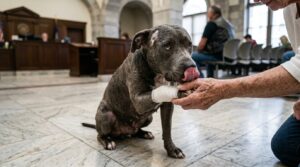
I looked down at Tank, whose missing ear and jagged facial scars were a roadmap of a life he never asked for. In that moment, I realized we were both on trial for the crime of where we came from.

The room in the county building was smaller than I expected, packed with people who smelled of damp wool and suspicion. I sat in the front row, my father’s old work jacket pulled tight around my shoulders like a shield.

Mark, my ex-fiancé, sat two rows ahead, his silk tie a bright, expensive needle in a room of denim. He didn’t have to say a word for everyone to feel his pity; it radiated off him, a silent testimony that I had finally lost my mind and traded my “perfect” life for a criminal’s scraps.

When the neighbor stood up to show her blurry video of Tank, the room went deathly quiet. On the screen, Tank looked like a predator, his massive frame silhouetted against the blizzard, but I saw what they refused to: the way he was leaning his weight into me to keep me from freezing.

I stood up before the board, my hands trembling as I pulled a yellowed notebook from my bag. It wasn’t a legal defense, but it was the only truth I had left—my father’s messy handwriting, detailing every dog he’d pulled from a ditch or a fighting ring.

“You’re not afraid of this dog because of what he’s done,” I said, my voice echoing off the linoleum walls. “You’re afraid of him because of what he’s survived, and because he reminds you that the things we throw away are often the only things worth saving.”

The board chair, a woman with eyes like flint, leaned forward to look at the veterinarian’s report I’d submitted. For a long minute, the only sound was the ticking of a clock that seemed to be counting down the seconds of Tank’s life.

As I sat back down, Mark turned his head just enough for me to see the smug tilt of his jaw. He was waiting for the gavel to fall, waiting for me to realize he was “right” so I would come crawling back to the safety of his shadow.

But then, the board chair looked past me, toward the back of the room where a man in a grease-stained cap had just walked in. He looked exactly like the kind of man my father used to be, and in his hand, he held a stack of papers that looked like they’d been pulled from a workbench.

Next up in Chapter 2: A sudden crisis at the property puts Sarah’s control to the ultimate test when an open gate leads to a viral misunderstanding.
CHAPTER 2: The Open Gate

The sound of the delivery truck’s engine fading into the distance was the only warning I had. I stood on the porch, a bag of high-protein kibble in my arms, and watched in slow-motion horror as the heavy chain-link gate—the one my father had patched with galvanized wire—drifted open.

In the backyard, June, the skinny black mutt with the white blaze, didn’t hesitate. She was a creature of the streets, built from lightning and old hunger. To her, that gap wasn’t a mistake; it was an invitation. Before I could drop the bag, she was a black blur streaking past the rusted milk cans, her paws kicking up plumes of frozen gravel as she headed straight for the county road.

“June! No! Stay!” My voice cracked, swallowed by the wind.

I bolted down the steps, my heart hammering against my ribs like a trapped bird. On the road, a silver SUV was rounding the bend, its tires Hissing on the blacktop. June didn’t see it. She was focused on a squirrel, her tail high, her mind filled with the intoxicating scent of the woods across the asphalt.

Beside me, a low, guttural huff sounded. Tank had been sitting by my side, his amber eyes tracking my panic. He didn’t bark. He didn’t wait for a command.


Tank felt the vibration of the car through the pads of his feet before the human saw the flash of metal. He felt the sharp, electric spike of Sarah’s fear—the smell of salt and sudden heat that always meant trouble. The smaller black dog was moving too fast, breaking the boundary of the pack’s safety. To Tank, the road wasn’t a road; it was a cliffside, a place where the world turned hard and cold. He lunged forward, not out of anger, but with the heavy, calculated weight of a mountain moving to block a landslide.


I reached the end of the driveway just as Tank intercepted her. It looked violent for a split second—a massive, scarred beast colliding with a smaller, fragile dog. I screamed, certain I was about to witness a mauling.

But Tank didn’t use his teeth. He used his chest. He slammed his bulk into June’s shoulder, knocking her off her line and pinning her against the muddy embankment just feet from the passing SUV. The car swerved, its horn blaring a long, accusatory note that echoed through the trees.

Tank stood over June, his massive head lowered, his body a living wall. He didn’t growl. He simply leaned his weight into her, a silent command for her to stay still. June, pinned and panting, looked up at him with wide eyes and suddenly went limp, her frantic energy replaced by a submissive whine.

“Tank, easy,” I gasped, reaching them. My hands were shaking so hard I could barely grab June’s collar. I looked up and realized the SUV had stopped twenty yards down the road.

A woman climbed out, her phone already held high, the lens pointed directly at us. It was Mrs. Gable, the neighbor from the hearing. Her face was a mask of triumphant terror.

“I saw it!” she yelled, her voice trembling with a mix of fear and excitement. “I saw that monster attack your other dog! It tried to kill her right in front of my car!”

“No, he saved her!” I shouted back, clutching both dogs. “He blocked her from the road! Look at her, she’s fine!”

Mrs. Gable didn’t listen. She was busy typing on her screen, her thumb flying across the glass. “I’m calling the Sheriff. This is exactly what we warned the board about. You can’t control that animal, Sarah. It’s a blood-sport dog, and now it’s turning on its own pack.”

I managed to lead both dogs back inside the gate, my stomach turning to lead. Tank walked at my heel, his head down, his gait slow and weary. He looked like he knew he’d done something wrong, even though he’d done everything right.

By the time I got back into the house and checked the local community Facebook page, the video was already there. The angle was bad; it looked like a gray blur tackling a smaller dog into the mud. The caption was worse: Aggressive rescue dog attacks housemate near Highway 4. Is your child safe?

Underneath, the comments were a wildfire. “Put it down before it kills a person.” “Sarah Whitmore is a danger to this town.” “Typical pit mix behavior. They snap.”

I sat at the kitchen table, the blue light of the phone washing over my face. Tank came over and rested his heavy, scarred chin on my knee. He let out a long, shuddering sigh, his amber eyes fixed on mine, asking a question I didn’t know how to answer.

“They don’t want to see you, Tank,” I whispered, my tears hitting his velvet fur. “They only want to see their own fear.”

CHAPTER 3: The Architect of Hope

The man looked like a mirror of my father—not in his face, but in the way he stood. He wore grease-stained Carhartts and a cap pulled low over eyes that had seen a lot of hard miles. He didn’t approach the porch right away; he stood by his truck, looking at the house with a mix of nostalgia and sorrow.

“I’m Luis,” he said, his voice a low rumble that seemed to settle the jittery air. “Frank—your dad—he saved my livelihood more than once. When the transmission on my rig went out and I didn’t have a dime, he just told me to ‘pay it forward to someone who actually needs it.’ Guess today’s the day.”

I felt a lump form in my throat, the first bit of warmth I’d felt since the hearing. “He never mentioned you, Luis. He never mentioned much of anything.”

“That was Frank,” Luis said with a small, sad smile. “He did his best work in the dark so nobody would feel like they owed him. I saw that video on the local page. I know what they’re saying. And I know it’s a lie.”


Tank watched the new human through the screen door. He didn’t sense the sharp, jagged edges of the people who came to shout or the cold, sterile smell of the men in suits. This human smelled of old metal, diesel, and something Tank recognized from his years with Frank: steady, quiet purpose. Tank’s tail gave a single, tentative thump against the floorboards. The pack was small, but it was growing, and for the first time in a long time, the air didn’t taste like fear.


We spent the afternoon working. Luis didn’t ask for instructions; he seemed to know exactly where the weak points in the fence were. He brought high-gauge wire and heavy timber posts, refusing any offer of money. As we worked, he told me stories about my father—not the “ex-con” the town talked about, but the man who spent his Saturday nights fixing heaters for seniors in the trailer park for free.

“He wasn’t perfect, Sarah,” Luis said, hammering a post into the frozen earth. “But he was honest. He told me once that he took the fall for your mother’s debts because he didn’t want you to grow up in a house with no soul. He figured he could handle the prison walls, but he couldn’t handle you seeing her fall apart.”

The sun was beginning to dip below the tree line, casting long, purple shadows across the yard, when a white rental car pulled up. My heart sank. I knew that car. It was polished, expensive, and entirely out of place in the mud of this driveway.

My mother stepped out, her designer coat pulled tight. She didn’t look at the fences or at Luis. She looked at me with a sharp, calculating intensity that made my skin crawl.

“I need to talk to you, Sarah,” she said, ignoring Luis entirely. “Inside. Now.”

I led her into the kitchen, the room still smelling of the coffee I’d made for Luis. She didn’t sit. She stood by the table, her eyes scanning the modest room with disdain before landing on me.

“I saw your post about the money, Sarah,” she whispered, her voice like a blade. “About the fifty thousand. You need to be careful. People are asking questions about where Frank got that kind of cash.”

“He saved it, Mom. Every penny from the shop.”

She laughed, a short, hollow sound. “He didn’t save it for the dogs, Sarah. He was holding it for me. He knew I was in trouble again. That money was my exit strategy, and he stole it by putting it in that dog’s collar.”

I felt the world tilt. She wasn’t here to check on me, or to honor my father, or even to warn me about the town. She was here because the “beast” was wearing her bank account.

“You’re not here for me,” I said, my voice rising. “You’re here because you’re broke.”

She didn’t deny it. She just looked at the door, where Tank was standing, his amber eyes fixed on her. “Give me the money, Sarah, and I’ll tell the board I’ll take the dog. I’ll make the problem go away. Otherwise, I’ll tell the Sheriff exactly how Frank ‘earned’ that fifty thousand.”

CHAPTER 4: The Midnight Trial

The woman on my porch was Mrs. Gable, the very neighbor who had filmed Tank and called for his removal. She wasn’t holding a phone now. She was drenched, her face ghostly white, her hands clawing at her own throat as she struggled to breathe through the freezing rain.

“My granddaughter,” she wheezed, her voice a thin, brittle thread. “The wind… the door blew open. She’s gone, Sarah. She ran toward the ditch line… she’s small, she’ll freeze.”

My anger at her vanished in a cold snap of adrenaline. I didn’t hesitate. I grabbed my father’s old heavy-duty flashlight and whistled for Tank. This wasn’t about permits or viral videos anymore; it was about a six-year-old girl lost in a forest that was rapidly turning into an ice palace.

“Tank, with me,” I commanded. He moved toward the door, his muscles tensing under his scarred coat, sensing the electricity of the crisis.


Tank felt the storm’s weight in the way the air pressed against his ears. The human female smelled of bitter salt and sharp panic—a scent that usually meant danger. But Sarah’s scent was different; it was focused, like the smell of a pack on a hunt. He stepped onto the porch and immediately caught a faint, sweet scent beneath the roar of the wind: a smell of bubblegum and laundry soap, moving away toward the sound of rushing water. It was a “small-human” scent, fragile and out of place. He didn’t wait for the leash to tighten; he leaned into the wind, his nose guiding him through the blackness.


The woods behind the property were a nightmare of slick mud and snapping branches. Every few steps, a tree limb would crack under the weight of the ice like a gunshot. Mrs. Gable stumbled behind us, sobbing, her flashlight beam dancing uselessly against the thicket.

“Lily! Lily, honey!” she cried, but the wind just threw her voice back at us.

Tank was pulling me now, his massive paws finding purchase in the slush where I slipped. He wasn’t barking; he was focused, his head low, tracking something I couldn’t see. We reached the edge of the old ditch line, where the spring thaw usually ran, but tonight it was a surging, black torrent of meltwater and ice.

Tank suddenly stopped. He went rigid, his ears—even the half-missing one—tilting toward the water.

I swung my light toward the bank. There, huddled under a tangle of fallen cedar, was a small shape. Lily. She was trapped on a crumbling ledge of mud just inches above the rushing water, her blue coat soaked through. She looked up, her eyes wide with a terror that surpassed her age.

“Don’t move, Lily!” I shouted, but as I stepped forward, the ground beneath my own feet gave way. I slid, my boots losing their grip on the ice-coated clay. I caught a branch, my heart leaping into my throat. “Tank, get her!”

The neighbor screamed as the “beast” surged forward. Tank didn’t hesitate. He launched himself down the slick embankment. For a terrifying second, I thought the neighbor was right—that he might knock the girl into the water. Instead, he planted his massive weight between the child and the current.

He didn’t grab her with his teeth. He pressed his broad, warm side against her, pinning her safely against the solid cedar trunk. He lowered his center of gravity, becoming an anchor. He looked back at me, his amber eyes steady in the flashlight beam, waiting.

I scrambled down, using Tank’s body as a brace. I grabbed Lily, pulling her into my arms. She was ice-cold, her teeth chattering so hard she couldn’t speak. She buried her face into Tank’s thick, scarred neck, clutching his fur like it was the only solid thing in a breaking world.

As we climbed back up the ridge, the neighbor was waiting. She reached for the girl, but her eyes never left Tank. She saw the “monster” who had just stood in the freezing mud to be a shield. She saw the “dangerous” animal let a crying child use him for warmth.

Just as we reached the safety of the gravel road, a loud, heavy crack echoed through the woods. A massive oak, weighted by inches of ice, began to tilt directly toward us.

“Run!” I screamed, pushing Mrs. Gable and Lily forward.

Tank surged, but his back leg slipped into a hidden hole in the mud. He let out a sharp, pained yelp that cut through the storm. I turned, watching in horror as the giant tree began its final descent right over the spot where he was pinned.

CHAPTER 5: The Tank & Frank Legacy

The morning air smelled of wet earth and cedar, a sharp contrast to the biting iron scent of the winter storms. I stood at the end of the driveway, watching Luis weld the final hinge on a gate that didn’t just look secure—it looked like it belonged here. Above the archway, a hand-carved wooden sign swung gently in the breeze: The Tank & Frank Rescue.

I looked back at the house, where Tank sat on the porch. He was graying around the muzzle now, and he moved with a slight hitch in his gait from the night of the storm, but he held his head with a quiet dignity that stopped traffic more effectively than any siren. He wasn’t a “beast” anymore; he was the town’s living legend.

Mrs. Gable was the first to arrive for the opening. She didn’t have her phone out. Instead, she was holding Lily’s hand, and the little girl was carrying a bag of the expensive, soft treats Tank liked.

“He looks good, Sarah,” Mrs. Gable said, her voice lacking its old edge. She reached out and touched the wooden gate, her fingers lingering on the grain. “My husband always said Frank was a man of few words but long actions. I think I finally understand what he meant.”


Tank watched the small-human approach. He recognized the scent of bubblegum and the rhythm of her heartbeat. He didn’t need to be a wall today. He didn’t need to track a scent through the ice. He felt the warmth of the sun on his scarred back and the steady, calm pulse of Sarah standing nearby. When the small-human pressed a treat into his palm, he took it with a gentle, deliberate softness. The world was no longer a place of loud noises and sudden movements; it was a place of familiar hands and the slow, rhythmic thumping of his own tail against the wood.


The backyard was full of life. June was racing Otis through the new tall-grass run, their barks ringing out like bells. Luis stood by the barn, leaning on his truck and talking to the board chair, who was nodding as she looked over the new safety protocols.

I walked over to the old workbench in the garage and picked up the heavy, studded leather collar. I ran my thumb over the hidden pocket where the letter had been. I didn’t need the bank book anymore; the sanctuary was funded by the very people who had once signed petitions to shut it down.

I looked at the photo of my father I’d pinned above the bench—the one of him at the shop, covered in grease, looking at the camera with that defiant, protective squint. I realized then that I wasn’t ashamed of his rough edges anymore. Those edges were what had kept me safe. They were the scars that protected the heart.

“We did it, Dad,” I whispered.

Tank limped over to me, nudging my hand with his cold nose until I dropped the collar and buried my fingers in the thick fur of his neck. He leaned his full weight against my leg, a steady anchor in the middle of all the new activity.

The unresolved question of my life—whether I could ever be proud of a “criminal’s” legacy—had been answered not with words, but with the clicking of nails on hardwood and the sight of a community coming together to save a dog they didn’t think they wanted.

As the sun began to set, casting a golden glow over the sanctuary, I realized that the deepest scars don’t just tell a story of where we’ve been. They show us exactly where we’re supposed to go.

Epilogue: 6 Months Later

The sanctuary is no longer a place of controversy; it’s a landmark. We have ten dogs now, each with a story as jagged as Tank’s, and a waiting list of volunteers that stretches into the next county.

Luis is our full-time foreman. He and I don’t talk much about the past; we’re too busy building the new medical wing. My mother sent a postcard from Arizona three months ago, but I didn’t reply. Some stories are meant to end so better ones can begin.

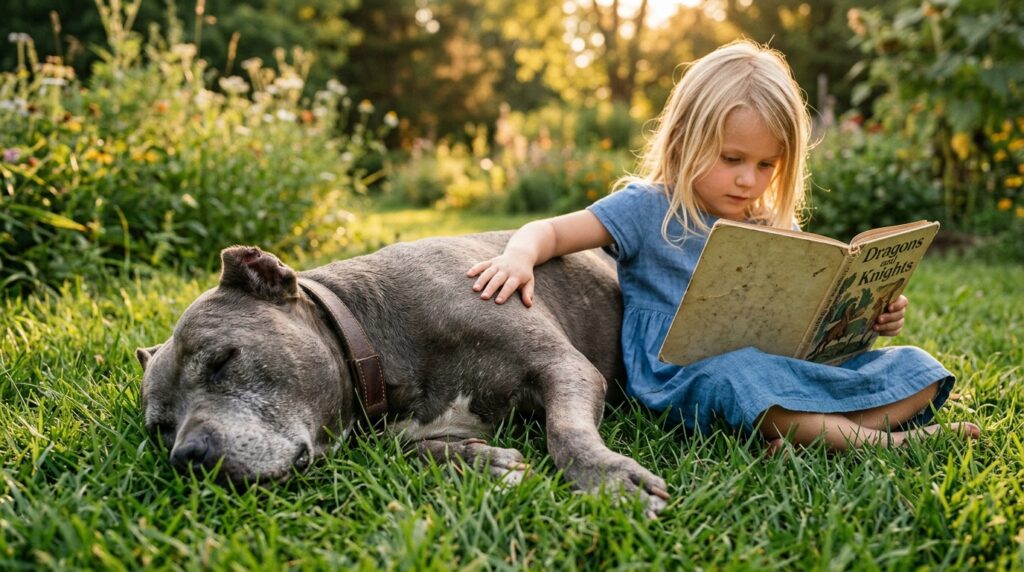
Every Sunday, Lily comes over to read books to the “scary” dogs. She sits in the grass with Tank, leaning against his side, reading tales of knights and dragons. Tank usually falls asleep halfway through, his snoring providing a steady bass line to her high-pitched voice.

I still wear my father’s work jacket when the wind gets cold. It doesn’t feel like armor anymore; it feels like a hug. And every time I look at Tank, I’m reminded that the world’s judgment is a fickle, thin thing, but the loyalty of a rescued soul is as solid as the earth beneath our feet.

Similar Posts

Leave a Reply

Your email address will not be published. Required fields are marked *